Ep11 WinstonRoberts
===
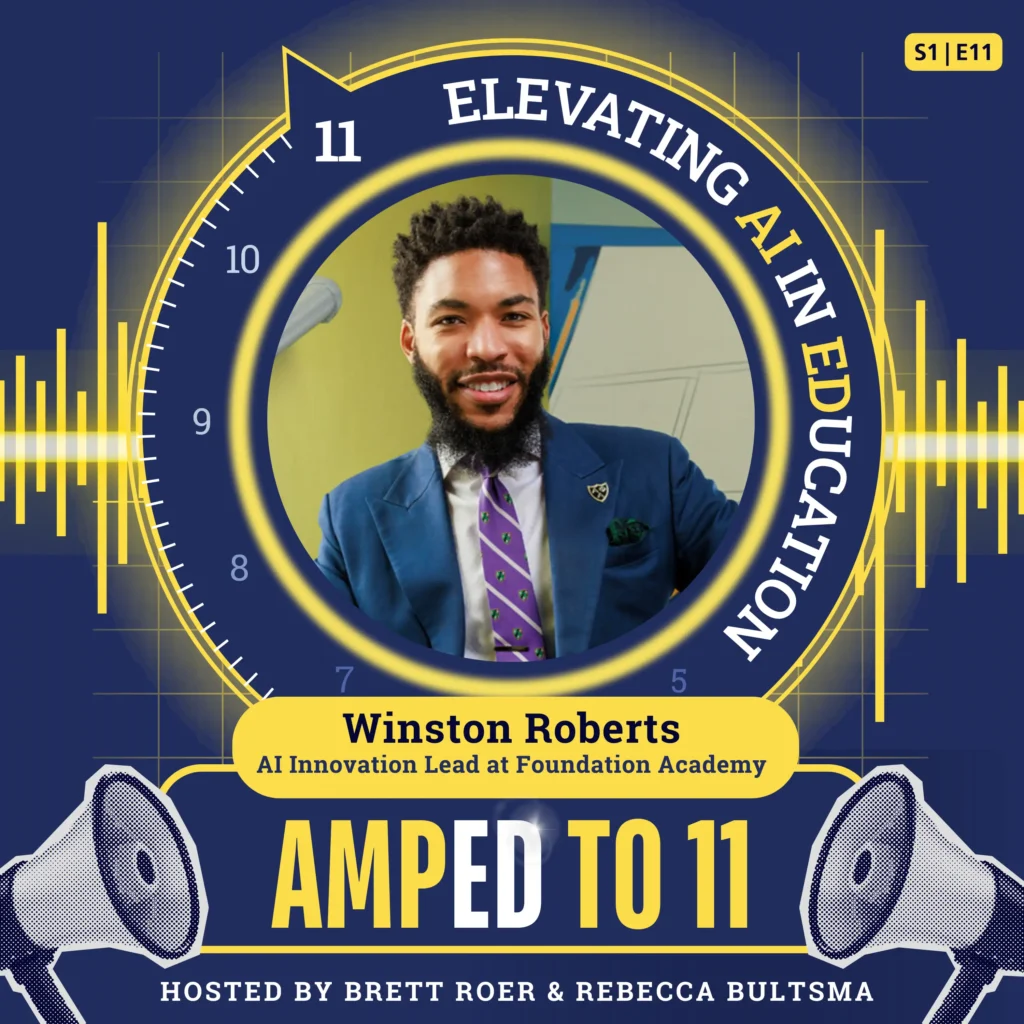
Brett Roer: [00:00:00] Welcome everyone to the AmpED to 11 podcast. We have a special guest today, Winston Roberts, AKA teacher in a suit. He’s leading incredible work on AI and innovation out of Foundations Academy. Winston, it is a pleasure to have you here today. How are you doing?
Winston Roberts: Doing well, Brett. Good Doing well, Rebecca.
Winston Roberts: It’s good to see both of you.
Rebecca Bultsma: Yeah, we’re. We’re thrilled to see you. I think we should, uh, start by talking a little bit about how we, how we met. Brett, why don’t you tell that story, because you’re always the one who meets everyone everywhere we go.
Brett Roer: Let’s see if I’m an unreliable narrator. Please both of you keep me honest and, and fill in the gaps, but, uh.
Brett Roer: We all met back in October, 2024 at the S-L-E-C-O-P convening in Chicago, Illinois. And what really stood out to me, which made me stop and kind of Google Winston, was we had just done this big AI summit in part of a much larger event, [00:01:00] and afterwards I see Winston like recapping his reflections, but not just
Brett Roer: typing into his computer, but like setting up a little reflection on where we had just held the event and the workers are trying to break down everything and they’re kind of giving him the look and he’s like, Uhhuh, yeah. But he’s like, I’m gonna get this. So I just watched how he operated. I saw just his passion come out on these recordings.
Brett Roer: And then again, I, uh. Just did a little quick research on him, and then I made sure I walked up to him when there was a social gathering later that day and just introduced myself and said, like, I, I, I almost wanna learn more about what you’re doing, something about what you’re, how you’re presenting yourself, and how you’re talking about AI was just really compelling to me.
Brett Roer: And, uh, you know, and then short order, the three of us all met, and then we’ve just been finding ways to intersect and amplify and elevate the work that Winston’s leading. What I miss guys? What I miss y’all.
Rebecca Bultsma: I, I like it. The rest is history. But, uh, we probably need some actual facts too. Winston, tell us about yourself.
Rebecca Bultsma: Tell us everything we need to know and our listeners will wanna know about you. [00:02:00]
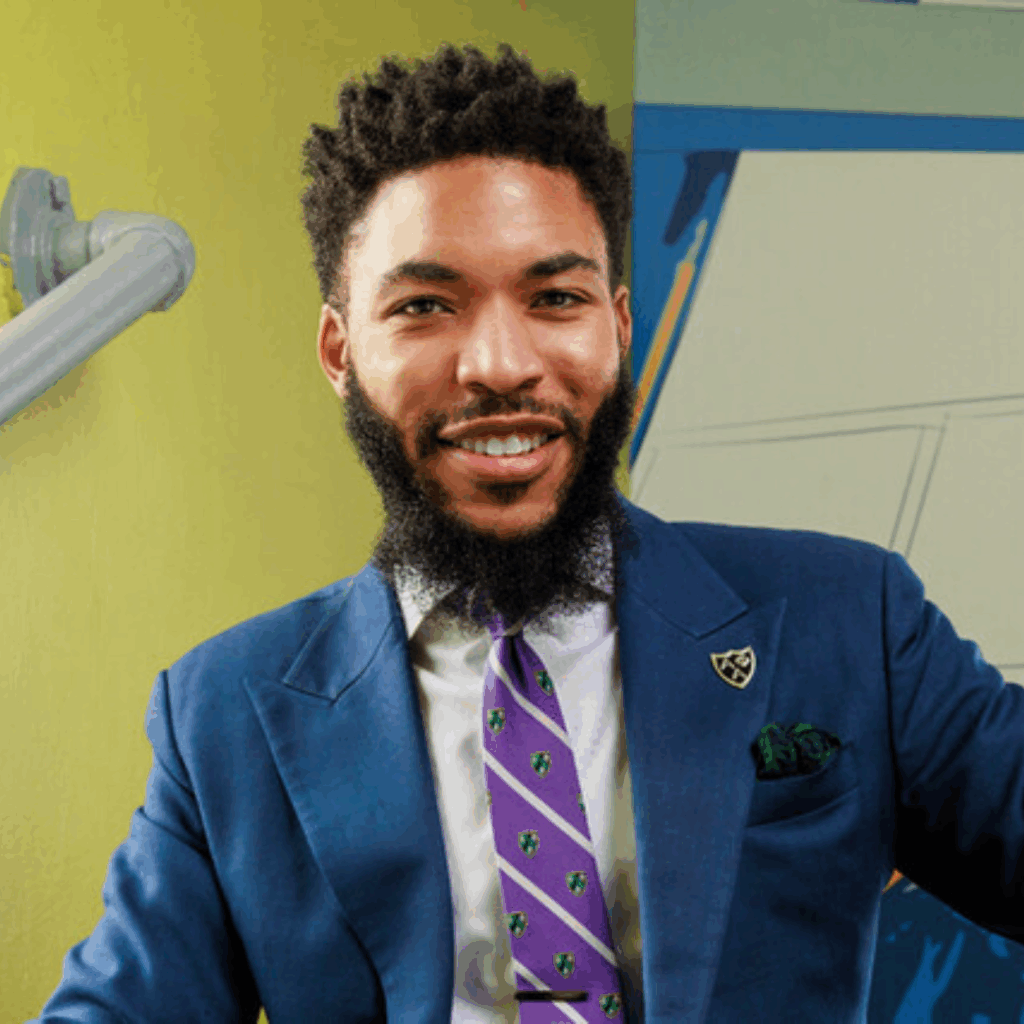
Winston Roberts: Yeah, Brett, you were, you’re definitely bringing back memories back in October, uh, where, where I take my, uh, ring light in tripod pretty much everywhere I go. So that brought back memories for sure. But, uh, as, as a favor, both Roberts AKA, the teacher in the suit, I am the AI innovation lead at Foundation Academies.
Winston Roberts: I’m also the founder. Tailored for education. So basically all the, all your professional development keynotes, PD services to make sure that we’re upskilling teachers and students for the future workforce, um, to prepare them for what’s gonna happen next with AI and education. Um, I’ve been speaking all over the country recently at South by Southwest, EDU, at ASU + GSV.
Winston Roberts: I’ll be speaking in May at one of the, um, AI summits in Ohio. So I spoke at Itsy last year, so I’ve just kind of been doing the whole tour, just going over the place hammering home that, you know, our education system as we know it, is preparing our kids for a world that no longer exists and we want make sure that we are preparing them for that world so that our students are able to lead the world that they’re [00:03:00] about to inherit.
Brett Roer: Amazing. And you know, maybe just for our listeners out there, give us a little backstory about, you know, your why. Like why is this your current passion and purpose in education?
Winston Roberts: Sure. So I guess it really all starts back when, um, well first with my daughter was born in November of, uh, 2022. And actually born the day before the public iteration of chat, GPT, uh, came out to the public.
Winston Roberts: So I like to say that I get to watch my daughter Zora and chat GPT grow up at the same time. But while I was on paternity leave, I actually started, kept hearing on every podcast talking about AI and chat GPT and generative AI and everything like that. I got sick of it and I said, okay, I gotta figure out what’s going on with this thing.
Winston Roberts: And so the first time I got to play around with it, I was like, oh my gosh, this is, this is gonna change everything. This is gonna change everything as we know it. And I went to my wife and I said, honey, this is gonna change everything. And she said, great. Hold the baby. So, um, so that was my introduction, but I was like, I was just amazed at how everything was going to [00:04:00] change.
Winston Roberts: I mean, I just had this. This vivid premonition of my most brilliant students sitting shoulder to shoulder with their more affluent peers in a college lecture hall who were using AI to reshape the world in their image. And my students looking up and going, wait. I was told that was cheating. And I just thought that was an untenable position, that if we’re educators trying to make sure that this technology is no different, we have to make sure they’re prepared for the real world.
Winston Roberts: Then it also reminded me of stories that my parents would tell me about growing up in Flint in the early 1970s. I mean, during that time you could basically walk off your high school graduation stage on a Friday and into a union backed factory job on a Monday morning with, and almost making six figures doing that.
Winston Roberts: And this was the way that everything had been, was gonna be as far as anybody knew until my parents had a sixth grade teacher named Miss Blight who said, by the time you graduate high school. All of this is going to be gone. And everyone in the room looked at her like she was absolutely [00:05:00] crazy because this is all they had known.
Winston Roberts: Their parents, their grandparents, everybody worked at the shop, had a Cadillac in the driveway, driveway, and was just living life and didn’t have a reason to pursue any secondary education. Thankfully, my parents did, and this had been a story that, you know, scare me and my sisters into going into college.
Winston Roberts: Um, it worked, but. We took from that. What I learned from that in adulthood is how the penalty for not seeing the trends in technology is an entire community being left behind and how one visionary teacher can have an impact on multiple generations. And that’s the I’m seeing with AI these days, and that’s the message that I’m trying to share with others.
Rebecca Bultsma: What a great story. Well, we are thrilled to learn more about you, and I know we sent you the questions ahead of time, but just to recap, for any of our new listeners, uh, we like to take, uh, 11 themed questions and get through as many as we can while we learn about you. So we’re just gonna dive right in and kick it off with question number one.
Rebecca Bultsma: If you’re ready,
Winston Roberts: let’s go [00:06:00] for it.
Rebecca Bultsma: All right, so in the show, stranger Things, uh, which I’m not sure you’re familiar with, there’s a character named 11 and she has these powers that every time anybody comes across them or sees them or experiences them for the first time, uh, they are shocked they are in awe.
Rebecca Bultsma: So, I wanna hear about a moment where you sat at your computer interacting with ai, where you had a moment of awe, where you sat back and thought, I can’t believe this. This is amazing. Do you have a moment like that?
Winston Roberts: Yeah, I mean, it, it kind of goes back to, you know, when I was on paternity leave and playing around with this, it was when I think just like, like a lot of people probably education.
Winston Roberts: I said, okay, write me an essay on, you know, to Kill a Mockingbird. And I was amazed at it. Just like, just like that wrote an entire essay right before my eyes. And I said, oh, okay, well what else can we do here? And what I ended up doing after playing around with it for a little bit, I said, okay, what if I took one of the New Jersey student Learning assessments or N-J-S-L-A state test questions?[00:07:00]
Winston Roberts: And put that in the corresponding passage in as well and see like if this can answer a state test question. And it did. And I said, okay, what if I had to grade itself, grade the response against our school’s rubric for this, and then it did that? And then I said, what if I had explained why it gave each grade, or you know, why it rated it the as the essay.
Winston Roberts: The way it did on each row in the rubric, and it did that, and it’s doing all these in seconds. And I, I was just like, I just took a breath and like took a step back and like, oh my gosh, like what does this mean now? And then I was seeing articles like Chat, GPT can pass the bar exam and just other things that were just, the news was coming out so rapidly.
Winston Roberts: I. So that was like my moment there. But what I did with that information is I made that sequence, the opening of the first professional development session, I gave the teachers on this technology, and I called it, uh, AI in the future of education. And the way I promoted it to teachers in the [00:08:00] building was I said, have you, did you see that I’m doing a session?
Winston Roberts: I said, yeah. Wasn’t sure what’s, I said, come to my session. It’s literally gonna change your life. And they were like, what? I said, trust me, it’s literally gonna change your life. And so after them doing that session, they were all walking out the same way that I just like, shit. My mind’s blown like, you aren’t kidding?
Winston Roberts: Like it literally changed my, I’m like, exactly. So that’s what excites me about technology. That was certainly my 11 moment, uh, with, with ai just, and to see that that was in its infancy and to see where it is now and where it’s going, it. The, the, the opportunities are limitless as far as I’m concerned.
Brett Roer: Amongst Rebecca, who is also a renowned keynote speaker.
Brett Roer: And I’ve had the pleasure to see her speak and had the pleasure to see you, uh, see you speak, and I’m looking forward to hearing you again this year. Coming up. I think what the best feedback I’ve heard, and it sounds like both of you do it so tremendously well, is you show people how it can change your life.
Brett Roer: And it’s not. Talking about it. It’s showing it. And I think that’s a really great testament to [00:09:00] the excitement you have. How do you get other people to feel infectious? So first of all, foundation Academies, very lucky to have someone like you who can get the entire community rallying around, you know, the excitement that you’re obviously feeling about ai.
Brett Roer: So, well done. Kudos to you and uh, great way to start off. Okay. You’re one for one for sure. Here we go. So I actually wanted to ask, because I hope you can also give a vantage point, right? You, you’re, you know, you go by teacher in a suit, even though you’re leading these, you know, you’re speaking on a national level, you’re still interacting with students every day in the classroom.
Brett Roer: Is that accurate?
Winston Roberts: Yes. Yes it is.
Brett Roer: So we usually ask a different type of question, but I wanna, I wanna. Make sure we’re engaging and hearing about what your student’s perspective is on ai. You know, we use this thing like what’s an AI tool? You know, we usually rank things out of a 10 outta a 10. What’s that AI tool that deserves an 11 outta 10?
Brett Roer: I’d love to hear from you. If we were to ask your students or you were to ask them like, what are the AI tools that they love either for school or personal life that you know they’re engaging with and that you think is just doing a great job of keeping [00:10:00] students engaged and learning about this future tool and skill.
Winston Roberts: Sure. So, I mean, I’m, as you can see, I’m in a classroom right now. I teach a financial literacy class on, uh, foundation at Foundation Academies in addition to all the other things that I’m doing as well. And what strikes me is that I can’t, even if I have teachers that are on the fence about ai, I. I tell them that’s interesting because your students are certainly, I can’t go five feet in this school without overhearing a conversation that a student is talking to somebody else about Chat GPT or about any other gendered AI tool.
Winston Roberts: Tool or how it’s impacting them. I mean, it’s, it’s everywhere. It’s everywhere. Even when I was, you know, going over to our middle school as well, same thing. Kids are talking about this, kids have made up their mind. So as teachers, we, we have to make sure that we’re, you know, showing them how to, you know, use it ethically and effectively use it to.
Winston Roberts: Think bigger as far as what, how students are, are using the tools and everything, what they would rate a low, what’s the name of it? But I think it’s, uh, it’s an, it’s a math AI tool that they’re using. I think it’s called Goth or Goth or something, ai, but it’s a math [00:11:00] AI tool that they’re using where they’re able to take pictures of their math problems and it’s able to give them answers to it.
Winston Roberts: Now, I always say get those answers because you know, these tools are all built on top of large language models and their specialty is. Translating and replicating and you know, replicating patterns in language. Math isn’t their strong suit as far as doing the computation of math. It will explain differential calculus to you in a way that a fifth grader can understand and no problem.
Winston Roberts: But if you ask it to do differential calculus, you’re basically flipping a coin on whether the answers are correct. Crazy thing is. Students have started to figure that out on their own. They’re like, yeah, I started using it for math, but eh, it doesn’t always get it right. So what what’s interesting is I’ve had a few teachers, it’s like a few math teachers that said, well, one thing that we’re doing based on the professional development sessions that you gave is we’re saying, Hey, go ahead and use AI for this project.
Winston Roberts: Do what you do and, you know, come back to me, we’ll see if it’s right or not. And they like do this trial and error experimentation with it. [00:12:00] And then they kind of, as a, as a collective. Pitch in and figure out what the best prompts are and who’s getting the best responses. And then they compile like a master prompt together to be able to complete, uh, the assignment.
Winston Roberts: So it’s the, because of the, the, the culture around AI that we’re building here at Foundation, the teachers are empowered to not ban the technology, but saying, yeah, sure. Go ahead. And now that you felt that that was too hard originally, but now you’re, you’re, some of you are having some success, some of you aren’t having success, let’s talk about why.
Winston Roberts: So that’s so big picture. Those are just ways that it’s being used. My 11 out of 10 tool for AI tools chat, GPT is, is one that I, I definitely go to all the time, but one that some people are sleeping on is, uh, Google’s notebook, lm, which is fantastic. What I, I like to use it in tandem with chat GPT because at this point chat, GPT’s been trained on my voice and my speaking style and my writing style and everything.
Winston Roberts: But for research, I use Google [00:13:00] Notebook, LM all the time. Case in point, um, I’m in a, I’m a graduate student at the University of Pennsylvania and what, we’ll, what I’ll do sometimes is I will take all the readings that we have to do and I’ll put those into Notebook LM and have it synthesize all the different readings.
Winston Roberts: And it will give you a lot of options where you can, you know, ask questions about, um, them as a collective or individually. You can create a mind map where it displays the information in different ways. Another thing that’s a lot of people’s favorite is the audio overview, where it creates a podcast style, um, overview of the information that you have uploaded there.
Winston Roberts: So one thing I did was we were on our way to our professor’s class. We had all these readings, and I. Created the audio overview. I told it to focus on our professor’s reading ’cause he was one of the, he had assigned one of his own readings, uh, for us to read. So I said, you know, definitely make sure you pay attention to this one.
Winston Roberts: So we’re well versed on it when we’re talking about it in class. I had to do the audio overview and I sent to my classmate saying, Hey, just in case you needed a [00:14:00] review of our readings, here’s a 10 minute podcast style overview of the readings we have for today. You can listen to it on your walk to class.
Winston Roberts: A lot of my classmates found that incredibly helpful and the discussion was really, really rich in our class. Uh, I’d like to say as a result, but maybe as an assist as well.
Rebecca Bultsma: Notebook is a great tool. That’s one Brett and I use a lot as well. Between that and GPT projects, you know, it really makes it easy to synthesize information.
Rebecca Bultsma: So you, this is something you brought up already. I heard you mention it, but something that’s of particular interest to me, um, I like to think and talk a lot about AI ethics. So I want you to think with me about if we’re turning AI up to 11, which we are, how do we keep. Ethics from dropping to zero. What do you think the secret is?
Rebecca Bultsma: What do you think some of the priorities need to be and the biggest risks in education?
Winston Roberts: Sure. Well, when it comes to ethics, I think a lot of the, a lot of the onus needs to be on the creators of this [00:15:00] technology. You know, they, we have to make sure that we’re holding them accountable in terms of what they create, the parameters they’re putting around things, because people are going to do what people do.
Winston Roberts: Sure we can, you know, put guidance out there. We could put, you know, suggestions out there. But whenever like a teacher comes to me and says, oh, well we use an AI detector so we’re good. I, I always say things like, you know, you’re one, the AI detectors are completely unreliable and then biased against those who don’t speak English as a first language.
Winston Roberts: But whenever they say, okay, this is, these are the rules that we have in place for ai. What I always say to teachers and other educators is a rule. Without enforcement is a suggestion. So if you’re telling students don’t use AI for this, and you have no way of enforcing it, it’s a suggestion. So in my opinion, we have to rethink what we’re teaching, what we’re assessing, and how students are actually learning.
Winston Roberts: Because this [00:16:00] technology exists and is only going to get better with time. So when we’re talking about, oh, well, students shouldn’t use AI for, or when I, when people ask me what my personal parameters are around ai, I try to think about how could this be used in the real world? And those are my parameters, and it’s on me as the educator to design my classroom in a way where learning can still happen, even if a student is using those tools.
Winston Roberts: So, um, one example of that is like, in my financial literacy class, if I’m just asking basic computation questions about the material or asking them to copy down definitions of what a budget is or what, uh, an investment is, that can be cha GPT, the death all day. And what are students actually learning from that?
Winston Roberts: But if I instead say, Hey, you guys are all now groups of finance consultants and we’re, I’m gonna put up a case study here for you, where you have to solve how you get this high school kid who’s making about 500 bucks a month, but spending his money in all types of ways. How do you get him to save for [00:17:00] his financial goals of buying a PlayStation five and some sneakers in a reasonable amount of time?
Winston Roberts: Your groups have to come together and come up with a plan for him, and then present your findings. To the rest of the class a week from today. Sure. Use chat GPT if you want to, but you still have to get up in front of the class and be able to present it. So when we’re talking about, oh well kid, I mean, are they cheating if they use chat GPT two to do it?
Winston Roberts: I mean, we can debate that, but at the end of the day, they have to get up there and present. And if you have a student who was hesitant about presentations before but is now standing confidently in front of their peers. When you have them presenting in front of their peers, and public speaking is a fear that’s rated higher than death in America, the way I see it, they’re conquering death every single time they get up in public speaking, do public speaking, so I.
Winston Roberts: This technology is helping to empower them to conquer one of the greatest fears in the country. But it’s on me as the educator to design my [00:18:00] lessons, design my project, design my class in a way where the technology only enhances what they’re doing and what they’re capable of, rather than policing the ethics of how they’re using it in accordance with an education system that was meant to prepare them for industrial era factory work.
Brett Roer: So Winston, first of all, thank you for walking us through like. You’re right, the onus is in so many places, and I love the use case you just provided. Here’s something that for our listeners out there, especially those that are current in, uh, currently in a position of educational leadership, for example, I often get from people, well, like where do you start?
Brett Roer: So because you’re in a classroom, you’re also leading the PD on AI in your organization, at your uh, school, and you also have your own, you know, personal organization teacher in a suit. Walk us through, right? If you’re coming in as the outsider, right? If you’re like. Brought on to help think through and reimagine learning the way you just described, give a little advice to everybody, like how would you approach it?
Brett Roer: What, what would be your systemic, thoughtful way to get to where [00:19:00] you are now if you were supporting another organization?
Winston Roberts: So, yeah, when, when we’re supporting other organizations with this type of work, first we have to make sure that they’re able to, they’re able to excite their teachers and their staff about what’s possible with ai.
Winston Roberts: We have to show them what’s possible about ’em. So usually we’ll do some sort of activity that. Blows their minds in terms of what’s possible with ai. One of the Hallmark activities that we will, um, usually do is debunk this misconception they have about AI not being able to be personal, not able to speak like a human.
Winston Roberts: That it al always speaks like, speaks like a robot. So what we do is we have them create a Grammy award winning song in the style of their favorite artist about a personal life experience. And literally every time I do this session, somebody leaves a session in tears of joy because they can’t believe what they, they’ve written a song about their firstborn child, about them being married, about their significant other, about someone conquering a [00:20:00] disease, something like that.
Winston Roberts: They always write these details about their, about the personal experience to them, and it’s in the style of one of their favorite artists. And it’s something that’s so moving that they’re like, oh my goodness, I can’t believe I sat down and created this in 30 minutes. Now it’s like, great. Now that you’ve done that, if you still wanna stay in education and don’t wanna become a songwriter, because I guarantee your song is better than a lot of the garbage on the radio these days, what does that mean for our kids?
Winston Roberts: What does that mean in a world where every student is able to do that? What does that mean for a world where, where students can walk across their high school graduation stage with products they can monetize? What does it mean when they can walk across their high school graduation stage with plans to solve the problems with or their own within their own communities?
Winston Roberts: When you have teachers thinking about that, now they’re thinking from within their own context. Okay, how can I, you know, use the technology to be able to do interesting things? So now it’s taking ’em through the process of showing them how, once they’ve like, kind of opened their minds to, okay, this technology isn’t [00:21:00] going anywhere.
Winston Roberts: It can do things I didn’t realize it could really do, and it’s only getting better with time. Let’s see how I can use it best. So then after we excite them, we educate them. Now we’re helping them to see how the technology works. It’s not just, you know, it’s not magic, even though it feels like magic, but there’s actually a process the same way that you have predictive texts on your phone, and if you type in once upon a, your phone is gonna think you’re saying time, like it’s just gonna pop up.
Winston Roberts: That’s what the technology’s doing at scale. The same way I can show you a red, white, and blue circle and go red, white, blue, red, white, blue, red, white, and everybody goes blue. Exactly. The technology is recognizing patterns and then predicting what comes next, but they’re just doing it with language and they’re doing it at scale.
Winston Roberts: So people kind of have get this idea of, okay, this is in our Netflix recommendations. This is what’s happening with TikTok. This is what’s happening with Autotune, you know, with like Chief Payne was using to sing his music. It’s like, okay, [00:22:00] I, I think you’re trying to get here. You’re singing here, but I know you’re trying to get here.
Winston Roberts: Let me help you out a little bit. It’s, it’s the same type of technology. When they understand that, now let’s apply that. Let’s apply that to, to different industries. Let’s apply that to different projects, different assignments, and see what we can do knowing how the technology works. And then once we give them a framework and a prompting process and a thought process, a lot of times just after that, that’ll start kind of getting the teachers, getting the administrative staff kind of going on their own and seeing that.
Winston Roberts: But in showing them with these use cases, helping them apply it to their own specific context, then you have teachers coming back saying, Hey, I did exactly what you said and I. Now I see it. AI is, AI is tra I had one teacher tell me the other day, AI has translated into more time with my family. Another teacher came in today and said, Hey, I had this, um, I had, I was able to come up with this incredible project, this incredible history project that I would’ve never been able to come up with myself.
Winston Roberts: I had my [00:23:00] students kind of creating their own amendments to the Constitution because they understood the process of it and. The AI tool kind of gave me the project and I, it created in like five minutes and I would’ve never come up with that myself. I get all these transformative stories of, it’s not just me, like, Hey, here’s how you do it here, here’s how you do it, here’s how you do it there.
Winston Roberts: It’s really a mindset shift and when you can get someone in there to talk to them about what’s possible with this technology frame for them, some specific use cases in some specific context, their brains start going on their own, and now you’ve created a culture around ai. In your own school. So that’s what we specialize in, a teacher in a suit.
Winston Roberts: That’s the process we’re trying to do here at, uh, foundation Academies, and we’re starting to see some incredible results from our teachers and everything too. Last thing I’ll say, we have one teacher also who was able to, he said, oh my goodness, on this one standard I had 18 out of 25 students that were able to master it after taking your session.
Winston Roberts: Now I’ve got 25 out of 28, and that’s something I wouldn’t have been able to do, [00:24:00] you know, without the things that you showed me without. Being able to think about technology in this way. So those are some of the things that we’re doing here.
Rebecca Bultsma: That’s amazing. Something that came to mind when you were talking about the songs is I, I remember Ethan Mollick about a year ago, posting about how he was surprised that people were using AI to write important things like a Best man speech or like wedding vows.
Rebecca Bultsma: Like that was surprising to him. And I remember at the time thinking. That it wasn’t surprising to me because those things matter to people and lots often people don’t have the words, and now that they have the words, they can deliver them, as you mentioned, with emotion, and it allows them to express themselves in new ways that maybe they weren’t able to before.
Rebecca Bultsma: They couldn’t find the words. And so it sounds like you’re giving your students some really great opportunities.
Winston Roberts: No, absolutely. That’s, that’s really how we think about this. And I, I, I’m a fan of, uh, professor Mollick’s work as well. I mean, he, I saw one of his assignments was to have his, uh, Wharton students create chat bots that could replace the very jobs that they were interviewing for.
Winston Roberts: And I was like, that’s just the type of [00:25:00] transformative thinking that we need here. But to your exact point, that makes absolute sense to me. And e it is a great use case because at the end of the day, you are the one that’s able to fact check and be the expert on what you wanna say. If it makes something up and it hallucinates, you can say, okay, I know that’s not, you know what my friend actually did, so I’m not gonna say that you’re, you can be the authority on what it does or doesn’t do.
Winston Roberts: And another thing when people say like, oh, well it’s cheating if you do that. I go, okay, so let’s, let’s think about it another way. When you see, you know, president Obama give an amazing speech. Certainly he’s writing a lot of those speeches. Certainly he’s writing a lot of the sections of those books. But did he sit down and write every single page of that 700 word book that he just came out with both volumes?
Winston Roberts: I, I don’t know that if he wrote every single page of that, he probably had some help, you know, and my, my own father, he was the deputy chief of staff to, um, the dean of a very large university, and he, one of his jobs a few years ago was to help write his [00:26:00] speeches and. It’s not like they credited Byron Roberts with every single speech.
Winston Roberts: Every time the dean went up there to speak, they’re like, oh, the dean gave a great speech. And it’s kind of the same thing. These are the tools of the elite. These are the tools of wealthy institutions. These are the tools of the, the process that the rich and powerful have been using for a while. Now, it’s just to democratize where everybody can do it.
Winston Roberts: So if we don’t consider it cheating when President Obama do, does it, or when you know, the deans of these universities do it. It’s like it’s helping everybody be able to access that same technology. So we just as the educators have to rethink what we’re teaching, what students are learning, and how we make sure they’re still learning when this technology is as available on everybody’s cell phone.
Winston Roberts: So that’s, that’s how I like to think about it.
Brett Roer: Thank you. Because I think you’re, you know, you’re bringing your passion and your expertise together and. This is what I think does get people inspired to want to, you know, continue this work and maybe push past the fear. I have so many more questions I could [00:27:00] ask you about your practice and how you are really changing that mental mindset.
Brett Roer: But alas, if people wanna learn more, they can go find, you know, Winston and teacher, uh, teacher in a suit and really learn more about how he’s doing these incredible things. I think that you are well positioned for this question. I think all of us here are very. Excited and passionate about the power of AI as a tool to change things, especially in the world of education and to make sure all students, you know, have access.
Brett Roer: And yet I call these champagne problems, right? We do have times where we’re like, AI’s incredible, but I’m as shocked it can’t do this. Is there something you’re still finding that you haven’t found, like a good AI. Solution or fix for, that’s just, it’s a tool that just hasn’t been able to help you yet in something you’re hoping to do or people are asking for support with and you’re like, we’re not there yet.
Winston Roberts: Spreadsheets. Spreadsheets are the number one thing where I, where I would say, and I see that there’s [00:28:00] probably some, there’s some advancements that are happening right now, but I haven’t found an AI tool that can, Hey, gimme a spreadsheet, synthesize all this data, and there’s some complications with it because.
Winston Roberts: Of how the cells are all relating to each other. It takes some work on the AI tools to be able to kind of figure out all of those different relationships. So do I think that will always be the case? No. I, I imagine we’re probably, you know, a few years away from them being able to do that right away. Also, some of the functions being able to be pieced together and integrated into workflows, um, that’s some of the work that people are figuring out with, with agents and everything like that.
Winston Roberts: So once people are able to connect the dots or there’s a tool that’s able to connect a lot of these dots together. That’s when you’re gonna see some, some even more incredible advancements, I think, in this technology. But spreadsheets would be the main one I would see. What if, if people, if, if the technology’s able to, to master that, then I think it’s a, it’s a whole different world that we’re, uh, we’re in, in for.
Rebecca Bultsma: We completely agree with you. The amount of time Brett and I have spent, uh, trying to organize information [00:29:00] into spreadsheets using AI has been disproportionate, to say the least. So I think we add our names to that petition for better AI to, uh, manage spreadsheets. I hear co-pilot’s pretty good, but we haven’t.
Rebecca Bultsma: Experimented with that yet, so maybe we’ll have to try it out. All right, next question. Uh, we’re here at, uh, the on two 11 podcast, huge fans of 11 labs for obvious reason. Uh, they are known for creating AI voices or text to voice, and we are curious if you had to choose. Anyone living dead famous, not famous to have their voice read you, your school research, your emails, your, all the reading you do in your everyday life, whose voice would you choose?
Winston Roberts: That’s a tricky one. ’cause I think it depends on the time of day, you know? ’cause. I love Morgan Freeman’s voice, but if I listen, if I’m listening to some readings with Morgan Freeman’s voice at, you know, 11 o’clock at night, then I, I probably won’t stay up with them. So, you know, certain readings I could see, uh, the legendary, the late [00:30:00] great James Earl Jones reading some of, uh, some of the things from, from my emails or, or anything like that.
Winston Roberts: Et the, the great Eric Turner. Reading, reading some of those things out loud. Uh, Ray Lewis, like, just really like motivational, really passionate speakers. Reading those things out I, I think would be amazing to, to hear and see, you know, that, that I think that those would be kinda my first choices.
Rebecca Bultsma: You had me at Ray Lewis.
Rebecca Bultsma: Ray Lewis, that’s a good one.
Winston Roberts: Oh man. Yeah, it’s. Yeah, I, I think like after hearing some of these, some of these people talk, you’re ready to run through a wall for them, you know, so hear hearing certain, you know, emails that are, that might be dry, but hearing them in that style, you’re like, you know what, yeah, let’s, let’s go.
Winston Roberts: I’m ready to wake up at four in the morning and just, you know, get this spreadsheet done, you know, whatever. It’s.
Brett Roer: Good answers. Uh, yeah, I think you’re right. You gotta just, like ai, it’s gotta be personalized, nuanced. You gotta get the, you gotta maximize it. So, great work there. Those are some people. We gotta make sure 11 Labs gets on.
Brett Roer: I think you’re so well positioned to be, you know, kind of sharing this. So let people behind the curtain. [00:31:00] One thing we love is we’re so fortunate that we get to talk to people like you, Rebecca is, I would say, on the cutting edge always of trying out new AI tools. But you know, here at AmpED to 11, it’s the 11th hour.
Brett Roer: What is. A tool right now that you’re like, if you’re sleeping on this, you gotta know about what is one AI tool right now that you’re like, it’s gotta really get more in the zeitgeist and it is your chance to do it.
Winston Roberts: Yeah, I would. I’ve talked about Chat GPT, of course, everybody knows about that one. Talked about Google Notebook, LM now, so I think that would’ve been one of mine.
Winston Roberts: I think Perplexity AI is another one that can be slept on as well. What I really like about it is how it tells you exactly where it’s pulling information from, even if it’s built on top of some of the other large language models. I really do like how I can put in a, you know, put in a prompt and it’ll tell me exactly where it’s pulling information from.
Winston Roberts: So sometimes I’ll use that in tandem with chat, chapt gpt, or Notebook lm, especially for my school research, if I’m, you know, trying to do market research and figure out how many teachers there are in the country, if I go to ChatGPT, it’ll give me an [00:32:00] approximate number. If I go to perplexity, it’ll give me the number and link me to the report where I pulled it from.
Winston Roberts: And even if both numbers are similar or the same, it, it helps me feel more confident in what I’m, you know, citing, you know, in my, you know, uh, grad school research because I say, okay, I can, I can go to the report and know that it’s coming from something that’s more trustworthy. So I think perplexity is certainly one, I think some of the, the image and video generation tools, um, I have to explore a little bit more with.
Winston Roberts: The video generation, to be honest, but just the, the way that, like what’s possible with some of these tools, I think is quite amazing. So I’m, I’m still learning every day, I’m still getting better myself, experimenting with them in terms of image generation. I created my own, uh, teacher in a suit logo through Dolly way, way back when.
Winston Roberts: It took me a lot of different prompts to be able to get to it, but I’m very, very proud of what I was able to create. And I’m sure now that process is even faster. So, and then it’s been integrated into chat GPT now, and then also [00:33:00] you’ve got Gemini, uh, 2.0 I hear is amazing in terms of their image generation as well.
Winston Roberts: So there’s a lot of different tools that are out there that can create a lot of different, uh, interesting things. But those are, those are just some of the ones that I would recommend us paying very, very close attention to because, especially with the image generation tools that are out there, I mean, I, my mind goes to the, to the preparing kids for the real world.
Winston Roberts: So now. In high school, we can have kids making their own short films. We can have kids starting their own business and doing their own, you know, high quality marketing for their own products. I mean, if the, if we were always saying that the college degree is a new high school diploma, we have to bring masters and, uh, and, and graduate level work into our K through 12 schools to help our kids solve.
Winston Roberts: These types of problems and create these types of, um, these types of products to go out into the world.
Rebecca Bultsma: Well, let’s think about the future for a minute here, because your daughter is two three, is that right?
Winston Roberts: Uh, she’s at two, I think, uh, [00:34:00] two and two and four months.
Rebecca Bultsma: Oh, wonderful. Well, I wanna kind of fast forward a bit and think about, let’s say she’s 11.
Rebecca Bultsma: Now we’re in the future, eight or nine years. What are your predictions? What do you think the world, what do you think ai, what do you think education looks like by the time she’s 11?
Winston Roberts: So this is, I I, it, this is a bittersweet question, I believe, because I think much like how things are today, there’s going to be a haves and have nots when it comes to this technology.
Winston Roberts: There are going to be schools that see what’s possible with this technology and get fully on board and start, you know, I. Integrating not only the tools, but also the mindset into their professional development, into their teachers and everything. And they have an ecosystem of, oh, our students just create with these tools.
Winston Roberts: That’s what we do. We help them with their skills. We help them build things in class. That’s really what our, our school is for. In addition to, you know, getting them on grade level standards and there’s gonna be those that are still. Doing industrial era factory work or being prepped for it. So there’s gonna be a, I I still think that [00:35:00] even in 11 years, you know, or eight years, she’s two.
Winston Roberts: So eight and a half years from now, there’s still gonna be a giant disparity. Um, I’m gonna push to put her in a school and to advocate for more schools, to put her in a place where she’s able to get the learning and the, the, the reading, writing and arithmetic that she needs as a strong foundation. And then.
Winston Roberts: From middle school and beyond starting to solve the world’s problems. There’s some interesting schools that are already exploring this. I mean, there’s, I mean, there’s one headline that’s been going around quite a bit is the, uh, alpha schools in Texas that’s claiming that, uh, they have an AI tutor that has gotten their, their kids in the top 2% of the country in terms of their MAP scores.
Winston Roberts: And, you know, usually when I hear about, you know, oh, we’re doing great in test scores, I’m like, all right, that’s a proficiency exam. Map is a growth based assessment. So that’s very interesting to me how either with their own proprietary AI tutor or with the suite of tools that they’re using, they’re able to see kids grow, you know, within the top 2% of the country.
Winston Roberts: So that’s, that’s amazing [00:36:00] for me to see. And they’re able to, they’re, they’re claiming they’re able to do that within, within a two hour period. But what people aren’t talking about is the other four hours of the day. Because if you look on their website and you hear from their, um, their co-founder, the co-founder’s talking about, yes, two hours outta the day, they’re working on grade level standards and the rest of the time, public speaking, financial literacy, entrepreneurship, learning how to navigate social situations, all these other skills, they’re getting considerable more, more considerably more time to develop.
Winston Roberts: So I’m not, I, I haven’t been able to. You know, independently validate the, the, the results that they’re claiming. But I think what’s fascinating and what every while everybody’s running with the test scores, headlines, that’s what schools tend to do. ’cause that’s what the incentives are, are set up. I’m much more interested in what they’re doing the rest of the time and how much further apart this elite private school that’s charging tens of thousands of dollars a year, how far ahead they’re able [00:37:00] to put their kids because they are hitting the ground running with.
Winston Roberts: All these different skills and what does that mean? Eight and a half years from now, 11 years from now, when, when that group of kids is entering the workforce versus other schools that aren’t as well resourced, that aren’t able to do the things they’re doing, that aren’t able to put the types of professional development and technology and structures in place to be able to see similar outcomes.
Winston Roberts: So. I’m hoping, and I’m, and I’m working to make sure that we’re all in the mindset where all kids can have a reality like that, especially my daughter as well.
Brett Roer: That would be amazing. And I hope that that’s the vision and that’s what happens moving forward. But people like you and the work you’re leading, and obviously your daughter’s so much, even more fortunate that she has someone like you guiding her on this AI journey.
Brett Roer: So.
Winston Roberts: I appreciate that Brett, and I, I, and that’s the thing. I, I’m, whenever, whenever I talk [00:38:00] about this technology publicly as well, I, I, I talk about, you know, my wife, who, who’s, you know, while, who’s able to work from home. She has her own private tutoring business where she’s, you know, tutoring kids with IEPs and 5 0 4 behavior plans online, but she’s spending the majority of.
Winston Roberts: Of her time, you know, homeschooling our daughter and so she’s our daughter now is, was, was learning sign language at five months. She’s, you know, started, she knew her ABCs at like 10 months. She’s starting to read now. She’s speaking in in complete sentences. She’s doing all these different things and I tell people I can’t parent my daughter.
Winston Roberts: The same way at, you know, five months or two at or 12, as I, you know, as I did, I have to evolve my, you know, parenting practices to keep up with her. Same goes for this AI technology where I’m seeing them grow at the same rate. So now where my daughter is sitting down on the plane with us, reading the ABCs of artificial intelligence, when she’s reading that to us.
Winston Roberts: Chachi t [00:39:00] can pass the bar exam and can create, you know, studio quality commercials and everything. We gotta constantly be thinking about, okay, what does this mean when they’re both 13 and when they’re in their adolescence? What does this mean when they become adults? And how do we make sure that everybody’s prepared to deal with the ramifications of that?
Winston Roberts: So, uh, so shout, shout out to my wife who’s doing fantastic work with our daughter, and I just wanna make sure that everybody’s. Thinking about this context is like we are watching these things grow up together and what’s that going to look like going forward?
Brett Roer: Real and very reflective. So again, thanks for centering it back to that again about, you know, the children and the future.
Brett Roer: But it is an amazing time, amazing time to watch both Children Grow and, and the world of ai. So thank you again. Hey, we’re gonna do something a little risky here, right? We’re gonna, uh. We’re gonna turn the keys over to the AmpED to 11 podcast. We’re gonna give ’em to you, Winston. So here’s, here’s what the next portion is, so you get the opportunity to ask Rebecca and I [00:40:00] any question that you have for us about either the world of AI education, the research, Rebecca’s doing whatever you want.
Brett Roer: So turn it over to you. Take your time to formulate that. We can always cut out any dead air or just you can hit the ground running if something already come to mind. Take it away. Ooh.
Winston Roberts: Okay. So let’s, let’s, let’s see if we can do this. All right. This, this, this might might be a lot and we may have to rephrase it and cut it for time or whatever, but if you two were coming up with the 11 commandments of ai, what would they be between the two of you?
Winston Roberts: ’cause I know we’re limited time. So you’re, you’re 11 commandments of ai. So
Rebecca Bultsma: my first question is, someone who came from a comms background is, who is the audience in this ama? Are, are they, do they just apply to everybody? Are we talking about educators?
Winston Roberts: Let’s go with educators since we’re we’re speaking, you know, more specific about education, but yes, your 11 AI commandments for educators.
Winston Roberts: What would those be?
Rebecca Bultsma: Hmm. I’d say number one is, uh, be open-minded and curious in perpetuity. [00:41:00] Maintain that curiosity around ai. We’ll take turns
Brett Roer: like thou shall. Make sure you prompt knowing inherently that the tool you’re using is as culturally biased as society. So prompt with care and give context and nuance so that you get outcomes that are more reflective of what you’re hoping for.
Rebecca Bultsma: Which leads to commandment three, which is thou shalt fact check and context. Check every output for bias. For bad information, for sure.
Brett Roer: Hmm. Okay. Thou shall. Treat AI like the kitchen in which you cook, and make sure that when you, before you put something in the oven, you’ve thought about what ingredients you’re doing, you’ve put them together in a certain order, and you then only at that point have something that you’re ready to put in the oven and see what that tool or machine can create.
Brett Roer: So key is, you know, [00:42:00] recipes and putting the right ingredients together.
Rebecca Bultsma: I would say the next one would be, uh, thou shalt ensure that every task you’re using AI for, you’re using it for a small portion, but using your human expertise and knowledge and context and wisdom as the primary driver of your collaboration with ai.
Winston Roberts: So just to recap, we’re at number five now, so we’ve got be curious. Prompts, uh, with care context and nuance. Fact check is number three. Number four is treat AI like the kitchen and being mindful of the recipes. Number five is, uh, ensure human expertise. Number six.
Brett Roer: So like my number six is thou shall put Respect online name.
Brett Roer: So use a tool just like you would for anything else. You wanna Google an assignment, you wanna take out the dictionary, but at the end of the day, recognize that as you’ve already said. You are the person who’s delivering that. [00:43:00] Whatever you’re making, whether it’s an email or a document or a homework. So respect yourself enough to know that what it spits out, an AI tool.
Brett Roer: If that’s what you want to turn in, then just be prepared for the blowback. But if you take that time and care, after you use the tool, now you have something you should be proud of. ’cause Rebecca said, using your brain and you’re putting your name on it.
Rebecca Bultsma: I would say, uh, thou shalt use ensure transparency in your AI use and be open and communicative and transparent about how you’re using it, where you’re using it, why you’re using it, and demand the same from the tech companies who are creating it.
Rebecca Bultsma: Thou shout, exercise, caution about what you’re entering into these models and ensuring you have the right settings on and you’re using models and not necessarily, um. You know, you’re respecting all of the laws that go along with privacy and confidentiality. Not that that’s as big of a deal as it used to be, because most of these tools have that option, but [00:44:00] awareness needs to be a commandment.
Rebecca Bultsma: Surround that.
Winston Roberts: I think you got two more, and I can do the 11th if you need to.
Brett Roer: Yes. Oh my goodness. Thank you. And actually, the way that both of you are just literally helped me, Rebecca, by giving me time, Winston by giving me, uh, not having to come up with a, a final one. It’s actually the, my last commitment is like.
Brett Roer: Thou sh like seek the knowledge and wisdom of others. So don’t think you’re in this journey alone. Build your community just like you would in anything else. So like find your problems of practice, find your community. I think we do that as education all the time. And so this is no different. It might even be even more important because you can move so fast now with ai, if you do it together,
Rebecca Bultsma: I would say thou shal.
Rebecca Bultsma: Always strive to be part of the solution and part of the collaborative efforts to make AI ethical and benefit everybody in society as a whole, and ensure that you’re using it and thinking about it in ways that help everybody have a good life and education as a [00:45:00] whole.
Winston Roberts: That’s fantastic. So, number six, res, uh, put respect on AI’s name.
Winston Roberts: You’re the authority. Number seven, transparency for all, both for the user and the creators. Number eight, be cautious about what you’re entering, being mindful of the privacy laws and everything. Number nine, seek knowledge and wisdom of others. Number 10, be part of the solution and collaborate, uh, collaborative efforts.
Winston Roberts: And number 11, think bigger. Think big when it comes to ai. The limits of AI are only your imagination. So think bigger. That’d be my 11th commandment. See, that wasn’t a song that you guys thought it was gonna be
Rebecca Bultsma: that. That was fun.
Brett Roer: That
Rebecca Bultsma: was, that should be the, that should be the mic drop at the end of the podcast.
Rebecca Bultsma: I love it. Yeah, that was great.
Brett Roer: Well, hey, we’re definitely, I think, you know, when we go to these conferences and events, I think that is such an interesting. Way to think about it, right? What are your, what are your non-negotiables, your commandments when it comes to ai? So I, I really appreciate that question.
Brett Roer: That [00:46:00] was, uh, that was an 11 outta 10. And speaking of, I’m actually, if it’s okay, I think we’re just gonna keep this flow going. So, Winston, first of all, you did a great job of asking an amazing question of taking notes. So Winston, we always end with our final question, bringing it back to pop culture, oceans 11.
Brett Roer: We’re gonna change the world of education, innovation, and ai. We need the right people in the room. So this is a great chance for you to give some flowers to people who are doing great things in the space right now that you wanna make sure other people can check out. These could be people, orgs, communities, school districts, whatever comes to mind that’s doing things that need to be recognized right now, and people need to go find it.
Brett Roer: That’s what this last question’s for. So let’s hear your Ocean’s 11 crew that’s gonna save education, ai, and bring innovation to more people.
Winston Roberts: One, I would say, uh. In terms of equity and bias and everything. Caroline Hill over at the 2 2 8 Accelerator. She’s doing a lot of incredible work in education and, um, in general, also some of us connected to AI as well.
Winston Roberts: So I think she’s definitely a voice that needs to be heard. [00:47:00] Uh, let’s see. Sheria McRae, our own CEO here at Foundation Academies, who’s a true visionary leader who has seen this movement and unlike a lot of other, uh, leaders that are out there. Recognize the challenges and opportunities with AI and soft fit to make sure that, you know, that we invest time and resources into, uh, learning and upskilling our teachers in this technology as well.
Winston Roberts: So definitely her as well. Um, I would also say, uh, Scott, uh, Clendaniel. He’s, he’s working on something called Al Bricks, which is helping, uh, students to learn how to use AI in a safe and ethical way. He’s, he’s great with that. Charles Monnett, he’s the CEO of, uh, kindred, K 12. Which is a platform that is basically helping, uh, teachers to improve social studies, uh, lesson planning and education, everything.
Winston Roberts: He’s got, doing some excellent work over there. Also at, at Foundation Academies here, Dr. Joy, uh, Barnes Johnson. Uh, she’s incredible. Doing some incredible work with, [00:48:00] uh, project-based learning and universal, uh, backwards design and. Uh, what is it like, uh, like STEM education, everything like that. She’s someone else.
Winston Roberts: Also, we’re paying attention to, um, my mentor, Dr. Calvin Mackie fellow, uh, Morehouse man. He’s working, doing some incredible work with STEM nola, where basically, uh. His whole idea was to take STEM and bring it into the community, you know, so that kids can experiment with the, with all the different technology and tools outside of the school day.
Winston Roberts: So he’s doing some incredible work. Uh, he was in Chicago with us too, uh, not too, uh, not too long ago. And we were also on a panel together at South by Southwest edu. Um, he’s doing some great work with AI and with, uh, with some robots and everything like that too. And rounded, uh, let’s say Professor Ethan Mollick over at, uh, Wharton School.
Winston Roberts: He is doing sub, he, he’s like one of the, certainly one of the foremost thought leaders in this space in terms of AI and education, particularly in the higher ed space. And he’s got this, uh, a substack, uh, one useful thing, which I highly recommend following, uh, gives you kinda like the [00:49:00] roundup of AI for, for the past couple weeks.
Winston Roberts: And, you know, very, very useful information too. Uh, to work within your, your AI journey. So that’s, uh, that’s my list for right now. I’m sure I’m, I’m sure I’m forgetting people, so I’m gonna, you know, uh, go with that list for now.
Rebecca Bultsma: I’m gonna tack on one edition onto your one useful thing, Substack, and you’ve probably encountered this too, but I think our listeners will appreciate it.
Rebecca Bultsma: He also has another website called More Useful Things, and it’s all really intense prompts for teachers, for students, for regular people like, and it has a ton of really amazing resources like courses and stuff about his book on there. So if you haven’t checked that out, I think you’ll really like it, Winston.
Rebecca Bultsma: I think our listeners will appreciate that too.
Winston Roberts: Thank you so much. I’ll make sure I check out, uh, more useful things. That’s cool.
Brett Roer: Winston, first of all, I wanna both thank you. One, you really pushed us. That was such, uh, a unique question and I really think it’s such a great way to get people to distill down what values they have around ai.
Brett Roer: So I just wanna say like. We will definitely [00:50:00] be inspired by that. And thank you for coming up with that amazing question. That’s gonna be such a great icebreaker and just a way to talk to people about AI and values.
Winston Roberts: No, absolutely. Brett, thank you, you and Rebecca for pushing me. ’cause uh, I, I wouldn’t have, uh, thought of that had you guys not pushed me.
Winston Roberts: So thank you. I’m glad we got to have this exchange.
Brett Roer: Yeah, that was incredible. And before we break, can you let everyone out there know exactly where they can find you, uh, doing all the amazing things you’re doing? If there’s websites, if there’s social media. Anything you wanna, uh, amplify in elevate right here on your own work, please use that space right now.
Winston Roberts: Sure, absolutely. So you can basically find me on pretty much every platform at teacher in the suit, whether that’s, you know, Instagram’s where I’m probably most active, TikTok, YouTube, X, all, all the things that teacher in the suit. Um, LinkedIn, I’m just Winston Roberts, so you can, you know, find me there.
Winston Roberts: And that’s where I’m doing, you know, all my different work and everything. So, you know, just definitely trying to make sure that I’m. Helping prepare teachers to use this technology and think [00:51:00] about this technology in a way that’s gonna help our students lead the world that they inherit. And that’s why we, a teacher in ASU provide AI training tailored for education.
Winston Roberts: Good.
Brett Roer: Well, I don’t think we’re gonna top that again. We wanna thank all our listeners. Please go find Winston Roberts. This person is doing incredible work in this space. He’s someone to watch out for. And, uh, on behalf of Rebecca and I at the AmpED to 11 podcast, we thank you. Keep saying curious and keep saying, uh, keep putting things out there in the world and we’ll see on our next episode.
Brett Roer: Thanks again, Winston.