Ep12 MerissaSadlerHolder
===
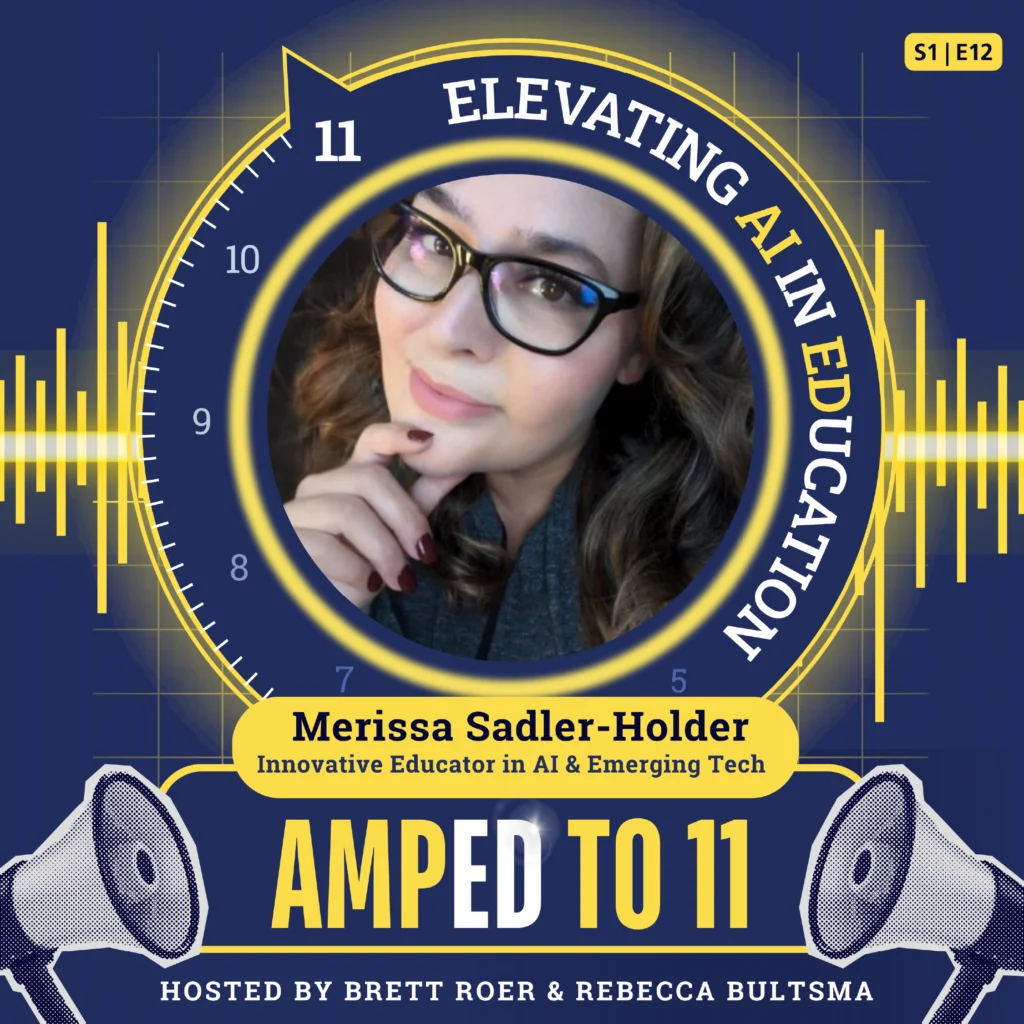
Brett Roer: [00:00:00] Welcome everyone to the AmpED to 11 podcast. I am flying solo today because the internet gods are not working and Rebecca is unable to join us. So instead of you listening to a staticky, Rebecca, I am honored to introduce our amazing guest today. I’m gonna do the honor of giving her a brief bio before we dig in, but.
Brett Roer: Merissa Sadler Holder is a two-time recipient of ASU GSV’s 20 24, 20 25, leading women in ai. She has 13 years of classroom experience. She’s a nationally recognized educator and innovator. She led, uh, work at La Canada Unified School District. She’s taught a variety of subjects. She’s been a teacher leader. She has her master’s in e-learning.
Brett Roer: She’s really being on the front lines of transforming what teaching can look like, especially when powered by AI and led by amazing coaching and uh, [00:01:00] and leadership like what Merissa brings to the table. Most importantly, she’s recently founded Teaching with Machines. It’s a platform and a consulting agency.
Brett Roer: She supports forward-thinking educators. She’s supporting school districts to harness AI to enhance instruction and student empowerment. Merissa’s working with public and private institutions around the country, including right in California, the Orange County Department of Ed, on their AI initiatives and AI integration.
Brett Roer: And if you’re not already up on it, she has this amazing weekly newsletter where she’s offering the real insights and resources in AI and education that people need. Merissa, welcome to the AmpED to 11 podcast.
Merissa Sadler-Holder: Thank you so much, Brett, for having me.
Brett Roer: I’m sure, obviously you’re a longtime listener, so you already know the format.
Brett Roer: But for the folks out there, we’re gonna kick it off with a number of questions, many of which are 11 themed, and we’re just gonna have a free flowing conversation on it today and really excited for you to share with folks you know, what innovative solutions are out there, who are some innovative partners and educators you wanna shout out and highlight.
Brett Roer: And [00:02:00] just also really talk about the work you are leading. This is an opportunity for people to get to know you, the work you’re doing, and you know, if they want to reach out and connect with you further, please feel free to let them know how to do so. Sound good? Yeah, sounds great. All right. So the first question we always start with on the AmpED to 11 podcast is with pop culture, stranger Things.
Brett Roer: One of the main characters, 11, the supernatural powers jaw dropping moments when everyone encounters them. So Merissa, you know, going back in the last few years or so, tell our audience what are some true jaw dropping AI moments you’ve seen that really move the work forward in, uh, in education.
Merissa Sadler-Holder: Well, and this is gonna be sound so ridiculously simplistic, but for me it was that kind of jaw dropping moment that I think most educators experience.
Merissa Sadler-Holder: And it was simply just rewriting an email. And the reason why I say this is because we have this. Kind of I, I like to say two light bulbs. The first [00:03:00] one is like, oh, this is amazing. Oh, I can do X, Y, Z, and look at it. Go. But then there’s that second light bulb that kind of goes off after you’ve been playing with it for a while that kind of says, Hey, this is amazing.
Merissa Sadler-Holder: This is going to be bigger than just amazing. This is going to impact humanity and of course impact education. And for me, as simple as rewriting an angry email from a parent and kind of responding to them. And I, I’ll give you a little bit of background. I got an E, you know, it was around this time of year, so like may right. Finals stress ready for the finish line.
Merissa Sadler-Holder: I got this angry email from a parent and I quickly ran to my, my, uh, classroom bestie, you know, my teacher bestie, and I said, would you see this email? And I’m having a miniature meltdown or whatever, and she says, you know, I don’t think you should respond to that email right now. I think you should wait.
Merissa Sadler-Holder: You’re, you’re really emotional. [00:04:00] And she said, but I think you should write what you want to say back to this person. No holds bar. Now, as a French teacher, I had some French choice words that I put in that response email and I wrote it out. Um, and then she says, go ahead and run that through AI to make it professional so you’re not gonna get a call from HR the next day.
Merissa Sadler-Holder: And it took kind of that same. You know, this is, I’m not gonna take this, but here’s a solution. And then at the same time, professionalized it, made it. So I didn’t get a call from hr, but I still got my point across and it was done and, and then a couple things happened there. It was like, okay, that would’ve taken me hours not just to calm down, but taken me hours to kind of draft that carefully worded email to capture what I wanted to capture.
Merissa Sadler-Holder: But then also that. Emotional ease of having a tool kind of take what I needed from it, but then turned it in quickly into something that I can send was twofold [00:05:00] for me. And then I thought, oh my gosh, you know, how is this going to impact education at that point because I, I understand it for me, what’s it gonna do for my students?
Merissa Sadler-Holder: And I think that is where I kind of said, okay. As simple as an email, that’s where I have my second light bulb. This is gonna be huge.
Brett Roer: I’m so curious, right? You’ve had this, you’ve had this very, you know, you had this personal moment. You immediately not only learned how to utilize it for yourself in that moment, but now you’re helping educators, you know, around the country, really think through those, how to go from, you know, a place of emotion and now to move it towards how can I utilize this tool to help me, you know, be, be a better communicator?
Brett Roer: Any of the aspects I. What are some either jaw dropping moments you’re seeing when you’re helping teachers right now out in the field? Or what are some things that you’re seeing from them where they’re like, when you teach them this now, they’re like, oh my gosh. You know, I know we had a moment with a teacher who said, basically started crying and said, I feel like I just [00:06:00] got my whole, you know, week nights and weekends back planning doc.
Brett Roer: So. What are some moments that you really stood out to you for that?
Merissa Sadler-Holder: It was, I would say, when teachers realize that they can create quickly, and I think that’s always been kind of the issue for a lot of teachers is that we have this creative capacity. It’s part of our craft, it’s part of our profession, but we just simply don’t have the time or bandwidth to do it.
Merissa Sadler-Holder: And so having something like AI that can actually do that and help you kind of. Enable you to create. I think that’s what I would see with coaching sessions, for example, they would create something and they’ll be like, just save five minutes. I think at that point, I like to take the conversation with them and say, now we have all this free time.
Merissa Sadler-Holder: What would you want to do next? Where could we go? In your craft and creativity, in your expertise, can we take it to the next level? And something that you haven’t been able to do [00:07:00] because you didn’t have AI on your side. And I think that’s my favorite when I see the teachers get excited about, yeah, it’s great about replicating and doing the things that we already do, but being able to do something they couldn’t do before without it.
Merissa Sadler-Holder: That’s where it is pretty incredible to see.
Brett Roer: And it requires someone like yourself or hopefully a leader, uh, at their school to be able to do what you just said, which is people, as you know, as you in your, uh. A dozen plus years of education experience, people aren’t typically asking you that. Like they’re not asking, what do you want to do?
Brett Roer: Or What would you like to do at this time? Because it’s typically, there’s so many things you have to do with your time that you don’t usually have that grace of free time. So what are educators saying they wanna do? Like, where do they wanna go deeper? When you give them that privilege,
Merissa Sadler-Holder: I think a lot of times they, they wanna.
Merissa Sadler-Holder: Maybe enhance their assessments. Maybe they wanna do something that they haven’t done before. A lot of times they’ll think of new projects. Of course, creating those projects, you know, [00:08:00] you have your rubric, your, you know, whatever student facing you have, the outcomes that you have to list for your students and what that would look, and then timelines and all of that could be done relatively quickly.
Merissa Sadler-Holder: But I think the spirit of being okay with just trying. Is probably the best thing that teachers can take away from all of this is let it be that messy process. We want students to be messy with their process of learning. We can be the same with our own. It’s okay to tell your students, Hey, I’m trying something out new.
Merissa Sadler-Holder: I would love your feedback. Here’s something exciting that you could be doing. And they’ll do. You know, I, we’ve had, you know, TikTok, you know. Project, something that’s super relevant to students, something that captures their own interest, and I, I found that a lot of teachers are kind of able to make that connection.
Merissa Sadler-Holder: Quickly for their students of like, so for example, I taught French. Well, there’s not a lot of kids who are maybe passionate about French and they [00:09:00] don’t understand why we have to learn it. But I, you know, using AI and leveraging it and bringing it together based off of student interests, suddenly French is now relevant.
Merissa Sadler-Holder: Suddenly learning French is relevant and it’s a heck of a lot easier having. Somebody kinda help connect those dots with you, then you always having to be, you know, big wisdom. The one that has to know everything.
Brett Roer: Yes. I think that’s a really relevant case. My mom was a foreign language teacher for many years, and some of the assignments you would do, like you said, getting students to see the real world connection after a couple use cases was, I think always a big challenge.
Brett Roer: But like you said, if you can connect passion with. Learning, you’re gonna have a much easier time as a teacher, and the kids are gonna be more engaged. So that’s, that’s a great example. You know, you just brought up something. You’ve talked about the power of ai. So something we like to ask our guests is, especially someone like you who’s using it in all these different use cases, with all these different, you know, educators and leaders, what’s [00:10:00] a, what’s something you’re still like, wow, I can’t believe right now, AI can’t do that or doesn’t really help support X when it comes to, you know, especially educators in AI or even your personal life.
Merissa Sadler-Holder: I was just thinking about this today, why can’t AI on a greater scale, help change mindset? Because it is one of those things where it’s like the person has to be willing to have that. The person has to be willing to change mindset to help change that mindset. And that is one thing that is uniquely human, that is, you know, is with our own agency to do.
Merissa Sadler-Holder: And I feel like it is, I. So imperative that we start changing our mindset about everything and it’s gonna lead to your, your amazing ethics questions at the end. But if we really kind of focus on what it is that we want our future to look like, I think, you know, a mindset will have to change. I’m like, gosh, it would be so great if we could just change the mindset of a [00:11:00] lot of people and really push education forward in a direction that will be beneficial.
Merissa Sadler-Holder: But, um. We’re not there yet, and I don’t think I would ever want AI to be able to do that. Totally. I think helping. Maybe helping. Okay. And then at core I could say, you know, it’s not folding my laundry yet, so
Brett Roer: that probably is gonna happen sooner than mindsets. I’m guarantee that we’re gonna have tools that can do that before we can change human mindset.
Brett Roer: But well done. You’ve mentioned, right, there’s so many right mindset to get people to realize AI is a tool. What are some of the tools that aren’t 10 outta 10 on the charts, but like what are some AI tools that you’re seeing educators? Utilizing that are 11 and 10, like 11 outta 10. This just getting things done in a way that, again, is, allows them, their creativity to shine, makes them more productive so they can reinvest in the things that they don’t usually As educators, what are you, what are some tools you think right now at people’s need to know about in the AI and education [00:12:00] space?
Merissa Sadler-Holder: I would say whether you are a chat, GPT fan, a Gemini fan, a Claude fan, any of the major LLMs, I think that is for sure start there. You can have your preference. Just get to know it really well because you can do just about anything or at least find the answer for anything that you need to do using just chatting with it.
Merissa Sadler-Holder: Prompting, iterating and working with those things. I think it gives you a really solid foundation of kind of the limitations sometimes we see with AI and helps build your own literacy of how far you can take it. And that’s one of, I think that’s probably the first thing I would have anyone do. And then the second thing is if you’re looking for something specific, like an actual tool wrapper or whatever you wanna call them, I would say probably, I really like Google Notebook, LM.
Merissa Sadler-Holder: It’s very practical. I think it’s great for not just teachers, but students as well [00:13:00] and kind of like shifting the way we. Put together, you know, um, our classrooms in a lot of sense, you know, and I, I absolutely love it and I think the teachers really like it because, you know, they can make it personal to themselves or they can easily collaborate with somebody.
Merissa Sadler-Holder: I know a lot of times schools, especially like when I was getting ready to leave the school, but it was a big push for several years of how creating curriculum and assessments that are common between two levels, or we teach the same class and we wanna make sure that our assessments are the same. And I, I find that this Google notebook LM makes it so much easier on the teachers to be able to do that because, I mean, look, I, look, I worked in.
Merissa Sadler-Holder: Language department, world language, and it was like the EU coming together to even kind of remotely agree on what is gonna be assessed. And it took us hours to come up with five questions well, that we would all agree upon. And now we have [00:14:00] something that can kind of take all of our different, you know, inputs and styles and put it into one place.
Merissa Sadler-Holder: And it kind of just takes from all of it and. Now we’re deciding rather than creating the, these assessment questions and spending all those hours creating it, it’s definitely a time saver there, but it’s also very easy to share
Brett Roer: pre AI, obviously collaboration and common planning, crucial to especially departments in, uh, in education at schools, you’re right, it, it goes from even like the five people in a department.
Brett Roer: Like one person’s literally writing it on, like either the, you know, the smart board or on a piece of. Loose leaf or a, or a, a poster board, and now it’s like, yeah, just let’s all say it and then we can all react to it instead of like in real time trying to get each word right. Just how different that is.
Brett Roer: So yeah, AI really brings that together. Are you open for like a rapid fire? If I’m like, what tool would you recommend if someone needs to create like a slide deck or this Yeah, sure. If, so, [00:15:00] uh, you know, you’re working with, uh, schools across, in this case Orange County, so obviously they might have different tools available to them, but I.
Brett Roer: Let’s say they’re like, okay, my hardest part is I really, I know what I wanna teach tomorrow. I have last year’s lesson, but I really wanna make it, I wanna oo it up. I wanna make it just better, more engaging. This is what I wanna change. And they can verbalize it to you and you’re coaching them. What, what’s a tool you might recommend to them?
Merissa Sadler-Holder: I would immediately go to one of the large language models out there, Gemini, go, you know, any of those, those guys,
Brett Roer: okay. They have their PowerPoints from the past and they’re like, again. This isn’t really, this is like someone like Brett who like, it’s a bare minimum. It gets the, it gets the job done, but it’s not really that exciting or engaging.
Brett Roer: I have it from last year. What am I going to?
Merissa Sadler-Holder: Um, I would use two tools. I would use again, a largely language model to analyze what could be improved upon, kind of, um, iterate what my goals are with it. And then I [00:16:00] would take that information and I would upload that into like, say gamma or something and have it reconfigure it.
Brett Roer: What about if a teacher really needed help, like creating a comprehensive unit plan? Right. They really wanna make sure like everything is comprehensive and maybe it’s incorporating new standards their school or state have adopted recently and they wanna make sure they’re compliant.
Merissa Sadler-Holder: I would probably use a combination once again between one of the large language models that are out there and then also um, Google Notebook for sure.
Brett Roer: All right, great. Well, I, I feel like, I’m trying to think of what are the major pain points we keep hearing from educators around the country. And it’s usually those things, they kind of have a sense of what they wanna do. They wanna either get better at it, they wanna, you know, reinvigorate what they’ve been teaching, or they know they need to, like, update or change with the time.
Brett Roer: So thanks for bringing a couple of those key, key tools out there.
Merissa Sadler-Holder: I, I truly believe in the foundation of it, like. [00:17:00] Once you can do, most of those tools are built on top of those language models anyways, so once you can figure that out, you can just run with it.
Brett Roer: Well, speaking of that, as you know, one of the bigger challenges is I.
Brett Roer: Going from right zero to one is probably the hardest when it comes to AI adoption, right? Getting people that level of comfort and fluency where they can like be like, okay, I kind of get it now and now I’m ready to try and learn a large language model. So in your work with teaching with machines, do you wanna maybe share like what are some of the things, how are some ways people can either engage or interact with you to get themselves there?
Brett Roer: So let’s use that use case there. They know AI’s out there, they hear you say, just go to large language model, and they’re like, great. What does that mean? What would be tips for people? Or how, how could they work with someone like you and teach you with machines to, you know, to, to get there?
Merissa Sadler-Holder: Well, of course they can always reach out to me directly.
Merissa Sadler-Holder: That’s, that’s by far, I will always be put teachers and educators first. If you have a [00:18:00] DM that you wanna send me, I will do it. If you wanna sign up for like a coaching session, of course we can do that. But start with just reaching out to me in the first place. But if you just wanna start playing, if you just wanna see where it goes, I think before you sit down with any kind of AI thing, sit down and think about what it is that you wanna do and before you make assumptions.
Merissa Sadler-Holder: If it can or cannot do what you’re asking it to do or wanting it to do, you simply ask it, can you do this? But first you have to have an idea of what it is that you want it to do. And if you don’t start without, you know, something super small, you know, and write a poem or whatever it is, you know, or here’s my assignment from, you know, last week, can you, uh, maybe.
Merissa Sadler-Holder: Add on an additional homework assignment that would support it, something like that. Something super small if you don’t already know what you want to do. But if you know what you want, all you have to do is simply ask ai. And then if it gives you too much [00:19:00] information, you can say, okay, you need to slow down.
Merissa Sadler-Holder: Walk me through this step by step, one step at a time. And I think that is key because then it just, it kind of checks in with you when you can get things done that way.
Brett Roer: I think, uh, you made, you made some great points. So one for folks out there, you know, again, reach directly out to Merissa. I know just from, I can speak very highly of the work she’s led at some of the schools we’ve been fortunate to collaborate on together, but also she’s working with, you know, entire schools or districts to integrate how to use AI strategically.
Brett Roer: Lead professional developments professional. So if you’re someone who’s. Figuring out where to start and also how do you get other people like educators or your leadership team on board. This is a great, this is a great starting point of try things and then when you read some expert reinforcements or people to help move your mission and vision forward around ai, you know, readiness.
Brett Roer: You have someone right here. All right, Merissa, we made up a game. A couple weeks, a couple guests ago, [00:20:00] which I’ve actually truly enjoyed. So I wanted to get a sense from you if these might be of interest to you. So one, if we were to think through, you know, right now is we’re at this precipice, right? Like we have come this far so far with ai, there’s so much more that’s gonna go.
Brett Roer: What would you say? Is your wish, right? If it’s 11:11, what’s the wish you would give on how AI can really shape education? I know we’ve talked about mindset for education in society. Like what would be the thing you said, wow, AI actually accomplished this and that makes the world a better place.
Merissa Sadler-Holder: Well, I don’t think it’s ai.
Merissa Sadler-Holder: I think it’s gonna be humans, and I think AI will be the partner in it. But or, or if anything, the callous, I think if I had the biggest wish is we stop seeing these tools like bandaids for a problem and really focus on the [00:21:00] problem. I think a lot of what we’re seeing right now. Is again, that mind shift that is required to kind of try to move forward.
Merissa Sadler-Holder: Um, I would love for us to see education truly for what it was supposed to be, which is for learning, for the beauty of learning, for the growth, the personal growth instead of. A means to an end, like, I need to get the grades in order to go to the college or in order to, you know, get that job. Because when we have that as our motivation, learning is no longer our motivation.
Merissa Sadler-Holder: But as, as our system is currently set up, that would require a huge change in the mind shift of saying, Hey, you know, grades, while they’re important, they’re not that important. You know what I mean? What is important is that you are demonstrating your understanding and it’s really tough. ’cause I see a lot of, um, like [00:22:00] I and just recently, Brett, I thought about posting this on LinkedIn today.
Merissa Sadler-Holder: It just, I, I see a lot about kids are cheating, you know, using ai. And then I see over here teachers are cheating for using AI for feedback. And I keep on thinking to myself, we’ve been told that. Getting things done quickly in order to move forward is the only way we can do things rather than students want to learn because they need to learn and they have a desire to learn, and teachers have the desire to teach them to learn.
Merissa Sadler-Holder: Not saying that teachers don’t feel that. I just think like even myself, I experienced it towards the end of my career. I would spend hours on feedback and very few kids. They didn’t care about the feedback, they cared about the final grade. And so then what am I doing here? You know what I mean? It gets really frustrating.
Merissa Sadler-Holder: So if we have that mind shift, if there is a world and a possibility where education can really truly return [00:23:00] to learning and education and that, and, and of course, you know, I would love to see education free for all. I’m just gonna throw that out there, and I, I feel like AI might be able to do that.
Brett Roer: This is your cha.
Brett Roer: Listen, there’s no, anyways, like if you wanna talk about it, this is where we get to talk about it. Like, no where else do we get to like,
Merissa Sadler-Holder: I mean like pie in the sky, you know, like, I mean it just requires a lot of changes and I think I. I mean, I’ll even give you one more example. I recently went to a go to market conference, which is completely different than an educational conference, right?
Merissa Sadler-Holder: Different audience, different everything. And one of the audience members asked one of the presenters, you know, with ai, um. You know, do you, do you just foresee it, kind of just doing what we already do and then kind of reducing the workload of the people and reducing, you know, essentially the amount of people that they’re hiring to be able to do these jobs.
Merissa Sadler-Holder: And the person, you know, speaking is like, yeah, we’re seeing [00:24:00] that, but let’s also focus on this other area. And I was, I, I think so many people think of like that gentleman asking that question. It’s like, this is what AI is going to do. And I. Really we need to be coming back to, okay, yes, it could do everything that we already can do, you know, that we don’t maybe want to do or takes a lot of time to do, but we really need to be focusing on that mind shift of what can we do next?
Merissa Sadler-Holder: How can we go even further as humanity? How can we take this company further? How can we take our students further? Those kind of things that I’m, I’m hoping that. One 11 Wish, or 11:11 wish will be, is really focusing on what can we be doing and how do we get there? What kind of learning will that look like?
Brett Roer: You’ve got it out there in the world. Let’s see, let’s see who, who rallies around this message of hope from, uh, Merissa? So, you know, many of the students that you served are probably now, uh, and the ones that definitely the, the educators you’re supporting now, [00:25:00] right? You have 11 year olds out there. Who will never know a world without ai.
Brett Roer: So what’s the message you wanna give them about as they start to encounter it? Engage with it not just in education, but in their own life. Like, what would be some tips or guiding principles you wanna make sure that you know, they, they learn from you now as they potentially are starting their AI journey in earnest?
Merissa Sadler-Holder: Embrace flexibility, embrace adaptability, embrace learning. Critical thinking, question everything. And then at the same time, really focus on finding your own authentic voice, because that’s the one thing AI cannot do. And I think in a world where we are seeing increasingly more and more, um, AI produced items and products and all these things, people are.
Merissa Sadler-Holder: Hungry and wanting authenticity, [00:26:00] and they’re wanting something real, and only you can provide your own authentic voice, and it’s gonna be the most powerful thing that you own.
Brett Roer: Well said. Yeah. I think that, as you said, the voice is, the voice is crucial. Everything else can now be kind of reproduced except what.
Brett Roer: Honestly what you think and believe. So hopefully assessments and education catches up to that. So we’ve got a few questions left. One of them I’m gonna tease out now so you can like start thinking about it in the background. One of them is gonna be, we’re gonna get to what I, I honestly, my favorite part is the shout outs and the flowers.
Brett Roer: So, in a second I’m gonna ask you to be thinking about who are some people, everyone out there needs to know about the great work they’re leading, but. This is, I think you kind of addressed it before, but it’s a new question that I really like. You know, as we know, Rebecca is someone who, uh, thinks deeply about AI and ethics, as do you.
Brett Roer: So if AI keeps moving up the scale and all of a sudden AI gets turned up to 11, [00:27:00] what are some safeguards or hopes you have, especially in the world of education, to make sure that ethics don’t drop to zero? Like, what are some things we should make sure are happening now? How can we, how can we start to think through that as AI continues to get ramped up in education?
Merissa Sadler-Holder: It’s such a great question because I really think we have to continually ask what is it that we want? If things are, if all things are possible, if there’s a million different things that are possible now, what is it that we want? What is it that we want for our students? What is it that they want and what kind of future do we want to have?
Merissa Sadler-Holder: I think keeping that in the center of every piece of approach to AI and integration to ai, we wanna make sure we’re using the tools that actually support what it is, what we wanna see in the future. Do we want to see AI replacing people or do we want to see the people being able to go further than they ever could before without it?
Merissa Sadler-Holder: Like what do [00:28:00] we want to see? And I think if we keep that at the heart of it, especially in education for our students and their future, because we don’t know what that future’s gonna look like. We don’t even know what five years from now, and that’s the scary part, right? We don’t really know. And so what we do know is what we want.
Merissa Sadler-Holder: We wanna make sure that they’re taken care of. Let’s focus on those things. And when we do integrate a ai, they better support those things.
Brett Roer: Absolutely. Yeah. So again, start, it kind of sounds like we said before for people wanting to dig into ai, what do you actually want? What are your goals? And then how does AI supplement that, not the other way around.
Brett Roer: So hope that’s, I hope that’s the direction we keep going. All right. This one also came from just a few podcasts to go. We started asking our guests, what’s a question that you might have again for usually Rebecca and I, but in this case that you might have for me that might be helpful for our audience to think through.
Merissa Sadler-Holder: I [00:29:00] really liked your question about like, what is it that you really would like to see? Like where do you I I, I don’t know exactly the question. It was, but it was like, where do you want, like if you Oh, the wish question. Like what wish would you like to see?
Brett Roer: I think it’s, I mean, I’m just gonna copy a bunch of your answers and weave ’em together.
Brett Roer: One mindset. Definitely asking people to start with. Let’s all acknowledge that all our students are coming in from different places. And in the past it was an impossibility if you had 150 students on your roster every day to personalize learning. But now you truly can, right? You can aggregate data so quickly and turn it into, you know, as you said before, if you know clearly what you want, if you want every student to engage in just using an example from you, um, a beginner level lesson in French.
Brett Roer: Well, if you actually know all the different learning modalities, challenges, accelerations, the students have, you can literally do that with some baseline data [00:30:00] and actually have each student learn about French from, uh, an area of subject matter that they’re more passionate about at the lexile level they need with the modifications.
Brett Roer: Like that to me is if that could happen alone, where people recognize that’s actually possible and it’s. Maybe a little bit of front loading work, but then the rest of your journey as an educator with that group of students could be just so much more engaging and wonderful. I think that would probably be like right now, in 2025, my biggest wish is that people recognize that we actually have that capability, and it’s not, it’s not potentially more expensive.
Brett Roer: It doesn’t require a whole lot of onboarding or training. It really requires whether it’s a teacher or an educator or a leader. To just like embrace that and know that that’s possible. And even if you can’t do it across all your different learning and data tools, you can, you can create your own pretty quickly now and provide it with some [00:31:00] baseline data again, as making sure it’s ethical data safety, whether you need to use, you know, the letter A through Z for your class of 26 kids so that you’re not putting any personal data in about the student, but it’s out there.
Merissa Sadler-Holder: I have a quick question, like a follow up question with that, right? Because I, I remember seeing on TikTok it was kind of like, tell me your unhinged teacher education opinion, right? And somebody wrote, I think differentiation is doing more harm than good. And I, I, I went down personally a, a rabbit hole on that because I thought, here we are in education, you know, being like, you can differentiate, you can personalize, you can do all these things.
Merissa Sadler-Holder: And, but I really couldn’t figure out, and this is my question to you, what would that look like in the class? If, if the hard part is differentiating, let’s say for 35 students right now, we have this tool that can actually help us do that. [00:32:00] What does and does it. Look like a traditional classroom. How would your time as an educator look like with your students in that classroom?
Merissa Sadler-Holder: If we are differentiating to that extent?
Brett Roer: Mm-hmm. Yeah, so I think, and I don’t blame that person for having that philosophy. I think everything in education, if you make it, this is a good example, data-driven instruction, right? Instructional cycles. I worked at so many schools where when we did it with fidelity.
Brett Roer: It was such a time consuming process that by the end of it, people were just like, no, I don’t wanna do this anymore. And I completely got why. Right? Just to do it well, takes up all of your time and then to differentiate instruction and be like, okay, we know which kids need this, this, and that. Now let’s make questions that meet them where they are.
Brett Roer: And that’s just like content, right? That’s standards and content now like, okay, now layer in this student, me and you got a different me and you did not meet the learning standards. But you have different needs in the classroom [00:33:00] than I do. That’s another level. It, it’s like, you know, it’s, it just keeps going down that rabbit hole.
Brett Roer: So I think it’s exhausting to actually ask educators to authentically differentiate and then when you do all that work, you have to do it again the next day or the next thing. And if they show progress, you have to use a different, you know, assessment checkpoint. I think that’s where I wouldn’t be. I wouldn’t blame a teacher, especially who’s on the front lines being like, no more, no more differentiation.
Brett Roer: Everyone gets what they get. This is, we all get the same test or standardized tests at the end. So why are we doing this? It’s because it’s exhausting. But if you imagine if you actually had a system whereby you inputting, you know, all of the checks for understanding and. All different types of assessments and it actually gave you feedback like based on today’s lesson, and you already know what your essential questions, outcomes, you have your great lesson plan, and you even know what your end of lesson assessment is.
Brett Roer: Great. Here’s 35 different exit tickets, or here’s 35 different ways to get them all hooked. [00:34:00] You’re not making that anymore, but if you’re not collecting that data and then inputting it into something, that’s where people, I, I would not blame a teacher for the way things have been. The high demands, especially data driven, data driven instruction, differentiation.
Brett Roer: That’s where I think it’s a mindset, but it’s only because people have been shown there is a pathway towards that with AI that you’ve just never been given access to. So that would be my, hopefully I can come up with a better answer to that. That teacher asks me that.
Merissa Sadler-Holder: I mean, it’s, it’s fascinating though, right?
Merissa Sadler-Holder: Because what does it actually look like? What would your instruction look like? What would an hour in your class look like? You know what I mean?
Brett Roer: No, I think, I think the thing that I’ve heard now nationally, like a couple keynote speakers, we were out in Ohio, we’re like very adamant about, right? There’s that, actually it was Matt Winters, right?
Brett Roer: He leads all of Utah’s AI initiatives for the entire state and he said, you know, there is this place of, um, what happens to the teacher’s position in the classroom if everyone has access to [00:35:00] AI and can get any answers and. First as a teacher or educator who’s like typically considered like, I think you said it before, right?
Brett Roer: The holder of all wisdom, to now be able to say, everyone has access to this. I’m really here to facilitate you towards like, how could you use this tool? Right? Think of as more like an apprenticeship. I’m here to help you master this tool that we all have access to. But, and a lot of the prep work that would go into being an educator is gonna be completely different, in my opinion, if it’s.
Brett Roer: I already know each of you because I know you as a human. But now I also know like all this data that would be very hard for me to analyze and then create something for you has been done. So now when I’m in the classroom, it’s like, everyone go to your device or I’ve printed this out. These are all differentiated for you, right?
Brett Roer: It does all the work for the teacher in that regard. As long as, as you know, you ask the right questions and you’re thoughtful about how to get to that end result, and then it’s. Now I’m checking in with you as a person, right? Like I already know this is the right reading level for you. If I’m [00:36:00] giving it the right data, I already know this is something you’re interesting ’cause you’ve told me this in the last week.
Brett Roer: So now it’s like, great. All that work that used to be, it’s like, well now I’m building a relationship deeper with you. And now I’m like, Hey, I know you had a rough couple weeks with what happened with your sister. Let’s check in about that because I know once I get you to a place where you feel seen, heard, loved, you’re gonna do the work, right?
Brett Roer: Yeah. But before, who has time for that?
Merissa Sadler-Holder: Truly, Hey, what is it? It’s, it’s taking the personalized to the personal.
Brett Roer: Well, excellent questions, very thought provoking. We are gonna finish up here with two things. The first one is, ’cause I feel like we always end with this question. Then we’re like, where could people find you?
Brett Roer: I’d rather make them Wait a second about this last question. So Merissa, just make sure everyone out there knows if they have been listening. And they’re like, yep, I gotta, I gotta learn more about what Merissa’s doing, or I gotta partner with her, or I gotta get her in front of my students, teachers, leaders, whatever.
Brett Roer: Tell them where can they find more about you? What are some maybe things you’re doing in the [00:37:00] near future? You know, this is a chance to amplify, not yourself here.
Merissa Sadler-Holder: Um, I’ll put it out there because then it’ll force me to do it. I am building something, um, hopefully that teachers are going to enjoy that is gonna kinda through the noise and, um, of the AI tool noise.
Merissa Sadler-Holder: So I’m hoping, um, I’m hoping to get that off the ground. Um, but you can find me on LinkedIn, Merissa Sadler Holder. Um, you can also find me on teaching with machines.com. And you can email me at Merissa, M-E-R-I-S-S-A@teachingwithmachines.com. I’d love to meet with you guys, honestly, even if it’s just a talk.
Merissa Sadler-Holder: And if it’s to hop on, zoom for a coffee, talk and talk high level, or play around with ai, like I’m, I’m all for it. Just reach out totally willing.
Brett Roer: Okay, well, again, that’s, that’s how you can learn more about Merissa. But now I’m hoping that Merissa, again, by no means feel like you need to, you could talk about [00:38:00] one person, you talk about 11 people, you can talk about 111 people.
Brett Roer: It doesn’t really matter. But this last question is more the idea of, you know, the movie Ocean’s Eleven, this great crew of people who are all like specialists and experts in certain things. They pull off this impossible thing. Um, they build this dream team. So right now. With the state of ai, the state of education, who are some people that everyone out there in the audience knows needs to know about?
Brett Roer: These are kind of Merissa’s team of experts who inspire her or who are doing great work in the field. Could be educators, could be innovators, could be a district, whatever you want. This is your chance to just highlight great things happening out there.
Merissa Sadler-Holder: As far as like educators connected to ai, I would say for sure Wes and Kunal from Orange County Department of Education.
Merissa Sadler-Holder: Let’s see. Jessica Ann. She’s at Stanford. AI tinkery. She’s amazing. There’s a, I mean there’s a slew of them of course, but when, when I think of the dream team too, [00:39:00] like I think of like who has helped me along my own journey and there’s a couple people outside of education too that provide amazing insights and that is Cory Coachella.
Merissa Sadler-Holder: I, I could be Katchola. I’m probably mispronouncing his name. He’s on LinkedIn as well. Back to education, Nneka McGee. She is. I’m so glad to be able to call her one of my friends, but she’s just such a great, sound, innovative person. And she just shares her wisdom and she’s always looking forward too. And that’s what I really appreciate about her.
Merissa Sadler-Holder: She’s like, yeah, AI is great, but what about this quantum computing thing that we have going on? And I’m like, girl, let me just catch up with ai. Like, but, uh, she’s another person that I definitely think people should be following. Kendall Sizemore, he’s actually one of my, my cousins in Texas, but he’s also an AI person.
Merissa Sadler-Holder: And. He’s more on the technical side. And man, I told him I had an idea for [00:40:00] something and he was able to create a prototype like in 10 minutes. If you have questions, go to him. He’s a good friend to have. Um, and let’s see. I think I’ll, I’ll stop there, but I just, it, there’s just so many people don’t think that you always have to be within the AI education space either.
Merissa Sadler-Holder: You’ll find inspiration wherever you go as a teacher of 13 years, go to market, you know. Conference. I was definitely not in my realm, but I’ve found inspiration there as well, and I was able to make connections with people there too. So just be open to learning. Be open to meeting new people and start saying, yes,
Brett Roer: yes, yes, I love it.
Brett Roer: All right. Yes. No, that was excellent. Thank you again so much, Merissa, for sharing your wisdom, your insight, you know, taking all the experience you’ve had in the classroom and beyond on all the work you do. First, just thank you for helping so many teachers and educators and leaders out there, and I hope that this.[00:41:00]
Brett Roer: Allows people to learn more about you and that they, you know, again, continue to engage with you and try to find ways for you to bring, um, your services and support to their, to their communities. Just wanna say thank you again, Merissa. Thanks everybody for listening to the AmpED to 11 podcast. Keep staying curious and as Merissa said, keep saying yes and be open to innovation and change.
Brett Roer: Especially in the world of education and beyond. Have a wonderful day and thanks for listening.