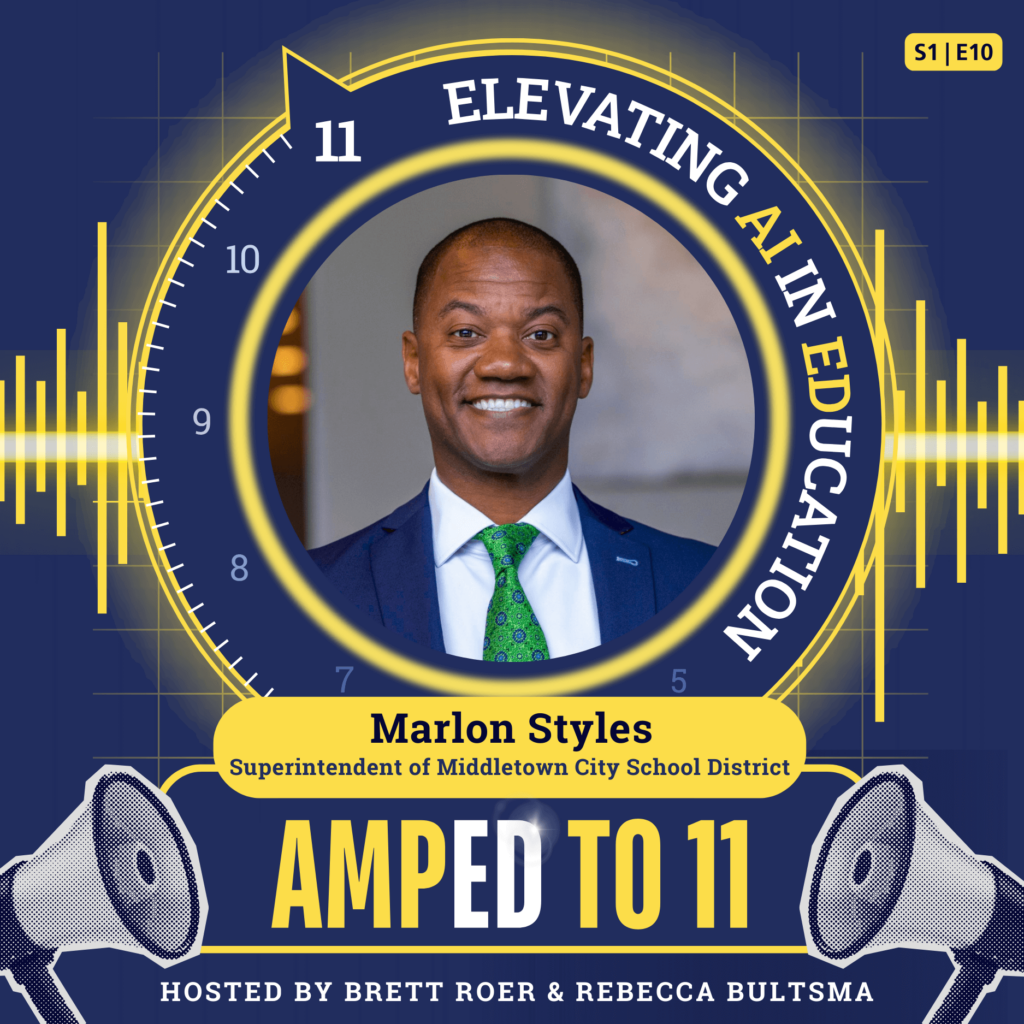
Ep10 MarlonStyles Youtube
===
Rebecca Bultsma: [00:00:00] Welcome to AmpED to 11. This is the podcast where we crank up the volume on AI and education to help you keep up with what’s changing, what’s possible, and what’s next.
Brett Roer: And I’m Brett Roer, CEO, and founder of Amplify and Elevate Innovation. And each episode we bring on a renowned guest to answer these 11 questions designed to really uncover the bold ideas, the surprising insights, and the real world impact AI is happening right now in the world of education.
Brett Roer: So this is truly an honor to today’s guest. We are joined today by Marlon Styles. Marlon is a nationally recognized education leader. He is also. Highly renowned for the work he has done as a digital trailblazer, uh, in the former communities he served out in Ohio. Marlon is now a renowned keynote speaker.
Brett Roer: He’s a learning partner at the Learner Centered Collaborative, and he has recently founded his own [00:01:00] educational consulting firm, Styles Junior, LLC. In his work as a superintendent, Marlon led Milltown City schools to become an ISTE dISTEnguished district. He’s testified before Congress on making sure. Uh, educational tools and innovation are equitable and accessible for all, and he was named a superintendent of the year for the work he has led in closing opportunity gaps.
Brett Roer: So Marlon’s on a mission to help educators embrace their role becoming unifier and leaders, and using AI to power that and make sure our students are stepping into the next phase of their, uh, lives and careers. Equipped to meet the moment. Marlon, an honor and a pleasure to have you here today,
Marlon Styles: Brett. So excited to be here.
Marlon Styles: Rebecca and Brett, I’ve been watching your, uh, your episodes here lately and just full of joy about the work you’re doing around ai, but just the impact you’re having on the profession. Honored to be here and spend some time with you today. Uh, I know you’ve got some tricks up your sleeve, so I’m excited to see what questions you got, but more importantly, excited, excited to have a good conversation around the topic.
Marlon Styles: Thanks for having me.
Rebecca Bultsma: We are thrilled to have you, and you mentioned [00:02:00] that you didn’t even know what Spinal Tap was, so we’re grateful that you’ve had that education. Now, if the origin story of our podcast name, uh, but
Marlon Styles: I watched the video.
Rebecca Bultsma: There you go. We’re gonna turn the amps all the way up to 11 here, and I think Brett’s gonna get us kicked off here with some of our 11 themed questions for you, and we can’t wait to learn more about you.
Brett Roer: Yeah, absolutely. Thanks Rebecca. All right, so Marlon, we were talking about your amazing children, and before you answer this question, after I ask it, give some shine to your, uh, amazing children and the work they’re doing, uh, in the world of sports especially, but they’re probably big fans of the show.
Brett Roer: Stranger Things. The one of the main characters, the breakout star was 11. She’s got these supernatural powers. Everyone’s in awe when they see them in action. So would love for you to share with everyone. Give us an 11 moment, a jaw dropping moment, one of the times you’ve experienced ai, and how did it really impact the way you were thinking about education and innovation at scale?
Marlon Styles: Yeah. Brett, you know me more than anybody, right? Firm believer in building [00:03:00] capacity and educators, uh, across all things, uh, K 12 school systems. Uh, just amazing work. Middletown city school district, all around technology. You mentioned, mentioned the ISTE DISTEnguished District Award credit to the staff. Uh, but as I think about building capacity, this 11 moment for me surfaced, uh, at a time where I just isolated myself amongst thousands of educators at the ISTE Live conference up in Philadelphia.
Marlon Styles: If you remember that, that time in Philadelphia, and this was several years back, this is right when AI started jumping in on the scene. Everybody’s mind was like, boom, what’s, what’s really happening? Uh, so my moment, my 11 moment. Uh, it was when I went upstairs in Philadelphia and they had that whole breakout area of all things ai.
Marlon Styles: There was a lot of student work there, a lot of educator work. People really started to make an initial splash. My moment came and I got stopped dead in my tracks. There’s this beautiful piece of artwork hanging on the wall that was done by a student. Now in my head I’m thinking, oh, a digital arts class.
Marlon Styles: I’m thinking, oh, a student who loves to paint. Nope. [00:04:00] My aha moment, my 11 moment, that just blew my mind. Uh, was looking at this young lady’s piece of artwork, uh, where she was given a social studies assignment. Uh, she did have an artistic brain at the time, and again, this is way back in the day when AI first started.
Marlon Styles: She completed the assignment. Uh, and the story behind this goes is she typed up the response. She’s very compliant in her response. Uh, but she took all of that insight, all those thoughts, all those inspirations. She fed it into this ai, uh, resource at the time that took all that text, translated it to an image, and then she wrote an essay around the image that came out of that ai, uh, image generator.
Marlon Styles: Um, and then submitted that into her social studies teacher, uh, to complete the assignment For me, it wasn’t about myself using ai. It was that moment, and you’re gonna hear a theme through this conversation today. Where a young learner inspired my thinking about the impact that AI can have on us as educators in our profession, but also the experiences they have in the class.
Marlon Styles: Again, [00:05:00] shout out to that young lady truly appreciate her curse, or pushing back on the system, not just being compliant, uh, but using what really is, uh, true to her heart and that’s, uh, expressing herself artistically.
Rebecca Bultsma: You bring up such, uh, an interesting point and very timely if you’ve been kind of on social media over the last week, we’ve seen, uh, OpenAI launch a brand new updated version of their image generator.
Rebecca Bultsma: And so we’ve seen kind of these, uh, anime type art everywhere that everyone’s been using, but it sparked discussions again around. Should we be using AI for art? And what does that mean for the original artists? And is it an extension of creativity or is it an insult to creators? And there’s not a, I don’t think a right or wrong answer, maybe depending on who you talk to.
Rebecca Bultsma: But I, I’m curious about your thoughts on that, because I’m sure, I know you’re in the space and you’ve seen this kind of influx of AI generated. I made one of Brett and I, it didn’t look a thing like him. Unfortunately, we have yet to make one that looks like Brett. But yeah. I’m curious about your thoughts over this last week with AI image generators, because you [00:06:00] mentioned that was way back at the beginning, uh, when you saw that and to where we are with AI art now.
Rebecca Bultsma: I’m just curious on your, your thoughts surrounding that AI art and where it fits in and doesn’t.
Marlon Styles: Yeah, I’ve got just, just two, two thoughts and I’m not artistic or image, uh, inspired in my mind. I’m an old school math teacher, so I’m order of operations through and through. Uh, but my mind immediately goes to this, number one.
Marlon Styles: Uh, if it’s inspired by what’s on the hearts and minds of young people, I’m in for it. Whatever that expression may come out. If it’s inspired by their thoughts, their feelings, their aspirations, let’s receive that inspiration, uh, in regards to, you know, whatever learning experience has been created, number one.
Marlon Styles: Number two, I’ve got a daughter. And as I think about these images that are being created, I wonder what her thinking may be around if we did, you know, take one of those image generators and, uh, allow to spit out an image of her, uh, and what her response to that may be mentally, emotionally. She’s a very confident young lady.
Marlon Styles: I mean, she’s just downstairs right [00:07:00] now, but it, but, but I’d be curious to see her response to whatever those images that that really came out, would it really impact how she saw herself? Uh, would she feel excited about what that image looked like? What to give her an emotion that brought on some sadness that typically doesn’t surface, but are, those are the two pieces that really jump in my mind as I think about young people.
Marlon Styles: I know we as adults, uh, have some opinions. Uh, mine are just purely around those, those two specifically to young learners.
Brett Roer: Yeah, absolutely. And I, you know, something that, you know, I share a lot when I give talks now on it is your, your daughter, my daughter’s even younger than you, she’s four. And I often use, talk to texts to have her create images and whether it’s of herself, of her friends, of me, I.
Brett Roer: It gets her to verbalize and realize there’s some, there’s some glitches in the system, even at four years old. She can figure that out. But what’s more interesting to me is how do you keep refining it so you do feel really good and confident about either how you’re being seen or, or others that you love or people you wanna, you know, show some respect to when you build a, when you build an image of them.
Brett Roer: So you’re right. Again, this goes back to Rebecca’s saying, right, there’s [00:08:00] a definitely a double-edged sword to it. So much possibility for good and for bad. So.
Rebecca Bultsma: I think kudos to both of you because you’re, you’re the core of your message is we’re gonna ask. Students, kids, adolescents, youth, what they think about this, because what we think doesn’t necessarily matter, they’re the ones that are going to be leading this work moving forward.
Rebecca Bultsma: So I love that. Sorry for the, the side note, that wasn’t necessarily an 11 themed question, but we’ll lead right back into one because. Now that you’re so familiar with Spinal Tap and the amps turning up to 11, I’m curious when you are busy, when you are, have a list of things to do, what’s in your tech stack when it comes to ai, when you really need to crank your amps up to 11 and get things done?
Rebecca Bultsma: Uh, what’s in your tech stack that you’re turning to right now for AI tools that deserve kind of that 11 out of 10 and push you to that next level?
Marlon Styles: I’ll say, and I’m gonna, I’m gonna be super vulnerable here right now. I’m a, I feel like I’m a creative person. I’m always capturing my thoughts in some written [00:09:00] form, housing them somewhere in a way that makes sense, feels right to me.
Marlon Styles: If you check that whiteboard out right over there in that wall, it’s just a bunch of random scribbles up there. That makes sense in my head. I. It’s been the way I function in leadership roles for 15 years, even six years as a superintendent. Um, it’s the way I enjoy being creative and I feel innovative in my approach and ability to serve other people.
Marlon Styles: Right now, it’s no different. Even outta the superintendency, I’m still capturing a lot of thoughts. Uh, so when I really need to be super efficient with my thoughts to make sense for me, I’m just old school basic chat GPT. It feels right for me. It, it allows me to remain efficient in my thinking. It allows me to remain fluid in my thinking as well.
Marlon Styles: Um, and as I’m scribbling things down and drawing connections, uh, visually that allow me to, to maintain my thought process, um, it’s that one tool. It is just super simple, super efficient for me. Um, it allows you to really push me. To really maximize my thoughts. So I dunno if that’s inspiring for [00:10:00] anyone, but I, but I guess my message is it doesn’t have to be, you know, the most glamorous AI tool.
Marlon Styles: It’s really about what’s, what allows you to be most efficient, uh, and really most impactful in some of the work you’re trying to do, uh, to think about will be possible to serve serving people. So for me, it’s chat GPT when it’s, I need that go-to efficiency tool to really, really help accelerate my thought process.
Brett Roer: So Marlon, it’s okay to, you know, call out the OGs, but I’m gonna ask you to take it up a notch. Take it to 11. For people out there, what’s like a tip or trick? So how are you, you got all your whiteboards, or maybe you’re scribbling by hand. Like, what are you doing to take that? Are you taking a picture of it and saying, put this into something?
Brett Roer: Are you using the project feature? Do you have a GPT? Are you talking to texts? Like, how are you getting all this brilliance into the system? Because that’s oftentimes why people don’t use it. There’s not a, there’s not a hack yet. So share a secret if you got one.
Marlon Styles: Two STRs that work for me. Number one, I’m awful when it comes to writing.
Marlon Styles: If you know anything about me, I talk way too much. I’ll probably be thinking about that at some point here on the podcast. Uh, but any chance I get to verbalize that [00:11:00] thing into my phone as I’m sitting there trying to record it, um, and really speak into the tool, it really helps really capture my thinking.
Marlon Styles: And I don’t have to worry so much about trying to structure it in a writing format. So the, the, the voice aspect of it is a great strategy that works for people who really function like me. Number two, I really try to really get really intentional about what I’m curious about. Uh, so if I, as I’ve captured all this thinking and really start honing in one spot, I’ve become really intentional about some questions that I ask.
Marlon Styles: I. Really gimme some specific thought partnership. Uh, and I’ve really tried to push the, you know, the resource that I’m using. Not to just affirm, uh, or agree with all of my thinking, but to really challenge my thought process. Really push me in some key areas to make sure that I don’t have any type of box.
Marlon Styles: Associated with my thought process, but really try to really, um, encourage this resource to, to specifically hone in on a key area. And that’s, that’s intentional by the, the questions that I ask and the interactions I ask it to have. I’m not asking it for [00:12:00] everything, feedback on everything but specific areas.
Marlon Styles: So, uh, for listeners out there, the more specific you can be, the better, more intentional about the areas you’re looking for. Thought partnership, the better. Really pushing the, the, the partner, the, the resource, uh, to not just be a, an agreeable companion, uh, but to be someone that’s really going to, I just call it a tool, someone.
Marlon Styles: But to be something or someone that’s really gonna challenge your thinking, really be analytical, and I won’t say judgmental, uh, about what you’re thinking or how or why you’re, you’re thinking it, but to really push you in some areas to stretch your mindset, uh, to accomplish some of those key areas you’re looking for.
Rebecca Bultsma: I think that is such great advice using AI strategically. This is how I got into it, honestly, because my background is communications and we all know just from regular interpersonal communications, the more effective and strategic you are at asking the right questions, the better response you get. And that same thing is true for people as it is for ai.
Rebecca Bultsma: So you bring up some excellent points. [00:13:00]
Marlon Styles: I was just thinking about getting, no, we, we often get the, the response that we just received those and we think we’re in a great, great spot. But I’m, I’m, how, how often are we saying, well, what am I missing? How might someone misinterpret? Right. Those specific like interactions really allow you to really dig deeper, uh, and the engagement with the resource that could potentially lead you in a better spot.
Rebecca Bultsma: 100%. So Brett mentioned how often he communicates kind of with voice, with his chat, GPT. I know he does that a lot. And one of our favorite tools for that is one called 11 Labs. I don’t know if you’re familiar with it, but it’s one that we’ll read you all of your emails or PDF or anything in a voice, a really human sounding voice.
Rebecca Bultsma: But we’re gonna modify this question a little bit since you are a chat GPT Pro, if you could have those interactive voice conversations with chat GPT, but you could have. Any voice you want interacting with you, whose voice would you pick and why?
Marlon Styles: That’s a, that’s a heavy question, but Brett, I’m gonna get in a little trouble here before I answer the question.
Marlon Styles: Um, it would [00:14:00] not be my wife love her to death. She’s in education, she’s got a beautiful mind. She’s a curriculum director, does some amazing things for kids. But I’m gonna need a break on this particular question, so I’m gonna go with a different person. Bucket list here. Bucket list is my man, Denzel Washington.
Marlon Styles: Uh, if I could have a conversation with Denzel every single day to ask him, do you understand me? I mean, it would brighten my day. Uh, but also you think about just how, how, how mentally, uh, strong he is, how diverse he is in his thinking, but just how in tune he is with his messages, um, as in interactions with folks and things he says, just inspires so many people across his country.
Marlon Styles: I would love to have some conversation with him to really push, push me and, and what I’m thinking about as far as interacting with different educators and young people. Again, bring me Denzel every day and I’ll, I’ll, I’ll promise y’all, I’ll keep a, a streak, uh, of engaging with that resource Denzel’s on the other end of that.
Brett Roer: Again, [00:15:00] every, every time we do an episode, we’re like, that was the best answer. That, that really was the best answer. Uh, that was really great. I almost wanna, no, I’m gonna ask. Now, what if there could be one Denzel character that you had to use for a day, which one would you choose and why?
Marlon Styles: Was it man on fire?
Marlon Styles: Uh, where he had the little bitty girl? Um, I’m drawing a blank right now, but you know what I’m talking about that I love his, the
Rebecca Bultsma: Dakota Fanning. Yes.
Marlon Styles: Yes, yes. I loved his character in that ’cause he was a, was so relational. You could just feel how much he cared about that young girl and just his, his desire to protect it just reminds me of educators across this country and how much they care for young people and how much they’re willing to just protect, uh, their dreams and try to bring those aspirations to life.
Marlon Styles: Would love to have that character interact with me as much as possible. That’d be a pretty cool, pretty cool experience.
Brett Roer: All right, we are gonna go back to a pre AI world where I first met Marlon. We’re gonna bring you here, but also this is an area where, um, Rebecca’s definitely the [00:16:00] resident expert here.
Brett Roer: So, Marlon, I’ve shared this before, but the first time I got to hear you speak was at ASA back in 2022, and you were on this amazing panel with some of the leading educational leaders. You’re literally saying to people, come on in, you’re gonna have your mind blown. And, you know, some people came in and some people didn’t.
Brett Roer: But essentially you kind of ended with this, this incredibly poignant call to action of like. Don’t tell me about innovation or ed tech or outcomes if you’re not helping the students who are historically marginalized and disproportionately not being supported, which, you know, you, you were exactly right, which are black boys.
Brett Roer: We always talk about AI is not the solution. It’s a tool. And first you gotta identify what the problems are, Sam out loud, and then make a plan. So I’d love to hear from your perspective if there’s any orgs, any tools in AI or elsewhere. Anything you wanna shout out now where people are really trying to take that problem and take AI or technology or something and are trying to address [00:17:00] it in a more innovative or effective way, in your opinion?
Brett Roer: So it is a chance for you just to kind of share on your beliefs, but also what what’s out there that people should know about if you’re trying to solve that same problem.
Marlon Styles: I think I wanna highlight my guy, Yusuf Ahmad from PlayLab, first of all, a big heart and a big soul, uh, for doing the right work to really have some really good impact on the types of experiences kids get in education.
Marlon Styles: I mean, he truly is focused on. You know what’s right for kids. Wanna, I wanna highlight Pay Lab to start with, but I wanna highlight a second, uh, organization here. Learner Center Collaborative. I just happened to, uh, to be part of the team, but I wanna highlight Devin Vodicka and Katie Martin from Learn Center Collaborative?
Marlon Styles: Well, to really formulate my answer here around this approach to leveraging AI for some really neat reason at Learner Center Collaborative, you know, we try to center learners by design. It’s a, it’s a, a, a, a theme in our work, um, and how we serve partner organizations across the district. Uh, we teamed up with Yusuf at Play Lab.[00:18:00]
Marlon Styles: To really start coming up with this concept, we don’t have to just go grab all of the latest AI resources that are out there and try to push them to work for us. Uh, so it’s really neatness, uh, relationship between Play Lab and Learner Center Collaborative, uh, where we are centering educators by design.
Marlon Styles: We’re starting with whole learner outcomes from the community in regards to the aspirations that they believe their kids have around the. Types of skills and competencies they have to possess as they walk across the stage. Partnering with Yusuf at Play Lab and his team, we’re creating some really unique environments, uh, where educators are in the space and building their own learner-centered AI context.
Marlon Styles: I. For the communities and the learners that they serve in their local school context, which is a pretty neat dynamic, right? So we’re taking learner profiles or graduate, uh, portrait of a graduate and all those outcomes and competencies inside that thing. And we’re, we’re training these, these AI resources inside these, um, play lab box that we’re creating.
Marlon Styles: All [00:19:00] inspired by learner-centered practices, uh, the Learner Center collaborative ecosystem, really driving, uh, the AI context. Play Lab is coming in to partner, to support, uh, to help, you know, engineer and, you know, build, uh, the, the personality of the bot and the structure of the bot. So that does offer you some really learner-centered, inspired offerings based on some of the interactions that you have.
Marlon Styles: So my shout outs are to those three individuals, Devin, Katie, and Yusuf. Learner-centered, collaborative and play lab really coming together in a really dynamic way, certain individual school communities and region across the country, uh, to build more learner-centered AI resources so that our students are getting some, some really good, meaningful learner-centered experiences in their, their school, uh, context.
Brett Roer: Amazing. Just a, just a quick follow up to that because I think something you said that’s really important for our listeners out there. ’cause and Mar Marlon, I’d be happy to hear your, your own perspective on this. You know, in the work you’re leading across the country, many, sometimes educators, their fear is this idea that like, [00:20:00] and you’ve said before, like AI can kind of go off on its own there.
Brett Roer: Right? So something you said, I just wanna make sure we’re highlighting is like you’re taking best practice from the Learner Center collaborative, their frameworks there ways that. Good leadership practices and then training a tool on it. So therefore when it’s being built, it’s being built with like the right guidance.
Brett Roer: We’d love to hear you just kind of expand on that and maybe words of wisdom for district leaders, you know, current sups, how to dig in there. And also, and I’ll give you some cover here. You know, Marlon goes everywhere around the country, so I can’t, we don’t got time to hear everybody that does amazing work.
Brett Roer: But if there’s like one or two that come to mind that you just wanna highlight a district or a leader that’s like. Doing the work through this partnership. Go for it.
Marlon Styles: Think about this from a superintendent standpoint, even a district leader standpoint. Uh, we get a lot of people knocking on our doors. A lot of emails coming in my resource and my resource and resource.
Marlon Styles: Um, you know, having some protocols and structures about how to vet what’s most meaningful for what you’re trying to accomplish for your learners. I. Absolutely, yes. It’s a whole nother conversation. There are times as superintendent where it made sense to bring us [00:21:00] resource in and we’d grip it and got the impact we were looking for.
Marlon Styles: Fantastic. But there were times where some of the big ideas or big moves that we were looking for, some of those innovative approaches where we felt it’s time to push back a little bit. Maybe we need to custom build something that works for us in our own local contacts. I did that with a, a student dashboard when the partnership with Aubrey around our passport to tomorrow.
Marlon Styles: Uh, so the strategy around building your own or, you know, bringing a partner in, uh, to customize the offering? Definitely a strategy. I encourage leaders across the country to consider in this particular context. Play Lab and Learner Center Collaborative. I’ll highlight the work outta Santa Ana Unified School District in Southern California.
Marlon Styles: Uh, superintendent Jerry there really doing some dynamic work and his team just, I, I think, are leading the way right now across the country in regards to some AI work that they’re doing. Uh, but they brought some. Indicators into a space. Uh, we did center around their framework for the future centered around their graduate profile, centered around the outcomes.
Marlon Styles: They’d [00:22:00] identified some of the key, uh, uh, components to their learning model. Uh, the big moves they’re trying to make, uh, around some of the, you know, key outcomes that, uh, Jerry’s searching for as the superintendent, all those local contexts, right? All the things that the community said are important to them.
Marlon Styles: As far as transforming the district, uh, the next three to five years, all those local documents to feed into the system to really make sure that we build this really unique sandbox, unique to SA USD. All that’s important on the backend. That’s what I mean when Yusuf’s team comes in and we’re gonna build that AI context.
Marlon Styles: Uh, we really able to, to customize that specific to what SA USD is trying to accomplish. There’s the customization first, and then as Learner Center comes in a really. Not just facilitating the process around those, those local documents, but also working with the teachers on some really unique ways to design meaningful learning experiences for kids.
Marlon Styles: You mesh all that together, uh, [00:23:00] inside a a, a play lab resource built locally by teachers, uh, in a PD experience. It gives a really dynamic way. Uh, to generate a, an AI resource that works for your local school community. So when I push on educators right now to, to find unique ways to make sure that AI context is unique to what you’re trying to accomplish for your kids, uh, I challenge anyone that says it’s not possible.
Marlon Styles: Learner Center, collaborative Play Lab, SA USD, as well as some others across the country. Definitely taking that, uh, opportunity head on and leveraging it as best they can for their kids.
Rebecca Bultsma: I love that you have this vision for what best practice will be and what will the best path forward is. And I kind of wanna build on that a little bit with my next question.
Rebecca Bultsma: Uh, there’s a superstition around 11, 11 being a, an angel number or a lucky number when you see it on the clock. And something about 11:11. Giving some extra magic. So my question for you is, if you could make your 11:11 wish about how ai, if everything goes [00:24:00] right, what the best case scenario looks like for education and society and AI together, what is your vision for that?
Marlon Styles: Getting excited here. You’re asking some really exciting questions. Uh, vision initially inspired by Nerel Winter, chief Executive Officer at Bostonian Global. Brett, I see you shaking your head When I say a beautiful mind. Definitely a beautiful mind who truly has his mind centered on kids specifically, uh, at Bostonian Global.
Marlon Styles: This was, uh, a little over a year ago we’re, we’re on campus doing some school visits. Again, I encourage you to get out, see what’s possible if you’re not doing that in your school community, take a team, travel the country, go see the, the amazing things happening for kids. But while on the school visit to Bostonian Global, uh, we got a sneak preview at something Nerel had been working on.
Marlon Styles: He had been, again, customized building his own AI resource, but I got this. Unique perspective on, he was trying to find a way for kids who’ve got dreams in life about being, I don’t know, being a Rebecca or a Brett or a Marlon or [00:25:00] an engineer or whatever they wanna be when they grow up, uh, these dreams of being, being whatever they want to be.
Marlon Styles: But coming up with this AI resource, uh, there was a companion for the counselor and the students as they work their own, you know, big, big dream plan. Really understanding the, the difficulties counselors have in getting with kids. Uh, but they were building, partnering with a, a local organization to build this AI resource.
Marlon Styles: They gave kids real time information on types of experiences, internships, pathways, types of courses, uh, knowledge they need to acquire as they thought about what they wanted to be when they grew up. This resource that worked for the adults, ak, your counselors and teachers, your parents as well, but the kids that make sure as I had, you know, interest in something, I could go explore it real time and have some resource available.
Marlon Styles: So as you think about this magic moment, I think the magic moment for me, if I had to sprinkle a little bit in on this vision, is an AI resource. That really was able to relate to kids. I don’t care if [00:26:00] you’re a five-year old in kindergarten, ’cause I, I challenge anybody that says it’s not possible for five year olds.
Marlon Styles: ’cause we did in Middletown city school district with our passport tomorrow. Or you’re a 12th, 12th grader ready to exit the system and move on to, to life after, after high school. But to truly have a. Resource that really got to know who I am, what I’m good at, how I’m good at it, and what my aspirations are.
Marlon Styles: That really got a chance to really get to know me and really started giving me some insights in regards to how do I get there? How do I need to prepare myself? What types of experience should I be thinking about? All those things that come with this conversation. Vision would have some magic to sprinkled in on a resource like that that really got kids excited beyond just exploring some different traditional, uh, career fields, but exploring what made them happy and brought them joy and giving them a chance to interact, uh, with this resource in some unique ways.
Marlon Styles: On the back end of that, that same resource. Really allowing teachers to get [00:27:00] excited, right? This is a retention mechanism for teachers in the profession to have a resource that gave teachers some ideas on ways to really maximize the type of experiences that they were able to dream up for kids, so that those aspirations really got to start to surface inside the classroom.
Marlon Styles: You know, as teachers, were always trying to figure out, how do I connect to my kids as teachers trying to figure out how do I give them a dynamite experience? What if we had this magical resource that allowed. Both parties really come together in some exciting ways.
Brett Roer: Marlon you know, I nodded my head vigorously ’cause it was almost a year ago where I first met Nerel.
Brett Roer: And again, I’m sure you can provide some insights here, but we did an AI student competition at the, uh, what was known as the air show last year. Now the AI show. And I worked with two schools, El Segundo Unified and uh, Bostonian Global, which is part of the larger Coone Valley District, I believe. And. You can imagine a year ago we had students create their own assignments using an acceptable AI use policy, and we [00:28:00] created a whole criteria and rubric.
Brett Roer: They, most of ’em had never thought about building their own lesson from scratch or resources or building anything using ai. Most eye-opening experience I’ve ever still had around AI and students just taking control and really leading at the forefront. But the best part was when I explained what we’re trying to do in IRL, he is like, oh yeah, we get that in five minutes.
Brett Roer: We have, we have a solution already. So like for him it was more like what you just said, like, well, we already know how to do this, but you’re right, we haven’t like done it this way. So like, we’ll have a teacher work with kids, and it was incredible what their students designed immediately with the help of their really amazing staff.
Brett Roer: So I love that they were already there and they just needed someone to be like, here’s a challenge. Great, let’s do it. We know how to do this. We just never done it this way. But there were many districts that really couldn’t. Right. It wasn’t even that they didn’t want to, they were just straight up like.
Brett Roer: I don’t even know how to get from here to here yet, even with the guidance that we were offering to support through a, a really generous grant from AiEdu and Schmitt Futures, what’s your advice? Maybe where would [00:29:00] you tell someone who’s at the district leadership level? How do you start, if you’re one of those people who, you got the, the will at this point, but you just don’t have the skill and you don’t feel like you have enough resources and guidance around you.
Brett Roer: Where would you give someone the starter? What do you often advise them on?
Marlon Styles: So take it back to Middletown City just real fast. When I first got there, we had ample opportunity, great staff, thriving culture, but we needed to, uh, to have a thought partner, uh, to really team up with. You can really accelerate your, your thinking, your team’s think, uh, capacity to think about what might be possible.
Marlon Styles: Uh, so first of all, I would say explore the opportunity to, to bring a thought partner in. I’m not saying I have to bring a consultant. Or another organization. It could be just a neighbor down the street at a neighboring district to be a thought partner with you about what’s possible. You can put a table in the middle of the room and some chairs around it and bring some people in from your local school community to really start diving into this really driving question about what’s possible around the use of AI and impact it can have on kids.
Marlon Styles: So this idea of not creating the same table with the same people sitting around it with the same. [00:30:00] Ideas and voices that have traditionally contributed to your school community in the past. If you’re a school leader, think about creating a brand new space with a brand new table since this is a new topic and really diversify the, the, the, the, the people in the room.
Marlon Styles: Uh, think about who the right, the, I’m sorry. Think about what the right seats are and who the right people are to have in those seats to really tackle this big question. That really is, is driving your thinking as that question gets on the board, my advice to you would be to just stay in the question for a little period of time.
Marlon Styles: Do not rush to get into solution mode. Just stay in that curious mindset and live in the question. Uh, ask more questions. Go gather more information, do some empathy work. Uh, sit down and talk to different people in the community. Talk to your kids and really get an idea. What’s on the hearts and minds at people and allow that to really influence, uh, the direction that you’re gonna take off.
Marlon Styles: Remember the, we didn’t know what blended learning was back in the day. We didn’t know what problem project based learning was back in the day. We didn’t know [00:31:00] what RTI was back in the day. AI’s no different. It’s just another trend that’s happening right now in education. It really is gonna impact, uh, our kids’ experiences a unique way.
Marlon Styles: Uh, so let’s just pay attention to how we lead through moments. Pay attention to our strategies, pay attention to our behaviors, focus on our mission, vision, and values, and make sure that’s guiding our conversations. Uh, solutions will come, uh, but allow some of that people work, uh, to really drive our thinking about what’s possible.
Marlon Styles: It’s a strategy I use in Middletown City School district. I see leaders doing it all across the country. Tackling that big question with community and, and seeking what possible, uh, impact we might have on our kids.
Brett Roer: Amazing best practices. And something you said, I wanna make sure everyone heard, I wanna amplify it was, I know with AI it’s like this, you know, it’s still, it, it’s scary, right?
Brett Roer: ’cause it’s not exactly sure what we’re doing, but as you already said, there’s so many times in education you’re not exactly sure what you’re doing, but you kind of know where it should go. And, uh, so the idea that you just said about like finding your people, making [00:32:00] sure that like you, you are an expert in education and systems change, right?
Brett Roer: That’s how you got to the leadership position you’re in. This is just a new solution that you’re trying to work through. So just really love that mindset when it comes to ai. You’ve done it before, just this is a new version of something you’ve mastered before you, you brought up earlier this idea of like, have AI kind of push your thinking.
Brett Roer: So I was actually just on a call with someone who oversees like a very, very large school district, and we were talking about listening sessions and I said like. Start by asking what in if this is our district demographics, ask an AI tool. Like what would make this statistically significant? Like how many people do you need to interview to say this is valid info?
Brett Roer: And just wondering from your perspective, how are you right now capturing these interviews? Are you using a note transcriber and putting it into something? Are you, how are you listening, learning, being present, and taking the wisdom from your community to build these more like comprehensive plans, strategies, theories of change, et cetera.
Marlon Styles: So take that conversation you just had there. [00:33:00] Uh, for any of the, the, the listeners who might be checking in on this, thinking about dabbling in ai, but just haven’t put our toe in the water first. If you were renovating new education space in your community, if you were going for, you know, a bond piece on your, your next, uh, ballot, you would go out and you would engage people, you would ask some questions, you would stay curious, you’d do some empathy work.
Marlon Styles: You’d gather what’s on the hearts of people’s minds, you communicate. You would engage the community. This is no different. Uh, the title of the work is just ai. It’s no different. So let’s start with that body, have those conversations, like you said Brett, and then really allow that to inspire what our next steps are.
Marlon Styles: Uh, again, I use the term, let’s live in the question. What’s possible, uh, if AI were present here and impact it could have on our kids live in that question. Uh, engage your people before we start really exploring solutions. Uh, live in the question for just a little while. See where that takes you.
Rebecca Bultsma: I love that.
Rebecca Bultsma: I think that that idea of engagement [00:34:00] and talking and listening is something that sometimes gets forgotten. Uh, but I, I really am a fan and something I talk about a lot in my work is this idea of like a collaborative Future building. I like to use something called an appreciative inquiry framework where we say, if this all goes well, what is our vision of how this could possibly be the best it could possibly be?
Rebecca Bultsma: And what does that future look like? And us building that vision together and then everything we do stepping together towards that future and building it together. And I think that that is a really critical ingredient. I find we talk about that a lot with teachers. We talk about a lot with students, but I think.
Rebecca Bultsma: We need to remember our communities and our parents really need to be heavily involved in that process as well. And it needs to start from a place of literacy and shared understanding before people can give kind of that meaningful feedback. So I’m really, really glad you brought that up. Thank you. I wanna go from the future, just back into the past for a second, and I want you to reflect back on your experience with generative ai.
Rebecca Bultsma: And I’m, [00:35:00] I’ve had many of these and I know Brett has, but is there ever, we like to talk about the Apollo 11 moon landing, right? Being a major leap for humanity. This thing that we thought we never thought would be possible, and here it was possible. Can you remember a moment maybe you were interacting with chat GPT or using AI where you just were able to do something and you sat back and you were like.
Rebecca Bultsma: Wow, I can’t believe we can do this. What? Like what a time to be alive? How is this possible? Was there a moment where you were like, this is going to change everything? That new frontier, that Apollo 11 moment.
Marlon Styles: This is unique to my moment here, so this might not be super, I. But it just was something that really touched my heart.
Marlon Styles: It was actually a, what I call goosebump moment for me, um, as it has been out on the, you know, just across the country talking to different educators across the country this past, uh, convocation back to school season. Got to hear a lot of stories from a lot of different educators, just about their current state, uh, of mind around education.
Marlon Styles: Good, good, bad, inspiring, frustrating, all those emotions that came, but I got to [00:36:00] hear a lot of stories. I started just taking some notes in my reflections around the stories that I was hearing. Um, and I was just so moved by some of these stories, you know, educators crying on your shoulders saying, I, I just needed to hear this.
Marlon Styles: I need to experience this, or, this really touched me and your message. So I really wanted to make sure I was affirming some different pieces in my message to educators. I went back into my AI resource and really started just. Plugging in some of those, the, those thought provoking conversations that I had, looking for some affirmation in some of the areas that I was thinking about as far as my message and my keynotes, uh, but unique to myself, I.
Marlon Styles: I try to stay as curious as possible about, you know, how can I reach more people, uh, and better serve them through, through voice and message. Uh, so I really started this unique dialogue with my AI resource coming up with some new ideas about how to emotionally better connect with educators specifically, um, and different types of conversations, uh, so [00:37:00] that my message, whatever that may be, that I, I really pray that my message is.
Marlon Styles: Serve as a retention mechanism and a source of inspiration for educators. Uh, but then my message really, really allows me to better emotionally connect, uh, with teachers, especially, uh, when I’m on stage and, and in different interactions. So my, my moment for me was experiencing what was possible with that two years ago and this past year.
Marlon Styles: Uh. Honed in, you know, in my heart what I was trying to accomplish to serve our, our profession through, through message that AI resource engagement is a thought partner right there. Really changed the dynamic for me.
Brett Roer: Another tip or trick that’s out there, and actually I owe this too, to work out in Ohio, that I was fortunate enough to, to work out last year with aiEdu.
Brett Roer: You know, we had al almost a thousand respondents to like, how did you enjoy this AI summit? What could we get better, right? We’re now is a year later, we’re about to head back out there. Super helpful that you can pull out from a thousand different survey results. Quantitative and [00:38:00] qualitative data that really can help you.
Brett Roer: Literally the next year when it’s time to get back on there. It’s like, well, this is what we did last year. Well, we have data points now and actual feedback that’s like, don’t do that again, or like, please never not, please never stop doing that. That was it. To your point, you can keep compiling this data and really build like a running record as we often hope like teachers and leaders are doing.
Brett Roer: Keep growing off of each time you get feedback to be better, but this stores it for you and can like change it in a dime for you. You don’t have to like recall that information anymore. So that’s amazing that you keep on trying to refine your message using AI and uh, hopefully people are using that, uh, for bigger da, bigger data sets as well.
Brett Roer: That’s great.
Marlon Styles: Yeah. Then I think the other lesson, I think you just brought back to some reflection right now for listeners, reflection for me is if that behavior, I’ll call it a behavior or practice or routine, whatever that may be, it is time intensive. If it’s important to you to really serve people better like it is for me, I.
Marlon Styles: You know, spending a little bit of time to A, collect the feedback is important, [00:39:00] but b, to take the feedback and you’re really getting into a situation, um, an experience where you can, you can analyze the feedback, you know, this AI resource, it can really be a companion partner for you to be able to do that.
Marlon Styles: Uh, but really dedicating time, just like you would dedicate time to answer emails or dedicate time to return phone calls back to someone who called. The office or, or left your voicemail dedicating time, uh, to really do this important work. You’re just happen to happening. To leverage AI to support you in endeavor, uh, really can really support your work in ways that you never could imagine.
Marlon Styles: So I, I encourage leaders or practitioners to think about, you know, dedicating some time in your busy schedule, uh, specifically for, for this type of work.
Brett Roer: Marlon, we’re almost, we’re almost going to do some, we’re actually gonna do something we’ve never done before in the history of the AmpED to 11 podcast. I know, I know.
Brett Roer: So, Marlon, we’ve got two questions left. So the first one is we’re giving you the keys to the car here. You’re now the host of the AmpED to 11 podcast. You get to [00:40:00] ask us one question that you’d like Rebecca and I to answer. And again, I know I’m putting you on the spot. Welcome to the uh, Marlon Styles AmpED to 11 podcast.
Brett Roer: What’s your question for your two guests?
Marlon Styles: My one question. Uh, I’m dying to hear your perspective here. There are a number of districts across the country. I’m not here to pass judgment on the decision, uh, but some decisions have been made to not allow the, to not allow AI into the space, uh, inside the district for the, the learners who attend school in those districts.
Marlon Styles: What would you say specifically to the learners? Again, not passing judgment on the people that made the decision, but for the learners that we know can have a really dynamic experience with the presence of AI in their learning spaces, what would you say to the learners in their school district?
Rebecca Bultsma: I feel very strongly about this just because I.
Rebecca Bultsma: I feel very strongly. I have four kids in college, right? And a lot of them go to colleges that are completely banning AI in any way, shape, or [00:41:00] form. But then we see these, this LinkedIn research coming out saying that it’s a super in demand skill. 77% of employers won’t hire you unless you have these skills.
Rebecca Bultsma: And I do see districts as I go along that are just completely banning it, not interested in it. My advice would be, uh, for these students to experiment with it within the boundaries that are there. Right? Like, don’t use it to write your homework for you. But even this last weekend, so Mark Cuban, who’s uh, an entrepreneur, he spoke at a social media conferences last weekend and I actually.
Rebecca Bultsma: I’m going to read it straight to you because it sums up exactly what I think about this. It was, uh, yeah. Uh, the South by Southwest, uh, AI kind of social media event. He said, if I were 16, 18, or 21 today, I’d dedicate every waking moment to learning ai. Even in my sleep, I’d be listening to AI podcasts, and I would just encourage students, especially post-secondary students, to just start learning about it as much as you can, even if you are not.[00:42:00]
Rebecca Bultsma: Necessarily given the green light to be doing it at school, nothing is stopping you, and this is for teachers as well in those districts to start experimenting with it, learning about it, listening to podcasts, because it is gonna matter for you. And use it in a way exactly like you described Marlon. That can make you smarter to make you think more deeply, to question your own biases and assumptions and figure out what you don’t know and dive in.
Rebecca Bultsma: Because eventually it will be green-lighted and you’ll be ahead, and you do still need to start moving towards the future, whether or not your district is rooted in the past, because the goal is to prepare for the world you’re entering, not the world where your superintendent grew up. Right? So I think the message is, I.
Rebecca Bultsma: To still be curious in every facet of your life when it comes to ai for the students. For the teachers.
Brett Roer: Okay. Tough act to follow. Good question, Marlon. Well done. First thing I would say is actually going back to last year’s student competition. ’cause unfortunately, again, it’s like a year later, so I’m using it as a chapter in time and my frustration is like [00:43:00] while I see it.
Brett Roer: Changing and innovating in so many great use cases. I also see so much inertia. It’s like anything else that, like you just, you know that it’s almost there. So last year these students came in and every single one of them, we let them speak. They spoke to hundreds of educators, said something like this, I’m paraphrasing.
Brett Roer: Before this assignment, all I understood about AI is that if I use it, I’m a cheater. And every single one of them create an assignment and could speak articulately and eloquently, unlike. I now realize that like you need to have guidelines. So they all made assignments that followed an acceptable use policy that a 14-year-old who’d never taught a class, had never made a lesson, could articulate how important it was to ground it in an acceptable use policy.
Brett Roer: And then they were able to be like, I now see that AI is not, if you use it right, it’s not to cheat, it is to learn. It will help you learn better, more effectively. It will help solve some of the challenges you or your teacher might have in like doing fun, innovative things. Yeah, [00:44:00] so I think that mindset of like, have the mindset of a 14-year-old.
Brett Roer: And so if you are a learner out there, start by doing something fun with it. Like what is the thing that right now you’re like, I really want to be blank, as you said, Marlon, like, what do you hope to be? It does not matter how whimsical or farfetched it is. If it’s you want to be an influencer, use AI to be like, what exactly like play the role of the, the, the 14-year-old, the biggest link, uh, the biggest.
Brett Roer: It’s gonna sound old. I don’t know. TikTok account, I’m sure there’s something more relevant out there. What did that person do to accumulate that base? What if I wanted to have that many users a year from today? What are some things I should do? And then you could say, well, I’m actually most passionate about, I don’t know what kids are into these days, but let’s say I did.
Brett Roer: I’m most passionate about, I wanna show all these great, uh, basketball dribbling skills I have. Now build that, or I love showing off the shoe designs I do on Nike. I create great, start doing that and like, how do I tell that story best? How should I shoot that picture? I don’t know the [00:45:00] answers, but AI does ’cause it can analyze every single use case out there for you and give you best tips and practices.
Brett Roer: So that’s my advice to, uh, learners out there is what Rebecca said already. You have access to all this at your fingertips. It’s not an access issue. It’s like. Go try new things just like you do on so many other, uh, technological platforms and go have fun and that fun will turn into you one day getting interviewed into a podcast by Marlon Styles to play your cards right kids.
Rebecca Bultsma: I’m curious, Marlon, what’s your answer to that question? Oh, the double flip. This is getting intense
Marlon Styles: Plot twist. I love everything that both of you just said. I’m a, I’m a big believer in not breaking rules, but putting some boundaries. So when kids in my district, you know, would approach me and say, Hey, these are the boundaries.
Marlon Styles: We want to go toe line and maybe step over it. Go dabble. Uh, go dabble, sit with your leadership. Let them know your desire to go explore what might be possible, uh, and just come back and, you know, just kind of do some share out and just en engage in some [00:46:00] conversation. Uh, but your voice matters. Uh, your advocacy matters.
Marlon Styles: If there’s something that’s near and dear to your heart, you think is really gonna change the game for your student body that you represent, you know, go advocate for it. It’s no different than kids saying, Hey, we want to take devices home in an urban environment that’s a hundred percent free and reduced.
Marlon Styles: Why do you wanna take the devices home? Well, we want to continue our learning when we go home. Great. Let’s change the rules and take those devices home so you can continue your learning. This is no different. So I would encourage kids across the country if you’re in those environments. You’re very respectful.
Marlon Styles: You’re super professional, you’re very mature. I believe in what’s possible in kids. So knock on somebody’s door and let them know what’s on your mind, um, and see if they’ll have a conversation with you and give you a chance to advocate. I love everything The two of you said. I’m so glad you gave me a chance to ask that question.
Brett Roer: That was about as good as that could have gone. All right, but we could end it there, but we got one last question. This is by far my favorite question, and this time I just wanna frame it the right way. ’cause I know this is like embodies who you are, right? I know you’re a unifier. You’re trying to bring people together to do better things.
Brett Roer: We used to call it the [00:47:00] Oceans 11, right? You’re gonna pull off like the perfect, perfect caper. The perfect heist in education, who you bring in with you who are all your one-on-ones. I think we’re kind of shifting towards the idea, like who’s in your 11, right? It doesn’t have to be 11, but like who is your crew?
Brett Roer: Who are the educators, innovators, people doing the work out there that our audience doesn’t get to go to their schools or might not be at the next conference. They’re gonna present that so. Who do they need to know about? We will link them and they can go explore, search and reach out to them. Floor is yours.
Marlon Styles: No particular order. I have to preface by saying this. We’re talking about one-on-one. Some of these are day one. Some of these just one-on-one, so no particular order. Give me Mike Nagler from Mineola up in New York. The must have on the squad, Brett, is if you ever go to Mineola school district, and we just left there a cute few weeks ago on Long Island, some amazing things happening for kids across K 12, uh, and have his beautiful mind to pull off a heist such as this.
Marlon Styles: Uh, give me Mike now. I don’t think I let [00:48:00] Mike drive. I think he would be a little bit slow behind the wheel. He just seems like a slow driver, I think is his wife takes the subway, but gimme that beautiful mind to help craft this heist, uh, from a strategy. Uh, definitely someone to have on the team, just as dynamic as Mike.
Marlon Styles: Uh, gimme Brian Troop from Ephrata Area School District, uh, in Pennsylvania. If you check out Brian’s Life Ready graduate. It’ll give you some really good inspiration around how he is seeing, uh, this education experience for kids in the school district. You’re looking for someone to have your next podcast, definitely recommend Brian, but give me those two beautiful minds paired together to help design this heist.
Marlon Styles: Absolutely, yes. A couple other adults here. I gotta pull in. Katie Martin, just from a, a long time interacting with her as a friend and now a colleague. Her perspective on how to evolve education is something like I’ve never seen before and just a beautiful mind would love to have her. [00:49:00] In this Oceans Elevens group to really inspire, uh, what we are gonna think about doing for kids just from a builder standpoint here lately.
Marlon Styles: Gimme Wyman and Yusuf from PlayLab, just those two beautiful engineers and being able to take all of these ideas about what’s possible for kids and engineer and really structure things, uh, so that they work for the kids and the users, uh, must have, those are all the adults I’m gonna talk about, and there’s probably a lot of other people.
Marlon Styles: But I can’t drop their name because if I did, we wouldn’t be able to pull this high stalk. But we got a lot of people out in the profession that would really in influence this. But really consistent with my, my, my practice and my belief here, centering on the kids. Uh, you give me five kids from across the country who you believe are furthest away from the opportunity, put ’em on a squad.
Marlon Styles: Give me five kids who are closest to the opportunity. Put ’em on the squad. Allow them to really inspire and push Brian, Katie, Mike, [00:50:00] myself, and some of those other folks who we don’t have time to really mention all of them. Put those 10 kids at the center of the room and I bet you we pull off something that’s pretty daggone special, uh, and really would influence the type of experience the kids have.
Marlon Styles: Give me 11, maybe a little bit more. Uh, a lot of those being, uh, some learners from across the country. Uh, we’ve been doing a lot of celebrating here on this podcast. A lot of celebrating.
Brett Roer: Amazing. 11 leaders and learners. You put ’em together. You, you let Marlon styles coach him up and, uh, look out world man.
Brett Roer: You, I think you ran the gauntlet, man. You might have like your daughter. You might have just won. You might just got the gold medal today. Well done, sir.
Marlon Styles: I appreciate you having, it’s been a blast. Been, uh, following the conversation here since you guys started the podcast, really impressed with the conversations you have, but just the content you’re pushing out.
Marlon Styles: Uh, really influencing a lot of people in the profession and just, uh, grateful for what you’re doing for the profession. Uh, really inspiring some people to, to go dabble in AI if they are or if they are not, to really get it on their board and, and give it a shot for the kids. So thank you for all that you do.
Marlon Styles: Uh, really honored to be on the [00:51:00] podcast with you.
Brett Roer: Absolutely. And before we let you go, if there’s any websites, any places, you’re gonna be speaking in May, June, July, 2025. Anywhere people can find out more about you, the person, the leader, and also how they can work with you, maybe in your role at Learner Center Collaborative.
Brett Roer: You know, please take it away.
Marlon Styles: Yeah. Two things here. Uh, number one, would love to be considered to come out to just share some words in your school systems. Uh, whatever inspiring message you need to, to get teachers excited about what’s possible for kids. You can check me out on marlon styles.com. It’s a website.
Marlon Styles: Uh, I’ve got all things you’re looking for there. Now, whether that be keynotes, leadership retreats, professional development, days in service, Brett, you’re not gonna believe this, but I just spent some time with some third through sixth graders at the local elementary talking about your spark. Uh, so there’s some, uh, exciting things you’re doing for your learners and assemblies.
Marlon Styles: Please reach out. I made a promise to pay it forward when I left the superintendency. So if you go to that website, marlon styles.com would love to come out, [00:52:00] uh, and really be able to pour into your local school communities. And if you’re looking for some learner-centered work, check out learner centered.org.
Marlon Styles: Uh, would love the opportunity for you to be able to, to partner with us, to build your frameworks for the future, um, and really center your learners by design. Again, thanks for having me. Would love to partner with some districts out there, uh, to really inspire some educators in the profession.
Rebecca Bultsma: Marlon, we’ve learned so much from you and we’re so grateful.
Rebecca Bultsma: We look forward to hopefully a future collab, uh, down the road and to keep seeing the great work that you’re doing. So thanks again for joining us.
Brett Roer: Thanks so much, Rebecca. Thank you. Have a great day y’all.