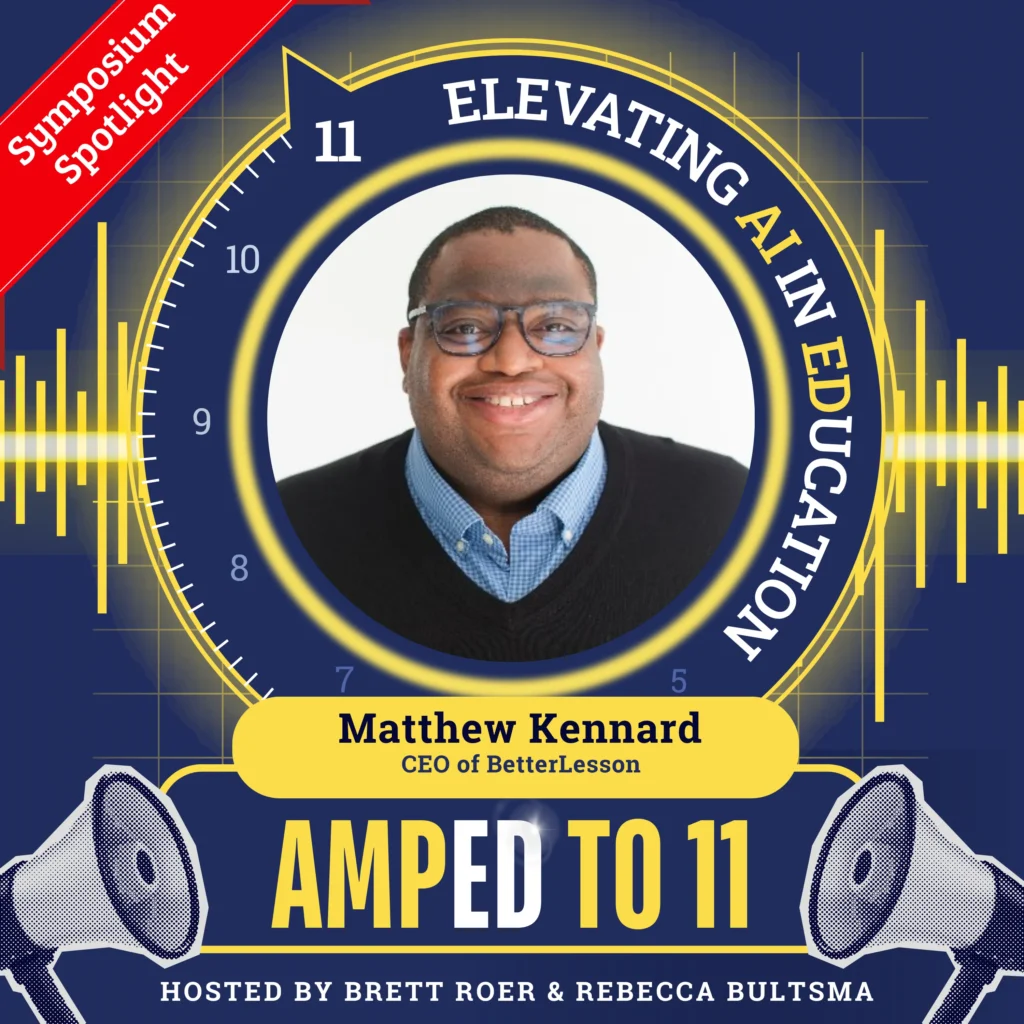
Brett Roer: [00:00:00] All right. Welcome everyone to the AmpED to 11 podcast. I am Brett Roer, CEO and founder of Amplify and Elevate Innovation. We have a very special episode here and a very special guest. We are joined by Matt Kennard, the CEO of Better Lesson. Matt, how you doing today?
Matthew Kennard: Hey Brett. Good. Thanks for having us on.
Matthew Kennard: We are, uh, excited to get to chat on obviously the AmpED Ed, uh, podcast. Also excited to, uh, be out in Albany this summer.
Brett Roer: Yeah. So for those that don’t know, if you haven’t been following us, amplify and Elevate innovation in partnership with the university at Albany are having an AI Symposium that’s gonna bring together state leaders from across New York state and the surrounding, uh, area.
Brett Roer: And it’s really to make sure that folks know what are the most innovative and best practices that they can be engaging with up in Albany, and then bringing back to their districts and communities. Throughout the summer and the upcoming school year. So we are super [00:01:00] excited that Better Lesson is one of our major sponsors.
Brett Roer: They’re one of the reasons we’re even able to put this on. There is no fee to the educational leaders who are attending. So first, Matt, I just wanna say on behalf of everyone, thank you for your generosity and support.
Matthew Kennard: Well, we are excited to get the support this, and I think that, um, you know, AI is one of those interesting topics, right?
Matthew Kennard: Where it is ever present. And yet when we think about application in our space. It’s almost a, a bit of a black box or a mystery, and I think that symposiums like this, honest conversations between leaders and thinking about application, uh, you know, it’s a huge part of us figuring out how to use this tool effectively to advance outcomes for our students.
Brett Roer: Yeah. So Matt, you’ve been a trusted leader in this space for years as well as better lessen an organization that you’re, you’re at the, you’re at the helm of. Why don’t you let our audience know? What is Better Lesson trying to achieve? What are your hopes to bringing, uh, the work you do to more communities in this area?
Matthew Kennard: You know, it’s [00:02:00] interesting. Better Lesson started as a less free lesson plan and instructional strategy practice provider as evolved into a professional learning company. And really over the last four years we’ve evolved into. And what we hope to be the best support for leaders or teaching and learning organizations at the district and state level.
Matthew Kennard: And if we really think about where the world sits today, when we talk to leaders, there’s two things that they’re trying to do. They’re trying to make sure that they have a hundred percent post-secondary ready students at graduation. And like, let’s be clear, post-secondary ready, meaning whether you’re enrolled, enlisted, employed, uh, you’ve had a rigorous.
Matthew Kennard: Meaningful educational experience and upon graduation, you’re ready to persist in whatever’s next for you. Be that in a career or a four year college. Two year college, right? We have a much more flexible definition of what that looks like. When you’re ready to be there, persist, gainfully employed, be a great contributing member of of your local community.
Matthew Kennard: We also think a lot about how do we help those [00:03:00] leaders not only produce that a hundred percent post-secondary readiness, but how are we helping them think about doing that? With the most efficient spend on resources. We know that dollars are not infinite, but really think about how do we tie those great student outcomes to where we’re making investments and ensuring that where we put our dollars as high ROI for districts and, and we think that it’s, you know, high time that there’s partners like Better, less.
Matthew Kennard: And you can sit with a district leader and say, how do we strategically plan for this? How do we implement it scale, and how do we use robust and accessible data to show our proof of progress?
Brett Roer: It’s incredible, and as you said, everyone’s looking for more efficient ways to increase their impact that they’re having in the communities they serve.
Brett Roer: If you don’t mind, take us down the current a little more, you know, what’s the better lesson? Like what’s the, what’s the magic recipe, what’s the secret sauce? How are you producing, you know, these impactful, more efficient r OIS for districts. That people should know about out there?
Matthew Kennard: Well, I think it’s a combination of, [00:04:00] of, of efforts.
Matthew Kennard: I think it starts with sitting down with our district and state leadership and really understanding what are our goals and what are our blockers. To creating those great outcomes for students and building coherent strategic plans on the front end. And then really think about what are the implementation steps required, whether that is reconstructing the instructional minutes in our day, whether it is using, you know, robust professional learning to ensure that all of the adults in the building or all the adults in the system are kind of understanding what we’re trying to accomplish and have the tools to do so.
Matthew Kennard: But it also goes into using tools like. AI, both from a implementation and an impact perspective to do things like objective classroom monitoring. How do we understand what’s happening with the student talk track, the teacher talk track? How do we get into things like. Wait time, reflection of academic language.
Matthew Kennard: How do we help a teacher in a classroom, uh, understand the right instructional strategies by using AI tools for observation? And [00:05:00] how do we think about things like intervention and support for students? And classroom educators using, you know, kind of machine learning and, and big data set analysis, uh, to help us understand the trends of what’s happening.
Matthew Kennard: Maybe in a building, maybe in a district, maybe in a region, or maybe even nationally across our system, right? We can use AI both generatively as well as from a machine learning perspective to help us understand the trends that we’re seeing and then, uh, you know, get much more aggressive in our ability to give.
Matthew Kennard: Great recommendations for what’s next, what’s needed, and support our educators. So we really think a lot about those tools in total as kind of key levers for the future. Uh, we’ll be able to pull to create greater efficiency in our system.
Brett Roer: Yeah. So what I just wanna make sure, you know, our audience really takes away from that.
Brett Roer: It still starts with what has been impactful in education. Indefinitely, right? You’re listening first, then you’re [00:06:00] creating, you’re creating a plan, right? With your expertise and with their knowledge of the communities they serve. And I think what you’re talking about, the leverage of AI is really being able now to take all of that information, all of those conversations, and now all of that data, like you said.
Brett Roer: Now, the possibilities are more infinite in terms of you could have an impact at a local level, a district level. State level or even nationally. And, uh, sounds like the blueprint is there now. You’re just really being, um, selective and intentional about what AI tools or what technology you’re bringing into the equation.
Brett Roer: Does that, does that kind of summarize like where, where better lessons started and where it’s going?
Matthew Kennard: I love it. I, I would say this teaching will always be a people business. It’s a human-centric business. I think one of the big concerns that we have heard. About AI because I think it’s an often misunderstood tool is whether or not it suddenly becomes a replacement for the humanity of teaching.[00:07:00]
Matthew Kennard: We’ve had the same conversation, by the way, when it came to computers, the internet, one-to-one in classrooms, and I think what we have found is when we keep humanity at the heart of what we’re trying to accomplish, we can use tools to help us do better. More quickly, right? And use those tools to help us understand large data trends in a way that is just more efficient and effective than we can do ourselves.
Matthew Kennard: Generate suggestions for what’s next in the classroom more efficiently than what we can do ourselves. But the advent of digital core curriculum did the same thing. The advent of the internet did the same thing. The advent of personal computing did the same thing. It made us better at our jobs so we can focus less on.
Matthew Kennard: The work of analysis and think more about the work of application and application is a human process.
Brett Roer: Well, there it is. That I think you just, I think if we just had listeners, especially educators out there, hear that part. You know, not just about Better lesson, but. The [00:08:00] fu the current and future state of education with, you know, ai, uh, at the forefront.
Brett Roer: I mean, that is it right there. So Matt, I wanna really say thank you because if more people hear that, which hopefully they hear this at the, you know, AI symposium or hosting in Albany, thanks to your sponsorship and generosity, I think they now just need to see like how that lives and feels. But I think you’re, you’re on the right track of how you’re messaging that.
Brett Roer: Humans are at the forefront. These are tools to help you succeed. And that data part, that’s not why any of us got into education in the first place. It was to make an impact with people and see the impact it has. As they, as you said, leave, uh, leave schools equipped for life ahead of them and, you know, ready, ready to meet whatever moments, uh, come their way.
Brett Roer: So Matt, I wanna say thank you so much for leading today’s conversation. Anything else folks should know about you? What are some things. They’ve known about you, they’ve known about better lessons, but as you mentioned, you’re always evolving. What are some things people might not know if they haven’t, uh, checked you Allall out in the last few months or last year or [00:09:00] so?
Matthew Kennard: Youn know, Better Lesson was the free lesson plan company, then the PL company. We now really think a lot about teaching and learning, and I think that what I’m most excited about is seeing our talented, passionate team here get to really reach out and have an impact, not only at a local and and district level, but also now at a state level.
Matthew Kennard: And I think being able to expand that impact, you know, it’s, it’s a wonderfully talented team here. And if you haven’t checked this out. In a while, go to better lesson.com and, and take a look. Uh, we recently acquired a company called Able, so we’re now also focused on instructional minutes and resource allocations.
Matthew Kennard: So we’re here to be the full service support for anyone who’s leading a teaching and learning organization. And, uh, we’re excited about the opportunity to get to join in and, and, and do that work side by side with you.
Brett Roer: Yeah. Okay. Well, thanks again. Thanks to our audience for listening. Check out better lesson.com.
Brett Roer: Matt, thank you again for being part of this. Can’t wait to see you in the Better Lesson team, uh, in Albany next month.
Matthew Kennard: Brett, we’re excited. Thanks, and, and looking forward to seeing [00:10:00] y’all.