Ep14 MatthewWinters Youtube
===
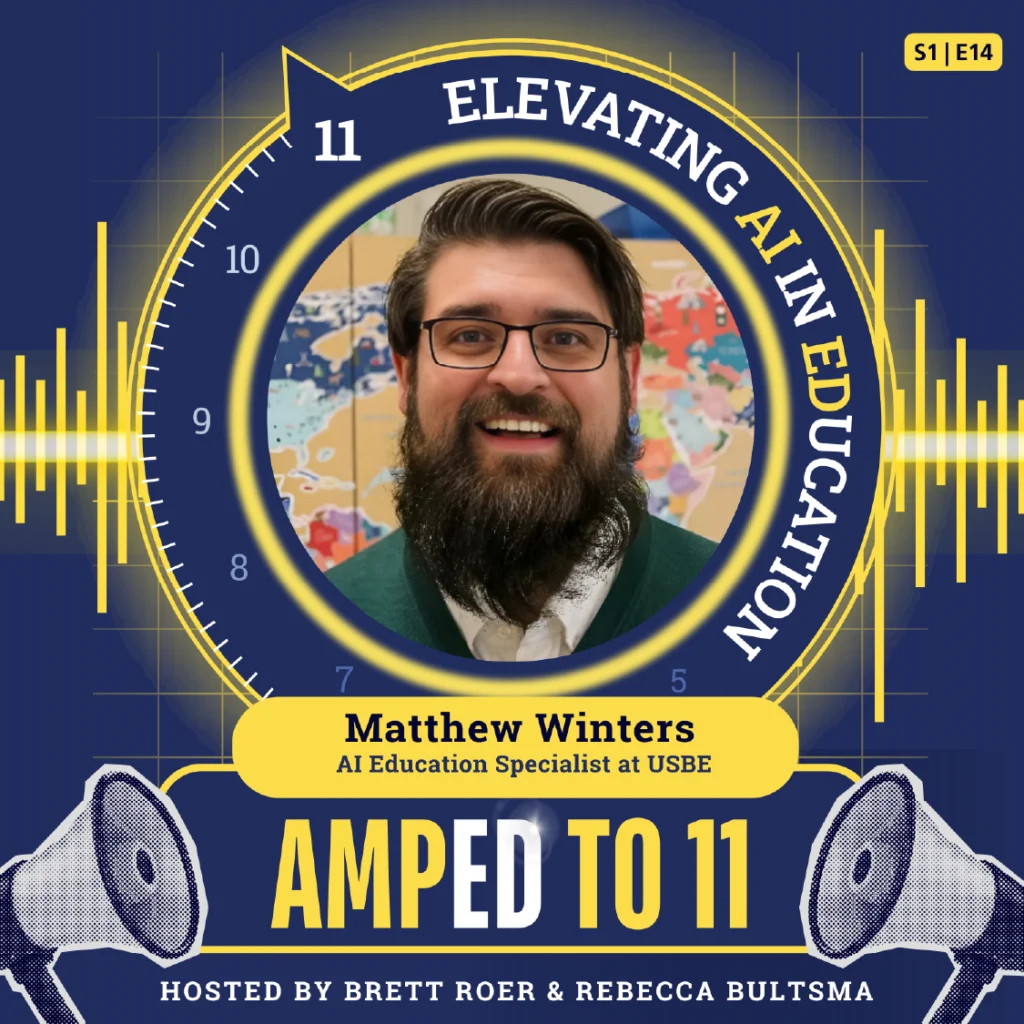
Brett Roer: [00:00:00] Welcome everyone to the AmpED to 11 podcast. My name is Brett Roer. I am joined by my incredible co-host, Rebecca Bultsma, and we have the honor of interviewing today. Matt Winters, the Utah School Board of Education AI Specialist, a one of one in terms of his job title. As well as his experience and the way he speaks about AI education and life.
Brett Roer: Matt, welcome to today’s AmpED to 11 podcast.
Matthew Winters: So excited to be here, Brett and Rebecca. Thanks for having me on.
Brett Roer: Absolutely. We were so, I was so honored that just, uh, recently in the past month, I got to hear you deliver a keynote address in Ohio. And as I was sharing briefly pre pod recording, uh, I learned so much about you as a human being and just what shaped your values and your philosophies.
Brett Roer: Um, and I just shared you’re really a true renaissance man. So thank you for joining us today. I’d love to hear what was your impression [00:01:00] of, uh, you know, your speaking engagement out in Ohio and, and then we’ll kick off the pod.
Matthew Winters: So fantastic. It was a really great experience to go out there and speak to educators in Ohio.
Matthew Winters: But then what I love about that is being able to see the different education systems we have across the country. I’ve known a lot of speaking gigs around the nation, and it’s always nice to, to connect with what’s happening locally. And, and one of our, our common friends, Eric Hurtz, was in the audience and he pulled me aside afterwards and he said.
Matthew Winters: Gave one of the best compliments I’ve ever heard about my speaking, which is one I learned a lot about you, like just what Brett said, but then also I learned a lot about how to keynote, which I was just like, that’s a huge compliment coming from from Eric. So appreciate the opportunity. It was really fun to get out there and speak.
Brett Roer: Well, first of all, that is high praise from Eric. Um, just to give some context as to what we’re talking about, in Ohio, we had five AI summits in partnership with AI EDU, the state of Ohio, and a number of other organizations leading incredible work in education, workforce development, and ai. And just recently I looked back at the keynote speakers and one, I’m so [00:02:00] fortunate, Matt was one of the keynote speakers.
Brett Roer: Eric, Matt was joined by Winston Roberts. Rebecca was a keynote at, I believe, the following day. So I think that night I drove. About halfway across the state and got to see, got to see Rebecca that evening and then got to see her give an amazing keynote the following day. So truly an all star lineup of keynote speakers spreading their ideas, uh, from around the country and the world.
Brett Roer: In Rebecca’s case. Matt, I’d love if you could share with our audience what is this really unique title you hold in Utah and what exactly is the work that you’re leading out there?
Matthew Winters: That’s a great question. So my, my role as AI education specialist at the Utah State Board of Education, we have an elected state board as well as kind of combined with what most states would see as like a department of education.
Matthew Winters: So everything that we do as employees supports our elected board and our state superintendent, Dr. S Dix, Sidney Dixon. My role came about, about a year ago. I’m almost a to my one year probably when this, by the time this is published, it’ll be past my one year mark. But [00:03:00] I came out of a space of statewide training at a, a organization called Utah Education Network, and we, I was starting to do trainings around AI before chat.
Matthew Winters: GPT hit November of 2022 and I. Came out and just 2023 was a blur. I did about almost 6,000 hours of training time with teachers across the state of Utah and going around the country and doing all sorts of things. And then in 2024, the state board decided to create my position, which roughly does three things.
Matthew Winters: My job role is cut into third, so one third is working with policymakers, so state legislature. Government organizations work with a lot with higher ed. Work with our districts and charter schools across the state to think about policy. What are the best possible ideas around artificial intelligence, generative ai, how do we work with those in policy ways across the state?
Matthew Winters: The second third is working with our local constituencies or districts and charter schools to provide whatever they need in terms of. Artificial intelligence. So that might be some training which we’re [00:04:00] rolling out. In fact, this week and next week, we’re training about 3000 teachers across the state of Utah, around artificial intelligence.
Matthew Winters: We’re doing all sorts of policy work. We’re bringing in constituencies and groups to to do feedback and things like that on some documentation we’re building. And then the third is actually internal training. So I, I’m the internal AI trainer. For the State Board of Education, which we have about 450 employees, and we actually ran an AI summit last week that did some really great work with about a hundred of our employees, which was really awesome.
Matthew Winters: So that’s, that’s kind of what I, my, my role is, but I, I do quite a few things across the state to help ensure that AI and generative AI goes the right direction for us. Is, is in education,
Brett Roer: what do you So far Right? One year in, first of all, kudos and, um, I wanna make sure it continues to come out and maybe if you wanna speak about.
Brett Roer: The fact that in Utah you’re doing, you know, you have this unique role in the intersections you just said about all the different, uh, touch points you can have in education at the state level, and then how that trickles down to, you know, schools. [00:05:00] What do you feel like in year one? And don’t be humble that you really, I.
Brett Roer: Are proud of. What are the biggest achievements you think you led at the statewide level that you think are gonna, you know, really push the work forward in year two and beyond? And what did you think maybe was the most surprising challenge, or maybe not surprising, but what are the challenges you’ve encountered that you really, um, need to continue to, to push on?
Brett Roer: And maybe we’ll solve ’em right here on the pod? Who knows?
Matthew Winters: I, I love that perspective. I, I, I wish it was that easy, like we could figure things out in half an hour, although conversation’s a good way to get things done. There’s a couple things that I’m really proud of. One of the first initiatives I, I, I, when I came into the role, I told my, I.
Matthew Winters: The two leads that I had at the time, I can only plan out this job really for about three to six months in advance. Like I, AI is so changing and permeable and, and, and just so many things going on with it that if really we, if I say this is my five year plan, I’ll, I’ll erase half of that by the time I get to year one.
Matthew Winters: And so I [00:06:00] said, here’s a couple things I really wanna do. Number one was. Run a series of AI summits, kind of like what you did in Ohio. We were a little bit ahead on a couple of things, and so what we focused on in those was data privacy and securing the teachers understand the importance of what data is, what data is being used, the importance of how that interacts with their classroom work and behavior.
Matthew Winters: And so we had data privacy experts from the state board come out and present all over the state to almost a thousand educators in different regions. Out of those summits, we actually collected a lot of data from internal conversations. So one of the things we did was instead of having a main keynote at the beginning of the day, we actually had me talk for about 10 minutes, and then we gave them time to talk about the big questions that they had around AI and document those, those thoughts on big poster boards and post-Its.
Matthew Winters: And usually those get, you know. Yay. We did that and then recycle. Um, what we did is we actually took all of those, took pictures of them, and then fed them to an ai. And [00:07:00] AI was able to take all of those and synthesize them into actionable items that I needed to complete because this is what our community is telling us.
Matthew Winters: So that’s been my guiding light, and there’s been two big things that, there’s a lot of other ones, but there’s two big ones that came outta there. One was teachers can see the importance of generative ai. And they can see the change that it’s making in their careers. They just can’t see it yet in their content area and grade level.
Matthew Winters: And so the, the reason for that is that there’s no real repository out there of here’s 50 lessons that are English language arts from ninth grade that a teacher can look at and go, oh, I could do that or that, I could manipulate that. I could change that up. And so one of the big initiatives that came out of, of that thought process and that need in my community, and that’s, by the way, a need I’m hearing across the globe.
Matthew Winters: It’s not just in uni in Utah, is we’ve been running a grant through a wonderful organization called Intermountain Healthcare. They’re a HMO here in Utah. Um, and one [00:08:00] of the big things that they gave us in this grant was funding to provide. Professional development in to teachers across the state. The, the two to 3000 teachers that I pointed to just a few minutes ago, that’s part of this group.
Matthew Winters: And so what the teachers go through is a one hour in person. About two to three hours in a canvas course. Then they write a lesson plan on their content area and grade level that either uses AI with students or teaches about AI with students. All of those lesson plans and we, we can pay the teachers about 200 bucks.
Matthew Winters: Their donors choose for that. That work, I. And when they complete that, uh, we’re, we’re winding this down in, in September, and all of those lesson plans will go up into a repository that’s OER, so open educational resources, so any teacher across the globe can access that for free. And as far as we know, that’s the first repository of its kind.
Matthew Winters: And so we’re trying to do a value add. The other thing that, that we’re thinking about, the other thing that a lot of teachers are pointing to is that we need. Embedded standards around AI and content areas and grade levels. Uh, we’re gonna be publishing in the next [00:09:00] couple of weeks the world’s first portrait of an AI infused.
Matthew Winters: Student and AI infused teacher, that will be a companion piece to our portrait of a graduate that our content teachers here in the state can use to go, here’s what a good use of AI looks like in a grade level one area. And so we’re going to build competencies around those in the fall and do that as a sister document.
Matthew Winters: But those are all coming outta things that are. Big needs in our community, and that’s really what I come back to, is listen to the community, see what they need, not just locally in Utah, that’s a big part of my job, but also nationally, because if I can do something in Utah that influences the work in Ohio or New York, or even across the, you know, the globe, that’s a, a, a big thing for me.
Rebecca Bultsma: Matt, we talked a little bit about like what you do, but if I were to spend, let’s say a week with you just shadowing you in your work, uh, what would do you think would surprise me the most about how you think? How you think about ai. Tell us a little bit about how you’re viewing the world in this point in time.
Matthew Winters: I [00:10:00] don’t use AI as much as I, I think most people would, and I’m a lot more kind of, I, I’m cagey about like what it’s doing to our society. I was told by a few people after, like after working with me for a couple of months, they were like, you’re actually way less positive about ai. And you ask the big questions about what it’s doing to our society.
Matthew Winters: And that’s something that I’ve been doing for a really long time. I, I’m a skeptic. I wanna make sure that if we’re going to use a technology, a, it actually does what it’s supposed to appropriately. Like, that’s a huge part of this. And especially when we’re talking about our, our K 12 students, like it needs to be doing what it, it should be doing.
Matthew Winters: The other side of it is this is a new technology. Like, it’s a fundamental technology. Like I always, I, I said this in the keynote, but like, it’s like electricity. It’s going to be something that once we plug things into it, which in this case is a human, it’s gonna get really, really interesting over the next 20 years.
Matthew Winters: But we have to remember that it’s a fundamental technology. And, and with that in mind, because it’s so [00:11:00] new, we don’t have a body of research and work that really supports. A best practices in the classroom, and B, how it should operate an educational system and whether or not it’s actually providing validity.
Matthew Winters: Now we’re seeing some cases, like small groups of research studies that are pointing to, yes, there is a net positive here if it’s used appropriately, and that’s the, the scaffolding that needs to be there. And there’s some big conversations around that. And if you’re interested, there’s a, a great research put repository put together by Chris Agnew over at Stanford that really has dev.
Matthew Winters: Kind of dove into, here’s all the research studies you could look at, and there’s about 450 of them right now on there. So that’s one of the things that I think a lot of people would not like assume about me, is that I am really cagey about what this is doing, and I wanna make sure that as we apply it to classrooms, that we pay attention to the research side and see if this is actually doing what we want it to do in terms of student achievements, student growth.
Matthew Winters: Personalized [00:12:00] learning, helping students with disabilities or multilingual learners are gifted and talented. And if it’s not, then we need to go back to the companies and, and who are producing this. ’cause that’s where we’re seeing the, the push is this is a, uh, you know, they’re owned by these ma uh, these major corporations and say, Hey, we need to figure out how to move this and get it to where we actually want it to be.
Matthew Winters: Um, and so that, that, I think that would be one of those things that most people would be like kind of surprised by is how push, how. I, I tend to push back on, you know, AI positivity. I want actually AI skepticism.
Rebecca Bultsma: You know what? I think you and I have that in common. I feel like the more I, I’ve learned and researched, and as someone who researches AI ethics full-time, my question for you is what are kind of your top three biggest ethical concerns that you have to sit with on a regular basis that you’re trying to navigate?
Rebecca Bultsma: And I know. That’s a blanket question, but there’s no right or wrong answers. I’m always just curious what’s on the mind of other people who understand attack. [00:13:00]
Matthew Winters: There’s a lot that we could kind of get into there, like, you’re exactly right. Rebecca. One of the things that really kind of hits my desk on a daily basis, I’m sure it hits you guys’ desks as well, is, is the plagiarism, ethical conversation around that and.
Matthew Winters: In my mind, there’s a lot of things that we could do to remedy that particular conversation. And a lot of it comes down to not necessarily even the students, like the students I talk to. And granted it’s in the dozens, not hundreds yet. I’m hoping to have some more conversations with students in the fall.
Matthew Winters: But every student has said the, basically the same exact thing about plagiarism and, and ethics for the student perspective is that. They know they’re probably cheating with ai, but they’re, they haven’t necessarily been told that they’re cheating with AI until they get caught, and then it’s a big penalty against ’em.
Matthew Winters: And we’re seeing in some of the, the, the court cases, like that’s a, that’s a problem because if there’s no. No, no policy in place at the classroom or the school or the district level, then that kind of causes some, some disparity for the student. And so that one’s the one that comes up again and [00:14:00] again with teachers.
Matthew Winters: But a lot of times I did a, a wonderful presentation with a group of our ELA teachers across the state about two weeks ago. And one of the teachers came up to me afterwards and she said I was ready to riot when I heard we were talking about AI at this. And now I’m like, I’ve got this, like I can do this.
Matthew Winters: And I’m like, yeah, you absolutely can. You just have to rethink a little bit of how you approach things on the other side, I spend a lot of time, I’m, I’m couched right now at the State Board of Education here in Utah on the student data privacy team. I work with some people that do some wonderful work about with national data privacy and student data privacy.
Matthew Winters: And so we’re constantly asking questions of what. Are the appropriate uses? What does it mean to have AI in the classroom? Is there a data privacy agreement? Those sorts of things in place. And when we talk to companies that want to work in Utah schools, the first thing I say is, you gotta have a DPA in place.
Matthew Winters: If you don’t have that, then we’ve really gotta have that conversation first, or else I’m not going to introduce you or [00:15:00] talk to you, talk to anybody about your product, because I think that’s such an important part of the AI landscape right now, that if we don’t have that in place, then it’s gonna cause problems ethically, almost immediately.
Matthew Winters: Um, and so that’s been a large part of the conversation. Yeah, I, I think there’s also this, this question ethically. About human on the loop versus human in the loop. And if you’re not familiar with that as a listener. Human on the loop means that there’s, you’re there, but the, the AI’s making a lot of decisions for you.
Matthew Winters: Whereas human in the loop, you’re kind of checking every decision that comes through the ai. And with adjunctive AI that’s coming up where you can create an agent that’s doing a lot of actions for you, building things, that’s great and it can really do some powerful things. But that means that you have, if you’re, if that’s a human on the loop thing, if you’re not in the decision making process and you’re working with students.
Matthew Winters: Then you may produce something that [00:16:00] is objectionable content that may be problematic, or you may even just straight up create misinformation to, from a teacher perspective. And that all creates an ethical standpoint that is really difficult to navigate. And if a teacher doesn’t even understand the underlying technology, they’re not gonna understand the difference between being in the system versus being on the system.
Matthew Winters: And that’s a really, that’s a big thing that we’re trying to reinforce in the trainings that we have here in Utah.
Brett Roer: Incredible. Thank you, Matt, for sharing all that. I actually wanna circle back to something you mentioned before. One, it’s so impressive that you’re gonna be unrolling this portrait of a student with ai, portrait of a teacher with ai, and I love this idea of a repository of lessons in getting to hear your keynote.
Brett Roer: You know, you shared so many personal stories about individual students that you, you know, had a great impact on your life in the classroom and beyond. I’m curious, like what is the guidance or advice you’re gonna give? So I’m a teacher in another part, in another state, and now you have these great lessons that, uh, you know, teachers are uploading and [00:17:00] it’s good to hear they’re getting some, some sort of stipend and compensation for that work.
Brett Roer: What kinds are you gonna give to someone like me who finds that and it is relevant to my subject and my grade level, but as you know, personalization for the exact students or maybe the school district priorities, instructional focus of that school. How does, how does someone really go through that process?
Brett Roer: What are some tips and tricks you might, uh, be giving to teachers on how they could use AI to further refine those really great lessons and make them personalized for their students? What do they need to do or know or navigate?
Matthew Winters: I. I love that question, Brett. So it’s not me presenting if I don’t talk about Ken Robinson for a minute.
Matthew Winters: So I’m gonna couch my first little bit of response to this, sir. Ken Robinson’s one of my, I consider him a mentor. He actually says in one of his books that a mentor is anyone living or dead, whether you know him or not. And every time I get kind of despaired. Uh, given that despair mode around what’s happening in education, I go and watch a TED talk from him or read one of his books, and I automatically feel a [00:18:00] lot better about what’s happening.
Matthew Winters: But one of the things that he talks about in one of his TED Talks is that everyone’s education is rooted in their biographies. And if a student wants to drop out. Or if a teacher is having a hard time in the classroom, it’s probably ’cause they’re not being honored in their biography. And that’s a, a thing that’s really important there, because as I talked about in my, my keynote, I was on the verge of, of dropping out from high school when I was 16.
Matthew Winters: 15, 16. Sophomore in high school. When I, ’cause I wasn’t being challenged, I didn’t see the point. And then I had a teacher who introduced me to James Joyce. And all of a sudden, overnight I was like, almost overnight, I was like, I’m back in school. I’m, I’m engaged. I see the purpose of my learning. And so I think for a lot of teachers when they see a lesson plan, and this is, this isn’t even a, an AI thing, they look at it and go, yeah, this is great.
Matthew Winters: And I can understand why it’s set the standards and like it’s obviously working. But really what we have to do is be able to see that and adapt it to not just our local context [00:19:00] of the students that we work with. Because one of the things that we haven’t accounted for yet with artificial intelligence is that.
Matthew Winters: The teacher knows the local context of their classroom better than any other person. If they’re paying attention and they’re, they’re active in that classroom. They know their students, they know what they need. They know that thought process and all, and most times they deeply care about what happens in that system as well.
Matthew Winters: And so I. Everything has to come back to that. So if a teacher sees something with a, an artificial intelligence lesson plan, whether it be our repository next fall or somewhere across the, the web, they have to be able to adapt it to what they need for that classroom environment. But then also they have to root it in their own.
Matthew Winters: Biography of what they love about what they teach. Um, so often I would bring in, I brought in Joyce most ti like a couple of times to my students. I taught Steinbeck, but then also I would introduce them to song lyrics from bands that I really loved as poetry. That was a huge part of my life being a [00:20:00] radio dj.
Matthew Winters: And so I brought that into my classroom a couple of times as well. And so. You have to be able to do both those things. And what’s great about artificial intelligence is that once you have a document that is pre-created, that you have a really great lesson plan is that you can upload that and say, Hey, here’s my local constituency, here’s my background.
Matthew Winters: How could I adapt this lesson plan to meet those needs? And it will help you generate those ideas more quickly and evenly because again, AI is one of the best thought partners. I mean, it’s not the thought partner. I think the human finding a human that thinks like you is even better, but other than will always be even better.
Matthew Winters: But this, this gives you some opportunities to really think it through in ways that maybe you haven’t been able to before.
Rebecca Bultsma: I know you said that people would be surprised, uh, that you don’t necessarily use AI as much as maybe they, someone would expect you to. But I am curious what’s in your go-to AI tech stack right now?
Rebecca Bultsma: What are some of your go-to apps and how are you [00:21:00] using them and are there any you would recommend to the average listener or educator and any that you would not?
Matthew Winters: I do work at a state board of education, so it’s a government organization, so we have very specific parameters on what we can use. So in my personal or my personal professional daily stack, we have access to copilot, we have access to Gemini, and that I use those quite frequently for different tasks, whether it be like something in my email, I go over copilot, if it’s something over on that’s got idea generation or trying to think through.
Matthew Winters: Maybe synthesizing a bunch of information. Gemini is usually where I go to, but those are part of my daily stack and, and each one is really interesting. One of the things that’s great about Utah and, and this was one of my. Proud projects that I worked with a large group. We have a, a wonderful, a woman here in in Utah education named Emma Moss.
Matthew Winters: She’s a district coach, and Emma came to me about a year and a half ago to, well that’s now two years ago almost, and said, we need a collaborative group in Utah that [00:22:00] is our tech directors or coaches around artificial intelligence. What do you think? And I was like, that’s awesome. I don’t have time for that.
Matthew Winters: And she was like, I’m not asking if you have time, I’m asking if you think that’s a good idea and cool. Are you gonna run it? She said, yeah. And so one of the things that came out of that group was a push for cheap effective consortium priced I. Safe AI tools. And so here in Utah, about this time last year, we closed an RFP for AI tools across the state of Utah that any publicly funded school can buy into for at a, at a cheap price.
Matthew Winters: And so we have magic school, school, ai, skill structure, chat for schools. Any school in the state can. Buy in those products year by year, they can switch on and off. And we have that consortium pricing for about five more years, which is so important. As I’ve talked to other states, I know that this is kind of sidestepping the tool question, but it’s helps to understand like this, this idea of the digital divide is very real.
Matthew Winters: And I [00:23:00] worry about the AI divide as well. Like who, if a student doesn’t have access to tools in schools. Of around ai. Yeah, they can go on at home, but then they’re not having that literacy component in a, in an active classroom environment. So they really have to have that at school and have a teacher that is engaged with it and bringing that into the learning process.
Matthew Winters: And so if we don’t have, I. Again, cheap, effective, safe AI tools in schools, then we’re not closing that divide. And so that, I’m very proud of the work here in Utah because that has opened up our conversations across the entire state from our tiniest districts to our largest districts. Around adopting AI tools.
Matthew Winters: And so those are tools that we use in our training, depending on which district or charter school we’re in to help amplify the work that’s happening there. On top of that, in the state of Utah, again, just a unique thing to us. Our legislature every year funds AI or tool EdTech tools, but two of them, particularly Nearpod [00:24:00] and Adobe, are free to any teacher across the state.
Matthew Winters: Adobe is free to every student K 12, and it’s, they’re both AI tools. So if I go into a district that hasn’t adopted the tool yet, I can say, Hey, you actually have two of them available in your district already. Here they are. And it’s been such a, a wonderful boon for myself and the trainers that we have here at USBE to be able to say.
Matthew Winters: You already have these tools, let’s go play and let’s get you used to these as we go out and do these trainings. And so as far as the tech stack, those are all of the things that I use on a daily basis or share out with teachers across the state of Utah.
Brett Roer: That’s incredible. I have a additional question.
Brett Roer: First of all, I love that you have a statewide, the fact that you have statewide access, and again. This one of one unique position you’re in where if something is worth scaling and letting people try and learn on, like you mentioned Nearpod and Adobe, you know, you’ve mitigated the risk. People know it’s safe, it’s coming from a statewide initiative.
Brett Roer: So I love that when you hold a convening anywhere in the state of Utah, you have a common tool and know everyone has access points to it. [00:25:00] So, um, that’s a great way to have people try things at scale and move a little and move a little further along in their journey. Um, you brought up. During your keynote, something that again, I think I did not know about you, maybe others did, is your passion for photography.
Brett Roer: So I wanted to ask, um, you know, in your, in your tech tech stack, you mentioned a lot of the work you use, uh, professionally, and I was curious because obviously you have such a fine eye for photography, you’ve, you travel is one of your passions to take this photography. Are there any tools. You’re using to get people maybe more excited about photography.
Brett Roer: I know that has really changed my life using AI as a way to like create visual appealing things, especially when I’m presenting. So do you use anything in your personal professional life for images that you’re like people should really try to use and then I have a follow up, but I’ll wait.
Matthew Winters: Such a good question and, and just to kind of tell people why I talked about that is I had two photos.
Matthew Winters: One that I’m, is actually the background of my personal laptop of, of [00:26:00] picture from the observatory in, in LA looking at downtown LA that I did tilt shift focus on. And it was a beautiful photo. It made everything look miniature. And then the next photo was a photo. I took that same night at the comedy club and it was.
Matthew Winters: Grainy and terrible, and like the lighting was off and everything, and it’s all about failure. Like you as a photographer, as an artist, you’ve learned very quickly that your first attempt is off, off the worst attempt. And so you go and try and try again. And that’s what we wanna do with AI is this recursive.
Matthew Winters: Creativity, bringing it back again and again and again. So in terms of my own practice, and sadly it’s been a busy year, so I haven’t had as much time to do photography as I would like, but a lot of it comes back to Adobe. I, I’ve long been using their suite as, uh, a way to kind of adapt my photography and generate things and, and make them look even more interesting.
Matthew Winters: When I was a, a yearbook teacher, my old junior high, it was right when Adobe was trying to put all these tools into place around ai, about 20 19, 20 20. And one of the things they came out with was Ager Deger, a [00:27:00] i i tool. And so I gave my students a picture of me and I, and by the way, if you’re ever a photography teacher or a a yearbook teacher, make fun of yourself.
Matthew Winters: It’s one of the funnest things you can do with those kids. Give ’em a photo of yourself and see what they can do. I gave him a picture of me. I said, make me the age you think that I actually act. And most of them actually said, I was like 19 20, which was really funny. And they made me look like I was like bright eyed and bushy tail with this like weird gray beard.
Matthew Winters: And so getting that into students’ hands has been really exciting. But yeah, I come to Adobe a lot and think through. What that looks like. But I think there’s some big questions around photography and creativity and providence and image creation. And when we talk about AI image generation or, or now video generation through like VO3, we, it’s getting so good and so accurate that it’s gonna reroute and change how we think about creativity and human creativity versus AI creativity or that mix between the two uh, is gonna be really interesting over the next couple years.
Rebecca Bultsma: I’m curious, Matt, is there a [00:28:00] book or a movie or a podcast that looking back, you feel like has really shaped how you think about. Your job, your role today, even if it has nothing to do with ai, or maybe it does, but what’s, uh, what’s something literature wise, because it sounds like you are, that is something that you are very familiar with and interested in, that you feel like has shaped kind of who you are right now at this moment in our AI moment in time.
Matthew Winters: There’s a few, I’ll, I’ll, I’ll narrow it down to a couple. And Rebecca, you’re asking kind of a loaded question there for me. Probably go the entire podcast talking about this. My background, my first master’s degree is actually in English language and literature, and I was gonna be an Irish studies scholar, so my, my whole focus was James Joyce and Ulysses, which anybody listening, if you’ve listened or read Ulysses or seen the book, it’s like that fat and basically it’s stream of consciousness the entire way through.
Matthew Winters: You’re, you’re writing as you talk. And weirdly studying those kind of big, high level thought pieces around literature especially, especially [00:29:00] like the last a hundred pages of Ulysses is no punctuation, no capitalization. It’s just thought process. It’s all Molly’s soliloquy as she falls asleep. And so it’s her last thoughts as she goes to sleep.
Matthew Winters: That has actually impacted me over the course of my career because it’s forced me to, to think about how things connect and the intersections and the leaps that sometimes happen in logic, and when we think about artificial intelligence, that’s understanding the thought. That an AI goes through is super important, so it creates that information.
Matthew Winters: So that’s been weirdly, hugely influential in understanding that complex text to understanding the complex text of artificial intelligence. Number two is one that I, I, I, again, I, I had to bring ’em up, but Ken Robinson’s Creative Schools came out in the early two thousands. Um. Basically the whole book is about schools that were really hugely creative and how they approach things, but a lot of it was personalized learning.
Matthew Winters: And so for me, reading that [00:30:00] about 15 years after it came out, I went, this is all stuff I’ve been concerned about right now in my career. I’m still hearing concerns about with like personalized learning competency, competency-based learning, how we. Teach students with really cool content areas like music, but we’re hitting all of the content areas.
Matthew Winters: Doing that cross curricular work, seat time versus, you know, competency. All of those things play into what he’s talking about there. And so this lineage of conversation for me, going back 25, 40 years, I. Has really awakened me to how the long tail of how we shift things in education. And with AI coming in, we’re seeing a lot of shifts in thought processes as well, and a lot of heat on that.
Matthew Winters: And being able to capitalize on some of those shifts as we move forward is gonna be really important and I’m really excited about that. So again, creative schools or the element is fantastic. If you’re going, I really wanna know where I can go with my, my learning. As far as AI goes though, I read a book called Four Battle Grams about two years ago.
Matthew Winters: It came out right before [00:31:00] Chat GPT launched, and it’s about the kind of military and economic battles around artificial intelligence and the the work going forward. And so it’s that larger conversation around manufacturing and international diplomacy around artificial intelligence, and I found that to be.
Matthew Winters: So helpful to understand why and how we’re we’re building factories here in the United States International trade relations. Some of those, like underlying communication, communicative, like conversations around artificial intelligence that we often don’t see in education. We think about, you know, what happens in the classroom, but these conversations that happen at a governance level or at a, a kind of a trade corporation level impact what’s happening in the classroom.
Matthew Winters: And being able to see those and understand how those connect are is vastly important. And so that’s helped me to navigate some of the conversations we have here in Utah with. With lawmakers or lawyers [00:32:00] or some of our policy makers, and, and that’s been hugely helpful,
Brett Roer: I think over the last month, right? We did five AI summits in Ohio.
Brett Roer: We just did one at Microsoft headquarters in Times Square. Rebecca gave an incredible spark talk on AI ethics. I talked a little bit about this portrait of our graduate initiative from, you know, making everyone, uh, share their values so they could win a free pair of Nikes for a student and. I’ve been toying with this idea, you know, you hear it at the state level and you know, you work across so many different, uh, states and the country and the world as, as is Rebecca and myself.
Brett Roer: And I’ve been toying with this phrase of like, zero to one is like the hardest part about AI training, like getting people comfortable and that’s, that’s really so many different initiatives in education, but I think AI has really frozen people in their tracks or paralyzed them to get to zero to one. If you had like.
Brett Roer: Quick tips, hits agnostic of audience. ’cause this is happening at the state level. Superintendents, teachers, you [00:33:00] know, it’s, it’s, it’s really everywhere. Parents. What are some like quick tips or tricks you’re finding that are getting the highest level of engagement, getting people to try something? Maybe our follow up question is then what do you do after you get into one?
Brett Roer: But let’s start with zero to one.
Matthew Winters: Systems level thinking is a lot of what I do. So I, I’m, I go out and do trainings, but, and I, I’m, I’m mostly supposed to be a systems thinker now in my role. And so one of the things that I’ve been thinking a lot about based on conversations I’ve been hearing nationally across different conferences, going out to Ohio, all those sorts of things, is a progression.
Matthew Winters: When we talk about an educator who’s going from zero, no AI knowledge, maybe they’ve heard of it, maybe they’ve been influenced by it, they’ve seen chat, GPT, that sort of thing. Just very casual. To actually implementing in the classroom. There’s a progression that happens there fairly naturally. That’s so far been very invisible and I’m trying to talk about it a lot with people.
Matthew Winters: The progression is they start out with productivity. So in [00:34:00] 2023, very beginning of the year to about midway through the year, there were a lot of companies that came out and said, we’ll, speed up. What you’re doing in your classroom, and there’s a lot of studies around that where we’re seeing some studies that are saying, you know, it can drop 13 hours of, of work a week for a teacher and things like that.
Matthew Winters: That’s a productivity conversation. So if I can create a lesson plan, if I can help you generate to do list, those sorts of things. Now, here’s the problem though, if, if a teacher only sees ai, generative AI specifically. As a productivity tool, it dies on the vine because that means that they’ll only use it for the productivity.
Matthew Winters: They’ll never show it to their students because it’s invisible tool to help them. And so the progression that we’re really, that I’ve been pushing on over the last year is moving from productivity to create creativity. And so getting teachers to see it as a tool that helps them to do things that. With their students particularly that have been largely unknown to them or undoable for them.
Matthew Winters: So maybe that’s [00:35:00] personalized learning. They can finally reach those, those areas that were really useful for them. Or maybe they’re creating a game through artificial intelligence that helps their students. And interact with them. Or maybe they’re teaching students how to use artificial intelligence creatively so that they’re more prepared for when they actually get into the workforce or into college.
Matthew Winters: But creativity is a really big, important part of that. And because it’s, I think ai, generative AI is a inherently a creative tool. It can really help us to do some innovative, amazing things if we allow it to, and we have that framework to push that forward. But again, if it stays there. It’s not really meeting its full potential.
Matthew Winters: And so where I’m pushing at right now is the, the third layer, which is inclusivity. How do we include every person? In a classroom that maybe is traditionally underserved through artificial intelligence. So I’m, uh, you know, our students with disabilities, our multilingual learners are gifted and talented.
Matthew Winters: How does, [00:36:00] how can AI help once leveraged appropriately through creativity? How does it help us meet those needs as well? I’m thinking about one particular teacher here in the state of Utah that I had a wonderful couple of days with. He didn’t quite grasp that he could create as many AI chat bots as he wanted.
Matthew Winters: He thought he could only make one. And when I finally got him connected to the idea of I can make as many of these as I want, he was like, I can make one of these for every single student in my classroom tuned to their own specific disability. ’cause he a SPED teacher and for the content area in which they are struggling.
Matthew Winters: That’s an incredible movement right there that gets from. Productivity to creativity, to inclusivity. And so as a, a teacher in the classroom, I would encourage everyone to kind of move through that progression and think as a systems thinker, but then also as a classroom educator, how can I get to the point where I am creatively meeting the needs of all of my students through artificial intelligence?
Matthew Winters: And you’ll be in a really cool [00:37:00] place.
Rebecca Bultsma: One of my favorite tools, uh, is 11 Labs. I’m not sure if you’ve used or heard of 11 Labs. It’s a text to voice technology. And a question we like to ask some of our guests is if you could have any voice of any person, alive or dead, or someone who’s real or not real at read you all of your emails and all of your content, whose voice would you choose and why?
Matthew Winters: My vo my brain automatically goes to like singers that I’d love to have ’em sing it to me every day. ’cause I, you know, music guy. But I kinda go with some classics like Bob Dylan would be great, like 1960s, like old school Bob Dylan reading my emails as like, like a almost a proto rap would be sing, but also like Christopher Walken, like, oh man, will Ferrell would be great as well, just to get a giggle every day.
Matthew Winters: But yeah, I, I, I go with classics on that one. That’s a great question, Rebecca.
Rebecca Bultsma: I’m, I’m a fan. I have Burt Reynolds read all of my academic research right now, and it’s a [00:38:00] huge win. So I like your choices.
Brett Roer: We’ve never asked a guest, but, hey Matt, what would that, what was it like to sound like early Bob Dylan reading you about ai?
Matthew Winters: Oh, I, I just like go to like subterranean homesick blues. Like, I like that rhythm of like reading me my emails or like reading my, my two list would just be a so fun every day, but then also just hilarious because. Just that cadence that he has in that song of like, yeah, it would be great.
Brett Roer: Okay. Maybe as you, you know, where I was going with that.
Brett Roer: So maybe at the end, uh, after we record, maybe you wanna show us what that sounds like. Maybe We’ll, uh, maybe we’ll put this transcript to that and you can do it. I can do my best Bob Dylan impression for you, which will be awful. Awful. So guests either, uh, listeners, either you’re welcome or I’m sorry.
Brett Roer: You’re missing it or you’re welcome that we’re not playing it. Now we got two last questions before we get you back to your important work. One of them is a twist that came from one of our listeners, uh, one of our most recent guests. So you, Matt Winters, get to ask a question to [00:39:00] me. And Rebecca, you get to be the temporary host of the AmpED to 11 podcast.
Brett Roer: It could be one question for both of us. It could be, uh, a separate question for each of us. So you’re on the hot seat. I’ll execute wait time, and when you’re ready, take it away, host.
Matthew Winters: So my question, I, I, I think this is a really important thought process for us to get in, but what it, what would you want a student who’s graduating this year to know about artificial intelligence in one?
Matthew Winters: If you could only tell ’em one sentence, what would it be?
Rebecca Bultsma: Mm, great question. I would, me personally, I would want to, uh, have them unlearn or. Un internalize that message that AI is bad and they should not be using it, and that it’s cheating. I would, that would be my message. I would instead encourage them to, uh, lean in, figure out how to [00:40:00] use it strategically, uh, as a partner and a thought partner and an assistant instead of.
Rebecca Bultsma: To replace their work they’re doing. But I feel like a lot of the messaging that’s come out in education specifically over the last couple of years is that it’s bad and wrong and cheating and, uh, shouldn’t be used. And I’m not a huge fan of that particular message. So I think that would be the message, and that’s the message I share with my own four kids who are in college all the time, is to learn how to leverage it strategically.
Brett Roer: I just did a workshop last week for a group of really high performing black and Latinx students in the New York region in Stanford, Connecticut, and many of them. What I noticed, Amelia, is these are incredibly high performing students. They’re going to top internships around the country, and same way they’ve learned so many different ways to navigate systems, navigate academics, navigate society.
Brett Roer: I’m actually pushing them to think, okay, this is your next tool. How are you gonna navigate it? What, what has worked best for you to be successful? How would [00:41:00] you grapple with it? So I think one thing I would highly recommend is no matter where you are in high school, college, or beyond, is figure out your comfort level so you can keep getting further along, uh, pasture zones of discomfort.
Brett Roer: So for many of these students, while we started the day, everyone said they typed into cha GPT. Virtually every single one of them. By the end on the free version of Cha GPT, were talking to it. And they were like, that’s what I left it with. So figure out how you work best. And then the next thing I was teaching, it was teaching them was, when you don’t know something, what role do you need it to assume to help you think through a problem?
Brett Roer: And then what context you need to provide it. So the same way, if you were going to a friend, a parent, a guidance counselor for advice, what do you need to make sure they know going in. So that they can actually be a helpful person. And, um, how do you kind of role play with an AI tool so that you’re, you’re getting the support you need in that moment
Rebecca Bultsma: For, uh, anybody who’s been a fan of pop culture [00:42:00] lately or is familiar with Utah, um, I’m curious about your swig order if you are into the dirty soda trend and, uh.
Rebecca Bultsma: What your order at Swig is. Swig is like a soda shop culture that is in Utah. It’s being popularized right now by some, a new reality show on Hulu. And, uh, I am personally a huge fan as I come from a similar type, uh, pop culture, but I’m wondering if that’s somewhere you go and if you are a fan of the dirty sodas and what your go-to order is.
Matthew Winters: Oh man, Rebecca, that’s such a good question and such an unexpected question. So it, for those of you that are outside of this, a dirty soda is basically, you take the soda, so like a Coke or Moutain dew and you add a bunch of other flavored syrups to it and or milk or cream or like all sorts of stuff to basically take it to 11.
Matthew Winters: Um. Some of them are really good, some of them are not good Mine, and it’s always been like [00:43:00] this. Like I, I have tried a lot of them. It’s a big thing at conferences to bring it out here in Utah. So like you’ll often see like soda bars. I’m just a cherry coke kind of guy. Like I just love a good cherry coke, put some Marino cherries in it, I’m good to go.
Matthew Winters: And so that’s really what all I order when I go to any of those. But I’m trying to cut down ’cause it’s not good for you. Surprisingly.
Rebecca Bultsma: Especially those 44 ounce dirty sodas. Right.
Matthew Winters: Yeah, I was trying to explain to somebody, like in the, in the New England area, we don’t have Dunkins here, we have soda shops, and that blew their mind.
Matthew Winters: Like it just, you just go to a soda shop instead.
Rebecca Bultsma: Well, for anyone else who’s listening, if you ever wanna try it, get some coconut creamer. Uh, this is my go-to coconut creamer at the grocery store. Add it into a Diet Coke, diet Dr. Pepper with fresh squeeze of lime or some raspberry syrup and it will change your life.
Rebecca Bultsma: Bre, don’t make that face. I’m telling you, it will change you forever.
Brett Roer: Okay, so first of all, sere, our [00:44:00] producer has put in the comments, yuck. My face only changed because I was reading. I went to Chat GPT, and typing was a dirty soda. And um, it was when it said soda mixed with flavor, spirit syrups, and a splash of cream or half an half.
Brett Roer: Now, I will tell you right now as a. An adult, let’s just, you know, for loose terms. Um, but when I was a kid, actually something I think this kind of was similar to, um, ish to a dirty soda, was I really enjoyed root beer with a little bit of milk in it. Brown cow, I guess. Uh, you know,
Rebecca Bultsma: I. I’m telling you, you’ve been primed.
Rebecca Bultsma: It was very good. You’ve been primed. Very good.
Brett Roer: It was very good. So I will give credit. I have about 14 more questions about Utah specific references. ’cause we know, um, as we know from Serena, our demographic is almost entirely Utah residents. So, no, that was really interesting though. And it is again, one of my biggest joys, uh, you know, after 16 years in New York City public schools, whenever I come back to New York and share what’s happening in other parts of the country, the reactions that people have.
Brett Roer: Is, [00:45:00] you know, mind blowing. And I was guilty of that too, right? When I saw Matt speak, I think it was in December, for the first time, it really put on my radar. Utah’s doing this incredible state level work. Ohio, there’s so many Hawaii, there’s so many places you don’t think of as potentially the hub of innovation that are just leading incredible things.
Brett Roer: So it is great to learn more about the culture ’cause you all are leaders in this space. All right, Matt, we are gonna take you out. It’s a two part question. The first question is, you know, you’re leading all this incredible work. You are sharing some of this at upcoming conferences and events. So one is, I’d love if you could share a little bit more about where people can maybe.
Brett Roer: Interact with you if you are traveling, um, around the country or the world in the near future, June, July, August this summer. And then the last question we always leave is we talk a lot about, you know, in solving problems in AI and education, we need a great team. So we always use the Ocean’s 11 analogy, right?
Brett Roer: You’re about to pull off the heist of reforming education in America. Who are your, you know, [00:46:00] one of one geniuses that have to be part of your career assembling? Um, by no means does it have to be 11, but, uh, you know, after you speak a little about yourself and where you’re gonna be, feel free to shout out any and all people that folks here need to know about.
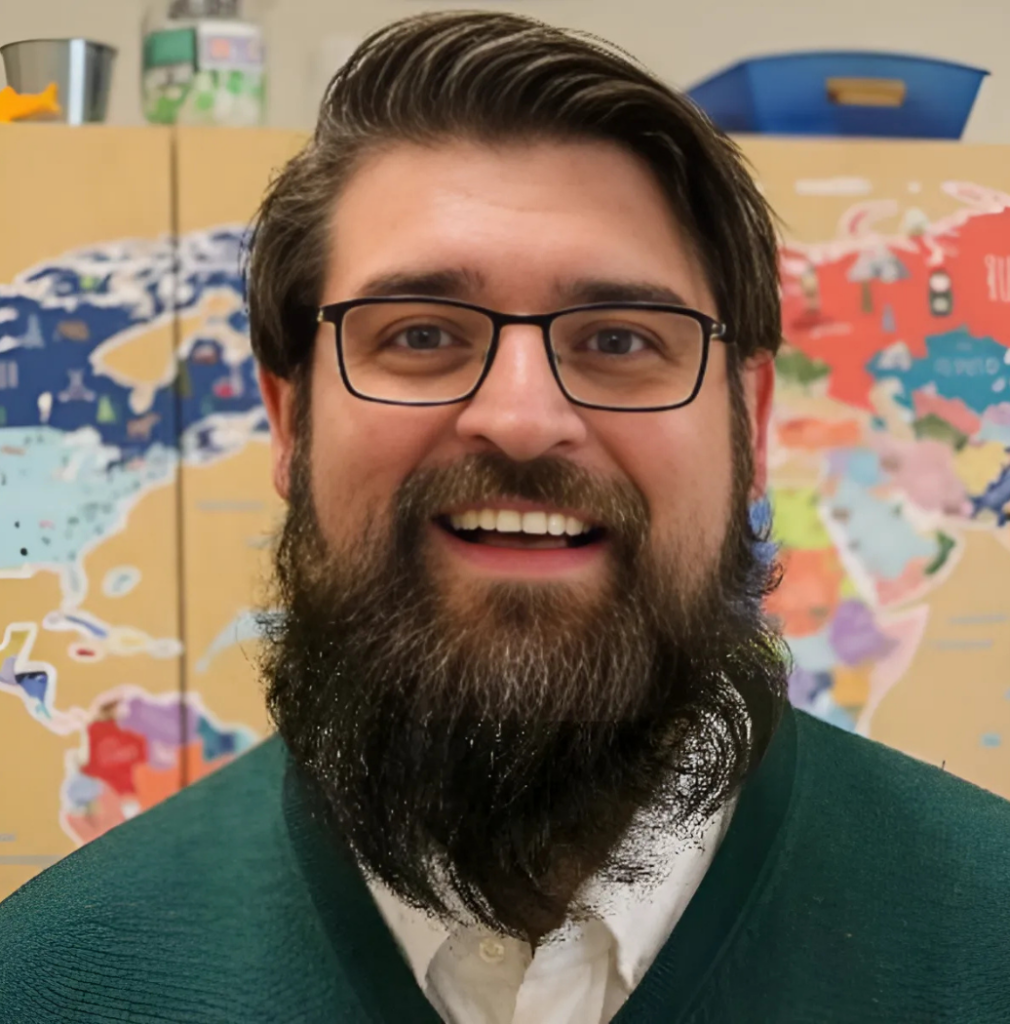
Matthew Winters: Awesome. So online you can check out schools.utah.gov. There’s AI stuff. My contact’s on there, but then also I’m on LinkedIn. I’m easy to find if you’re watching this, my, my beard is a little more grayer in this picture than it is on my profile pic, and I probably need to update that. I literally took my profile pic on LinkedIn a month before COVID.
Matthew Winters: And so I didn’t have the gray beard, so this is my COVID streak right here, which is great. So as far as where you can find me in upcoming conferences, I’ll be at ISTE + ASCD in a couple of weeks. At the end of June, I’ll be hopefully going to Mass Q in Massachusetts in October, ed Tech Week in New York City, shortly after that.
Matthew Winters: FETC. I always try to go south by Southwest, but next year, and I got a point, and this is kinda my transition right [00:47:00] here, is the award that we won at A-S-U-G-S-V up there on my shelf. We won the educational award for impact across the globe for the work we’re doing here in Utah. And so that points to my team.
Matthew Winters: That is an award that I get to hold of my office, but it’s for the entire Utah State Board of Education around the work we are doing with artificial intelligence. And that’s thanks to. A wonderful person named Sarah Young who put us in for the award and brought me along, thankfully for that project. Um, Utah is a really unique space and one of the things that makes us really unique here is we are very collaborative and so I absolutely love being able to bring along the people that I love working with here.
Matthew Winters: So I’ve got a point to. Emma Moss, again, who is a wonderful educator in Canyon School District who look at her work, um, she is doing amazing stuff around. Quantifying and then also documenting the work that she’s seeing in classrooms around ai. And so she has some of the best examples of how to [00:48:00] work that through.
Matthew Winters: We have a team of seven educators that work under her as our trainers across the state, and they’re indispensable. And I could take the time and name all of them, but that would be counter projective. So just thanks guys. Thanks everyone on that team. My state superintendent, Dr. Sidney Dixon is amazing as well as our incoming superintendent.
Matthew Winters: Molly, Dr. Molly Hart is amazing as well. And nationally. My, I, I’ve long hung out with a wonderful educator named Dan Ryder from from Maine, did design thinking with him, done some wonderful things with Dungeons and Dragons and creativity, and Jackie Gardy from DC and one of my favorite, one of my favorite people in education, Kim Zajac from Massachusetts.
Matthew Winters: She and I have conversations almost. Every single day about what’s happening with AI, specifically around students with disabilities. And I, I just always shout out her work ’cause she’s doing amazing things as well. Those are kind of the, the, the people I always go to. But there’s so many others. There’s so much good work happening here in the United States, but also across the globe around ai.
Matthew Winters: [00:49:00] Um, and I’m just really lucky to be a part of the team that’s really pushing this conversation forward. That is amazing.
Brett Roer: And again, congrats to you and your team. I know you’re leading it, but it’s always, um. So always so encouraging to hear you, you know, make sure you’re giving the flowers to your amazing team and those above you who are empowering you like your state superintendent and others.
Brett Roer: So Matt, on behalf of myself and Rebecca, we just wanna thank you for providing our audience with your wisdom, your insights, um, and just a really great conversation about where AI is going and how you are. Truly leading at the systems level, but you’re leading it with heart and individualization as well.
Brett Roer: So again, thank you. Thank you to our listeners, uh, for joining us for another amazing episode of the AmpED to 11 podcast. Um, keep staying tuned. We’re gonna have some great episodes on the way and everyone have a wonderful day. Thank you.