ep15 SonnSam Youtube
===
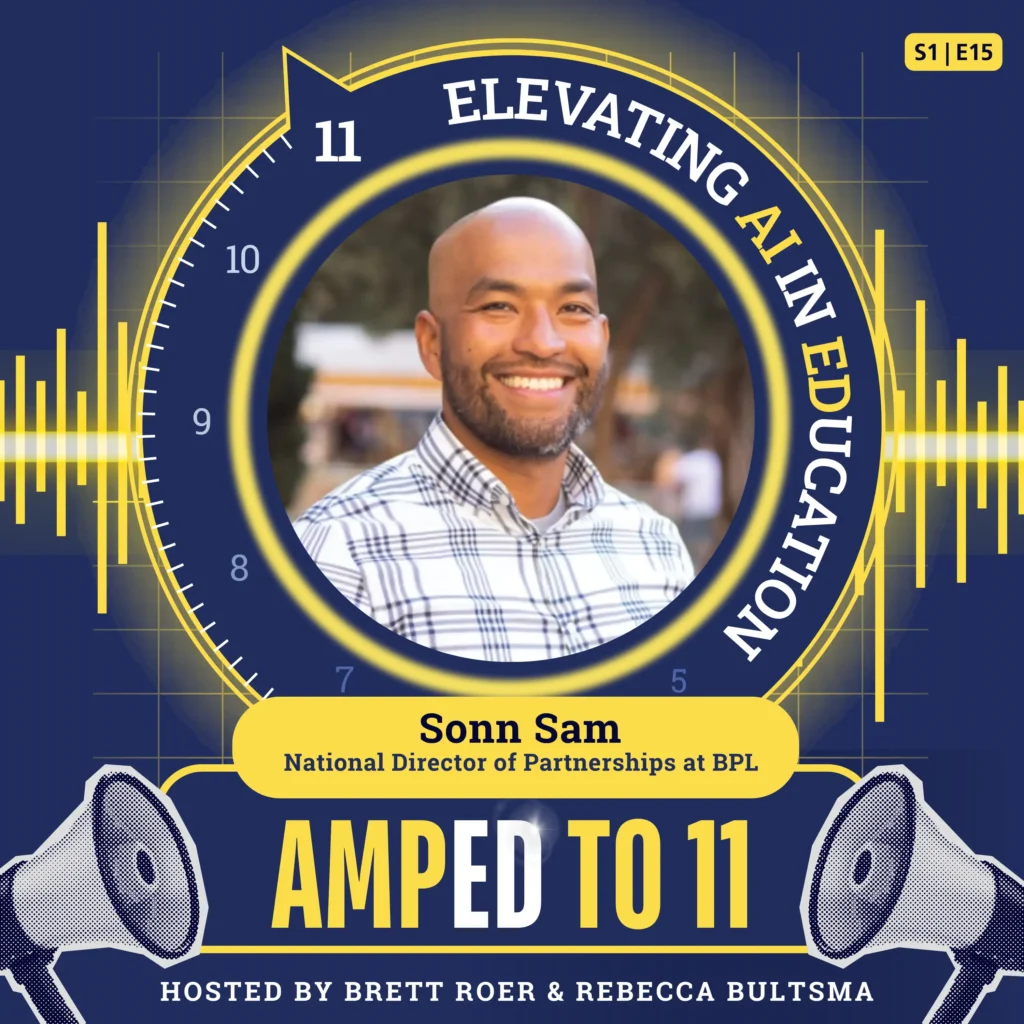
Brett Roer: [00:00:00] Welcome, everyone to the AmpED two 11 podcast. My name is Brett Roer, host of the AmpED to 11 podcast. My co-host Rebecca Bultsma is unfortunately feeling under the weather, but that won’t stop us from bringing in our amazing guest today, Sonn Sam from Big Picture Learning. How are you doing today, Sonn?
SonnSam: I’m doing well.
SonnSam: Brett, honored to be here. Brother,
Brett Roer: we are honored to have you. Uh, it’s always a pleasure and honor to have another bald, bearded, beautiful leader in education. Join us on this program. There’s too few of us out there.
SonnSam: I think you just created a, a new acronym, the Ball Balded Beard and Beautiful. Oh my God. I, I don’t know what to say to that.
SonnSam: I just feel so revered. That’s awesome. I feel seen
Brett Roer: you, you are seen here on the AmpED to 11 podcast Sonn, and that’s really what this whole hour’s about. Just to glow up on Sonn Sam. No. We are here to talk to one of the leaders. Who’s doing really incredible [00:01:00] work, not just in the space of ai, but he’s been a lifelong leader in education.
Brett Roer: I’m not gonna belabor you with his backstory ’cause I want him to share his story. I have had the pleasure and honor to see him perform a keynote that truly moved an audience of a hundred of educators and leaders, um, recently at an AI summit in Ohio. So, Sonn, I would love if you could please start us off by just sharing a little bit about yourself, your journey, the intersection of your life, education, ai.
Brett Roer: You got the floor. Take it away.
SonnSam: Thank you, brother. I appreciate you and, and thank you for this opportunity. I, I usually start, I’m just a kid from Providence, Rhode Island. Never in my wildest dream would I ever be thinking I’m doing what I’m doing today, let alone be on a podcast with you Sonn, Sam. Proud son of genocide.
SonnSam: Survivors. Refugees, and a child of poverty. I hold that very dear as my identity markers because they make me who I am. My parents are my greatest heroes. I can’t. Talk about me without talking about them [00:02:00] because I am, because of them. And coming here to America, you know, several decades ago and having me, our journey hasn’t been easy.
SonnSam: And it’s on that journey that’s really sort of crafted my life purpose. And really, I’ll just share quickly, you know, predominantly I’ve grown up in some failing school systems, and that process has really, really taught me about the long lasting effects of education and what it can have on young people.
SonnSam: I think we, we aspirationally talk a lot about the positive side, uh, but I’ve also felt the negative side, which serves as my purpose and my mission mission in life and is to build new systems to make sure that all young people know that they’re brilliant. But without sort of dwelling too much on it, I was a square peg.
SonnSam: I did not fit neatly into the, you know, the round hole as they say. [00:03:00] And with it, the system did a very, very good job of pushing me aside. And so that experience was not pleasant at all. It, it, at a very young age, I attributed to my failures in school to just not being smart. And I just thought being intelligent was, you know, hereditary and I just didn’t get the smart gene.
SonnSam: So when we talk about intelligence and, and smart to this day as a, a middle aged man, like, I cringe a little bit, you know, because of just all the stuff that comes with it. But, you know, my, my one story that I wanna share just quickly and then we’ll, we’ll move on, but the moment that I realized that, that I was brilliant was when I started pursuing my passions, you know, in, in our community, in the Southeast Asian community, especially from more tour countries.
SonnSam: We had a lot to deal with, particularly gangs. And I remember vividly I was actively recruited or being recruited into a gang. And I was at a crossroads in my life as a very young man. But my best friend and I, and I shared this [00:04:00] at, at the keynote Brett, so you know this. So my best friend and I Sakio, he, he came to our apartment, he put in this video and my jaw was to the ground and, and what I was seeing.
SonnSam: But he put in the movie Beat Street from the 1980s and for all my friends who were born in the 19 hundreds. I hope you saw that because it was iconic, you know, but there was a classic battle between the New York City Breakers and the Rock Steady Crew. Two, like very, very big originators of break dancer, you know, straight out of the Bronx.
SonnSam: Sidebar, another conversation, you know, about what happens. With our marginalized youth. When you take away arts programs and other resources, an entire revolution of art form was birth through not having, and you know, longer conversation around that. But anyways, this break dancing culture was what really, really like threw me for a loop.
SonnSam: I was just like, oh my God. And then we found this little, little family called the Jungles [00:05:00] and they had a little theater called the Carriage House. And every Tuesday from around three 30 to five 30 qui and I hopped on the city bus, went over there and it was the first time learning made sense to me. I was in a community of adult experts who really poured into me and I was learning so many things about life.
SonnSam: It wasn’t just about break dancing, you know, it was deeply connected about. You know, pursuing your passions about the integration of just like science and body movement, it was how do I be healthy and spread the message? How do I develop, set design and choreography? It was a business, so how do we market and bring more young people?
SonnSam: There was just so many things that I was learning, and it was the first time in my young life where things started to make sense. And, uh, the most important thing, I’ll just say, and I’ll be quiet, is the first time in my life I started to love myself because before then I just didn’t see any worth because the system didn’t reflect any images of worth to me.[00:06:00]
SonnSam: And so in this experience, it was really powerful for me because it was the first time and there was a domino effect after that. Some other stories, but I’m sure we’ll get into it. But yeah, that’s me. That’s a little bit of me brother. Sorry. Sorry that took so long.
Brett Roer: No, please listen. Uh, for those listeners out there, you caught like the briefest of glimpses of the most powerful personal keynote that I ever heard.
Brett Roer: That was supposed to be about AI and it took a good while to get to the AI part, but I think you now understand why really understand his Sonn’s journey and how he is really an advocate for personalized learning, making everyone experience that self love through school. And you know, I’d love it if you could briefly just explain to folks also the work, like if they don’t know what Big Picture Learning is, like please take a moment and just give like, you know, the overview of what it is that you and the team at Big Picture Learning are building.
Brett Roer: That would be very helpful. ’cause it’s such a unique, amazing model.
SonnSam: Thank you, Brett. I appreciate that innate, like [00:07:00] we believe that young people, all young people are innately brilliant. They’re just born with gifts, talents, passions. And it’s the responsibility of us, the adults, the education educators in this world to build a system to cultivate that innate brilliance that they already already have.
SonnSam: So, you know, we, we believe that young people are the curriculum and the community is the school. Uh, so what does that mean? So students are the curriculum meeting, just like I said, their gifts, their interests, their passions. That’s the curriculum. Build the learning around that. And you wanna talk about agency, you wanna talk about voice, you wanna talk about empowerment and ownership for their learning.
SonnSam: That’s how it happens. And the community of the school is my example that I shared with you that, you know, 13 years old, I found this little, you know, mom and pop family, like. Giving free break dancing classes and it changed my life, like literally saved my life. And that’s what it means for young people when they’re able to, number one, pursue their [00:08:00] interests.
SonnSam: And as I’m sharing this, this is the essential components of big picture learning and the systems that we’re trying to build. But pursuing your interests, connecting young people with local experts who share that interest and then engaging them in meaningful work that have impact. And so I’ll give you example going back to my break dance example.
SonnSam: Like to me learning transcended this transactional economy, meaning like I was always used to do my assignment check, do my assignment, check, alright, study this, you get, you get a grade. It was very transactional. But then for the first time when, when I was learning about, I was learning with this dance crew, I.
SonnSam: One of the funding sources for this small mom and pop shop was federal grants that came through, and in the early nineties, there was a huge push for anti-tobacco, right? So there was funding to support that. So the family wrote a grant for it. So part of our work was we did performances in elementary and middle schools across the state, [00:09:00] and our main focus was, let’s really, really focus on the hip hop culture, dance, being active, moving instead of smoking.
SonnSam: Right? At 13 years old, things started to connect for me. I’m learning these things, I’m doing these things. I’m performing for young people with this real positive message that I hope can really keep a young person from smoking that my friend. Is transformational for a young person when they see that their learning is beyond acquiring a grade, but they can see that right now they can impact their community and the world at large game changer.
SonnSam: So that’s what we aspire to really help school systems, uh, build structures, culture, policy, all to really help young people. So just to drill it down a little bit more, and, and that’ll be our share. We do have like distinguishers that distinguish us from other school designs. So I’ll just say this like we’re asked all the time.
SonnSam: So I’ll, I’ll, [00:10:00] I’ll just share a little bit as far as what we’re asked to sort of help a lot with. And there are five systems that we come in and really help build. So the first one is one student at a time. So true personalization. All of our students have individual learning plans that are asset based and they’re interest based.
SonnSam: And this is the seminal document that. Young people are co-designing around their interest in their learning, and we build rigorous deep learning around that. The second thing is advisory. So we have a small learning community of young people that stays with one advisor for a set amount of time. That intent is, you know, you’ve heard it before as far as like young people falling between the cracks.
SonnSam: That is impossible with an advisory system. And when done well and you know your students well, you are able to support them in a way that in a large sort of system, you won’t be able to. So the advisory system is meant to really deepen the relationships, connect to the relevance, and really push for the rigor.
SonnSam: The third thing is real world learning. So this is the community as the school. So we believe the community is an asset [00:11:00] and there are community champions all around the school waiting. To engage with the school, excited to mentor young people. They just need to be asked. And so what happens is through a multitude of modalities, internships, externships, community service, service learning, learning excursions, you name it, we help school systems and communities build a real world learning program that makes the most sense for them.
SonnSam: The fourth thing is interest-driven project-based learning. Everybody knows what project-based learning is at this point. We just believe deeply that once a young person knows what high quality project-based learning is, let them build it around their interests so that you know, once they know the framework and then now they can really articulate, this is what I’m interested in and let me build a project that is, is perfect for me.
SonnSam: And the last piece is really authentic assessments. This is, I’m saying it last, but it’s the most important, but we all know that if the assessments don’t change. Nothing really changes. So in addition to the standards based assessments that aren’t going anywhere, anytime soon, we [00:12:00] intentionally build holistic learner-centered assessments that give value to the entire child and their brilliance and their learning over time.
SonnSam: So through a portfolio based system, performance based assessments and a competency based framework, that’s how we sort of make sure that we honor the whole child. So those five things together, big picture learning. We’ve been doing this for 30 years now. We’re celebrating our 30 year anniversary this summer at the Big Bang.
SonnSam: You gotta come check us out. Um, but we just believe deeply in the potential of young people, and it’s our responsibility to, to build systems, to cultivate that innate brilliance. So that’s big creature.
Brett Roer: Amazing. Thank you Sonn, for giving everyone that overview. You know, I was very fortunate and I know we’ve shared this, and one of the biggest things we’re gonna be doing today, Sonn is, and I know it’s something you’re great at, but I’m gonna tease it out now.
Brett Roer: So you, you got a little time to process. We love giving flowers here, right? So we’re gonna talk, uh, later on as you saw, like our final questions. This Ocean’s 11, you’re pulling, you’re pulling off the heist, right? Big picture Learn is gonna keep spreading that mission, vision. Who are the people in education, [00:13:00] ai, innovation that you need part of your squad.
Brett Roer: So later on I’m gonna ask you that exact question. So people always say, oh, oh, you know, I’m gonna come more people. I’m sure there, so you got, you got time. But I want to give the first flowers on this one to a mutual friend of ours, uh, someone we both revere and look up to, uh, as an education leader and a, just a champion for fighting inequity.
Brett Roer: Javier Guzman. I know Miss Junior. He was my first assistant principal at Automotive High School. He went on to found. I believe the first big picture learning school in Brooklyn, New York. And then he also became a member of the leadership team at Big Picture Learning later on in his career. So everything that, um, San just mentioned, I got to see firsthand as a fairly new teacher as Javier was building out this brand new school on the third floor of the building I worked at.
Brett Roer: And everything you said was true, right? Integrating the community, having students choose their passion and purpose, and then finding ways to authentically assess them. I mean, it was so cool to watch this thing being built and being at a school that was founded in the [00:14:00] 1930s, A CTE school based in automotive repair.
Brett Roer: And seeing this totally different way to experience education, just one floor up was truly like, has always stuck with me. Um, and just been so incredible to see. And then, you know, getting to work more closely with big Picture learning on a national scale has been just great to see the work they lead. So, uh, I.
Brett Roer: Just wanna make sure we got those flowers out there early to a mutual connection that we both have.
SonnSam: That’s right. Flowers to Javier . Yeah, man. One of the most brilliant, brilliant human beings I’ve ever met in my life. So honored to call him a friend. Yeah. And another member of the
Brett Roer: Triple B. Bald, beard. Beautiful.
SonnSam: Oh, for that too.
Brett Roer: You know, we’re gonna keep that squad going.
SonnSam: Yes, yes, yes.
Brett Roer: I’ll make sure I get all my flowers at the Triple Bs. You know, as you mentioned, and as I hope everyone’s here and the work you’re leading, that big picture learning is incredible. Again, your own personal journey and the intersection of your life and education, again, just cannot say this highly enough if you’re looking for a keynote speaker, to either just engage your community, to get them excited and passionate about [00:15:00] the work ahead, to learn how to bring some of these facets of big picture learning to your community.
Brett Roer: Like do not sleep on Sonn, Sam, uh, given keynotes at your, uh. At any of your upcoming events, AI or otherwise. ’cause this is just a snapshot and this isn’t a plug, this is just reality. That was just the feedback I saw on, on my own personal, uh, testament to that.
SonnSam: Dang, brother. Thank you. Thank you. I’m not good with compliments, but I’m, I’m holding your words close, brother.
SonnSam: Thank you. I appreciate that.
Brett Roer: So, on the AmpED to 11 podcast, we typically have some pretty prescribed questions. It’s really just to walk people through. As someone like yourself who was an education leader, obviously pre ai, who’s now doing so many innovative things with ai. We’re gonna start a kind of that, that genesis for you.
Brett Roer: So our first question is like, we always start with this pop culture question called like, what was your 11 moment? And we talk about 11 from Stranger Things, right? People see this almost supernatural being, they’re shocked, they’re in awe. If you could take us through whether it’s good or bad, what was [00:16:00] kind of that first moment you had with like generative ai?
Brett Roer: You know, in this age of LLMs. Where you were like, wow, this could change everything and again, could be good, could be bad. What, what initially comes to mind? What memories?
SonnSam: Well, if I could go back just quickly, because I wrote about this and I just wanna share it. Going back now to, I believe 2023 Open AI just released, or this might have been 2022, maybe into 2023.
SonnSam: I can’t remember off the top of my head right now, but I know it was November when Open AI released chat, GPT what as earliest versions to the world. And it was December that I, you know, people digest news in multitudes of ways for me. I listened to the Daily every morning and they had an episode around open ai and you know, they were going back and forth and just talking about it, but they were giving these commands and it was the most.
SonnSam: Like unique things that they were asking, like, give me a [00:17:00] mob tone, you know, set the set like, so it was just very eclectic. So, and the response to it was just like instantaneous. It was actually the first time where my brain couldn’t process what the podcasters were talking about and what the response was from AI and what it delivered.
SonnSam: I was just like, wait, what? What is this? Like? So I remember in December just taking a deep, deep dive like everyone else, because the backdrop of all this, and very similar, when we have breakthrough innovation, everybody sort of grabs their chest and their neck a little bit and just takes a deep breath and just like, oh my God, like, what’s happening?
SonnSam: So, like everyone else, I was scared. I didn’t know what was going on. I was like, let me just figure it out. You know, let me just try to, and what I learned pretty quickly was we have a tool that I feel with. The right guidance can be transformational for [00:18:00] our world. There is a realistic side to it where it, it’s a fine balance between ethically what it can do and its purpose.
SonnSam: Um, but what really, really inspired me is just the possibilities. So let me just talk about that real quick. I started writing about this and I started seeing this, and over the next two years, this is what we started tinkering with. The backdrop of this is for 30 years, big picture has been in existence, right?
SonnSam: And we’ve had some groundbreaking, groundbreaking, transformational experience. And, and the proof points are in our communities, our alumnis, our families, but, and, and, and really, really impact the larger system. It’s been a uphill battle. And, and partly because the system that we’ve built is a co compliancy driven system.
SonnSam: So when you come in and you say, no, it’s one student [00:19:00] at a time that friction is ever, ever present, and it, we, we run into that brick wall 150 miles per hour, literally daily, if not hourly. And so it’s really, really frustrating for me. The, the really, really powerful side and what I’m seeing with AI right now is I think we have an opportunity to truly, truly do learner-centered education and do it well and really transform this entire system.
SonnSam: When it comes to personalization, when it comes to real world learning, when it comes to interdisciplinary projects, when it comes to like authentic assessments, which is like the game changer, what I’m seeing is the, the, the pace at which we are evolving in technology through the power of ai. We truly, truly can get to that, like our vision of really cultivating the brilliance of every young person, you know, and so that’s the work that we’ve been in and [00:20:00] tinkering like everyone else around the planet.
SonnSam: You know, everybody’s been tinkering with the ai, but for us is the 30 years of work that we’ve been making progress on, but also hitting brick walls on how can we use AI right now to truly, truly move the work forward and move to a place where we can cultivate the brilliance of every child. And that’s, that’s the actual work.
SonnSam: And I’m sure we’ll get to like the nitty gritty of it, but that’s what’s really, really exciting for me.
Brett Roer: Yeah, I mean. First, again, I, it’s so interesting now when you even said, right, we’re, we’re talking about November, 2022, and that’s now coming up, you know, it’s almost when you talk about like, COVID, right?
Brett Roer: That’s five years ago when the world shut down, and now this, we’re coming up on two and a half years, almost three years, where AI has become ubiquitous, uh, generat of ai especially, you know, again, this is not to give unsolicited or unwarranted praise to big picture or to one of the, one of the, um, solutions y’all offer, blaze.
Brett Roer: But I’m gonna share a narrative about pre [00:21:00] AI versus today and how you can do what Sun is really talking about, personalizing the experience and then also making the experience more meaningful, uh, when you talk about repurposing time. So, quick anecdote. As I mentioned, Javier opens up a school on the third floor at the automotive campus.
Brett Roer: Some of the students are really excited in a number of different fields. At that point, with a brand new school and a pretty young scrappy small staff, they’re finding all the internships themselves. They’re tapping every personal relationship. They’re making sure everything is tracked and monitored to make sure it aligns with, you know, New York State policy.
Brett Roer: It’s all done, you know, spreadsheets, Google Docs, et cetera. That is such a toll on the teacher. And remember, these are all young passion. They’re, they’re, they’re jumping on the ship with Javier, building it as they’re going, building the plane as it’s flying. Just recently, you know, I was very fortunate, just came across, uh, a solution that Big Picture Learn has calls Imblaze, and I’ll let you do the justice of like explaining what it is.
Brett Roer: But immediately, as soon as I met the person from the Big Picture [00:22:00] Learning team or the Imblaze team, I was like, oh my gosh. All my friends who were teachers sharing all the work they do, which was so exciting, but still just a lot of work. Instead of getting to really deep dive and like, let’s say Sun was the student listening and talking to Sun about the experience, which is what the authentic part of these big picture learning internships are, is allowing that student to reflect and grow.
Brett Roer: Just like a lot of aspects of education, you’re ultimately also beholden to like, is every, is all the paperwork legit? Is everything like structured the right way? So maybe talk about this, what’s a tool that you, you all are using AI for to make that experience better for all parties and help students find their experience and help teachers do the work that’s important.
Brett Roer: Just repurposing their time at work for what’s valuable.
SonnSam: You know what, let, let’s do this in real time as a practitioner because man, what you just said right now I twitched a little bit because that was me. I was an advisor in 2003 and we had an a mean, mean Excel spreadsheet to sort of [00:23:00] organize, assist a stagnant Excel spreadsheet that we entered information in manually.
SonnSam: Right? So let, let me talk to you about the work of advisor and then we’ll talk about Imblaze and how it just has completely transformed the flow of work made us more efficient and we could focus on other things in the old system. Sitting down meeting with students, really digging deep into like what are they interested in?
SonnSam: That’s the first thing is just really identifying the different areas that young people are interested in. Then what we did as a staff, we came together, and again, this is about social capital and social network. We had a list of our students’ interests and we started as a staff say, who do you know? Who do you know?
SonnSam: Who do you know? And then one by one we started just putting it on this Excel spreadsheet, you know? And from there then we would manually sort of set up opportunities. This is who’s interested in this. Uh, a young person would raise their hand, the advisor would be responsible to creating that list, who would then bring it to the bottleneck of the learning through internship or interest [00:24:00] coordinator who, so who managed the overall Excel spreadsheet.
SonnSam: So was there was this manual sort of going back and forth and say, Hey, my kid’s, hey my kid is interested in this. Kristen, can you let me know if he can pursue this? And it was these one-off conversations that was just so. Laborious. Just, it was just inefficient. Uh, but it was what we had, so we sort of worked with it, right?
SonnSam: So to manage the process of helping young people sort of articulate the things that they’re interested in, gathering community assets that are aligned to our students’ interest in, in, in an effective way, and bring it and centralizing it into one location, tracking the progress of where young people are.
SonnSam: You know, in our, in our sort of paradigm of the work around real world learning, we have the cultivating interests, we have the community asset mapping, we have interest interviews, we have shadow days, and then we formalize the sort of real world learning, right? Every step of the way [00:25:00] is a process and a journey for the students.
SonnSam: And as an advisor, I manage that one student at a time through my own system. Here comes Imblaze, right? And for, I’m not even gonna, like, really, there has been some AI integrations that I’m super excited about. Uh, but I won’t talk about them just yet. But I’ll, I’ll, I’ll share sort of just like the sort of backbone of what it’s been able to do.
SonnSam: So I’ll just share this because a lot of folks, what folks are very interested in, so processes, right? Students, the LA coordinator advisors have accounts. And whenever you have a potential site that we could connect young people with, everybody has access to dump it, dump it into one central location. So it’s easy, it’s seamless.
SonnSam: You could do it on your phone, you could do it on your laptop. It’s just one easy way to be like, oh, I just met someone at lunch. Seems like a really dope person. Let’s figure out this more. Let’s just put them in the list, right? So now you have this centralized place that’s [00:26:00] accessible via your phone, you know, the website, your laptop, anywhere, anytime you could really add to the list and, and, and it, it just keeps on growing internally.
SonnSam: The second thing is it streamlines the process as opportunities are opening up very similar to young people in social media right now, which they’re so inept to, like something they can, like an opportunity and automatically it, it sends a ping to the LTI coordinator and say like, Hey, this young person is interested in this.
SonnSam: And so now the flow of young people sharing what they’re really interested in pursuing is much more fluid and much more real time, and we could respond to that much more efficiently. Whereas in the past it’s always been like, okay, who has that Excel spreadsheet? Who, who I’m waiting on this person to update it?
SonnSam: You know, this is very sort of like, you know, it’s just really, really inefficient. But now it’s sort of automated a little bit. Now schools can set up a system where that response is really, really [00:27:00] fast and we can really move young people to the next phase. Tracking that process, the young person is now really the agents of their own learning.
SonnSam: So as they’re going through the process, the informational interviews, the shadow they like, they click all that. And so an advisor in a snapshot can really, really see all the students that they’re supporting in real time and see where they are in the process. And also all the paperwork that’s needed is, is can be uploaded onto there.
SonnSam: So as an advisor who used to print out all the paperwork, create a folder for each and put it in my file cabinet to make sure, like you can imagine all that stuff, but now it’s instantaneous where young people could fill it out. We could bring it to a mentor to design and it’s all done digitally and it could be tracked.
SonnSam: The second piece, which is really, really important is attendance. I. Safety is really important. And so it’s our number one concern. As educators, we wanna make sure that young people are safe. So knowing where they are is really important. And that’s with the records around attendance. So Imblaze is GPS located.[00:28:00]
SonnSam: So what we do is we build a culture around student res responsibilities around checking in. So all of our students download the app on their devices. And if they don’t have a device, usually there’s a device at the location a young person signs on with their account, they click a button, they say, I’m here.
SonnSam: An email goes to the mentor, mentor confirms email comes to the school to say, young person is here. So we have a set, a system set amount of time. If we don’t get a check in from a student, automatically I’m the, I’m an advisor, I’m on the horn, right? I’m going, I’m like, where, where is my student? But this process has really, really allowed us to be really, really digital in tracking the attendance of our students, but also for accreditation and purposes, the time that young people are there.
SonnSam: The last piece is really young people setting their intention around the things that they’re doing and learning. So there is a note-taking aspect where between the student, the mentor and the advisor, we could come together and really say like, Hey, this is what I’m working on. This is what I’m doing right now.
SonnSam: And it becomes this digital documentation [00:29:00] piece along the way around students learning. So streamlining the process. It is a, the backbone infrastructure that I, as an advisor who did this work manually in 2003 to 2007, that I cry. Like I, when this came out, I literally almost cried because I was just like, oh my God, if I had something like this As an advisor, I just think about how much more effective I could be.
SonnSam: So I’m, we’ll jump into like what else I could spend my time into. Maybe in another question, but like, I could really, really, I’ll just say quickly, the most important thing I. That I think as an advisor that we’re most concerned about is the depth of learning that we want for all of our students, right?
SonnSam: That’s something that we care deep deeply about. And I think about if operationally there’s a system that can really streamline and move things fluidly, now I could really think about, okay, what are you doing? What are you learning? What’s your projects? Where are the competencies? Where are the skills?
SonnSam: Like, where are the certifications you’re working on? I could really, really dive into [00:30:00] those, which is, to me the, the, the, the most fun as being an educator. Um, not necessarily the operations, but yeah, blaze is a game changer. Yourself. Just one ai to your point, I just wanna say like, when. When community asset mapping, and we used to do that manually around the staff table and everyone would throw out people that they know.
SonnSam: Like with AI right now, if a student has an interest, it will generate a list right around the school, around community assets that we can tap into in, again, like millisecond. So that’s just one sort of a faded feature on Imblaze, but y’all gotta check it out, man. If, if you’ve got a work-based learning program, a real world learning program, and you’re really trying to manage it fluently so your educators can work on the real stuff, like the, the stuff around deepening young people’s learning and development, you gotta check out Imblaze.
Brett Roer: Well said. And because this isn’t just about Imblaze, right? This is what Sonn just explained to everyone, is you, if you’re an education leader listening or if you’re even someone on the innovation or [00:31:00] EdTech side listening, everyone has that version of their pain point, right? Like you, it’s so evident you can hear right Sun and big picture learnings mission, just like he lives it, he breathes it.
Brett Roer: It’s transformational if done well. So I’m gonna share a brief anecdote that’s similar around different community values and I want people to really think about, right. What’s the thing you are trying to do? So I did a lot of AI training for school out in the Los Angeles area, just like at, you know, a big picture learning school.
Brett Roer: An internship might be a requirement to graduate at theirs. It was community service. So this is a problem that everyone has. Uh, I’ve been at schools that say, you know, we want students to achieve this many hours community service. So let’s say you have a motivated student, you really need them to check in with a caring adult at your school and be like, okay, here’s what I’d like to do.
Brett Roer: Let’s say they’re their family and themselves. Don’t, just don’t know the neighborhood or the community or even how to start this process, right? You haven’t, you’ve never been trained on that and now all of a sudden it’s junior or senior year and you’re expected to like, yeah, go do community service one.
Brett Roer: Think about the danger that that could bring, right? If this child isn’t [00:32:00] properly informed or the parent, they could be going to places that just aren’t ready for that or aren’t really. Have the best intentions of that child or student, uh, possible. So a great example was this community had three things.
Brett Roer: They were really valuing one, it was, um, a community. It was a faith-based school. So they wanted for All Saints Day, they have this really great social justice standards. They have a great DEI curriculum. I said, let’s build that into the tool because this way, first question is ask students like what are some of their personal values or beliefs or things they care most about in terms of like helping their community?
Brett Roer: The first thing it did is it provided three saints that they should like, learn more about on their own time because they align with what they value. We then trained it to align with DEI and social justice standards so that they were always gonna have a diversity in terms of gender, uh, country of origin.
Brett Roer: That’s something that wasn’t happening there, even though it was a core belief of theirs because no one had ever compiled all the saints and [00:33:00] had a way for students to pick and choose. But then. It also then took all of the community service opportunities that you’ll get. Those random emails you send out once a week or you’ll put a poster up on the wall and be like, well we put ’em up on the flyer in the college center.
Brett Roer: I don’t know why kids aren’t taking it up. And then it said, would you like to learn about some community service opportunities, um, surrounding this school that seem to align with your values and your interests? And then it did. And so it just took what that school already was doing and it made it something that any student could immediately engage with or a parent or a teacher or a guidance counselor, anyone to be like, Hey, great, we know you’re ready for this.
Brett Roer: This is now personalizing it aligned with your values, interests, passions, and we know this is safe ’cause we’re already sharing it with you. We’re just putting it in a way now that like you can access it without reading through all these different things. You’re combing through your emails. ’cause that’s just parents and students aren’t doing that.
Brett Roer: Neither are the adults and educators. So anyway. Whatever that thing your community values is, just keep thinking that at top [00:34:00] of mind of like, this can all be put into one safe resource that you’ve already vetted what the sources are and then it produces it back based on probing questions of that student or whoever the audience is.
Brett Roer: So find what you’re trying to solve for and what’s those things that it now opens up. Everything is really the conversation around like, great, let’s prepare you for that specific internship, community service project. Let’s talk about the experience. What skills are you learning? How are you gonna put that in a digital resume?
Brett Roer: That’s what’s important. Now,
SonnSam: I, I don’t know if you have another question, but I can 100% elaborate on that.
Brett Roer: Sonn. There are no questions. Elaborate. Go for it, man.
SonnSam: This is a free flowing conversation, dude. Like, so I’ll just share with you challenges we have. We have two, so I, I’ll share this. I. Like everyone else.
SonnSam: As an educator, we care deeply about the depth of learning that young people are engaged in because the deeper they go, the higher chances of transformation and really, really preparing ’em for the next stage of life and learning and whatever it is for them, hopefully aligned to their [00:35:00] purpose. So that’s really, really important to us.
SonnSam: So a major staple to our design, of course, is student driven, real world learning. So our young people are out, right? One thing that we are continually working to get better at is the quality of learning that’s happening at this real world learning experience, right? But there are some variables. So here are the variables I share with you.
SonnSam: It really comes down to the experience, capacity, and knowhow of the student, of their advisor and of their mentor, right? So, son, what do you mean? Like what can go wrong? Number one, this whole concept of student agency around interest and learning. I. I can pretty much guarantee you, like the majority of our schools, if it’s not a K eight school, our students come to us in high school and they’ve been in a system where it’s sit down, do this assignment and turn it in.
SonnSam: And they haven’t had really had authentic opportunities to build their muscle around their agency for learning around the things that they’re interested in. So [00:36:00] a young person really needs intentional time and opportunities to build that skill. An advisor, all of our teachers are certified teachers in the state.
SonnSam: And if you take a look at the, our education system and training teachers, the school of ed programs, the master programs, they’re designed to prop up the system, uh, that’s been in place. So like innovative learning, interdisciplinary learning, real world learning, connecting career standards, connecting social emotional learning.
SonnSam: That’s all stuff that our teachers aren’t necessarily trained for. Right. And then you have a mentor who is super interested in this career, this field, they got trained for it. They spent many years honing their craft, becoming a master at it, right? Um, but what is this thing called mentoring a young person?
SonnSam: What is this thing called it? Meeting high school credits. What is this thing called the interdisciplinary project? You know, so those three people play the biggest role into the quality of experience for a young person, right? So what have we, [00:37:00] what have we been able to do to really like, get at the heart of what young people are doing?
SonnSam: So through ai, this is what we’ve been thinking, tinkering around, and how do we use ai? Some pain points, project ideation, a connection to competencies and skills, chunking problems, timelining them, the products and the authentic assessments. Those are very, very clear barriers that we run into all the time.
SonnSam: First and foremost, helping a young person decide on a project idea that’s aligned to what the mentor agrees with and what the advisors are working on. Just time consuming, right? Really being explicit around the competencies and the skills that young people are working on, exposed to deepening, mastering through a project.
SonnSam: Super, super challenging. This, I can’t say enough, chunking. One thing that our young people are not short of is really, really dreaming big. It’s one of their gifts. They dream really, really big. But from an executive functioning [00:38:00] side, you know what they need help with is, okay, this is your goal for your project.
SonnSam: All right, let’s work this backwards. Let’s backwards map this. You have three months to complete it. Here are the six milestones. In addition to these milestones, here are the many milestones that you need to get done. And guess what? The timeline here are the due dates. So we’re literally teaching young people how to see a big long-term goal and how to build towards it in a really sort of consistent kind of way.
SonnSam: That’s the timelining and chunky piece. And then like products that young people can create at the end. Real concrete things that we can deliver and showcase as far as demonstrating their, their learning. And lastly, it’s just like, how do we know? How do we know that they have really met this requirement or this skill and we could develop a framework.
SonnSam: All those things right now has. Through AI has expedited us and moved the needle to move closer to deeper, rigorous vigorous learning that we want for all of our students. So that’s just an example of a problem. [00:39:00] Specifically, we want equitable, high quality, real world learning for our students, and it wasn’t happening on a equitable level.
SonnSam: And right now what we’re tinkering with is how do we use AI to really support the student, the advisor, and the mentor, to get centralized into like, this is what the young person is doing and this is what depth means, and this is how we can support them. So just to feed on what you’re saying, being super intentional and purposeful around AI and how you use it to solve the problems that are just digging at you every day, like that’s an example that we’re doing in our network.
Brett Roer: Everything you just mentioned is transferable. Not just to, you know, internships and, and the big picture learning model. That’s, that’s really everything you just said is good instructional design for teachers. It’s, it’s good executive functioning, again, not just for students, having people think about, okay, you know, what you want students to look and feel like when they leave your school.
Brett Roer: So again, you know, we are out in Ohio. I know you had to, you had to boogie, but you know, that’s literally what I got to do with over a couple hundred educators in Ohio. I said, you [00:40:00] tell me right now. What values and skills do you want your students to leave your district with when they graduate? And we were able to create a portrait of a graduate for each section of Ohio based on that.
Brett Roer: But what was crazy was no one had ever been asking teachers or superintendents those things to put together a comprehensive document. So again, if you wanted to make like for your school the best playbook around executive functioning, go ask your students using ai. Hey, when we give you these large projects, what exactly do you need more help with?
Brett Roer: They can articulate it. When you ask ’em, it’s harder for them to say, go do this six month project. And for them to think, okay, I’m gonna chunk it out. But they know what they don’t know a little better than we do sometimes. So again, the problem you’re trying to solve, use this method that sun is, um, sun is really clearly articulated it, and again, it’s kind of agnostic of students.
Brett Roer: It’s really learners. And I’d say I like your style there with like, I think the people I love most being in community with are big dreamers. I don’t mind if they don’t know how to get there, but I think now [00:41:00] with AI and letting them be like, as long as you can articulate this and are open to like learning a new way to repurpose your time, it really has changed the limits on what people can do, in my opinion.
Brett Roer: We got, we got a few questions left for you. So this one I am gonna go on book on script four ’cause you kind of said it, you know, you talked about your own life, the students you’ve led, and I know something that you shared explicitly when we were out in Ohio with your keynote was this idea of like, there was just very specific questions that you were never asked as a learner, right?
Brett Roer: There was very specific things you never shared with people that you share all the time now in your keynotes, but as a child you weren’t really able to share those. So thinking about that and maybe sharing a little bit with our, uh, audience, like what are some of those things I’m, I’m referencing, but also imagine you, you know, we call AMP to 11, 11-year-old is in your community.
Brett Roer: What are some of the things you hope that right now they are like thinking about or using AI right [00:42:00] now that would help them be more prepared for whatever’s coming next in their life in the next chapter?
SonnSam: Some really tough questions, man. I appreciate that. Uh, but the story that I shared with me, the question was, son, what are you passionate about?
SonnSam: That was the question. And what I shared was based on my experience in education, the profession that I was clearly staying away from, what I thought at the time was education. So I went into college as an international business major, but really quickly after my freshman year, I was like, this ain’t it.
SonnSam: So I went to my academic advisor, Dr. Joanne Rivello, love her to this, to this day, she’s incredible. She let me sort of, you know, bug out a little bit. I was like, what am I gonna do? I’m like, international business. I don’t, and she was the first educator. Out of 13 years of traditional education that ever stopped to ask me, son, what are you passionate about?
SonnSam: And the weight of that [00:43:00] question, I didn’t know how to answer it, you know? I was just like, no one’s ever asked me that before. I was like, oh man, that’s, I don’t know. And the only answer that I could give her was my entire high school career was I was working with young people, you know? And it brought me a lot of joy.
SonnSam: And there were different contexts, you know, of working with young people, but that was what brought me a lot of joy. And she said, son, you ever thought about being a teacher? And seriously, no joke, I laughed. I was like, oh hell no. No way. No way, no way. But you know what? There’s, there’s a higher power in work here and, and the path that you’re supposed to walk, you know, things happen.
SonnSam: And pretty quickly I changed my major and got into education and that’s, that was the one question. So a deeper, a deeper thing that I think about. Right? And it’ll connect, I’ll connect to that a little bit because it’s just what I believe in, and I’ll bring it like clear as day to my parents, right? I know [00:44:00] my purpose and my purpose is to really, really help young people live a life on purpose and build generational wealth, right?
SonnSam: Like that is my service and my purpose. A true example of some folks that didn’t get that opportunity were my parents. They were in survival mode. They were providing for my family. They woke up every single day and worked their butts off to provide for my brother and I. They didn’t have the privilege of pursuing your passion.
SonnSam: You know what I mean? Uh, and that breaks my heart, but it’s my source of sort of motivation because I feel similar to that 11-year-old. That’s it. I want them to pursue their passions, and I want them to leverage AI in any way to help them pursue their passions. So what does this mean? As a, as an 11-year-old, there’s sort of things that are, that are interconnected here and, and woven together.
SonnSam: Your interests matter in this world. So I, I [00:45:00] see a sort of pathway and I break it into four things. Young people are innately curious when they’re born, right? Curiosity, exploring your curiosities eventually lead to interests. Exploring your interests eventually leads to passions, and pursuing your passions eventually aligns you with your purpose.
SonnSam: That’s usually the trajectory in my experience and how I call it, like young people really moving to live a life of purpose. So that’s the overall goal. And trying to get them to get to their purpose. They have to explore their curiosities, their interests in, in their passion. So even at 11 years old, I would tell them to explore.
SonnSam: So how do they explore that? Right? Whatever they’re interested in, I want them to leverage ai. How, the first one is I want to, I, I want to interest in who are the experts that you look up to that’s connected to your interests, right? Who are the experts and I. This is connected to the generational wealth, and I’m drawing on the, the research from Ra Jetti.
SonnSam: [00:46:00] Uh, this is about social capital who you know, matters, but also who you know is your way out of generational poverty. And so building your social capital is super, super important. So what I would say and challenge a young person, even at 11 years old, how can you build your network around you to support you pursue your passions?
SonnSam: Like, who are those folks? I want you to get connected right now. Of course there’s gotta be barriers. ’cause an 11-year-old can’t just randomly just pick up the phone and start talking to people. So if, if we’re imagining this there, there’ll be, you know, structures put in place to facilitate that. But nonetheless, the, the point is not lost in saying that building your social capital is critical to this and who you know matters.
SonnSam: So I would tell that to that 11-year-old, like who, you know, really, really matters in life and. I would challenge them to use AI to meet new communities that are centered around their interests professionals. So that’s [00:47:00] really, really important. The second thing is how can you build your knowledge around this interest in this topic?
SonnSam: So what does that mean? You know, is it certifications that are recognized in the industry? Is it just like a background knowledge? Is it them being able to teach what they know? Are they joining a community and leading a YouTube page around, you know, instructional stuff that they’re learning around their interests?
SonnSam: Like how do they build the prerequisite around this interest that continually will make them an expert and just go deeper in their knowledge and their learning? The last thing I would say, so between increasing their social capital and meeting new people in new communities around the things that they’re interested in.
SonnSam: Really, really getting specific around the skills and background knowledge that they can build to become the experts. The third thing is. I want our kids to be bosses. I, I, I don’t want them to only be like, and no disrespect to anyone. ’cause I work for a company [00:48:00] like, you know what I’m saying? I’m not the CEO and I love what I do, you know.
SonnSam: But I think sometimes when we talk about workforce development, when we think about, you know what I mean, like, we don’t talk enough. Also, I want you to be a CEO. I want you to be a boss. And particularly around the things that you’re, you’re passionate about. So whatever it is that you’re developing your skills, you’re diving deeply in the back of your mind.
SonnSam: How do I become an entrepreneur? How, how can I be a breakthrough leader in this industry? How do I be a pioneer? You know what I mean? Like, those are the things that I would really talk to that 11-year-old to see. And again, you know, it is 11 context, nuance might be a bit much for an 11-year-old. But nonetheless, those three things would be really, really important.
SonnSam: And I would begin the conversation anyways with this 11-year-old.
Brett Roer: One thing I’ve loved in getting to meet you and just listen and learn from you for the last few months, and I’ve known about your work for longer than that, but it’s great to, that we’ve been so fortunate to form a personal connection where we could just talk about this stuff, is [00:49:00] the way you just talked about it is so similar to all.
Brett Roer: I hear many of the leaders at Big Picture learning like, you know, Carlos, Dennis, Javier, yourself, really anyone. It’s like you all talk about really, pardon the pun, big picture things with young children or young adults and you don’t like, you don’t sugarcoat it, but you do make sure it’s like I’m talking to you at the level you’re at because I need you to see like the big picture that many students don’t unfortunately get access to.
Brett Roer: So I just wanna like, again, commend that, that like, you know, 11 year olds, you can put yourself in their shoes. You have empathy, but you really are trying to make sure you’re pushing their thinking. In service of, like, that’s the kind of mindset you need to adopt as early as possible so you can have a life filled with what you pa what your passion and purpose.
Brett Roer: Not because you have to provide for your family. You do need to do that. You need to ride yourself, your family, your loved ones. But imagine, like you said, that you get to wake up every day and do what you love. Like that’s a totally different mentality and it [00:50:00] just, it’s a blessing. But you’re, you’re, you’re doing it.
Brett Roer: So thank you.
SonnSam: Thank you, brother. One, one thing, and I forgot to mention, uh, probably the most important, but I’m in my head. I’m sort of thinking about this right now, but probably the most important that I would tell this 11-year-old is love yourself. And I’m looking back at my 11-year-old self myself. And if there was one thing that I would tell myself is exactly that, um, because the system can also do a really, really, really disservice and harm, uh.
SonnSam: By really taking away the self-love of young people because they can’t excel in these very traditional measures. And when that is the only thing that we lift up and we hold up consistently and a young person does, quote unquote, doesn’t measure up to that. I don’t need to be a rocket scientist. I don’t need to be a 60 year psychologist to understand what type of impact does that have on that [00:51:00] young person and their morale and how they see themselves day in and day out.
SonnSam: So what I would tell that 11-year-old is you have gifts that you already have, and it’s my responsibility as the adult to help cultivate that. That’s my, I challenge you to challenge us to service you better. To build a system so that you can see your innate gifts and talents and love yourself for that.
SonnSam: Once that happens, everything else falls into place. Um, and I think that is something that, that we don’t talk about a lot in education, like young people’s love of themself and, and what type of messages are we seeing saying directly and indirectly by the measures that we put into place and what we value.
SonnSam: So I think that would be really important to tell that 11-year-old as well.
Brett Roer: You know, as I’m sure you do, I mean, I’ve seen that you had this amazing video at the keynote with your, uh, wife teaching your [00:52:00] child, you know, obviously the love and passion for education. Um, we read a lot. I have a, she tells me every morning, so I think 27 days from now, she’s turning five, she’s got the countdown going on since like, almost a hundred days ago.
Brett Roer: So we read books with her every night. We read books with my son every night, obviously. And, uh, there’s this book. I think it’s called Go be wonderful or Be wonderful. And so we say that all the time when she goes out the door. And then recently there was some, some epiphany similar to what you just shared, where it’s like being wonderful is a pretty high bar.
Brett Roer: I get the sentiment behind it. But then we started saying, go feel wonderful. Like if you leave here and you go feel wonderful today, that’s even better. ’cause if you be wonderful, but you’re not enjoying it, like, you know, that’s one thing. And then we started saying every day basically it’s like, go feel wonderful, go make other people feel wonderful just by being you.
Brett Roer: And then you. Wonderful. So we’re trying, man, we’re trying to listen. I hear things like this from people like you. I’m like, okay. I’m like almost there, you know? And it’s always just about like, it’s just always about those little, [00:53:00] those little refinements like you said at the end. You know, I got one more word of wisdom, but that’s like you buried the lead, right?
Brett Roer: If you don’t love yourself, what’s the rest of it for? So again, I love these talks about AI that have nothing to do with ai. That’s my favorite thing that I’m learning. Okay, we’re gonna go out on two last questions. The flowers coming, so you better have that list ready again, you don’t need to actually have 11 people in mind.
Brett Roer: And we all know this is high stakes and you know, we could go on for days, but our producer’s gonna give us a hurry up sign soon enough. So like, it’s all good. If you forget people when you forget about ’em, you text ’em and you say, Hey man, I was on this podcast with Brett and I was asked who was doing the best work in education, who I need to bring along.
Brett Roer: And I, I just blanked on your name, but I wanna make sure you hear it before, so maybe it’ll give you some good homework to reach out to all your favorite people afterwards. But the last question that you get is we’re gonna exchange one bald, beautiful, bald, beautiful, bearded host for another. You’re now the host of the AmpED to 11 podcast and I am now the guest.
Brett Roer: You get to ask me any one question you would like [00:54:00] about the world of AI education, whatever you would like. It’s a pleasure to be on the show, Sonn.
SonnSam: Oh my god.
Brett Roer: You’re a podcast host, so I know you got this. You know, I do this to people who don’t have a podcast, so you got this, man, I believe in you. I wouldn’t give it to you otherwise.
SonnSam: Yeah. Well this is, this is a, a little bit of a mind trip, right? Because if it hasn’t been crystal clear yet, you and I are huge advocates of ai, right? Yes. So I’m gonna ask you another question. What you’ve learned along the way, responses that you’ve given life, lessons that you’ve learned along the way as you’ve been tinkering around this.
SonnSam: What are the guardrails that you’ve seen, um, that folks really, really need to pay attention to when you think about ai? Because I think you and I both, I’ll talk about the good stuff all day and it’s, it’s real, it’s happening. It’s like it’s transforming lives as I know it, and I’m gonna continue to advocate, but there’s [00:55:00] another side to it as well.
SonnSam: So I’m super curious, what, what are some guardrails for you that you wanna share with your community?
Brett Roer: Well, I’ll tell you like some best practices that I share with people when I’m either speaking to them, providing pd, giving a keynote on this podcast, and I’ll kind of try to, you know, summarize ’em for everyone.
Brett Roer: So like, I’ll take what like, people often say about AI and then like, kind of my yes. End. So AI saves people time. My yes end is stop thinking of AI as saving you time because if you’re passionate about your job, you’re probably thinking about it longer than you need to anyway. You’re trying to solve a hard problem.
Brett Roer: So one is stop thinking about AI as it’ll save me time. It does if used effectively, but instead be like, how am I repurposing that time and then pay that forward? How am I repurposing the people I serve, the people I lead my family? Use AI to just alter how you’re spending your time. Not that it’s gonna maybe make your time, uh, you’re gonna spend less time.
Brett Roer: So if I’m giving a keynote, I [00:56:00] might spend more time on like, I. How is the words I’m using emotionally resonating with people and using AI to really think through that as opposed to like, great, this is what I wanna talk about. I’m done. Okay, I’m gonna go to the beach. Like that’s not how I think about it.
Brett Roer: ’cause I want that audience to feel how I want them to feel, and AI is a good partner for me, whereas instead of like the writer’s block, so that’s one. Number two, I use AI a lot in voice activation. I do a lot of role playing with educators. I do a lot of role playing with parents. So here in New York City for example, there’s approximately 500 high schools you can send your child to and you have to make a top 10 list.
Brett Roer: So if I do a parent workshop, I’ll have a parent role play with me and I’ll say, I’ll pretend to be your high school counselor. You’re in eighth grade, you have a rising eighth grade child. Say, tell me anything you want about that child. But here’s things I don’t want you to tell me. Don’t say their name, just say My son is 13 years old.
Brett Roer: Don’t tell me your address. Think about what you don’t want the system to know about you when you add all this other context, right? It doesn’t know who you are right now, but it can help give you theoretical advice based on the neighborhood you [00:57:00] live in, based on whatever you tell it. So I always say like, use it as much as you’re comfortable with.
Brett Roer: If you want to learn from it, but you don’t want it to know everything. That’s a guardrail to me. Like you don’t have to. Um, so those are just examples of how I tell people, like, use it effectively. Use it with precautions and optimism. Same thing with students. If you wanna help a student with an IEP, right?
Brett Roer: I tell people I have a, I made a tool for my son that helps me help them, and I, I have no problem putting in his 5 0 4, but I don’t tell other people to do that. I say, go take the parts that you think will help you. Let’s build a tool. So when you’re interacting with your child, it’s not based on your beliefs, it’s not based on anything other than like the best insights you’re getting about your own child.
Brett Roer: Then putting your own beliefs about how you, where you struggle to meet them, where they are. That to me is really important that like you have to decide what those are. And when people ask me for those guardrails, I then ask ’em questions. Like I just said, like, would you feel comfortable doing this On the, on an email?
Brett Roer: They say, no. I’m like, then definitely don’t do that in chat. Bt [00:58:00] I’ll say I feel comfortable with it, so that’s why I do it. So I often make sure people have that feeling of like, digital, what’s your digital, um, I don’t know, level of, uh. Comfort, I guess, for lack of a better term. And I help people through those types of things.
Brett Roer: That’s my best advice is like there’s no one size fits all. And then obviously if you’re using EdTech tools to serve your community, that’s a totally different story. Um, there’s so many great partners, the EdSafe Alliance, ISTI, All In For ED. I mean, there’s so many great organizations that can make sure you’re aligning with whatever your district policies are.
Brett Roer: Our co-host, who unfortunately is under the weather, I think she’s one of the leading experts on AI ethics and data privacy. So like, reach out to Rebecca if you’re like, Hey, should I use this tool? And she’ll give you the low down dirty, she’s probably already done research on them. Yeah. So in terms of safety and advocacy, I think those are my, like, those are my areas of, that’s my, those are my feelings on that.
Brett Roer: And my advice for people.
SonnSam: Dopeness brother dope.
Brett Roer: Did you, you tell me, I asked the hard hidden questions, but I give you one shot and you just come at [00:59:00] me.
SonnSam: Amen. That’s, that’s, I, I know that’s where the world is right now. I know that’s where educates, I mean, some people. Are super excited and others are just like, I don’t know, like, so, so yeah.
SonnSam: So that’s your, your response. I, I hope can, for those that are a little hesitant anyways, know that there are guardrails we could put into place to really continue to move the work forward for our young people. So, yeah,
Brett Roer: and I’m giving a shout out, like, uh, so I, I’ve led a ton of AI summits. I’m really proud of the work I’ve done with others.
Brett Roer: We’re doing one in July and I always talk about Maslow’s Hierarchy of Needs. The first session, AI EDU district policy toolkit. What tools are out there for leaders? Second one, ed Safe, uh, and, uh, innovate. EDU, you know, a key member of the ED Safe Alliance, data Privacy and Ethics. When Rebecca gives her Spark Talk, it’s gonna be about literally questions you should be thinking.
Brett Roer: ISTE is gonna give us a checklist for vendors when you go out into our exhibition hall. What do you need to make sure you’re asking [01:00:00] that it’s New York State compliant, federally compliant, just also just ethically compliant. That’s so important when you have an AI symposium. If you can eliminate those two things, what is AI literacy right now?
Brett Roer: What’s the state of the state and how do I do it safely and ethically? Then people are ready to learn. But to your point, I think it’s probably why you asked this question. Good leading question. You have to make sure people feel those two levels of comfort. They know what’s going on to enough extent to dig in deeper, and then they know what questions they need to ask.
Brett Roer: They don’t have to make decisions in the moment. They need to ascertain data and then bring it back to their leadership team or their data team, or their chief technology team, whatever it is. Yeah, yeah. All right. I’m switching. I’m taking, taking the mic back, man. No way. Not giving you that co. Okay. Now I know.
Brett Roer: Careful. What you, careful. Alright. Last question. We’re gonna take you out on this and also I’m gonna let you, before you give flowers to others, I’m gonna ask you to just self-promote for a second, let people know. It’s alright. Two party here. First, let people know again, like where they can engage with your work, both personally and that big picture learning.
Brett Roer: What [01:01:00] are some of the things you’re doing in your own role, like in helping to spread the word and your own belief and message like that you work on keynotes and then again, you’re gonna give flowers to as many people as you would like, that are doing great work in education, innovation, advocacy, society.
Brett Roer: You take it where you want. But this is our last question, the mike, is yours. Go.
SonnSam: I’m living a life on purpose and I’m super grateful and honored to do that and I know what a privilege that is. This is what I’ll be doing into my last breath. So yes. One of the things is if, if folks would love some inspiration context in this new age of ai, but also really what’s possible in education, in cultivating a system that acknowledges and cultivates the brilliance of all learners.
SonnSam: I’m super interested to have a conversation around that, whether keynote, whether workshop, whatever it is. Like we, I’m super excited for that in general. Please check me out. sonn@bigpicturelearning.org. Uh, you can always email me. I’d love to chat. Like I literally have meetings every single day just talking to people that are interested around learner centered education.
SonnSam: So [01:02:00] there’s three things, and I’m trying to meet people where they’re at based on the current sort of landscape. So coming to us. So I lead these two day intensives at some of the most highly effective BPL schools across the United States. This experience is called BPL guided experiences. So come and to me, there’s no better learning sort of arena, if you will, than experiencing it firsthand.
SonnSam: So there’s no keynote, there’s no workshop, there’s no whatever that’s gonna replicate you. Going out with a student, meeting their mentor, learning about their projects, like sitting down with them, them explaining their learning plans, participating in advisory, giving them feedback at their exhibitions, doing a tuning protocol around their projects, like these are real experiences.
SonnSam: That will give you the most insight that other avenues won’t, other arenas won’t. So I really, really encourage, encourage people to come check out and be a part of the BPO guided experiences. I have eight schools lined up for next year [01:03:00] already. You could find it on our websites and the BPL guided experiences.
SonnSam: Each of ’em have their own sort of nuance sort of identity and some funky things that they’re working on. K 8, 9 12 alternative schools. Like, it just really is an array of incredible, incredible schools that you can take a lot from. And, you know, my record so far, for the last three years, 100% of every single attendee said this was worthwhile and worth the investment.
SonnSam: And that’s something that I don’t take lightly. And I put a lot of time into designing those two day experiences. So in addition to just being, you’re not gonna be a fly on the wall, what makes it really, it’s just like I lead professional development along the way. So we experience, we reflect, I do pd like it’s, it’s really, really intentional in that way.
SonnSam: So. That’s folks coming to us. I’m also going to people, and what I mean by that is I’m doing these BPL popups across the United States and really there’s some targeted sort of communities and partners that we’re connected with. But I do one day [01:04:00] sort of a summit on high quality student driven, real world learning and work-based learning.
SonnSam: And so if folks are interested in, in hosting and like really generating some energy around that, or if they have really begun the journey around work-based learning and really want to dig into high quality learning like. I’m building that like and, and I, I will go to your community and really support that and invite whoever you want to invite and we can dig into that a little bit.
SonnSam: And then what’s really exciting, and it’s still sort of en wraps a little bit, but I’ll just give a little precursor, but we’re developing a BPO 1 0 1 course with a major university that we wanna make accessible to everyone in the world. So more to come on that, but really meeting everybody where they’re at, you know, it’s them coming to us, us going to them.
SonnSam: Then there’s the virtual space, synchronous, asynchronous. So just making it real accessible. If people wanna dig in and learn a little bit more, we just wanna meet every learner where they’re at, because that’s what we talk about and do with the students in our school. Look, I just came from a workshop yesterday with Education Reimagined and I was able to see some data, and [01:05:00] I’ll just lift up some flowers of the most important people, right?
SonnSam: As a learner-centered advocate, we talk a lot about the young person, which is exactly the point, right? The conversation needs to be on the young person, however. The most important people connected to this equation that we don’t talk about enough, that we don’t engage with enough are the parents. And I want to give flowers to all the parents in our world working just like tirelessly to provide for their families, to raise their kids, to make sure they get everything that they need to thrive and know their inner brilliance.
SonnSam: Um, I wanna give flowers to all the parents. Man, this is really, really hard work, especially in, you know, today’s landscape. The world is very, very different than where it was when you and I grew up, Brett. Um, and so I just wanna give love and flowers to the parents. And I think there are ways that we [01:06:00] can engage and partner with our parents that are much more authentic, much more meaningful, and much more consistent in the space of K 12 that we haven’t done before.
SonnSam: And naturally, I think one of the most important parts, and you could see it, right, like from. Elementary to middle to high school. The engagement just dissipates as the young people get, get older. And I wanna challenge that. I really, I really want us as a system to pay attention to that. Like, how are we partnering with our parents?
SonnSam: Not a formality, but like real, with real intention and purpose and, and helping like really the young people along the way because parents are involved, you know? So I think I want, first and foremost, I want to give flowers to the parents. I wanna give flowers to Doc and Elliot. Man. Those are my mentors.
SonnSam: These crazy hippies who had the courage to really put a design together that puts young people front and center in their lives and learning, man. So [01:07:00] back in 1995, they came together and sort of. With the Commissioner of Ed, Peter McWalters, I want to give him his flowers. Teddy sizer. I want to give him his flowers.
SonnSam: For folks that don’t know, we’re going back, back in the day now, but Theodore Sizer, Teddy Sizer, longtime professor, researcher in, in progressive, innovative student centered learning education. Brown professor. But he is one of the leaders, you know, that really, really paved the way he created the coalitions of essential schools that we were a part of.
SonnSam: He was my mentor’s mentor, so I want to give, you know, him, his flowers, you know, before him, John Dewey. For anyone who’s like really, really talking about, you know, progressive education, I wanna give flowers to my man, Charlie Plant, who is my first principal, one of the greatest human beings I’ve ever had a chance to meet, to be a mentee too.
SonnSam: He taught me everything that I, I needed to be and more about [01:08:00] being a human being, but also an educator. I wanna lift up my first cohort as a brand new 21-year-old trying to figure out what it means to be a professional, let alone an educator to Kimmy and Damien. We came into this world together in the Met, and we were all figuring it out, and man, it was messy, but, but we, we really, really leveraged our strengths to really support each other in supporting our students.
SonnSam: Uh, I wanna give a shout out to the Dream Team Advisory, which is my advisory. They were my greatest teachers. They gave me grace in a way that my first year where I felt like I failed them miserably as a 21-year-old trying to figure out, again, this thing called education. They never gave up on me. And, and to that I’m forever in debt with them, and they were with me every step of the way when I built my muscles and capacities to be a learner centered educator.
SonnSam: And they really, really showed me what was possible when we build a system around young people. I wanna give a shout out to the P [01:09:00] Street community, uh, which is the first school, Charlie Plant was the principal, and that’s where I was an advisor at. We were the rogues, the square pegs, the, the, the, the school that really challenged the system.
SonnSam: We got into trouble a lot, so I’ll just say that. But it really, in the essence, we were on an island and it really gave me the spirit of doing what you feel is right for young people and not being, and just not being apologetic around when you do your advocacy. I don’t know how much more time I have, man.
SonnSam: I, I, I, I’ll just say this, I want to give a shout out to Dr. Mario Santos. He was the principal of Eastside High School. Man, you know, this is another podcast, but you know, I’m human. You don’t make the best decisions professionally or personally. And I made some really trained wreck decisions, misguided decisions, but.
SonnSam: Shout out to the mentors who have grace, who see the totality of you, who sees the potential in you and gives you another chance. And Dr. Mario Santos saw that in me. He provided that for [01:10:00] me to, and without him, I don’t think I’d be here today to continue to do this work. I want to give a shout out to Carlos and Andrew to pioneer educators who are currently leading big picture.
SonnSam: Um, man, I was rocking out with them. There was a little rivalry going on because they rocked out in the Unity building and we were in P Street, but, you know, they were a year ahead of me as an advisors. But one thing I couldn’t knock, man, that building handled their business and, and what they were doing, and I was constantly trying to learn from those guys.
SonnSam: So it’s been 23 years that we’ve been in this work together, and every single day I have nothing but admiration for them. So the last one, I, I’ll just, there’s just too many. Like, I, I, I just can’t, people that I’ve bounced along the way. But the last one is just my sister from another, Mr. Ms. Eunice Mitchell.
SonnSam: She was the the first leader of the Big Picture Learning Academy in Eastside High School back in like 2009, and that’s how we crossed paths. She eventually became my [01:11:00] mentor. Now we’re in big picture, but like to have someone who understands you, not only professionally, but personally, and every time y’all get together, not only do you like make like masterpieces together, it’s just nothing but joy and love and that that fills your soul and fills your cup.
SonnSam: Man, I feel so privileged to have a Eunice Mitchell. You need a Eunice Mitchell in your life. Uh, just a comrade who just fills your cup. Every interaction you have with this person. And I can’t even explain it, but so many others, brother. I’m a, we don’t have enough time, but I’m, I’m,
Brett Roer: no, we do not. We are, we never actually get the like, wrap it up from our producer, but we’re getting the wrap it up sign for good reason first.
Brett Roer: Son, thank you for all your work and your wisdom that you just shared with the Amp two 11 audience, thank you for being part of this today. If you all get a text sometime in early to mid-June from Sun Sam, shit, get [01:12:00] send you some flowers. It’s ’cause he forgot you, but he didn’t mean to. We ran outta time.
Brett Roer: So Sonn, that’s your homework coming outta here. That’s your takeaway. And for our audience, thank you for being with us throughout this. I hope you learned a lot. Please reach out to Sonn. You now see the work he’s leading, the work that he does personally, professionally, his passions and, uh, keep scaling this great innovative, uh, mission-driven work that’s really bringing the individual students.
Brett Roer: Uh, passion and purpose to the forefront. So thank you again, Sonn. Um, everyone have a wonderful day. Thanks for listening.