Bill Bass: [00:00:00] What it means to be literate in the digital age is shifting bec- and, you know, it’s not something that we can kind of pinpoint and say, “If you do these X number of things, you will be literate.” It’s, it’s a moving target now. There’s a tone-deafness when it comes to the realities of what is happening in schools because a lot of assumptions are made, and a lot of assumptions are made about the, what schools need.
Bill Bass: We should have learning experiences that explore the environmental impacts of AI, and we should have learning experiences that ensure that critical thinking doesn’t get lost along the way because we’re, you know, quote-unquote, “having the AI, uh, do all the things for us.”
Brett Roer: Welcome, everybody, to the AmpED to 11 podcast. I am joined, as always, by my incredible co-host, Rebecca Bultsma. Rebecca, where are you and how are you?
Rebecca Bultsma: I [00:01:00] am at home in Canada, and I am doing well. I’m excited to be here. I love talking to Bill. So I think, I think we’ve got a really good episode lined up today.
Brett Roer: I do too.
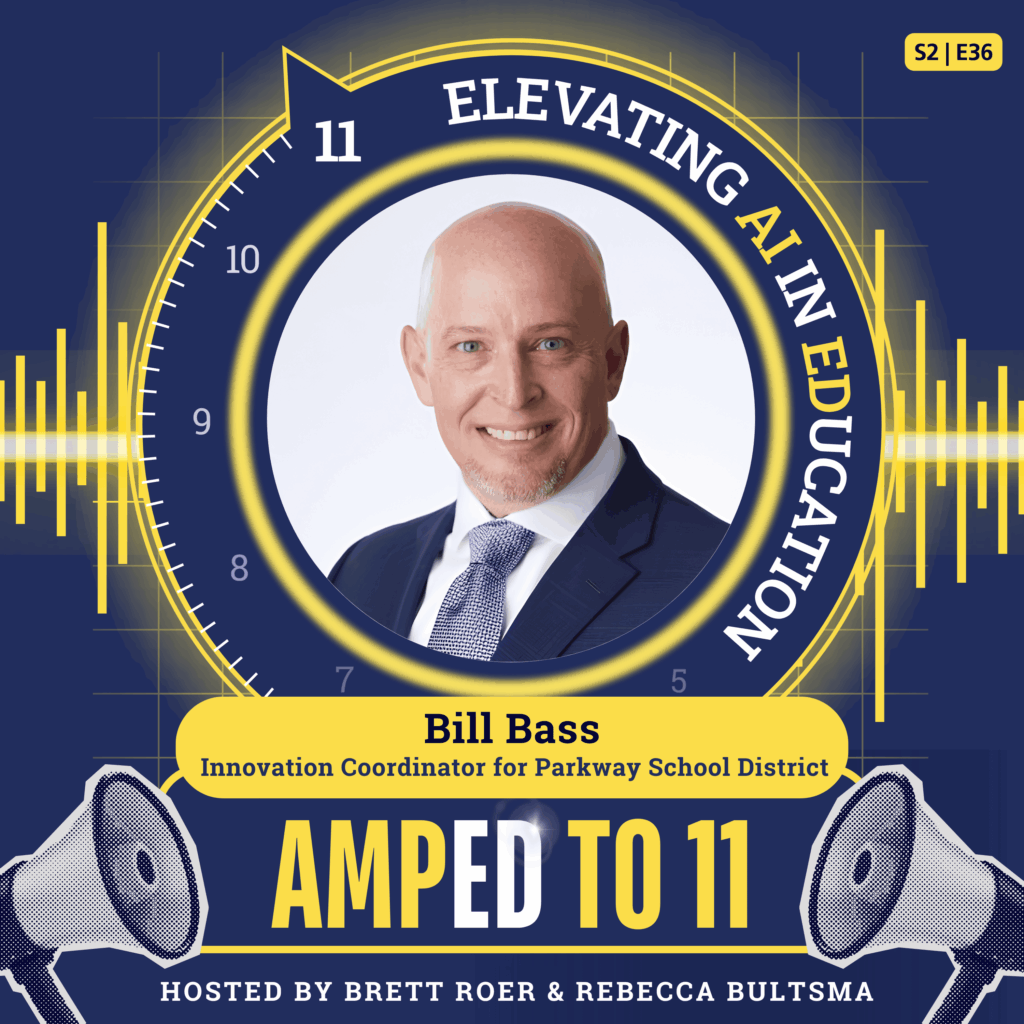
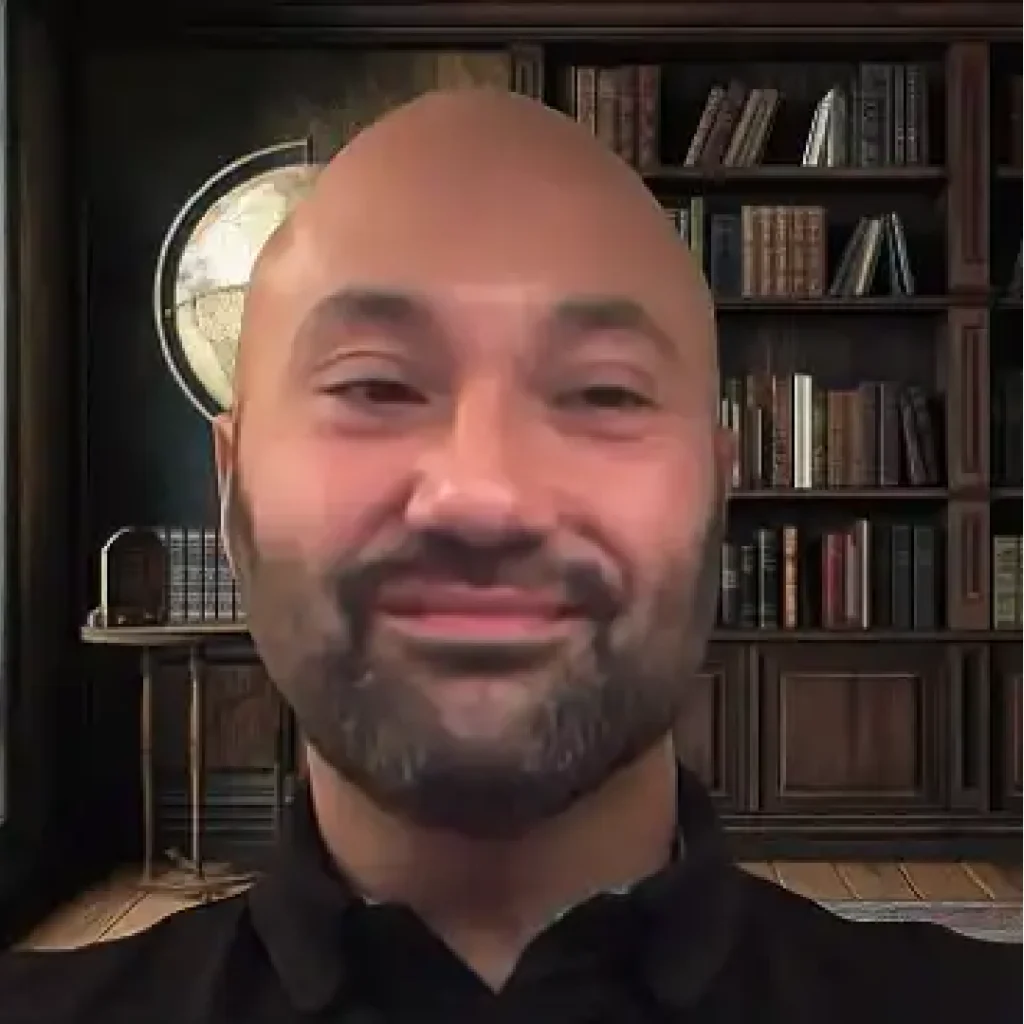
Brett Roer: And speaking of Bill, we are joined today by the innovation coordinator for Parkway School District in Chesterfield, Missouri, the incredible Bill Bass. How are you doing today, Bill?
Bill Bass: I’m doing great. It’s really good to be here. Thanks for having me. It’s good to see you all.
Brett Roer: Same here, Bill. Yeah, we’ve been really fortunate that we just both got back from San Diego.
Brett Roer: That’s where we met on a rooftop for a Digital Promise party, I think about four years ago, almost exactly to the day. And we’ve kept in community, and you’ve obviously been one of the leading voices in education and innovation and access. And so we are so excited to have this conversation with you today.
Brett Roer: Welcome to the AmpED to 11 podcast.
Bill Bass: That’s very kind of you. I really– when– every day when I, when I think about the work that I do, I just try to make things better for kids and, you know, and, and try to do that a little more broadly than just in my space. And so [00:02:00] I know I have been very fortunate in my career to meet folks and, you know, have whatever modicum of influence that I have had on the, on the space.
Bill Bass: And so I’m really– I, I just feel really fortunate to have the career that I’ve had.
Brett Roer: Absolutely. And so for our listeners out there, you know, we’ve been fortunate, Rebecca and I, that we’ve gotten a chance to obviously learn about this extensive career you have. Here’s your chance to– we appreciate if you can be not humble for a second because you do have many accolades that I do want our listeners to know about, just to frame today’s conversation.
Brett Roer: So if you could, maybe share with folks out there what your journey’s been in education and some of the different organizations or different places where you’ve lended your expertise in this field.
Bill Bass: Yeah, yeah. I’d be happy to. So I, um, I started off my career in the late 1900s as a high school English teacher.
Bill Bass: It was, you know, it was a different time then. I, I thought that my career was going to be centered around teaching kids how to write and teaching kids how to [00:03:00] read, and, and I did that. You know, about… Well, I used to be able to say h- about half of my career was spent doing that, is no longer half of my career.
Bill Bass: Let’s just say that I’m one of the more mature voices in the room sometimes when we, when we all get together. But I– So taught high school English, taught middle school English for a little while. I became a tech coach, um, because really what happened was I was, I was thrust into a classroom to teach a class called Modern Media at the, in my high school English class.
Bill Bass: And, you know, it wasn’t so modern when I got it, when I acquired the, the class. And I thought that we probably had opportunity here to do something different. And it had a bank of computers that were running Windows 98, and so, you know, like I said, it’s been a day or two. But in those, in those computers, you know, like, I was just like, “I, I’m gonna have to figure out what to do with these.”
Bill Bass: And so I began. I, I went and got a master’s in instructional technology, and that kind of took me down that [00:04:00] technology path. You know, when I was in college, I took one cal- computer class, the one requisite class that every teacher had to take that had the, you know, the flashing green cursor at you, because that’s what I had to do, right?
Bill Bass: And yeah, that changed a lot of things when I started teaching that class, and I quickly found my place in, in education. Got my master’s, became a tech coach, became an instructional coach, and for the last 12 years now, I’ve been a district administrator responsible for innovation in my district. Along the way, I was able to– My first– I, I g- I started getting involved in organizations, and so I became the secondary representative for the National Council of Teachers of English board.
Bill Bass: That was my first, like, national board. After that, I stayed involved there but became more involved in ISTE, and ended up on the board and ended up president ISTE. And so that brought a whole different perspective and a whole [00:05:00] different level of, um, just experiences that I, again, super fortunate to have had those and to be able to, to say that I, you know, was part of a lot of the work that has led up to, you know, where, where ISTE is today.
Bill Bass: ISTE ASCD, you know, that, that merger was something that I, I wasn’t involved in directly, but I think, you know, like my work kind of set the stage for that, for the ability the, the organization to be ready to do a merger with another organization and still retain the, you know, like kind of what made ISTE, ISTE.
Bill Bass: And so, you know, tried to… Oh, and it was during COVID too. So the fact that we, that ISTE still exists after COVID, you’re welcome, is what I would, what I would say to that. It was the CEO and I, Richard Culatta, we would talk almost daily, and it was never good news. It was always something. And so we just…
Bill Bass: You know, but we’re on the other side. We’re solvent. [00:06:00] Our membership continues to grow. And now, as past president, I am just kind of always on call as opposed to the in the every day, and so that’s a, that’s a nice shift. It’s a nice shift for me to be able to do that. And it, and it allows me to do other things, you know?
Bill Bass: And so, so that’s… I think those are, those are the highlights, let’s say. That’s my highlight reel, as it were.
Brett Roer: That’s, that’s quite an impressive one. And, you know, again, it spans millenniums. It spans, it bridges technology, right? You’re talking about you’ve survived both sides of the pandemic, and you’ve led through it.
Brett Roer: And like you said, a lot of the innovative changes, especially like with ISTE at the forefront, it sounds like you’ve really helped navigate that. So I wanna say thank you as someone who’s a proud member of ISTE and someone who does a lot of really exciting, innovative projects with them. Thank you for that.
Brett Roer: I would love to talk about some of the biggest things that are coming out of the ASU+GSV Summit, that are happening in AI in general, and I’m gonna turn it over to Rebecca [00:07:00] to frame some of these questions that are really top of mind with, you know, what’s going on April 2026 in the world of AI and innovation.
Brett Roer: Rebecca, where do you wanna kick off today?
Rebecca Bultsma: So many things. It’s such a, an interesting month for AI, and it sounds like, Bill, you follow it too. I think the stories that are kind of top of mind for me right now, number one is the Claude mythos, uh, slash non-release release. Uh, for our listeners who aren’t aware, Claude kind of announced a couple of weeks ago they have an, a new model that is incredibly powerful.
Rebecca Bultsma: So powerful they are not planning to release it to the public because they realize it has the ability to find and then hack vulnerabilities in just about every major system that exists. So what they did instead is pull in major CEOs and major players in companies like Amazon and all of these big companies that run major critical infrastructure in the United States to give them a limited preview of this so they could [00:08:00] test it against their infrastructure to find the vulnerabilities and hopefully fix it before this AI ends up in the hands of people who would have less pure intentions with it.
Rebecca Bultsma: Uh, and that’s, that kind of, uh, freaks a lot of people out, which kind of leads over to the other thing that we’re seeing, Bill. Uh, a real kind of- violent plot twist in how people are feeling about AI right now. So this month alone, uh, there have been attacks on the homes of CEOs of AI companies. Uh, we’ve had major ousters by public officials in towns and, and cities after they’ve agreed to data centers, and the communities have, uh, fought back against those things.
Rebecca Bultsma: And even most recently, Reese Witherspoon went online and told women they needed to get involved in AI because not enough women were understanding it, and, uh, it was not well-received. So I guess my question for [00:09:00] you, this idea where there’s, like, these amazing advances in AI happening, but simultaneously we’re seeing kind of a twist in public opinion.
Rebecca Bultsma: I’d love to get your read on that and see how far that’s filtering down and how and if that’s reaching you, and you’re noticing any part of that where you sit right now.
Bill Bass: Yeah. I– It is, it is super interesting where to, just to see the landscape is… ‘Cause that’s really what I, I, I kind of think of it as this, as this landscape where we have, we have– I always expect peaks and valleys, right?
Bill Bass: I always expect anytime we have a, a technology that’s going to be influential, that’s powerful, or that changes the way we think about things, that, that matters. And we have to be, we have to be really cognizant of how that’s going to impact us. One of the things that I was fortunate a few years ago to be part of, I, I, I said that I was part of NCTE, and one of the things that they did was they created a definition for literacy in the digital age.[00:10:00]
Bill Bass: And so we, we, I was part of the team that wrote it initially, and initially it was for 21st century skills. Happily, we revised it twice, then we moved away from 21st century skills as a moniker. But in that, one of the, one of my favorite lines that I, that I quote regularly is that as, as technology and society change, so does what it means to be literate.
Bill Bass: And when I think about, when I think about this specifically, like, as an English teacher, right? I, I see the world through story, I see the world through the, the, um, through, through writing and, and literacy really. And, and literacy can mean a lot of different things, but what it means to be literate in the digital age is shifting bec- and, you know, it’s not something that we can kind of pinpoint and say, “If you do these X number of things, you will be literate.”
Bill Bass: It’s, it’s a moving target now at where it… I mean, it always kind of was, but not to this extent. You know, like, the definition almost changes daily. [00:11:00] And so, so when I think about, you know, these shifts that we’re seeing in, in technology and as, as you say, the The rapid pace and the, the fact that we’re seeing, you know, CEOs’ homes being threatened and things like– That’s the, that’s the, the technology and society, those are at odds in right now, right?
Bill Bass: And it’s not, it’s not like nobody’s ever always just all in, “I’m gonna embrace everything around technology.” Like, that’s not how, that’s not how we roll, and that’s fine. But much like a, there’s a divide in just our society, we’re seeing the, that divide in technology as well, and our usage of technology.
Bill Bass: And when we’re talking about, you know– I have, I have eighteen thousand kids in my district, and when I’m talking about that, and I’m talking about the twenty-nine schools that we have, that means I have twenty-nine communities that are all in different places. And even [00:12:00] inside those communities, there– I have parents and I have teachers who are like, “Under no circumstances will my kid ever touch AI.”
Bill Bass: Impossible, right? And the, you know, like, they, we have this, we have this conversation. But then on the other side, we have, you know, people that are wondering why we’re not pushing AI harder. And so in the same community, we have this, this schism between these two groups that is… It’s so, it’s– Managing that and trying to, you know, find that happy space in between is, is almost impossible.
Bill Bass: And then, you know, and beyond AI, we’re just, you know, we’re talking about screen time, we’re talking about cell phones, we’re talking about the technology that is part of our lives, trying to remove it from our lives in our, in a school setting. And that is, that’s troubling for me as someone who has done technology their entire career, right?
Bill Bass: That’s troubling for me because I think about my own kids. I [00:13:00] have twenty-two-year-old kids. I, I have twins, and they are, they see the world similarly, but very differently. But everything that they have, that they are creating now in their college career, everything that they are experiencing, is influencing the things that they do and the way that they think about the world.
Bill Bass: And, and that’s great, and I’m, I’m not a proponent for, like, eliminating that. But I’m also not a proponent for saying that just because one set of people doesn’t want to use a specific technology, that makes the technology bad, right? And so we’re demonizing this thing that has really good things, but it’s the intentions that we bring to it, right?
Bill Bass: It’s, it’s because adults suck just as much as kids sometimes, right? I mean, we all, we all make decisions. And so I would much rather help kids make decisions when they can make mistakes, and I can help them, as opposed to leave them to their own devices, and when they get out of [00:14:00] the school setting and into real life, they don’t have that direction.
Bill Bass: And so we’re, we’re trying to create this inauthentic space in a school where the authentic space in real life has that technology, but we’re trying to keep it out of our learning spaces. And so, like I understand the– I understand it, right? I understand why. I just– I have a hard time with that because I don’t think that we’re preparing kids to– We should be wary.
Bill Bass: I mean, like, let’s be clear, we should pay attention. We should not just go all in on anything, but we can’t ignore the fact that if we don’t have the technologies, if we’re not talking about AI in schools, then we’re doing a disservice to our kids when it all is said and done because they won’t have the structured conversations about it and the perspective that comes with multiple [00:15:00] classes and multiple teachers and multiple kids all engaging in conversation around this topic.
Bill Bass: And so I really, I do, I do worry about what I would consider a tech backlash because I think we’re creating inauthentic spaces even under the guise that kids will learn better. And we don’t, we don’t actually know because a lot of times– I mean, there’s, there’s plenty of research on both sides, and there’s plenty of things that say if we, if we create experiences for kids that are inauthentic and that don’t– that aren’t relevant for their life and all that, then they’re not going to be interested in learning those things.
Bill Bass: And as soon as they leave school, they’re in a tech-rich space. So what’s the, you know, like this dichotomy, we’re trying to preserve a society and a, a, a time that doesn’t exist anymore in [00:16:00] our reality. And so that’s where– I think that’s why schools are in a rough spa-space right now. We keep trying to figure out how to respond to the needs of our community, which we need to do, while at the same time supporting kids in the world that they’re going to move into.
Brett Roer: I just wanna first say, like for our listeners out there, so Rebecca, myself, Bill, you know, like we’ve been in numerous districts across the country, and many people express what Bill’s saying, but like they don’t have the privilege of someone like a Bill or myself or Rebecca that we get to actually engage with school districts nationwide, in Rebecca’s case, even more.
Brett Roer: And so first, I just wanna say like thank you for sharing that narrative because, one, we’re gonna talk more about your emerging technologies guidelines that you’re providing, but you’re the past president of ISTE. You’re on the cutting edge of innovation, and that story you just told is the story we hear everywhere.
Brett Roer: So like we always tell people, the fact that you’re even having these conversations, engaging your community, [00:17:00] that’s step one, and you’re doing that. But like, I also wanna make sure people hear it’s so important that if you’re struggling with this with all of your knowledge and all the things you’re able to see, that’s almost- I hope gives everyone the empowerment to realize, like, you’re, you’re gonna be struggling with this, but that doesn’t mean you don’t do it.
Brett Roer: And so maybe for our listeners, could you kinda share, could you share what this emerging technologies guidance you’re providing is? Kind of where your community was, ’cause I’m making an assumption based on your previous work that you’re building upon things you’ve done pre-generative AI becoming ubiquitous in schools.
Brett Roer: And then how do you hold space for the fact that people are trying to grapple with this? And so how do you ensure maybe you have a vocal minority, that their voice is heard, it’s accounted for, and yet you’re still trying to move forward with emerging technology for the best use of, you know, the overwhelming majority of your students?
Brett Roer: Lotta questions there, but we’ll let you unpack it. And then Rebecca, I apologize, we’re gonna turn it back over to you after this.
Bill Bass: There, yeah, there is a lot there. I would say– [00:18:00] So first let me say that it is, speaking to the fact that we were just both in San Diego at, for ASU+GSV, one of the things that I found kind of remarkable is the number of people who didn’t un- know that this was kind of the plight of schools.
Bill Bass: As I was talking to, you know, like, different folks that are in, in companies or they are thinking through the lens of, you know, as an edtech provider or something like that, there were amazing amount of people, not everyone, obviously, right? Painting with a very broad brush here. But the fact is is that there are, there are, there’s a tone deafness when it comes to, in, in some cases, not all, obviously, right?
Bill Bass: But when it comes to the realities of what is happening in schools, because a lot of assumptions are made, and a lot of assumptions are made about the, what schools need with- in, in a lotta cases without actually talking to schools, which is problematic in and of itself. But the, the fact is is that we’re not in agreement, you know, as [00:19:00] to where, where we need to be and where we need to go.
Bill Bass: So one of the things that we did, to get to your actual question , uh, one of the things that we did was a number of years ago, you know, we had been– We’ve always been a tech-rich school. We were doing a lot of, a lot of people moved over to kind of a, a one-to-one environment during COVID out of necessity, right?
Bill Bass: We had been– We’re 11 years into our, we call it our access program, because we’re not, it’s not just ac- it’s not just about the device, right? The device I’m less concerned with, but it’s about devices, it’s about content, and it’s about experiences. And we worked, we wanted to provide access to those three things.
Bill Bass: And so In, in digital spaces specifically, like utilizing technology. So we want, you know, we can have the device, but you have to have access to the, the internet at home. So we worked on, you know, s- kind of quote unquote “solving that.” Still haven’t gotten 100%, but we’re, you know, like this is work [00:20:00] that is ongoing.
Bill Bass: It’s not an, it’s– there’s not an end finish line here. And then we, you know, we work to create access to digital content. So which means that, okay, so you have device, you have the internet, now you have to have content in order to engage with, and, and not just content, but experiences further. So we want the kids to have all of these things, all access to each one of these things in order to become, you know, citizens of the digital age, was, is kinda how we approached this.
Bill Bass: From there, we recognized that, that we needed to better document wh- how we make decisions, right? And so it’s not just that, you know, somebody makes a request, and it’s at the whim of Bill on any given day. Like, we, we needed to do better than that. We needed to actually have, these are why we make the decisions we are making.
Bill Bass: And so it doesn’t matter who is sitting in my seat or who is a part of the culture that we are create– we have been creating in Parkway. And so [00:21:00] we created these technology commitments, uh, instructional technology commitments that we made to our families. And those, those commitments, I mean, they’re, they’re actually, they’re pretty simple.
Bill Bass: Um, basically we, you know, we wanted to be– we ha- only have five. And so when that was– when we were making those, it was so that we would, we would be able to say, “These are the things, these are our rationale for why we do these things.” And so one of the things, I’ll just, I’ll just read them to you real quick, and there’s only five.
Bill Bass: The first one was we wanna create a, a balanced approach to student learning, right? And so, and this goes, gi- this gets to that screen time, this gets to that, you know, technology backlash. We don’t want kids to be 100%. The least interesting thing a kid can do on a computer is flick through slides and, you know, answer some questions.
Bill Bass: That is, that is not what technology is designed for when it comes to learning. Now, it is the point of least resistance, right, in a lot of cases, but we don’t, you don’t actually… That’s not gonna, [00:22:00] that’s not gonna help, right? And so we wanna create that balanced approach to student learning so that students can decide when technology is appropriate and when technology is not appropriate.
Bill Bass: ‘Cause we’re not designing, we’re not supporting them for being in school. So that was our first commitment. Our second one is to enhance students’ educational experiences through the use of technology. Very similar to the first, right? But it, it does, it does lend itself to the fact that we want kids To– We don’t want them to just, you know, w-word process the entire time, right?
Bill Bass: There are, there are opportunities for creation, there’s opportunities for exploration, simulation. I mean, there’s so many ways that they can approach this. But we had to commit to our community that we were going to use technology in really intentional ways, right? And so these digital tools that we adopt, we adopt them because we only ha– we know that we only have so much time in front of kids, and we have to use that time really intentionally, right?
Bill Bass: And we can only put so many things in front of ’em. And so that was– [00:23:00] that’s our second one. The third one is develop a safe digital environment where students are able to learn from mistakes. I w– Make mistakes. That’s right on– I mean, I make mistakes every day. That’s how we learn things, right? But if we take away every opportunity for them to make mistakes because maybe we’re mo- over-monitoring them, or maybe we’re blocking everything, or maybe we aren’t u-utilizing technology to address the issues that are, that are coming up and all that, yeah, we need, we need safety measures, but if we’re not actually using technology and providing a space for them to make mistakes, we’re missing the boat on that.
Bill Bass: Because they’re gonna make mistakes, it’s just who’s gonna be able to support them on the other side of that, on the other side of those mistakes? The third one– fourth one is support students in their digital wellness, which I think is something that we continue to think about. We don’t want kids addicted to screens and things like that.
Bill Bass: We don’t want adults addic-addicted to screens either, right? But we do wanna be sure that they are– that they understand [00:24:00] and know how to make decisions because they are going to be living in a space where technology is readily available to them. And then the last one is just advancing digital equity and making sure that it’s not just kids that have access to– that have the means to have access to devices in their home, but it’s if we’re going to– if we’re gonna ask you to do something, then we ha- we better provide access to that thing.
Bill Bass: And so, you know, going back to, like I said before, device, internet, content, experiences. All four of those things we need to have opportunities for all of our kids, not just the ones who can, you know, maybe afford to go to a camp or afford to, you know, have those experiences outside of school. We wanna bring those and give them the opportunities to have them inside of school.
Bill Bass: And right now, AI gives us– Like, this is one of those things that we have to provide experiences around. And so these tech commitments are kind of the hallmark. These are– This is why we make our decisions. If it doesn’t [00:25:00] go with one of these, it has to be magic, right? It has to be the best thing we’ve ever seen and is going to do all the things that we want.
Bill Bass: But I haven’t found it yet. So these are the, the, you know, these tech commitments really guide us. And so we put those in place a few years ago, and that has led us now To, you know, the state of Missouri has a– the school board association has a AI– an AI policy that they are asking us to adopt. Um, and not asking, but suggesting.
Bill Bass: Let’s say it that way instead. And I read it, and it’s fine, except that, you know, board policies are– take a lot to get across the line, right? And so this is, this is not going to be the la– AI, you know, and AI as we currently define it, is not going to be the last technology that is disruptive in schools.
Bill Bass: And so what, what we’re doing instead is we’re, we’re– and it’s, it’s going, going to go to our board, [00:26:00] but we’re trying to create an opportunity for our board to look at emerging technologies and have a policy around emerging technologies as opposed to AI specifically. Because by the time we get a pass, it’s gonna– I’m gonna have to revise it again, and it’s gonna be on every board meeting that we go to.
Bill Bass: With an emerging technologies policy, we can say, “We wanna ke-keep kids safe. We wanna ensure that they understand the technology and how to use it if it is in fact safe, and the risks that go along with that. We wanna support our teachers with professional development so that they understand how to utilize this with kids, if it’s appropriate to utilize with kids.
Bill Bass: And then we want to, basically we wanna say that we’re not going to shy away from emerging technologies just because they’re emerging.” Like, those are the kind of the, in broad strokes, those are the things that we stand on when it comes to our policy. Now, underneath that, we’re [00:27:00] gonna have guidelines, we’re gonna have a guidebook, we’re gonna, you know, I mean, w-we’re, we already have developed a lot of stuff that goes along with supporting AI specifically, and teachers using AI, but that doesn’t mean that I need a policy for my board that I’m going– that is going to be outdated and that we have to comply with when those emerging technologies change, ultimately change what it is that we need to do and teach.
Bill Bass: And so that has been, that has been our approach so far, and it is, it has been well-received because it’s not about the technology per se, it’s– or the, the platform or whatever. It is about how we approach our work through our technologies, and I think that shifts the conversation a little bit and makes it less scary too.
Bill Bass: Because we can say, you know, under our board policies, “Here are all the things you can and can’t do,” but what a horrible way to approach board policy. [00:28:00] Um, you know, we need, rather than large P policy, let’s, let’s create some small P procedures and policies that go along with, you know, the work that we do.
Bill Bass: And so academic integrity, we already have a policy for that. We don’t need a new one because AI has everybody scared of AI, we need to understand how that, we need to translate it. We need to translate our academic integrity policy into an artificial intelligence space.
Rebecca Bultsma: That’s fantastic. That’s actually, as like someone who does a lot in, uh, governance with AI and ethics, that’s exactly what I recommend, uh, as well, having these more policy-level things that no matter how the technology changes, you don’t have to change these things.
Rebecca Bultsma: And you have administrative procedures that are a little bit more agile that admin can adapt as we go, but then handbooks that adapt as well. I think my favorite part is focusing on teaching kids about making responsible [00:29:00] choices with the technology. Um, I, my current research right now and what I’ve spent the last month doing is documenting every single, uh, deep fake case in K-twelve that have happened over the last three years, gathering every single story, every single institutional response, every two- single community reaction, and mapping those and looking for trends.
Rebecca Bultsma: And some of the outcomes of that is a board hurries and rushes to put a policy through that’s, um, that bans deep fakes, which like makes no sense, right? Like we already have things that already go, um, you know, around that, and I think the more reasonable reaction, as you’ve mentioned, is to be more proactive, make sure kids understand, uh, responsible use of technology, emerging technology, whatever that is, and having that commitment be to raise good digital citizens in a world full of emerging technology, rather than be reactive and put policies for every single possible little thing that make it unmanageable.[00:30:00]
Rebecca Bultsma: So I think you’re doing good things, and I hope other districts, uh, sit up and pay attention to doing it that way because I think that’s the way ultimately that’s going to work best in the future.
Bill Bass: Well, thanks. Yeah. I, I think it– So let me, let me add one piece to that. I think that the, you know, as, as I’ve talked to districts and, you know, I, and the, the policy pieces, there were so many…
Bill Bass: I re- I remember two, three, two years ago, three years ago, I was, I was at an event, and there was a, a superintendent there that was very, very proud of their policy that they just got through the board. And I was like, “Wow, okay. I mean, that’s great. I– Do your thing. If that’s what your community needs, then, then that’s what you should do, right?”
Bill Bass: And I, I, I feel like that’s the– You have to know your community in order to know the approach that you take. And, uh, so I think that’s, like, that’s what I, that’s what I hear in, in what you’re saying, Rebecca, that we– it is about [00:31:00] leadership, and it is about going forward, but it’s also understanding your community, what they need, and then understanding the impact that any of those policies that you are creating or anything that you are the guidelines and all that, the impact that that’s going to have on your community.
Bill Bass: And that’s a really important piece to unpack and make sure that you’re being intentional about it and not just reacting because you got a nasty gram email from somebody who is irritated with you.
Rebecca Bultsma: I think if you can build those commitments too on top of your existing mission, vision, and values that you have as a district, it’s easy to point and say, well, we did this because these are our values.
Rebecca Bultsma: And it ties back to like the foundational commitments that you have as a district and things that you value. It’s hard to dispute those things, right? Like because we value student learning on our [00:32:00] website or whatever it is, that’s why we’ve implemented this as kind of a core pillar of the work that we’re doing moving forward.
Rebecca Bultsma: And I think being able to articulate the why behind all of these things ultimately is what matters and helps get people on board when they maybe don’t understand or they’ve been influenced a certain way by media or friends or community or a little piece of something that they picked up that they don’t fully understand, especially in the community, which speaks more to that kind of level of understanding that people have and don’t have, which taking another step back, I think fundamentally the fact that we’ve rolled it all into this big AI heading, the AI that powers your Netflix is the same thing we’re talking about with data centers is the same thing we’re talking about with deep fakes.
Rebecca Bultsma: And it’s just this big, ambiguous, scary thing that has so many things all rolled into one giant ball. And I just think we can do better at picking that apart and identifying the parts that are useful, the parts we should be worried about [00:33:00] instead of just rolling it into this nebulous AI bubble ball that doesn’t necessarily truly reflect the technology in any sort of meaningful way.
Bill Bass: Yeah, I would agree. And mostly because this is what I hear. I talked with a parent recently that doesn’t want her kids on their Chromebooks. And then in the very next sentence asked why we’re not teaching them to type effectively. And so I understand the sentiment, but it is because of AI. And we look at one of the things that I hear almost every other day is that I have students who don’t want us to turn off AI because of the environmental impacts.
Bill Bass: And we have parents who are saying they don’t want their kids to use AI because they’re no longer going to be able to think critically. And I understand [00:34:00] the sentiment behind all these things. But the fact is that The design of our lessons and our learning experiences are what’s going to guide some of, like, those pieces, and we should have learning experiences that explore the environmental impacts of AI.
Bill Bass: And we should have learning experiences that ensure that critical thinking doesn’t get lost along the way because we’re, you know, quote unquote, having the AI do all the things for us.
Brett Roer: Bill, I’d love to ask if this is something that’s on your roadmap. You said a couple things, and you know, you’re pointing out the, the knots that you as a leader of innovation are get, you know, can get yourself into when a parent says two things that seem di- uh, you know, like opposed to each other.
Brett Roer: Do you ever do things like, or is your district in the process of kind of we just said, right? So like, we want our students to use deeper thinking. So like, here’s ways that AI can– by using AI in this way in a [00:35:00] lesson or in a curriculum, this is the moments where AI can lead to deeper thinking or deeper learning.
Brett Roer: Do you align it to any of like the frameworks like ISTE’s, you know, you know, like attributes of an AI-ready graduate? And how do you explain that to a parent? Like you said, like there is a time and place to learn typing, so like this idea of like, I don’t like this term, but this is what a lot of people are using, like good screen time and like explaining why that is the be- if your goal is to deeper learn or something, that’s the best use of a screen.
Brett Roer: That is why you would want to use a screen in this case versus what you mentioned before about like just having kids, you know, basically just turn worksheets into things that they could just do online or like a PowerPoint. How do you help people see that that might just not have the understanding and only are getting bits and pieces of the narrative?
Bill Bass: When one of the things that I learned about leadership, specifically with ISTE, is that, you know, sometimes you have to make decis- unpopular decisions, right? And, and sometimes you have to s-say no to really good things [00:36:00] because of capacity, because of, you know, in schools’ cases, because of laws, because of– and because of your community’s readiness, right?
Bill Bass: And so rather than focus on what we try to do is rather than focus on what we can’t do, right, we try to focus on the opportunities that exist. And so we can lament, you know, some of the, the decisions that are made that are outside of our control. But- That doesn’t necessarily, that doesn’t necessarily matter, right?
Bill Bass: Because they’re outside of our control. It’s not something that we can do. But what we can do is we can be sure that we’re talking, we’re, we’re celebrating the good things that are coming. We’re s- we’re ensuring that our, you know, as, as we, as we work with parents, and as we have student focus groups, and as we do parent surveys, and as we engage our community in different ways, what we can do is we can take those opportunities to, to educate and to, and not try to convince.
Bill Bass: [00:37:00] It’s not, you know, one of the things through our guidelines, our AI guidelines, one of the things that we really tried hard not to do was suggest that this is, that every teacher needs to use AI every day in some way, right? We, we didn’t, we didn’t want that level of directiveness. What we wanted to do is open the door where innovation can occur.
Bill Bass: And, you know, a lot of times in my position, people ask me, you know, like, “Well, I don’t understand what your title even means.” Which, I mean, it’s made up, let’s be clear. But when we are– Like what I try to do is set the stage where innovation can occur, right? And create a culture of innovation throughout our organization.
Bill Bass: And I understand that I’m, that doesn’t mean that I’m gonna hit every classroom, because culture isn’t, doesn’t mean everyone, right? It means our approach that we are taking in this time is something that we [00:38:00] need to, is, is where we’re going to invite thinking about things differently. And so it’s kind of like an invitation to innovation, right?
Bill Bass: And so if you, if you’re not down, that’s fine. And so, and I’m not gonna, I’m not gonna make you, I’m not the, I’m not gonna be your, the AI police or anything like that, but I am going to support you in those things that you’re trying to do because I want that to trickle down to our students, right? In li- in, in lots of different ways.
Bill Bass: And so yeah, we, you know, like when we did our, you know, I mean, call it what you want, Portrait of a Graduate, we have Vision for a Learner. Like that’s, everybody is calling their thing their thing, right? But it’s essentially Portrait of a Graduate work. And what I liken that to, and this is, this is where we tied all of our AI stuff to, was our Vision for a Learner.
Bill Bass: And the reason we did that was because it was something that our community had already accepted, like it was part of our culture. It was something that we had, you know, we had committed to, [00:39:00] and, you know, our mission and vision supports it as well. But by tying it, by tying the reasons, and we kind of interpreted that down, for, to tie the reasons that we’re doing things with AI and providing examples and supporting our teachers and celebrating amazing things that they’re doing in their classrooms, by tying it to that Vision for a Learner We can show what that means, and ultimately the vision for our learner is much like the ISTE Standards, right?
Bill Bass: Just the, the– And this is, this is another thing that I learned along the way, is when the, the ISTE Standards were created, like it was very much, “This is what, what we want kids to do with technology,” right? We want them to be able to word process. We want them to be able to edit images and things like that.
Bill Bass: These were earlier iterations. Well, around 2016, those shifted, and, and I was, I was fortunate I was on the board then, and I recognized this shift from what we want kids to do to who we want them to be, right? And so the ISTE Standards now, I mean, going through [00:40:00] them, we want them to be creative communicators.
Bill Bass: We want them to be digital citizens. You know, like there’s, there’s things that we want them to be. That’s what Vision for Our Learner is. We want them to be these things, and in order for them to be these things, here’s how that translates down into using the tools or the approach that AI comes with in order to get kids into this space.
Bill Bass: And if we want kids to be these things, our adults better be these things, right? If we want them to be learners, w- our adults have to be learners, and we have to have culture around each one of these pillars that we stand on. And, and so that, that be- that has become our approach is to tie it to something that we are already doing, and we’ve already, we’ve already said, “This is what we’re doing.”
Bill Bass: Well, here’s the interpretation of how it can be done with AI or how it can be done with technology or how it can be done without either one of those things based on [00:41:00] circumstance and based on the fact that we want kids to be self-reliant, and when they leave us, that they’re going to be ready to face the digital world and be a part of the digital world as opposed to being scared of the digital world and make their own decisions along the way, and that’s when, in education, we talk about student agency all the time.
Bill Bass: That’s student agency, being able to decide when and why and how to use these tools. That is, that is bringing yourself to the technology, not utilizing the technology as somebody else designed it for you.
Brett Roer: That, that– These are just– This is so helpful because, again, we do a lot of this work, and, and you said at the start this idea of like you’ve learned a lot of things about leadership, and ultimately that’s really what you’re describing is how do you lead people through change?
Brett Roer: And most importantly, it’s the… Many people can get the… Well, not many, but [00:42:00] what you’re doing, you can find the research to find some best practices, like what Rebecca was speaking about. Like, you can find people like Rebecca to provide you the research. And you can even find people like Rebecca to give you the, the next steps in the plan, but The implementation and leading people through change is probably where most school districts, if they’re ready to accept this, are, are gonna struggle.
Brett Roer: So I just wanna thank you again for, like, leading people through this narrative. I do wanna give you a chance, Bill. You know, you’re, you’re traveling the country. You’ve done many things in your career, but podcast host I don’t think I heard you say is one of them. So we’re gonna turn the tables right now.
Brett Roer: We’re gonna give you a chance to ask Rebecca and I. You get, you get full reign of the Amped 11 podcast right now. What’s a question or a burning question you’d like to ask us that we might be able to share, you know, and answer for you and our listeners?
Bill Bass: Yeah, yeah. Well, uh, so I appreciate that. And one of the things– It’s actually really funny that you say.
Bill Bass: I, I have not created my own podcast, but back in 2005, I taught kids how to [00:43:00] podcast, and it was much harder then, incidentally. Like, we had to write our own RSS feeds in order to distribute them, and this was before, like, Apple put out the iTunes store. And so it was– Like, it was early days, but I taught kids more about storytelling and creating and broadcasting through the creation of podcasts.
Bill Bass: It was, it was awesome. It was hard, but it was awesome. So when– So here, here would be my, my question for the two of you. When we– When– A lot of times, and I, and I’ve said it myself, is that, you know, we talk about… For the longest time, I ta- I used to talk about how I want kids to consume less and create more, right?
Bill Bass: And AI and technology just in general, but AI specifically, has given us great opportunity to create, right? My stance has kind of changed on this, where I don’t necessarily want them to consume less, I just want them to create more. ‘Cause I recognize that creation requires [00:44:00] influence, and that influence you get f- when you consume, right?
Bill Bass: So everything that you consume influences something you create. And so as you are, as you are thinking and, and seeing people out in the world and the schools that you work with and the, and the leaders that you interact with, what are the things that– what are the things you’re excited about that people are creating out in the world right now?
Bill Bass: Specific, you know– And whether that is inside of, inside of a school or just, you know, like, kids, kids or adults in education. Like, what are the, what are the things that you, you think are exciting that are going to, that people are creating in, in our space these days?
Rebecca Bultsma: I personally am loving the workflows and the agents and the tools people are building that alleviate their pain points.
Rebecca Bultsma: I, I love seeing the way that people are identifying something that’s been a [00:45:00] challenge forever and ever, and within a few hours finding a way to solve that problem. I’ve done it, um, even just in my research, right? Like sending out, um, swarms of agents specifically to school sites to find deeply buried statements about incidents that I wanna look at, uh, or to be able to find sigal-signal in noise easier, or to track workflows that I’m working on.
Rebecca Bultsma: Um, Andre Ca-Karpathy, who is like one of the most brilliant foundational minds in AI, posted a couple of weeks ago about how he uses AI and Obsidian to build his own personal wiki, uh, which I took and I built, and it takes everything I’ve ever bookmarked, uh, or read or everything, and it maps it into a giant wiki and maps those nodes all onto each other.
Rebecca Bultsma: Uh, so it’s a giant knowledge base of my whole life and everything I’ve ever consumed, um, and, and found value in, [00:46:00] and maps them together so that if I want to suddenly like remember that thing I read about this and how it might map to this, that’s all available to me now, and that solves a pain point for me, which is h- you know, I read this thing, I consume like all of these great papers and everything but can’t quite remember, and now that’s solved that problem of making that and servicing that and making it available for me.
Rebecca Bultsma: Um, and having agents that do things that don’t burn me out by the time I get to the actual work, so that I feel more, more fresh, right? Like agents that will go out and find the things that I need that I would find interesting, and surfacing things that align with things that I, I agree with or, or want to dig deeper into.
Rebecca Bultsma: On a smaller level, just seeing, uh, teachers. There’s a, a woman named Kelsey from Ohio who, she just built like a gem, a Google gem, that alleviated her biggest pain point, uh, which was sub plans. And she has a gem now that anytime she needs a sub plan, it generates it for her in under 30 seconds. And before– And I’ve talked to so many teachers who are like, “You know what?
Rebecca Bultsma: I [00:47:00] would rather just come to school not well than have to sort out a sub plan.” And that solves a pain problem. So I think in terms of what people are creative, I just love seeing people being able to actually do something about their biggest pain point, when before it was just like, “This part of my job sucks, and it’s hard and it’s draining me, but there’s nothing I can do about it.”
Rebecca Bultsma: Now seeing that solutions focus and a-the actual ability to solve those problems, which I hope leads to people enjoying what they do more or freeing them up. It does certainly for me. Uh, things that used to take me till 1:00 PM can now be done in 30 minutes by an agent before 8:00 AM. They get me set up s-for success.
Rebecca Bultsma: So I think that would be my answer in a really broad way.
Brett Roer: Yeah. I think to echo some of the things Rebecca said is one, seeing a shift in mindset. And so this idea, you know, and Bill, you’ve already kind of spoken to this, this idea of like there’s still a lot of people for rightful-rightfully so, who like they [00:48:00] still see some of these problems in education as they’re just baked into the system at this point.
Brett Roer: And I totally get that ’cause if you’ve spent your whole career trying to fight against these like barriers that just have seemed immovable, it’s hard to shift your mindset and get unstuck. But I’m, I’m seeing that more and more, like Rebecca’s case of like start with an actual problem. Don’t expect AI to provide solutions to problems that don’t exist or problems you can’t address or identify.
Brett Roer: But once you’ve identified a problem, that’s where a tool like AI can start to shift mindset and show you there’s ways to just repurpose or reconfigure the resources and strategies you have to try to solve something. So that’s one, is when people get the chance, and I, I would love to learn how to do this at better scale, but a lot of time it really is just giving people either a walkthrough or sitting with them and just helping them unlock something, and then they get it.
Brett Roer: So again, that’s slow at scale, but it’s the most important thing I’m seeing is just getting people that first aha moment. [00:49:00] And then the second thing, like Rebecca said, is educators themselves. So like seeing joy return to people because it really sparks a creativity, and, you know, all teachers are artists in the fact that they have to create lessons every day.
Brett Roer: And to see that they can do it now in a way that they might be a veteran teacher or a new teacher and just they have another tool in their toolbox that makes them feel just good about going in and differentiating learning or making it more engaging or knowing how their students really wanna learn, that’s been probably the most fun.
Brett Roer: And I’ve seen so many teachers, educators, leaders say some version of like, “It’s fun again to teach. It’s fun again to create.” And I think that post-COVID, as you mentioned before, is probably what people needed. And even though there are a lot of pain points with like teacher exodus and retention and hiring, for those people that see that, it’s like a breath of fresh air that we just wanna keep giving to more and more people.
Brett Roer: So that’s been probably the most exciting things I’ve seen in the, in the space the last few years. [00:50:00]
Bill Bass: That’s great. That’s great. And I think, you know, I– you both brought up different but interesting points where it is, you know, it’s, it’s really about empowerment of people who, this is stronger than I mean, but in some ways had lost some of the hope that they had and the, and Brett, I think you said it, joy in, in their work and in, you know, fi- in figuring out their workflows or, you know, all the things that we hate to do.
Bill Bass: Just like bringing all of that together, um, it really, it really is empowering. And that’s, you know, to To shift the focus back to me for a moment, that’s what we wanna do with kids, right? We wanna empower them, and that’s what we try to do every day as we’re creating these opportunities around technology.
Bill Bass: It really is about empowering our, our learners, and think about it in [00:51:00] terms of learners very broadly.
Rebecca Bultsma: Great answer. That’s what we like to hear. I think we’re all saying the same things. Uh, yeah, I don’t think the goal is to just teach kids to use AI for everything. It’s to teach them the foundational responsibilities that they have and that digital literacy based on those commitments, uh, and then let them be creative from within those boundaries.
Rebecca Bultsma: Brett, you love to ask our final question. Why don’t you go ahead and take it home?
Brett Roer: I shall. Thank you. So Bill, you know, you’ve already shared so much about the organizations you’re in community with, you know, the leadership you’ve, you’ve provided to some. And so we’d just like to use this last question to really get broad again of, for folks out there, right, what are either some of the organizations that they should start to explore more, um, you know, especially our educators, our innovators, our leaders.
Brett Roer: Who are some people they might wanna look towards to find more inspiration, to find more great tips and tricks [00:52:00] about AI innovation education? This is really a chance to just give flowers and, and praise people out there in the space that our listeners might not know about or that they should hear their voice again to remind them that these are excellent people out in the field.
Bill Bass: I try to think– When I, when I, when I look at questions like this, I try to think about it in terms of, you know, yeah, we have voices that are out in the world, right? And so organizations, obviously, like one of the organizations that I find value in is ISTE. And I also find value in NCTE. They are doing some really good things right now when it comes to AI.
Bill Bass: And as an English organization, it’s, it’s an interesting space for them to be in because, you know, a lot of, a lot of the pushback has come from English teachers, really. And so they’re, they’re really trying to think differently about it. But, you know, like we have AI4EDU, and we have Cosine, and we have Digital Promise, and we have– There was a, there was a project that I was a part of not too long ago that was called Engage AI that, you know, like there…
Bill Bass: [00:53:00] A lot of good work is being done out there right now. And so the, the way that I try to think specifically about people is that I l- I look for attributes as opposed to individuals, right? And so the, you know, like I– and there’s, there’s people out there. But I think that the thing that I always want to think about is the authenticity that comes with those folks when they are, you know, like, what is their, what is their, what is the motive behind their, their, their speaking or their writing or whatever it is?
Bill Bass: Like, what is the motive that comes along with that? Are we, are we trying to create, and I, and I say this not disparagingly, but are we trying to create a career or are we trying to create a, are we trying to create impact? And I think those are very different things, right? And so as, as we’re looking at the, the work that a lot of [00:54:00] people are doing, who should you listen to?
Bill Bass: You should listen to the, the people who con- who you connect with. You should listen to the folks that will help you serve your community, help you serve your students. You should listen to the folks that aren’t necessarily the people who are keynoting everywhere. Um, you should listen to the people that are in classrooms right now talking about and working with AI on any given day that are going to– Because, because they understand what it actually means.
Bill Bass: And, you know, in a lot of cases, hey, that take, that takes me out of the running here, right? And that’s, and that’s perfectly fine because I haven’t been in a classroom for many years, right? As a, as a daily practice. I’m in classrooms all the time, but I’m not the one who is in the classroom with kids on any given day.
Bill Bass: And I think that those, those are the people you listen to. You listen to your colleagues. You listen to the people who are in your district or in your region or who are classroom-based that are going [00:55:00] to not just share the magic thing that they created, but who are going to share how they talk to kids about AI, how they teach them to be responsible, how we make kids be the people we want as opposed to do the thing we want them to do.
Bill Bass: Because I think that’s where, those are the folks that live it every single day, and who are the ones that if we’re not listening to them, then shame on us, really, because we have not, we have not empowered them, or we don’t value that voice as much as we value the person who is up on stage or who, you know, has written 12 books or, you know, whatever that may be.
Bill Bass: I think the people that I would, I would encourage everyone, go find that classroom teacher right now in your local school, in your, in your building, whatever, that is talking with kids about AI and uncovering what it means to be [00:56:00] in our space right now in education, because they’re the ones that I think have the most valuable voice that we can find in education right now.
Brett Roer: Well said. No notes. Thank you. Thank you, Bill, for everything, right? You’ve really shared with our listeners how they can be a leader in this challenging time, but also lead with, you know, inspiration and, and, uh, the right values at the front. And those are great things. You know, we’re all out of the running based on what you said, but so important that you’re in community with educators on the front lines doing this important work.
Brett Roer: So just wanna thank you again for everything you do in the field of education and innovation. If people wanna learn more about how they can learn more from you, is there anywhere they could go and check out at this time?
Bill Bass: Um, I think, you know, I’m, I’m on, I’m on l- I’m in lots of spaces. Just billbass.tech is my site.
Bill Bass: And go there and, you know, LinkedIn, whatever. There are, you know, I’m, I’m, I’m places. There’s no one single source of truth. [00:57:00]
Brett Roer: All right. So look for Bill Bass wherever you find people on the internet or in the world, sounds like. Thank you so much, Bill. Thank you to all our listeners. Make sure you make today a Jumbo Cannoli Day, meaning live life to the fullest.
Brett Roer: And, uh, thank you again for listening to the AmpED to 11 podcast. Everyone have a wonderful day.