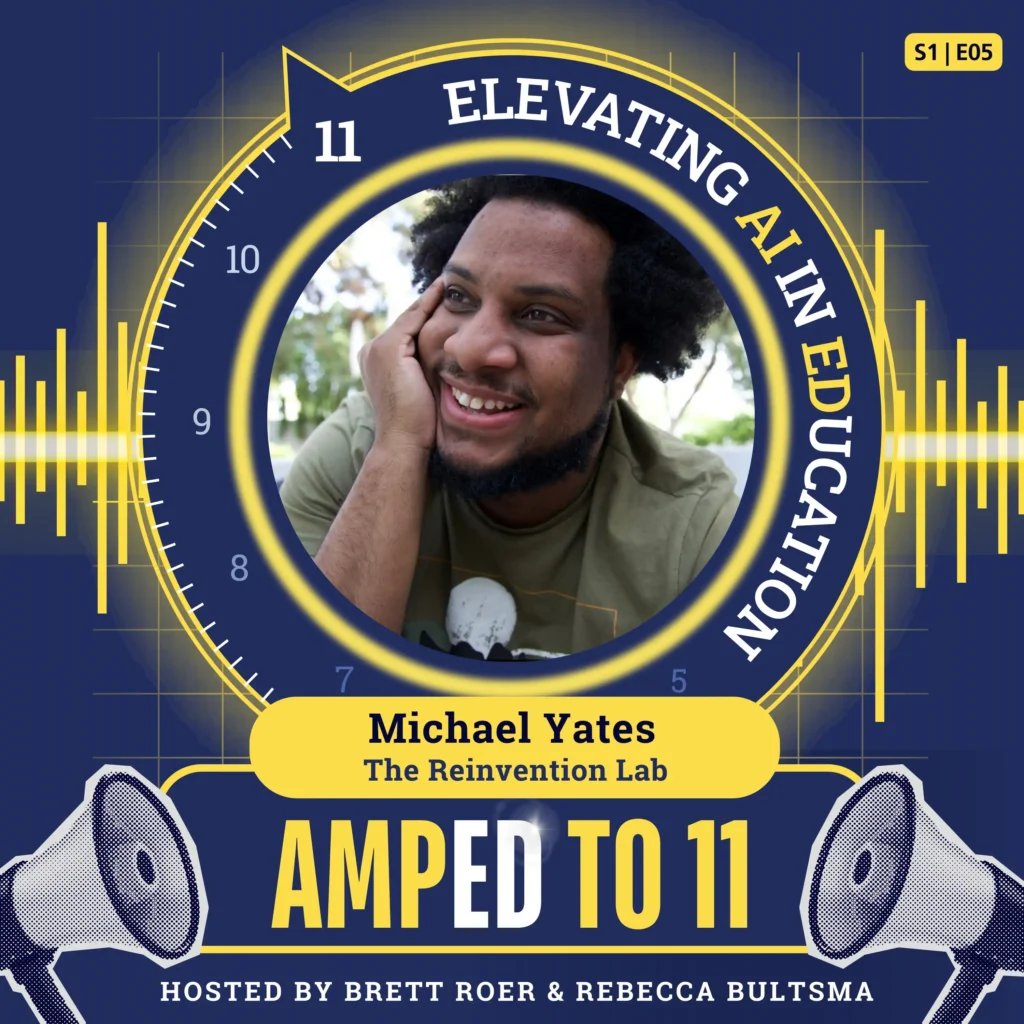
AmpED to 11 Ep 4 Michael Yates
===
Rebecca Bultsma: [00:00:00] Welcome to this week’s episode of AmpED to 11. I am Rebecca Bultsma, and this is the podcast where we crank up the volume on AI and education to the absolute max to help you stay on top of everything AI, education, innovation, and why it matters.
Brett Roer: And I’m Brett Roer, CEO and founder of AmpEDlify and Elevate Innovation.
Brett Roer: Super excited. I’m AmpED to 11 to be here this week alongside Rebecca talking to our guest, Mike Yates. Every episode we’re gonna take people like Mike through our 11 AmpED to 11 questions. Each guest that joins us is doing something incredible that you need to know about in the world of AI innovation and education.
Brett Roer: And so these 11 questions will help us see the world in the future, the way they see it, and hopefully AmpEDlify that vision and have a collective impact on the future of education and society. Welcome, Mike. How are you today?
Michael Yates: I’m great, man. How are you? [00:01:00]
Brett Roer: I’m doing excellent. I’m AmpED to 11 to get a chance to catch up with you.
Brett Roer: As we all know, Mike is renowned because he leads AI and other innovative solutions for America’s Reinvention Lab on top of so many other things he does. So Mike, instead of me telling everyone what you do, give us a real quick overview of some of the things you’re most passionate about right now and leading in the world of AI, education, and innovation.
Michael Yates: Yeah, thanks. I think the thing I’m most excited about in, uh, with AI right now is I’m excited about the number of people That are racing to the bottom, meaning that there’s a lot of people in the field that are just building sort of like baseline, regular school AI offerings so that I can say to schools, like, trust me, you’ll have something that’s decent.
Michael Yates: Now I’m going to go over here and build weird stuff like AI for fashion design. Like AI coffee shop locators, like I’m excited right now. The thing that’s like really given me a lot of energy is sort of pushing to the fringes and figure out, figuring out [00:02:00] like what hasn’t been done and just the ability, the ability to try everything and not worry about which ones fail, just like figure it out.
Michael Yates: So that’s led me to like working on some projects with some big tech companies, working on projects with university football teams, like. All sorts of fun stuff. So that’s what I’m excited about.
Brett Roer: Incredible. So for folks out there that don’t know when Mike really gets a passion and uh, an idea, he really goes deep with it.
Brett Roer: So I’m sure we’ll cover a lot of this today, but you might learn a lot about, you know, Mike’s passion for the Houston Rockets. Design and sneakers. He’s a whiskey aficionado. So I would say resident expert. So you’re gonna learn a lot about Mike today I am always honored because when I see Mike Yates at something I know I’m in the right place and I’m even more honored that I’ve gotten the chance to see him speak And I’m even more honored that Mike is our first ever Podcast guest on AmpED to 11 because many many moons ago the first ever podcast I was fortunate enough to be a guest on [00:03:00] was Mike’s podcast at the time which was called schoolish.
Brett Roer: So Mike Really great, honored full circle moment here.
Michael Yates: I’m proud to be a part of it. Like, it’s, it’s, it’s awesome. That was back when you were at, uh, Outlier.
Brett Roer: Yes, sir. Yeah, yeah, man. So here we go. Um, again, our inaugural podcast guest is about to run the gauntlet on 11 hard hitting, innovative questions all focused on AI.
Brett Roer: So, Mike, you ready? Yep, I’m ready. Let’s do it. Alright, let’s do it. So, first question is coming to you. It’s a pop culture reference, Stranger Things. We all know the character Eleven. She had a real moment. She was in the zeitgeist. She had these supernatural powers. Anyone who saw it, right, they’re in awe.
Brett Roer: They’re like, what am I seeing? So, Mike, what’s your Eleven jaw dropping AI moment? The first time that jaw dropped or the weirdest, most unexpected thing that you’ve seen AI able to do?
Michael Yates: It’s the video capabilities. When we went from, like, the Will Smith eating spaghetti video [00:04:00] where he’s just, like, morphing into himself and seeing, like, those first renderings of Sora, I was just watching a video about Sora, like, the first, like, official Sora demo from Marques Brownlee yesterday, and as somebody who also loves videography, I’m like, man, I can spot the difference in most of them, but I’m also getting fooled, like, 70 percent of the time.
Michael Yates: Right? So, like, I am, it’s, it’s this weird conundrum. So I’m, I think that’s probably the most eye popping thing, just going from basic sentences to being able to build full worlds that are, that are moving and interactive, uh, honestly, like I love strangers things and the upside down feels like something that an AI generated.
Michael Yates: So that’s a good, that’s a perfect setup for that question.
Brett Roer: Also want to shout out what you just said. We’ve seen just the advancement in video. Sorry yesterday was the first time I saw it. Thanks to actually Rebecca posting it on LinkedIn and I immediately went to it and was like this is incredible and also traffic was so high that I don’t have my, uh, I [00:05:00] don’t have my account yet but excited to get in there and dig in.
Brett Roer: Second question is actually the namesake. Where we got the name for AmpED to 11 comes from the famous mockumentary Spinal Tap. The scene where that AmpED cranks up to 11. The limits of the ordinary don’t exist when they, when they get that AmpED out. So. Mike, what’s your AI tool that you push to its absolute limits when you really need to get things done in your personal or professional life?
Michael Yates: But now it’s Microsoft Copilot. Like, I was a real hater on Microsoft Copilot. I was like, I don’t want it. I don’t want to use it. And then we got some licenses. And I’ve been using it for really just like two weeks. But it has become a really important crutch for me because I notoriously I’m saying this on the podcast, I don’t read emails.
Michael Yates: Like, if you send me an email and the email’s not addressed to me directly, like, I will read the ones that are addressed to me directly. Copilot makes that so easy because I can just say, Hey, which emails in my inbox right now are addressed to me? [00:06:00] Like, I’m tired of being cc’d on all these emails, but even then when somebody’s like, So I have the CoPilot Microsoft Outlook app on my phone.
Michael Yates: I literally just did this, I’m not going to say who, because maybe if the timing’s right, they’ll, but they were like, oh, you remember this email? Where we were talking about that thing? I was like, yeah, you know what? Hold on, I got to send a message real quick. And I asked CoPilot about it, and I, just like the commercial I was reading, I was like, oh, yeah, yeah, yeah.
Michael Yates: No, I didn’t, and we were able to actually like, have a real conversation instead of having to take 10 minutes to catch me up on the details, so. Copilot and like the, the way that it plays with the Microsoft 365, like suite has been Revolut not, I mean, I wouldn’t say revolutionary, but it’s been super helpful for like quick task management.
Michael Yates: And knowledge management, like there’s so many things that I need to, like so many little bits of knowledge that I need to go build the next thing, uh, that it’s helping me do that right now. [00:07:00]
Brett Roer: That is a nugget, a golden nugget of wisdom there, so thank you for that tip, trick, and letting people under the hood.
Brett Roer: You know, we always say this is a 10 out of 10, we’re used to rating things like that, but something, sometimes something is so good, um, you know, it goes above and beyond even an 11 out of 10. So right now, what’s another AI tool in your toolbox that you feel deserves an award of 11 and
Brett Roer: why?
Michael Yates: It’s so funny, this person just, just texting me, I will say PlayLab AI.
Michael Yates: Like I, I think PlayLab is best in class at what it does. It is, PlayLab, if you’re not familiar, it’s a tool that allows anybody to build their own AI tool or chatbot. And it is so easy and so intuitive that, that like right now it is the best AI builder on the market. Like it’s, it’s better than Google studio.
Michael Yates: Google studio is cool. But like, it’s so confusing. Google studios clearly meant for developers. PlayLab is clearly meant for real human beings. So for a real human [00:08:00] using consumer grade AI, 10. Uh, the team at PlayLab is obviously great. I’m, I’m biased cause I know them all and used to work with one of them.
Michael Yates: So, but I, I just bias aside, like I have seen it transform people’s work. Um, I’ve seen it transform people’s life. Uh, and, and I, I’ve had the chance to teach many people how to use that tool, so I, I, I think PlayLab is 11
Brett Roer: Well, thank you. And also, yeah, big shout out to Yusef, Wyman, the whole team over there.
Brett Roer: I want to say the first time I ever saw the power of PlayLab was in Hawaii with first year TFA ers and in a one hour session, they’d never seen PlayLab before. One hour later, so many first year teachers said like, I can’t believe I didn’t have this for the first part of my teaching year. I’ve never had a more, you know, exciting experience at a PD and I’ve never felt more prepared to teach tomorrow.
Brett Roer: So I want to say, I mean, that’s PD feedback. So shout out to PlayLab. Thanks for giving them their flowers. Mike, here at AmpED to 11, [00:09:00] we’re big fans of 11 labs. I’m sure you are as well. Um, you know, just for folks that don’t know, they’re known for creating AI voices that are truly level 11 amazing. So Mike, if you could have anyone’s voice, read your daily emails and 11 labs, listen up.
Michael Yates: It would be Samuel L. Jackson because to date I have seen almost every, I’ve been slacking lately but I’ve seen almost every film he’s ever been in, which. So, you know, it’s a lot like it’s 474, uh, like it’s a lot of movies, but, uh, I would love for Samuel Jackson to read my emails to me. And now that gives like, I’m going to go produce that on 11 labs.
Michael Yates: I am an avid user of 11 labs. I use it so much in the early days of my bourbon TikTok account that people thought I created the voice like Adam, they’re like standard voice. They thought I made that voice. Uh, and I was like, no, this is an existing tool.
Brett Roer: Mike wants that Samuel one? I would love a Mike Yates voice, please and thank [00:10:00] you.
Brett Roer: This next question, Mike, is, first of all, for our listeners out there, if you don’t know, if you want to just get, go down a rabbit hole with Mike, just ask him, what do you think of the Rockets this year? So, This guy is a basketball aficionado. He’s an expert in the space on that as well. So, um, I’m going to talk about one of my more devastating childhood moments.
Brett Roer: Reggie Miller, eight, eight seconds, right? Um, so between the Rockets and John Stark’s shooting performance and Reggie Miller, my childhood was pretty scarred. Nick’s never brought it home. Um, but Reggie Miller, 11, famous for delivering those clutch performances in the playoffs when it mattered most. So Mike Yates.
Brett Roer: When’s a moment an AI tool really just came through for you when you needed it to deliver it on a project you needed and just, again, went above and beyond your expectations of where you could take it.
Michael Yates: Canva and their AI suite has been really helpful for me. I was prototyping, uh, this [00:11:00] project where, this project is heavily based on the, the, the company called Mischief.
Michael Yates: If you’re listening, you haven’t heard of Mischief, look it up. It’s, uh, M, it’s like the word Mischief without vowels, dot X, Y, Z. That’s the website. Mischief is this, the, all these devious art projects and like products. I just bought some slides that look like they’re like braces for broken feet. And that’s the kind of wacky products it creates.
Michael Yates: So I looked at that and said, why not learning? And obviously like if you go to a team of people, especially in the ed world, where like everybody is uptight and wants to be professional and you say to them, I want to build the mischief of learning. They’re like, never heard of it. What are you talking about?
Michael Yates: And then you go, Oh, you remember the big red boots? They’re like, no. Did you see the shoes where they put human blood and then they’re like, what is going on? So I need a very quickly, like within 15 minutes to be able to show them what these concepts look [00:12:00] like. So I went into Canva and I used their AI image and video generation and I generated.
Michael Yates: 13 different cards of like these projects that I wanted to build that were mischief style. And so had these beautiful presentations so that people could see like exactly what I meant and like printed them out, went to a conference and started just handing them to people so that my team could then. Be immersed in that idea and that prototype, as opposed to just me explaining it to them or me giving them a doc.
Michael Yates: So Canva’s AI tools allowed my idea to come to life, which is what got the, got the buy in for me to work on it for the next eight months, you know? So that, that tool came through in the clutch for sure.
Brett Roer: All right, moving right along. We are at the halfway point. We’re at number six here out of 11. So now we’re going to talk about the 11th hour, right?
Brett Roer: So now it’s getting late. Um, and we really want you to tell people what is the AI breakthrough tool right now that if you’re an educator, [00:13:00] you need to know about right now. What is that crucial tool right now for educators to get on with?
Michael Yates: I wouldn’t always say the word crucial, but one that I do think more teachers need to, cause I really do.
Michael Yates: I really, I believe in the founders and I believe in this tool’s ability to like say help you plan quickly at. 1159, yeah, not magic school AI, but school AI, just the way that they’re thoughtfully building with educators. And what I hear educators say about that tool, what I know about the partnership that I’m working on with them, right?
Michael Yates: Like, they are really committed to a tool that’s built by teachers for teachers. Both of the founders. Former teachers, one of them built the Apple educator ecosystem, right? Like, so they’ve got like chops in this world. So I think, uh, school AI is one that more teachers should know about for sure. It will help you with anything from planning to like interest management in your classroom.[00:14:00]
Michael Yates: Uh, you can even build your own little custom chatbots inside of there. So, uh, school AI has got, it’s, it’s, it’s, it’s pretty cool.
Brett Roer: That’s amazing. And also, I love how you brought to that analogy of it’s 11 59. I really got to finish this lesson so I can get to bed. Um, knowing there’s tools out there, that’s real helpful.
Brett Roer: Or 11:59, and that class starts at 12, you’re ready. So, good to know, that is a great use case, uh, for all you teachers out there that with busy lives. Alright, again, this is actually real personal because you’re, uh, you’re based out of Houston. I’m pretty sure, OLLO 11, does that sound right? They do some, uh, they do some aeronautic stuff out there by you?
Michael Yates: Yeah.
Brett Roer: So, Apollo 11, moon landing happening right in your backyard it took off from, giant, giant leap for humanity. What’s kind of your personal connection to the Apollo 11 moment with AI? The breakthrough that felt like you are, you know, kind of pushing into new frontiers or it’s going to take. You know, humanity to a new level.
Michael Yates: I, I had my moment in 2014. I had a student who couldn’t read [00:15:00] at all, like at all. He’s in sixth grade. And this was my second year of teaching. And I remember saying to him, I said, he came to my desk and he was like, Hey, so you know, I don’t want to read out loud. And I was like, okay, well, why? I didn’t even know at that point, like, look at his.
Michael Yates: 504 plan, it will tell you why. He like, whispers to me like, I don’t, I don’t read very good. He’s like, I don’t really know how to read at all. And I was like, oh, okay. And afterwards, I went up to him and I was like, hey man, I don’t know a whole lot about this job, this teaching thing, but you cannot walk out of this classroom not knowing how to read.
Michael Yates: I didn’t even teach English. I was, I was a 6th grade world cultures teacher at the time. But I knew that I had like, some responsibility to be like, hey dude, And he’s like, great, are you going to help me learn how to read? And I was like, dude, I’ve never taught anybody how to read. So let me go home and Google this and figure this out.
Michael Yates: And like, we’ll learn together. So I went home and I literally Googled [00:16:00] how to teach a sixth grader how to read. And all these apps started popping up and I just went one by one and I was testing them all night long and the next day I came back to school, it’s like, hey, try this app called Nuzella. He starts reading everything he can about soccer.
Michael Yates: And I didn’t know what adaptive learning was at the time, never heard that term. But I noticed that the reading level, the Lexile level started increasing over time. And by the end of the school year, his reading level had jumped. From a first grade level to a fourth grade level. So like he wasn’t on grade level yet, but he had made three grade levels worth of progress.
Michael Yates: In one school year with just 45 minutes a day, it was really about 20 minutes a day of him on that app in my classroom. That is when I said, yep, this, uh, teaching thing in regular schools for me, that’s done. I don’t do that. And I kid you [00:17:00] not, that, the, like, the school year ended that summer, the movie Her came out.
Michael Yates: Um, and I remember watching that movie and I was like, yeah, I’m also a conspiracy theorist, so I was like, they know something. This is, this, this exists. And that’s why that clip today in 2024 is like even scarier, but that, I mean, that was my moment is like watching, watching at the time we were just calling it machine learning or adaptive learning, like watching that do right on behalf of a student drove me to, it literally changed my career.
Michael Yates: I would not be doing this today if it had not been for that moment.
Brett Roer: I just want to name like, not everyone has your. insight, intuition to realize, unfortunately, too many educators, myself included, have had a student say something like that. So one, obviously flowers to you for then taking that initiative.
Brett Roer: So many teachers do that. They don’t always know where to turn, but this is like the premier exAmpEDle of you can personalize learning at scale now. When those students come up to you, that reaction is always going to be so visceral, [00:18:00] and you’re going to sometimes feel helpless. Like, I was a social studies teacher, not a literacy expert by trade, but there are so many tools out there to help you get those students where they need to get.
Brett Roer: So thank you for sharing that journey, what you did about it, and also just making sure people know, like, those solutions are now out there. And that’s kind of what the, you know, the mission of AmpED to 11 is, to AmpEDlify these incredible tools and people like Mike who are in the know for the right reasons. So, Mike, we know when it’s 11.
Brett Roer: 11, someone will turn to you and say, Hey, Mike, make a wish. So, as you’ve already heard, Mike is the realist, right? He tells you all of it. So, like, if you follow Mike on LinkedIn, he’s got some wishes, like, I wish we could all just stop talking about AI. Because, not the right conversation. So, I’m not gonna tell you what your wish is, Mike, but how do you hope or wish AI can shape education in society?
Brett Roer: Like, what does that look like to you?
Michael Yates: I think in the short term, I hope that it puts pressure on the system, like good pressure. What I want is for a watershed moment to [00:19:00] happen in learning. I thought it was the pandemic. It was like, oh, this is it. People were calling the pandemic the moonshed moment. Or the moonshot moment, and I was like, no, this needs to be slightly tragic, like, like people need to start understanding for the first time that the system is broken.
Michael Yates: And I do think that AI has the ability to give us data so quickly and in the way that we want to see it in the way that we need to see it, that we can finally see the system for what it is, a system that is not functioning on behalf of kids. And what’s beautiful about the potential of AI, uh, or generative AI as we know it, It’s that the AI can both identify the problem for us and help us start to fix it.
Michael Yates: And connect us to the people, like connect the real ones in the field. Like the reason why I said that on LinkedIn, like I’m really ready for the AI hype cycle to die is because there are too many people who are just not doing the work but are winning awards and are on stage talking. [00:20:00] People, some people who I like a lot as people.
Michael Yates: And I just want them to stop talking. Um, because the more they talk, the less we focus on problem solving. Like if we’re clapping and looking at them. Who are we not looking at? The students who are suffering and dying in these classrooms, right? So, like, for me I’m a person where education changed my whole life.
Michael Yates: Like, if I, my free, high quality public school education set me on a different trajectory because I had educators who decided, like, for whatever reason, they were like, yo, that weird kid in the classroom, something special about him, and I’m gonna make sure that he knows it and make sure that everybody else knows it too.
Michael Yates: Like, I, I can’t shake the fact that education is too powerful. So I really do hope that That like we’re able to see these disparities, we’re able to see like racial disparities, uh, gender disparities, we’re able to see the wealth gap in a new way. And I really believe that AI is a part of the answer for how we, for the [00:21:00] first time, make sure that every kid can have what they need in a high quality education.
Michael Yates: Maybe for the first time ever.
Brett Roer: I absolutely concur with that, right? Being able to personalize learning. I love what you said, right? It can help solve, it can help identify and solve the problem. A lot of us maybe know the problems we’ve seen in classrooms. But, you’re right, without having all of that data at our disposal in real time, being able to personalize learning and help each student exactly where they’re at, it often felt like an insurmountable task.
Brett Roer: You’re right. First time it feels like there’s hope out there.
Michael Yates: And the thing I’ll add is like, like sometimes we don’t, our problems are too localized. Like we understand how it plays out in Houston, Texas. You mentioned earlier, like I love whiskey and I love whiskey in a way that most people don’t. I love it to the point where I geek out about the Master Distiller and like, Who is the person at the front desk at the distillery, like, I love it to that level.
Michael Yates: So that means I spend a lot of time in middle America and every [00:22:00] day when I’m in Middleburg, Virginia, or, or when I’m in Lawrenceburg, Indiana, or, you know, like Covington, Kentucky, I’m literally learning about a new way of life. Like literally learning about new problems in the Appalachian region of the country and like how some people don’t have clean water in 2024, right?
Michael Yates: Like, like, so I do think that the ability for us to finally see and get angry about Like what else is going on or get active about what’s happening. Like that river between Cincinnati and Covington, Kentucky, that was one of the first documented times in American history that somebody saw another person’s problem.
Michael Yates: Harry Beecher Stowe saw a, a slave with her children fall into her backyard, lay on the ground and cry because she was finally free. And that is what caused her to write a book that changed the way that the entire country thought [00:23:00] about slavery. So that’s the type of, like, process that I’m hoping AI can help replicate over and over but with, you know, learning and other problems in society.
Brett Roer: I love how you always bring your passions in your Mike Yates way. Like, really bring them back home and, uh, you know, again, whiskey. Whiskey is the, uh, is the door opener to changing society’s problems. It’s what I took away from that. Yeah. So, Mike. First, I would love for you to just give a shout out real quick.
Brett Roer: Shout out to your amazing family. So tell us, you know, your partner, your kids, names, ages, all that good stuff. And a little bit more about your history and your family’s history about, uh, how you’re educating them these days.
Michael Yates: Yeah, yeah. My, my wife’s name is Alexandria. She’s a saint. She’s amazing. None of what people know about me is possible without her.
Michael Yates: I have, we have four children. Austin, Brooklyn, London, and Kingston. Uh, they’re all named after cities. They’re all homeschooled. And they are, I don’t know, just like the coolest kids right now. [00:24:00] They, you know, they’re, one of them is, their interests are all very defined and very different. Uh, but they also know how to sort of like step into each other’s world and participate.
Michael Yates: Like my nine year old daughter is She’s really into making movies. So she, one day I remember her being frustrated and I was like, well, you know, like if you’re going to be the director, like you need to give people instructions on where you need to be. The next day she like shows up with a full shot list and like, all right, this is where I need you to stand and you got to stand over there.
Michael Yates: And I’m like, wow. You know, so just watching them sort of like, like the world is their classroom. And I am thankful that we made the decision to homeschool. A lot of people have this misconception about the homeschool community where they’re like, well, that’s for wealthy people. We were homeschooling when I was making 32, 000 a year, like, it’s a sacrifice that we chose to make because I had just seen too much.
Michael Yates: And I just, you know, I was like, I want to do this for my kids. My wife wanted to do it. For our kids, so [00:25:00] homeschool is, is a lot of, a lot of it’s either one on one tutoring or working with adaptive learning software and then doing just the craziest projects we can think of, like, you know, go introduce yourself to five people at the mall, like we’re with them, but like five people, five strangers you never met before and they’re like, well, do I really have to do that?
Michael Yates: And we’re like, well, no, you don’t, but if you don’t do it, you don’t get this points or the prize or whatever, like, so, uh, it’s a, it’s a blast and we will keep developing and building on top of it.
Brett Roer: Incredible. Well, again, just shout out to you and your amazing family. I know you talk about them often when I get the opportunity to see on the road.
Brett Roer: So I wanted to give them some flowers. And also you don’t have to imagine it cause you’re living it. You know, we have 11 year olds out there. We’re going to grow up in a world, you know, never knowing what it’s like without AI. So a big picture, not just your own children, but for everyone out there who’s got children and the educators out there shaping minds.
Brett Roer: What’s the message you’re going to give about the future in an AI driven world to the 11 year olds out there?
Michael Yates: I’ve got a kid who’s 10. He’s about to be 11 in may. And the thing that I tell him and the rest of his siblings is to be [00:26:00] patient. The great luxury that you have of being 11 years old is that you can watch us crusty adults figure it out.
Michael Yates: You don’t have to be broken while we, while we move fast and break things like, like, don’t be in a rush. The tools are not that cool. By the time you really get access to it, they’re going to be much cooler. But I would say like the, the, the, the key is for the 11 year old is what I would also tell the 21 year old and the 51 year old is to tinker around and play.
Michael Yates: Like all of these, the utility of these, these tools, they only make sense. If they make it easier for you, the human to construct the world around you to sort of like bend your world into like what you want it and need it to be. So treat it as a playground. That’s why I think the, the name play lab, like play lab, uh, playground AI, like runway, right?
Michael Yates: Like these names of these AI companies are [00:27:00] sort of telling you what to do. Like, this is a playground, treat it like. A video game, right? Like, like that, that is what it is. I, so, you know, if you’re an 11 year old, you’re using AI, be careful. Uh, it’s weird. We’re very far away from sentient AI taking over the world.
Michael Yates: I don’t think it’s gonna happen, but I would, I would actually say be patient. Like, my, none of my kids, by the way, are allowed to use AI. Uh, by themselves until they can make meaning of the world from literature that they read. That’s the link for us. It’s like, if you, if you can’t read what an A. I. says to you and go, Mmm, that’s probably a hallucination because what I know about the world doesn’t match up with that, it’s not time for you to use A.
Michael Yates: I. So, if you’re 11 and you can’t do that, off the brakes homie.
Brett Roer: Amazing life advice for, as you said, all age ranges. But um, I did want to say something you said before and give again some flowers to like, Something PlayLab does that I do love that creates a sense of, you know, play, but also personalization, like you said, is the remix feature.
Brett Roer: So, whenever I’m speaking with [00:28:00] someone who wants to tell me about their AI tool, I’m always like, Great, do you have a way for people to personalize or build off of something else that’s working in District A and your District B? To personalize what they’re doing, because while the problems might be the same, as you said before, they’re localized.
Brett Roer: Like, how do you solve for the exact issue? So, I love the fact that people can try, learn, but remix it up is, uh, essential, I think, for like, play, innovation, and construction. All right, this ties in very well to kind of what you were just referencing, right? We gotta go slow, AI is the worst version it’s ever gonna be.
Brett Roer: If AI is right now, if it’s a level one in the technology we’re using today, what is happening when we crank it all the way up to 11? So describe that future of Ed when AI really reaches that full potential, and what’s possible that’s gonna feel like sci fi today to people.
Michael Yates: I actually don’t think it’s like I think people have to get out of the mindset of text being the thing.
Michael Yates: Spatial computing is here. And, so by the way, all [00:29:00] of this is about making life more convenient and more connected. So, I forget the name of the glasses, but Meta’s got these glasses. They’re literally, they, they’re not releasing. They have, for the first time, glasses where you’ve got the overlays, you can see your screen, and it’s not the big, bulky goggles, right?
Michael Yates: It’s, it’s, it’s a, it’s a step in between the go, the goggles and the Meta Ray Bans that exist today. It’s amazing, right? Like, but the, their, their battery life is two hours long. Like, you got these cool glasses on for two hours, and then you take them off. There’s so many questions to figure out, but I do think It’s about immersion, like, when the digital world is really an overlay onto the physical world.
Michael Yates: Like, you know, it’s like, instead of this Zoom call, you can have holographs, holograms of us, like, sitting around the table. But that’s meant to To like [00:30:00] recover what and pull together what is human. So I do think like the future of like where AI is going, it’s about like the data that’s running in the background.
Michael Yates: Like what, like what things are we measuring about people, the way they feel, the way they think, what they say? How is that data being used to create a situation that is ultimately using technology to advance humanity? The thing I think like a lot of people discount when they look 50 years into the future, we saw happen with COVID.
Michael Yates: Like, I remember thinking when COVID happened, I was like, yep, shopping malls are done, turns out there’s still a hotspot for 13 year olds who want to go hang out with their friends. Like, turns out that having a ice rink inside of a, inside of a freaking shopping mall is still a brilliant idea. Like people love going to, you know, I remember hosting events like virtual events.
Michael Yates: We have this meetup for education [00:31:00] innovators in New York and the pandemic was like, Like people were starting to go outside again, and people came to our virtual event to tell us that they could only stay for a little bit because there was a real thing with real people going on down the street. That interaction right there, like that is human nature, it is in our nature to want to be with other human beings.
Michael Yates: That’s why we come to these silly conferences and these convenings and stuff like that because humans want to be together. So even when the hologram situation exists. Like, people are going to want to get in the same room. So, I, I, I think the digital and physical will, will, will mesh in some way in the future.
Michael Yates: Uh, less about text, more about sound and images.
Brett Roer: Amazing. Yeah. I think that’s, that’s the dream, right? Having that information, especially in a classroom, but even in society, you can just be able to pick up on cues, especially helping those that have accessibility issues, right? This could [00:32:00] really change their experience with the world.
Brett Roer: I saw yesterday, I was at the, uh, New Jersey statewide AI summit yesterday and saw an advertisement, uh, you know, a video from one of the, uh, sponsors where it showed someone who. Was blind and able to use an AI powered tool that would like calculate and then verbalize for them. You have this many steps till that door, you know, like it actually said what each sign said to them so they could make the choice.
Brett Roer: You know, I’m sure you’re familiar with, uh, you know, we start with pop culture. We’ll end with pop culture. Ocean’s 11, right? You’re Danny Ocean. You are pulling off the ultimate heist, changing the world of education. In this case, you know, AI through putting together a team of experts and specialists. You know, I know you’re going to overlook people because you know everyone in this space, but feel free to just, just cook for a couple minutes and name all the right people that folks should know about or organizations folks should know about in order to solve the biggest challenges we have.
Brett Roer: Go ahead, build your squad. Well, I mean,
Michael Yates: you should, I’m definitely, I’m taking Caleb [00:33:00] Hicks with me from School AI. Caleb is a real builder. I’m taking someone from the PlayLab team. Um, but then I would also take like, I need a, like a real, somebody who’s been the, who’s like, gone the distance, and who’s not necessarily focused on AI, but understands that AI is a complementary tool to be able to accomplish tasks, and that’s my guy Byron Sanders, for sure.
Michael Yates: I need like, inventiveness, and grind, so I would take Aditi Garg, who used to be on the Reinvention Lab team. Uh, Nicole Jarbo, who’s now running 4. 0 schools. Nicole is one of the greatest, like, idea to prototype to, like, product person that nobody talks about in the field. HomeGrow is all that. So Nicole Jarbo is coming with me.
Michael Yates: My guy, Tabon Cosmos. Tabon, and Tabon was my RCTO and my co founder in my first startup. He can teach himself any coding language overnight. [00:34:00] He’s a super learner in that way. And he’s super curious about the world. And then I would take my best friend, Brett Gray. Brett does the same job that I do. He just does it in oil and gas.
Michael Yates: So that means the stakes for him are. infinitely higher than me. If I, if one of my projects fail, I’m just like, ah, move on. If one of his fails. The plant blew up, so like, but he leads innovation for Baker Hughes and has access to all sorts of like AI tools. He’s a person who’s like not posting a lot, but like he is like, if you reached out to him on LinkedIn to have an insightful conversation about where AI is going, he’s had experience working in the wine world, working in like social media, content creation, healthcare, like all over the place.
Michael Yates: So, uh, like, like him being able to pull those together. Um, yeah. That’d be great. So that’s my team so far.
Brett Roer: That is quite a team and, uh, obviously we’ll link everybody so that folks can really listen, learn from them and connect with them if it makes sense. You know, so Mike first just want to say thank you so much again for taking [00:35:00] time out of your busy ever changing world to, uh, you know, just chop it up with us and go over.
Brett Roer: What’s really happening in the world of AI. We really appreciate it.
Michael Yates: Hey, no problem. I’m happy to any time.
Brett Roer: All right. Again, thanks to our Mike Yates for turning it up to 11 with us this week. Rebecca, I’m honored to share with you. What are some tools that you have in the spotlight this week for us to learn about?
Rebecca Bultsma: I’ve actually got some great stuff that I think our listeners are really going to like.
Rebecca Bultsma: So let me show you.
Rebecca Bultsma: So my AI tip of the week is to try out an app that I’ve actually been using for a while and it’s been around for a bit. But it’s something that I use every single day, and it is called the Eleven Labs Reader App. And it’s a text to speech app that’s designed to take a PDF, an EPUB, you can copy and paste text in, PDFs, and it will read it to you in extremely high quality, natural sounding voices.
Rebecca Bultsma: So it’s available for free in [00:36:00] your app store for iOS or Android, but it uses what 11 labs is famous for, which is this advanced AI voice technology to give you a really immersive sounding listening experience. It sounds like somebody is actually talking like you’re having a real conversation so it can read all sorts of different.
Rebecca Bultsma: Formats of text, you can choose tons of different ultra realistic voices. My personal favorite is Burt Reynolds. I love it when Burt reads me, uh, scientific articles on artificial intelligence. But there’s also Maya Angelou, there’s Judy Garland, and it actually supports narration in 32 languages. I love this because I listen to all of my stuff at, you know, 1.
Rebecca Bultsma: 5, 2 speed. You can actually control the playback speed and it now a new feature is that you can create personalized podcasts from your imported content, kind of like notebook LM. So it’s definitely worth checking out and I will [00:37:00] leave you. with a clip of Burt Reynolds, my favorite, uh, suggesting that you give this fantastic AI tool a try.
Rebecca Bultsma: Enjoy. Thanks for listening to the podcast this week, and don’t forget to check out the 11 Labs reader app. I’m Rebecca’s favorite voice to listen to, me, Burt Reynolds, because my voice is smooth, confident, and just the right amount of dramatic. Have a great week. That’s it for this episode. We’ve checked all our boxes.
Rebecca Bultsma: It’s been a great week.
Brett Roer: Yeah. So remember folks, Mike Gates has not only answered all 11 questions, AmpEDed us all up to 11 about the future of AI and innovation and education and beyond.
Brett Roer: So if you’re not inspired. Go rewind and listen to that again. I’m sure you missed one of the pros of wisdom that Mike shared with us. And one of the folks you need to know about in the world of AI and education. So until next time, stay curious, stay bold and keep it AmpEDed to [00:38:00] 11.