S2E2 Jacob Kantor Youtube
===
Jacob Kantor: [00:00:00] I, I’m trying to kind of do the biggest, the biggest things that could move the needle with data, with efficacy.
Brett Roer: What does your kids’ classroom look and feel like when they’re 11? What do you hope, what do you dream it looks like best
Jacob Kantor: coaches are the ones that see something in you that you don’t even see in yourself.
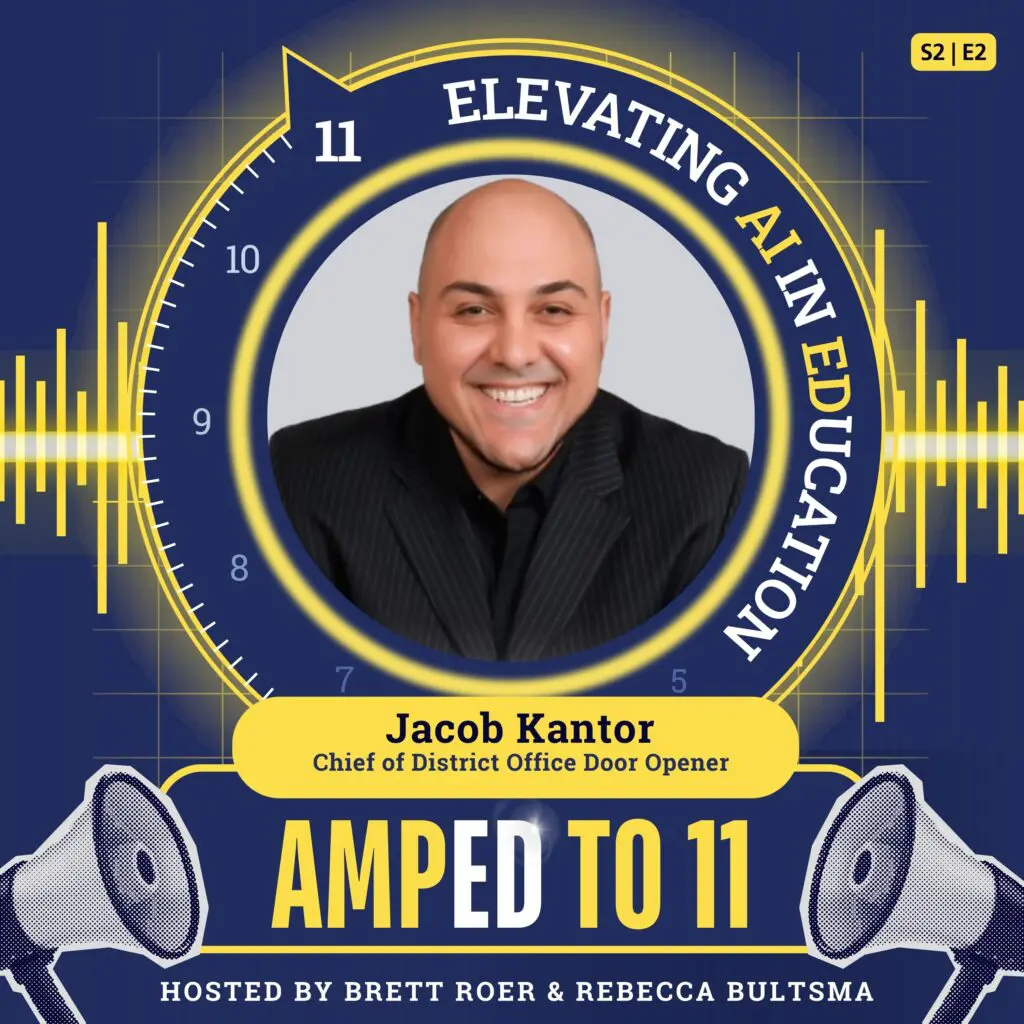
Brett Roer: All right. Greetings everyone. Welcome to the AmpED to 11 podcast, your stop for all things education, innovation, and inspiration. I am joined by my amazing co-host, Rebecca Bultsma, and we have someone who is not only a legend in the making, but his title has made him extinct, obsolete, and yet he is everywhere at once.
Brett Roer: We have the chief dodo, Jacob Kantor. If you own a LinkedIn account. Chances are you have seen his feed. Jacob, welcome to today’s AmpED to 11 podcast. It’s a true honor to have you on, friend.
Jacob Kantor: Excited to [00:01:00] be here with you guys. Thanks for having me on. Thanks for keeping me always informed in this crazy space that moves in my a million miles an hour.
Brett Roer: Absolutely. And we, as we were actually just talking about offline. And Rebecca, feel free to share it. I think you described Jacob as someone who goes a hundred miles an hour. And while you think we’re keeping you informed, I think your LinkedIn and your group texts that we’re fortunate to be on really keep us in the know about what’s happening in the world.
Brett Roer: What would you say to that, Rebecca?
Rebecca Bultsma: I would say absolutely, but I think you need to share a little bit more about your title with our listeners because I think that hook, we can’t leave them hanging that much longer.
Jacob Kantor: Sure. Happy to do so. I could even go back to the wee wee wee times of like the, the mini dodo coming to America and learning English four days a week in LA USD, right?
Jacob Kantor: So, grew up here in la. Long sales career grew. Across McGraw Hill, C2 Education, revolution Prep, college-wise Varsity tutor, [00:02:00] spark Education, and for the last three and a half years doing kind of some more strategic consulting. And you know, Brett, as you can probably attest to it too, every time you were at least myself in a room and somebody’s like, so what do you do?
Jacob Kantor: It was like, whoa, I’m like, spent 15 years selling, so like I have relationships and this and that. And then I was just kind of on a call with Ian, who’s in a lot of the, the same chats and he was, uh, you know, I like tapped him for an hour of marketing wisdom and I was like, Hey, can I like take you through my flow and what I do?
Jacob Kantor: And then off comment, he was like, you’re kind of like a dodo, you’re like the district office door opener. And I was like. I kind of like it. I might like literally just steal this. And he is like, oh, I was just making fun of you. And I was like, that’s cool. I’ll make fun of myself. No problem. But like it’s sticky and it’s good and I’m gonna run with it.
Jacob Kantor: And I think that week I was at a conference and I just put it on my badge and like a superintendent like grabbed my badge and she’s like, this is really clever. And I was. I didn’t [00:03:00] know if it was gonna be like received well or if somebody was gonna be like, oh really you have all these relationships?
Jacob Kantor: Like I did And it was so positive. So I just kind of took it and ran with it. And you know, Brett, you and I have a common friend in Tom Davis right? At anytime I went to a conference before this and I, if I knew people, knew Tom, I’m like, oh, I’m trying to be like Tom to like one 10th of his level of knowledge.
Jacob Kantor: And that worked for a while until it didn’t. So really. You know, on my end, I spend a lot of my days across organizations trying to figure out who they should be in the room with. If it’s the Department of Ed in the state, if it’s the county office of Ed, you know, in California there’s 58 of them that controls 6 million students.
Jacob Kantor: Or if it’s just an innovative district leader that will thoughtfully listen and give some feedback and, you know, we’re really on, on a hunt to find signal. And you know, I, I do my best to take a lot from Brett because he’s like the master coach in all [00:04:00] things, right? And I’m like, Hey, you know, if you go in and it’s the whole VC world, right?
Jacob Kantor: Like if you go in looking for money, you’re gonna get a whole lot of advice. And if you go in looking for advice. You’ll get advice, but you also might get some money. So I, I, I spend a lot of time upfront now with orgs to say, Hey, we have to be really thoughtful. We have to be good collaborators. We have to really try to build a relationship.
Jacob Kantor: And if you’re not working with me past our 90 days that we’re. Working together, but you can build a sustained relationship and the next time at a conference you’re speaking with that person I connected you with on a panel. Nothing would bring me more joy than like you guys hitting it off and like doing your own thing, right?
Jacob Kantor: Like, I don’t like to do the, the bottleneck of the relationships after the fact. Sorry, long-winded there.
Brett Roer: No, that was, I think, uh, our listeners are probably hearing, you know, the three of us collectively we’re on group text, but I would say like. I don’t even think there’s an [00:05:00] exaggeration probably in the past few years.
Brett Roer: Myself with Rebecca and Jacob, probably in the tens of thousands, the numbers of messages or correspondence that have gone out that I’m on with them. So I hope our listeners today really get a sense of like what’s happening behind the scenes with people like Jacob and how they’re moving work forward in education, ai, ed tech.
Brett Roer: So, you know, Jacob, you’ve explained. Kinda what you do, could you give everybody a sense of like why you do it and what does the most successful version of the work you do, what are some of those outcomes metrics again, what does success look and feel like to you in your current role?
Jacob Kantor: Good question.
Jacob Kantor: That’s kind of always a work in progress for me, right? I’m forever the like, if something’s working, double down on it. If something’s not, let’s refine it and figure out how it can work better. But you know, what does success look like? I can kind of give you two examples from just the last. Basically two and a half weeks.
Jacob Kantor: Uh, I launched two new [00:06:00] clients a week on the second, right after the holiday. And in the span, basically the second through Friday the 12th, we’ve had basically 11 meetings booked with district leaders, state leaders, county offices of Ed. So a really good response. And, you know, I, I always say that. The solution has to be really good, right?
Jacob Kantor: Like, yes, folks know me. Hopefully they trust me enough to, you know, read the emails that I send them, or the text messages or the phone calls I make. But ultimately, the solution providers that I ultimately choose to partner with have to also be strong. Like we can’t put junk in front of a superintendent and say like, oh, you know, you trust me.
Jacob Kantor: Like, let’s talk about this junk solution. So it’s really, you know, making sure that I align up front with a company that they’re solving something, that there’s a true need at, or they’re the best in class at what they do. And then one other client that launched just as of. Last [00:07:00] week, right? In the first five days, again, all credit to those companies, but in five days we’ve secured seven meetings with district leaders and state leaders.
Jacob Kantor: So like a, for it being back to school time, I’m. Excited for those numbers across two companies. Purely. You guys know these folks are like the busiest folks ever, right? Like when they’re not superintendents, they’re also parents or state leaders. They also have parents. Everybody has family things going on.
Jacob Kantor: Extracurriculars also own personal hobbies, right? Like I know both of you guys are. You know, keen on moving your bodies and eating healthy and making sure that that side is buttoned up, right? Like a lot of these folks that, uh, I’m requesting time also have. Activities that they enjoy outside of the workday.
Jacob Kantor: So really being thoughtful on, Hey, this is what the organization does, this is what they solve for, like would you like to learn more? And if no, that’s okay too. Like, no. You know, as soon [00:08:00] as I hit send, I probably won’t remember that I sent you a message by the end of the day, just because there’s so much flying every hour, if not every 15 minutes.
Rebecca Bultsma: I have a question for you, Jacob, as someone I who wrote. Research is ethics. How do you, what’s your vetting process? What questions do you ask some of these companies you work with, what’s the ethical bar that you set? What are your expectations before you move somebody forward?
Jacob Kantor: Yeah, great question. That’s definitely changed over the last year.
Jacob Kantor: I think when, you know, Brett and I spent a lot of time at ASU GSV attending sessions also like going to. Social events and you meet a lot of companies. Right. And even from two years ago, the AI show, you know, I don’t know how fresh this is in your minds, but like I probably spent four months meeting 75 of the companies that were in attendance and.
Jacob Kantor: This isn’t like humble bragger anyway, but I’m pretty [00:09:00] decent on calls. It’s hard for somebody to meet me and be like, you know what? I don’t like that guy that, does it happen? Sure. But like, not often. But I met 75 of those orgs and you know, I didn’t end up working with any of them and I had this like, you know, like a late night session with myself.
Jacob Kantor: I was like, am I not communicating clearly my value prop there? Is the company too early? Did they spend all of the money already on hotels and conference registration and all this stuff? And I kind of came to the realization that, you know, a lot of those orgs were quite early in their stage, right? So now it’s kind of refined in.
Jacob Kantor: I do a lot of upfront level setting on do you have data? Do you have efficacy? Do you have pilots already running? Do you have tangible evidence we can present to somebody to say, Hey, this is what a different school or district or system is doing. [00:10:00] You can replicate this to a T with your students because we know all students are a little bit different.
Jacob Kantor: But if we can thoughtfully align, then we can have similar results. So really around like, you know, I’m sure you guys are, Brett, I know your work with ISTI, so ISTICO or Digital Promise badges, or you know, in structure. Efficacy. So really that side of the house is really important. So I do a lot of screening upfront.
Jacob Kantor: I think on my end, I launched a website basically nine weeks ago and I’ve had something like 21 or 22 companies submit information to say like, Hey, we’d like more info. And I am like very strict in advance to like put somebody through a screener. And I think I’ve only. Talked with three of those 22 companies, not because I don’t like, like the solution, not because the founder doesn’t have a huge goal, but purely I’m very particular on do you have a [00:11:00] demo?
Jacob Kantor: Do you have accounts you’re already working with? Like, what kind of data are you seeing from the schools you’re already working with? Because those are basic questions that everybody’s gonna ask within the first 10 minutes of a call, right? Like, this sounds awesome. Where are you working already? This sounds awesome.
Jacob Kantor: What kind of results are you getting for others? Like, how does this work in a district like mine or for wherever this is across the country?
Brett Roer: Yeah. I think the, what you kind of highlighted there is, you know, there’s so many different things to consider, both in your role working with the anti companies and the uh, district leaders of the districts.
Brett Roer: You have to think of these questions to make sure it’s an ethical decision to match all these people. And obviously we know our district leaders, that’s one of the biggest challenges they’re facing is making sure who do they trust in this space. And you need some great, uh, nonprofit organizations that do that work.
Brett Roer: And having someone like you who again, has seen so many products and really has a sense of what. Should be in the hands of, uh, educators, students, children, [00:12:00] faculty. So that’s incredible. You have, I, again, someone who got to watch you like literally first use AI to what you’re doing now, today. It’s so clear you’ve truly been going deeper on, uh, your AI journey.
Brett Roer: So you know it’s amp to 11. Some of our questions are 11 themed. We talk about Reggie Miller. My arch nemesis as a Knicks fan, he wore number 11. He always came through Clutch and now he’s got the reincarnation in Halliburton. Like we’re reliving this tragedy again over in here in New York City. What is an AI tool that you’re currently using that really goes beyond your wildest expectations, especially when you needed it to, uh, currently or in the past, or, you know, what are you using right now that’s really changing the game for you?
Jacob Kantor: So for me, one of my biggest pain points. Truly across district leader scheduling across my calendar, across the organization’s calendar, across the sales rep at the organization that I have to set up a call for was really like this back and [00:13:00] forth of when are you guys available and are you free on Tuesday?
Jacob Kantor: And like, so I’m going super old school ai, which I don’t even know if it’s truly an AI product, but something as like. Basic, but not basic as like Calendly and tidy cal, even though it is not like the shiny AI tool that like helps me in everyday interactions with my kids if we’re looking something up.
Jacob Kantor: Like something like that for me has been a true game changer because it eliminated the back and forth and now like. It’s so easy, right? Like it makes life so easy to truly schedule and not have to worry about things and crossing schedules. I know Brett, you, when we worked closely together, right? We had like shared calendars where your calendar was in there.
Jacob Kantor: My calendar was in there. My other emails calendar was in there. We had another person’s calendar, so it was like, when are we [00:14:00] all. Free only Tuesday at nine o’clock. Cool. That’s available. So something as basic as like Calendly or Tidy Cal, I mean saves me hundreds of hours. Hundreds. Like I would pay quadruple what I paid Tidy Cal for that access.
Rebecca Bultsma: Before you hopped on for this podcast today, I was telling Brett that I’ve been experimenting with this new, uh, tool within Google, actually, that has an automation feature right in it, where as soon as the call ends, sends the transcript to ai, writes a summary, drafts you a follow-up email, puts the tasks in your task management and leaves it in your drafts of your email to, for you to like human review and send off.
Rebecca Bultsma: So I just think. Where we’re going is just even better ways to customize and streamline our lives. And I know you love to customize because I have seen your shoe collection. I’m pretty sure the three of us have a matching pair of Nikes, right? Oh, do you have ’em handy? Oh, oh, oh, there they [00:15:00] are. Wow. He knows his shoes Well, wow.
Rebecca Bultsma: There, there they are. That’s one of the better ones, man. Well done. It’s nice work.
Jacob Kantor: I’m, I’m gonna leave them out there for you.
Brett Roer: Oh wow. Okay. Also speaking of this, so you know Jacob, something I think you’ve shared before, right? So I just wanna give you some credit ’cause I’ve, I’ve seen you either post about it or maybe it was something you’ve shared with me or some other people is so like you have a busy calendar.
Brett Roer: So this is really applicable to any of the spaces, ed education, ed tech, what we’re all doing. I think it was you who’s like, you can go into either your Calendly, tidy Cal, Google Calendar. You can basically like get all of the meetings you’ve had recently. So you can look at like the last quarter or month or week and start to analyze.
Brett Roer: You could throw into any large language model or AI tool and be like, what? Gimme trends, what am I spending most of my day doing? How often am I meeting? Like, who does this seem I’m meeting with most? And I actually just adopted that. Uh, yesterday using Notebook lm I started taking all of my transcripts from all of my meetings and putting them into a single notebook for that week.
Brett Roer: So it’s like, okay, what did I do that week? Like what are the high level [00:16:00] things I talked about? It was so helpful to really start using Notebook lm, but. You definitely were someone who I think gave me that first inspiration. So. Thanks for that. That really has always stayed in my head is like, I need to be more thoughtful about how am I looking at how I’m spending my time.
Brett Roer: I dunno if you remember that, but you know your thoughts.
Jacob Kantor: Yeah, yeah. I am. I’m the weirdo that loves some Tony Robbins and Sahil Bloom and so I, you know, in my ears always constant betterment of self health. Whatever. So on my end, you know, they nudge, it always comes at, Tim Ferriss does this as well, right?
Jacob Kantor: They always do like a year in review and it’s less of like, here’s all the cool things that happen. Here’s all the positives, the negatives. It, it’s really an assessment of energy on where you’re spending your time and what is giving you maximum amount of happiness. Versus what’s just stealing your joy.
Jacob Kantor: Right? So [00:17:00] as I read this, I think Tim Ferriss calls it like the fear, like fear setting is one of the, where he literally like, what’s the worst thing that could happen from this decision? And like if it’s I’m out some money or I have to say sorry, like that is not that bad of a, a thing to be afraid of.
Jacob Kantor: But it really kind of shifted how I looked at how I spent my time and, you know. We’re all parents, right? Like I do drop offs in the morning. Mondays, we have speech therapy. Thursday we have speech therapy. Last year we had Tuesday and Wednesday speech therapy. We have karate, we have basketball. So on my end like it’s.
Jacob Kantor: As the kids get older, we’re only gonna get busier with the amount of things that are on the calendar. So I really try to protect my time at all costs. And that, that goes back to kind of your first question, right? Of like, how do I vet these solutions? Um. [00:18:00] Very intentionally, right? It’s very 80 20. And that’s not to say, you know, if you’re listening to this and you’re like, I, I don’t want to talk to Jacob, he’s gonna reject that.
Jacob Kantor: That’s not the premise of why I say this. Like, I’m rooting for everybody. If you wanna impact kids’ lives, like I’m gonna be your cheerleader. Uh, but you, we just might not work together because time is scarce and like, I, I’m trying to kind of do the biggest, the biggest things that could move the needle with data, with efficacy, with.
Jacob Kantor: Traction, right? Like I, I, I wanna work on some of the largest things going on. And sometimes while those founders have great ideas, great products, it’s really pushing the boulder up the hill. To get them to their first, you know, pilot adoption, whatever their, their goal is, right? So I I, I do my best to really protect my time and I think a lot of it is, you know, that’s a great use case of Notebook LM that I haven’t even thought through, right.
Jacob Kantor: Of literally, I. Housing, all meeting notes, [00:19:00] and you know, on, on my end, I do something on Thursdays that I literally have a nerd reminder in, right? Like I recap the week and say, Hey, like these are the folks I’ve met with. Like, thanks for spending time with me and. Initially like it was, Hey, I’m on Monday with Google Tuesday with Gates Foundation Wednesday with Chan Zuckerberg, and I was like, nobody knows about any of this stuff other than my calendar.
Jacob Kantor: So like, can I give praise to those people who spent their time with me? But now it’s turned into on Thursday, it reminds me of all the stuff I did that week. So it’s like a dual exercise for me. ’cause I’m like, I’m pretty good at follow-up, but I’m like, oh yeah, we talked about that and I owe them like this other person that I told them that they needed to meet.
Jacob Kantor: So it serves kind of two different things, right? It’s giving some praise to some people. We spent time with me, but also reminding myself of like. Here’s who I met and here’s what I do. And again, like yeah. Sharing a personal story, [00:20:00] right. I also have nerd reminders for family stuff, right? Sundays IS re send a recap to my son’s email that’s been created since he was born, and he gets a.
Jacob Kantor: Digital digest of like, here’s the photos that came from school this week. Here’s what we did. We, last week we celebrated mom’s birthday, we had cake, we went swimming. Here’s the photos. Is Eddie, anyone ever gonna look at that? Hopefully, but it, it brings some joy into my life that when he’s 12 or 13 and he is using email, like he’s gonna be able to like nerd out on.
Jacob Kantor: Every single week, dad’s sending a weird email with photos and videos and like Disneyland, whatever, whatever the activities were.
Rebecca Bultsma: You keep saying Nerd reminder. Is that like an actual branded thing or is that like a dodo thing? Tell me more about
Jacob Kantor: No, that, that, that’s more that I think some of the stuff I do like I, I do it and it brings me joy and then I talk to my wife about it and she’s [00:21:00] like.
Jacob Kantor: That’s weird.
Rebecca Bultsma: I have that same experience, so I’m glad I’m not,
Brett Roer: we have many of those, unfortunately. We’re, we’re just all, uh, we’re just tortured. We’re just tortured artists, right. At the end of the day, you know, Jacob, you said something, uh, that I really wanna highlight because it’s so applicable and transferable to educators out there, especially leaders.
Brett Roer: And I actually had, as I’ve shared on this podcast, I just, I’m really fortunate, just onboard a chief of staff and she has been like asking me the most. Innocuous, uh, discovery questions and I keep being like, oh yeah, I used to do that when I was a leader all the time. And like, oh, I give that advice to leaders and I haven’t had someone really an, uh, analyzing my own process.
Brett Roer: So two things we talked about today were one is what you just did, um, where you talk about those recaps are so incredible ’cause it’s. It’s obviously great for you to showcase and give praise to other people. Um, and it’s also a reminder of you, of how important the work is you’re leading. So there’s this amazing podcast, uh, Amy Poer, right from Parks and Recs.
Brett Roer: She has her own podcast now, and she does something at the [00:22:00] beginning of every pod where she brings on a friend of the guest without their knowledge, and she asks them questions and she says. We’re gonna talk good about them behind their back. And basically when I was a principal, we always did that. We had a weekly, we call it the Bronx Beat.
Brett Roer: And it was basically just me walking around like who’s awesome, who did something awesome this week? And then we cheered on Mondays and it made me feel like that’s what I wanna start doing on LinkedIn is a weekly, I’m gonna talk good behind people’s back and ask people to also talk good about other people’s back and kind of bring like a positive cycle to the week of like who, who’s just so amazing people should know about.
Brett Roer: And you know that saying of like, yeah. Your character’s really what people say about you when you’re not in the room, and like, why don’t we do that more in a specific way or, or systemic way, or a nerdy way as you or you or your wife would call it.
Jacob Kantor: You know what that reminds me of as well? Do you guys remember during COVID as we were living the same Zoom life we are on now, that Jim from the office that show weekly that he dropped, it was called some good News.
Jacob Kantor: Yes. [00:23:00] And like that was my favorite time of the week where he just highlighted like. You know, first responders that were getting a parade, a car parade from kids that they were so, like, all these like good things that just like flooded you with a ton of dopamine, uh, and all good feelings. So like I, I’m right there with you, right?
Jacob Kantor: Like, uh, it takes no effort whatsoever to make somebody else’s day, right? Like I, I’m very fortunate during my career. It’s very 80 20. That applies to so many things, but 80% of the bosses I’ve ever had are still dear friends. I still talk to them regularly. I was catching up with one on the way home from drop off today.
Jacob Kantor: Right? Purely because not only did they see my work ethic and like obviously we worked together for many years, but when I hit my goals, they hit their goals. So we like mutually aligned in the beginning like, Hey, I’m a sales rep. If I hit my goals. The company hits their goals, but like, [00:24:00] what does this do for you and your family?
Jacob Kantor: Like, are you taking your family on vacation? Are you trying to buy a home? Are you trying to save for retirement? And I would just be like, I am an immigrant kid and I’m building for my family and like I’m looking to buy a home. So tell me what you’re trying to do. That way when we talk and we are talking about the ups and downs of sales life, we could also nudge ourselves to.
Jacob Kantor: Center ourselves on what the big goal is and like, again, just those influential leaders, those VPs of sales or those CEOs that I’m still close with, like a shout out to them for hiring me and seeing something in, in myself, right? Like the best coaches are the ones that see something in you that you don’t even see in yourself and like, you know, praise to them for having that confidence in me.
Rebecca Bultsma: I love how you bring up that kind of, as Simon Sinek would call it, the giver’s mindset. I, I think that’s so important, and you’re throwing me back to [00:25:00] those COVID days when everyone was craving things like that, and Ted Lasso was like the number one show, and that’s what people wanted. So in the spirit of a giving mindset, we’re actually going to flip the script and give you an opportunity.
Rebecca Bultsma: To ask us questions. It’s one of our favorite kind of plot twists that we like to do on the pod here, and give the guest a chance to ask us anything they’d like and make you for the next five or 10 minutes. The official host of the Amp to 11 podcast, we are giving you that gift
Jacob Kantor: for each of you guys. Who is somebody that you’ve met in our education, ai, nonprofit, wherever, school leader space that you’ve met recently that you were like, oh my gosh, you run at the same speed that I run.
Jacob Kantor: Like, we’re gonna be friends.
Rebecca Bultsma: Honestly, I think Brett was that person for me. Like, you know, we met, we only met like a year and a half ago and uh, we were just so aligned on a lot of things. I think, uh, [00:26:00] Carolyne, Quintana is somebody that I think is amazing and I look up to. She’s someone that. Brett introduced me to, and she is like a powerhouse female leader in education and tech and leadership, and she’s probably one of the, one of the most memorable people that I’ve kind of met on this path, and I’ve been lucky to cross paths with her.
Rebecca Bultsma: Brett probably has 10,000 people to choose from. I, I live in Canada, so my list is shorter. You know what? Coincidentally, I’m gonna keep it NYC centric, obviously Carolyne Quintana an incredible leader. Um, she’s nationally a great, she pushes the work forward in so many districts nationwide, but she’s obviously, uh, much of her amazing work was held, uh, done right here in New York City.
Rebecca Bultsma: I’m gonna shout out another person from New York City because Jacob, I think when you talk about the idea of like the speed they move at, um, is Tara Carrozza and. She, uh, has led so many of the incredible initiatives across New York City public schools, the largest school district in the country, especially when it comes to like digital learning and innovation is her [00:27:00] official title.
Rebecca Bultsma: But on a national level, you know, people look to New York City for guidance or to be a leader in this space, and she. Works with an incredible team and obviously she’s so great at like amplifying others, right? If people are doing great work above her, she wants to make sure the leadership gets the recognition.
Rebecca Bultsma: The people on her team, she always tries to make sure they get recognition and when she sees something innovative, when she goes and speaks, you know, she’s a prominent speaker like ISTE or ASU GSV or any of these places. She’s constantly in the lookout for like who’s doing things ethically, who has the right values, how does this help students meet whatever the current challenges are in New York City.
Rebecca Bultsma: And so like. Having someone who cares so much and is so incredibly smart in that position, like. The impact that has on almost a million students is just like infinite. And the wrong person having that kind of role in New York City or another large school district or anywhere just could totally set back a community.
Rebecca Bultsma: So [00:28:00] that’s someone who’s running a mile a minute. ’cause the work’s super important and just someone who tries to do it all with like a great sense of humor and whatever the next hurdle is, she knows like she’s gonna keep doing it because it’s in service of kids and her values. So that’s my shout out.
Jacob Kantor: Two great ones. Yeah, well for sure tag them so they can listen to the praise they got on that same wavelength. A similar question, so those were on the educator side. How about on the solution side? Like who have you met recently that like absolutely blew your mind on not just the solution but with like how they thought and how quickly they moved?
Jacob Kantor: Quickly. They moved. Might be a, a stretch for some. That might be earlier.
Rebecca Bultsma: Okay. Then I’ll give you a, I’ll do two answers for you ’cause there’s two amazing people I wanna highlight. One is the founder of Prisms VR. So her name’s Anurupa, and there’s a few reasons I wanna highlight her. Again, I’m thinking of the Mile a [00:29:00] Minute mantra, and I’ve never met anyone who was that busy because again, her passion is making sure we change the trajectory of.
Rebecca Bultsma: Math and science outcomes engagement. And so not only did Anurupa put in her time as a public school education leader, actually right here in New York City and Boston, but you know, she’s like an MIT grad. She cares so much about, uh, making sure that students learn through spatial reasoning, how math plays a role in everything.
Rebecca Bultsma: And then she creates this VR tool that’s like meaningful and makes kids. Want to come to school to the point, there’s actually data that shows prisms days are higher attended days for students. So I just cannot get over how much this woman pours into this. It’s her life’s work. It’s like the culmination of her passion and her knowledge.
Rebecca Bultsma: So that’s someone that’s just amazing. And then someone else I wanna highlight is, uh, I believe he’s, I don’t wanna get his title wrong, but he’s the CEO I believe of Brisk teaching. His name’s [00:30:00] Armand. The thing that I really appreciate about Armand is both in person and in his writing. If you follow him on LinkedIn, I’m sure he does at other places, he can name a problem and then very thoughtfully explain how that problem, like risk has been a solution in that space and like why they were intentional about like.
Rebecca Bultsma: This is how we decided to do it. Here’s, those people might have initially thought that were skeptical, but like, we thought it would work this way. And luckily it has, but like it’s not, um, bragging in any way. He also did a keynote at an AI summit we held in Ohio where he and I give him this praise all the time.
Rebecca Bultsma: I’ve told this to his face. So like speaking good behind his back and speaking good to his face. He kept prefacing, you know, I’ve never been an educator, but. Then he would go on to explain the modern day educator and all the different tools they have to use and all the systems they have to navigate no passwords for and help students with.
Rebecca Bultsma: And he just kept being like so clear and everyone is nodding their head like, that’s literally my life. I’ve never seen anyone [00:31:00] break down what it feels like to be in the classroom. And then how do you use some of these tools? Better and more effectively to like just be a better teacher and like not make it feel so burdensome and that you are doing well and there are tools that can help you right away with less friction and less adaptability.
Rebecca Bultsma: So those are my two, um, that I wanted to shout out. So, uh, Rebecca, I hope that that did you justice. I appreciate it. I’ll take the brisk one ’cause I think I’ve actually met him and he was a great guy and I follow him on LinkedIn, but I’m sure they’re both great. You’re good at this. Jacob. We might have to bring you into guest co-hosts sometime.
Jacob Kantor: Can I flip it? I give a couple of mine if that’s okay. Yes. You know the engagement wise, you know I’m an engagement person on LinkedIn. If we mention them, I’m gonna text them all and be like, we were talking about you. You’re gonna have to listen. If it was good or bad, I don’t know, but like. Ben Kornell and Alex Starlin.
Jacob Kantor: Right. What they do with Ed Tech Insiders, right? It like that was a passion project three years ago with five [00:32:00] episodes and now they have Sam Altman join and Hillary Clinton and like the biggest names of in every space. So they’re doing some good work. Patrick at Linwood, the brand new superintendent, like.
Jacob Kantor: Probably top 10 most AI forward thinking superintendents in the nation. West in Orange County, same thing. Uh, Sophia Mendoza at L-A-U-S-D, Rob Dixon at Wichita. Like these are like the state leaders of the largest districts in their state. That are thinking about things differently, right? Like they’re experimenting on how a they can use things and then how that applies every day.
Jacob Kantor: Julia Fallon, Dr. Conner, Mike Yates at Laco, Chris and Alice, right? Like these are just people that are thinking about education differently, right? Like they’re looking at it and saying. I’m removing my judgment on what I think about this and is this good for the kids [00:33:00] that I serve? And if this is good for the kids I serve, then let’s have a conversation about how we can serve them better.
Jacob Kantor: And like, those are my people, right? Like those, I can always jam with folks that are trying to move the needle for kids like, like myself, right? That came to America. Didn’t last one day at the school that my parents put me at and I had to go to a different school because they didn’t have the supports I needed, which was great for me.
Jacob Kantor: Right? Like thank, thankfully there was a school nearby that was able, but like I, I think about these students that are, you know, going to class. I’m sure you guys saw some of the articles this week about, you know, it’s not your kid that’s falling behind, it’s just your kid that’s boarding class and like you’re seeing a lot of solutions that are.
Jacob Kantor: Coming to the front center of like, Hey, if we engage students in a different way and they’re actually learning things that they’re interested in, are they gonna show up to school? Are they gonna participate? Right. You talked about Anurupa, [00:34:00] right? Meeting her years ago, and it was hard to coordinate a meeting.
Jacob Kantor: Because every day she was in a different state and I was like, I don’t know anyone that runs at the speed that I do, but like, I’m tired for you. So it’s awesome to see the, the success that she’s had.
Brett Roer: You’re still the host, Rebecca. Are we taking the reins back or Jacob, you got a final, you got a final, uh, question you want to make sure you get to.
Brett Roer: This is your only chance to be the host of this podcast.
Jacob Kantor: Who is, for each of you guys, who is the dream guest? That like in the, and it could be education related. You could also throw, uh,
Rebecca Bultsma: no question, no hesitation. Ethan Mollick. Ethan Mollick. I’m tagging you in this. Come be on my podcast or just gimme a call.
Rebecca Bultsma: I just wanna pick your brain for like half an hour.
Brett Roer: I mean, present company excluded. I have to say, and I mean this, like this is not, uh, as you said before, Jacob, right? I’m saying this very humbly and like very gratefully like. We actually haven’t, [00:35:00] we’ve literally anyone we’ve asked to be on this podcast has come on the podcast.
Brett Roer: We haven’t had a single person turn us down. Scheduling sometimes gets in the way and like rescheduling, but like. It’s really just who, Rebecca, I think are like, like an Ethan Mollick. If we’re like, that’s who people need to hear from or deserve to hear from. We’re very fortunate that we know so many of these people, and my dream is like, I want people to hear all these behind the scenes stories and like insights that we’re so fortunate to get.
Brett Roer: So if I don’t know them already, it would be very hard to say who I want my dream to be. But like, like what Rebecca just said, resonates. I mean there are so many. I would love to have some of the leaders, like the true people who are building these tools, like for the largest large language models and AI tools, just to like kind of nerd out and be like, well, why did you do that?
Brett Roer: Or like, what could happen if so? If you’re someone who’s the leader of building these amazing [00:36:00] tools in the space of ai, and especially if you’re thinking forwardly about how this impacts students, teachers, the world of education, and obviously the bigger picture, like, come on the AmpED to 11 podcast. I would add Mustafa Suleyman to mine just because he’s like head of AI at Microsoft right now, and he wrote a book called The Coming Wave that I read a couple years ago, right on the early days of generative AI on the heels of it.
Brett Roer: And it’s like a big. Big ethics kind of book, and I am, I am pretty sure that’s what drove me in the direction that I went, him asking all of those questions. So to see him asking all the interesting questions and important questions, and then him also being a builder, like Brett said, I, I follow those.
Brett Roer: Builders. Oh yeah. Uh, Mira Murati I would love to have on the podcast too. She is amazing. And, uh, she was at OpenAI forever with Sam, and now she’s has her own lab. So sometimes those female builders in the space, because there aren’t [00:37:00] as many of them. Yeah, I, that’s a good question. I like it.
Jacob Kantor: Sam and Sia. At Open AI would be great guests to talk about higher ed and also the K 12 side of what Open AI is doing.
Jacob Kantor: Wes and Steve at Google are great, like behind the scenes, you know, Google operates at its own unique pace, but also speed. Um, those, as you were talking, I was like, oh, the builders behind the scenes that are like making an impact for, you know, huge amounts of students. They, they would be great guests for sure.
Rebecca Bultsma: Love it. We’ll have to have you make those intros for us.
Jacob Kantor: No worries.
Jacob Kantor: That’s
Jacob Kantor: what I do.
Brett Roer: We’re gonna make sure we keep talking about some of the major people that you know, inspire us. We’re gonna talk good about a couple more people before we take off on our final question. But, you know, you’ve talked so much about your children and obviously that’s one of your main whys and drivers and you know, you’ve shared posts that you’re very trying to be as active as you can as a parent, both in extracurricular, going to coffee [00:38:00] with the principal.
Brett Roer: Here’s what I’d love to hear from you, right? It’s AmpED to 11, so your kids are just a little bit younger, but in a few years, time’s gonna fly and they’re gonna be 11 year olds. So you talked about the crisis of lack of engagement. The question you, Jacob, is if we get it right over the next few years with AI education innovation initiatives.
Brett Roer: What does your kids’ classroom look and feel like when they’re 11? What do you hope? What do you dream it looks like?
Jacob Kantor: You know what’s funny is I actually ask myself that quite often as we’re doing homework in the evenings, right? My oldest, Luke, he’s six, he both kids started at new schools, one’s in a specialized.
Jacob Kantor: A USD TK program, one’s in a highly gifted school. If you asked me this question about a year ago, I would say that I would. Be supplementing tremendously, right? Like we talk to chat GPT voice all the time, as you guys can relate, right? It’s six 30 and it’s almost [00:39:00] bath, bathtime, and bedtime. And I’m like, oh my gosh, I’ve answered every question imaginable.
Jacob Kantor: Like, we need, I need a sub here. And, and a a, a friendly patient person to answer questions, but I think a lot of it is really like. Could they be learning what they need to learn? Math, science, you name it, we’re on the human body right now. Then we’re moving on to fables in my son’s class. But could they be learning the things that they’re learning in school and could I be supplementing it using AI and reinforcing what they’re learning?
Jacob Kantor: With their interest, right? Like I’m sure everyone’s aware that’s listening. K-Pop Demon Hunters is the largest show F folks ever had. We may or may not listen to it on the way to school every day. Like don’t know, no comment here, but like, you know, that is like a hot button thing that my 6-year-old is into right now.
Jacob Kantor: He knows all the words of the songs. [00:40:00] We have assignments coming up where he has to memorize something for a class presentation at six, right? In first grade, like this is a very high, high level program. Like, could I, as a parent use AI to supplement what he’s working on, or even like giving him information in that style.
Jacob Kantor: Like, can you watch something? Or could he take a quiz at home using Netflix content for learning or whatever. Like some version of that where it’s hyper-personalized to what he needs to learn, but also hyper-personalized to what he is interested in. ’cause I’m sure we’ve all seen this as parents, right?
Jacob Kantor: Like. If they’re into dogman, which we’re into now as we just started reading, like they could spend hours doing that. If it’s my choice of book from the library, it could be a five minute activity, right? So [00:41:00] like giving them the ownership, I’m really interested in this. How can I do more learning? And I’m really into that.
Jacob Kantor: So like just thinking about things like that of like, how can I personalize? Things to my student where this activity of learning becomes excellent and excellent is like a high bar, right? That’s like, I wanna keep doing this dad, when the time is up. Like that doesn’t happen often.
Brett Roer: So I just wanna say, obviously like what you just described is like exemplary, like parenting, right?
Brett Roer: And really knowing your child and doing all this extra support. You know, I kind of guess what I hope, right? I could, I could push you further and say like, great, now what do you want school to look like? But I think you’ve just described this is what we hope school looks like. And then the bigger question that maybe, you know, will, I’d love to turn back to you, is like, so how do we do that at scale?
Brett Roer: Right? Not everybody has a Jacob at home. How are you thinking about that when you, [00:42:00] you know, try to take your own personal, uh, experience with your child and their homework and how you want them to succeed and feel eng feel engaged and wanna keep going the extra mile? How have you like internalized that into the work that you lead?
Jacob Kantor: Great question. So I think some of it comes down to, you know, both of us were at, you know, the Google AI day, right? And I remember as we were going from table to table, right, like that was still have the badge nerd again, still have the badge and got some headphones. So shout out Google. Um. But I don’t know if you remember like the table that had learn about and then there was one table that had like VR museums that you can visit.
Jacob Kantor: There was one table that like mapped out college and career options based on what the student is into. Like there was so many, like I walked up to friends at Google where I was like, that product needs to partner with that product. And together you guys. Would accomplish way more than separate. So I think there are [00:43:00] already a ton of tools out there that can truly move the impact.
Jacob Kantor: Right? Like at ISTI, Google released it’s 50 tools, which I can’t say I’ve played with personally just yet, but I know what they do. But like there are so many different things out there that could make reading, learning. Presentation, you name it. Whatever a student is working on, it could really amplify.
Jacob Kantor: Right. Going back, Brett, that is uh, I love that word, right? It can amplify the learning to get that student very. Interested and excited and whatever words we wanna use, right? Like, but that is like, I’m seeing it now in my 6-year-old and credit to the school he’s going to, I was not seeing the same thing at the previous school.
Jacob Kantor: Not to say it was a bad school. We had a killer teacher. She was pheno. I would like, I would hire her one on one, like. She was [00:44:00] amazing, but it was not the same kind of rigor or challenge for my student. And like luckily we live in an area where we had the options to apply to other schools. Right. And I’m cognizant that in Dallas or Mississippi or you, you name it wherever across the country, those options aren’t similar to what I have here in Los Angeles.
Jacob Kantor: So like. I, I think as time goes on, right, there’s gonna be more and more options available. Sorry, long-winded here. Ben Cornell told me a story yesterday. He’s on the board of Oklahoma University. He said in Dallas, because Oklahoma University is an SCC school. The most amount of students that go to Oklahoma live currently in Dallas.
Jacob Kantor: I was like, I, I, I’m not picking up what you’re throwing out. Tell me [00:45:00] more. And he said, Oklahoma’s on TV every single Saturday, free advertising to all students. If you don’t want to go to a Texas school, who do you see on TV playing your local schools? Oklahoma and other schools. And they have an online program.
Jacob Kantor: So there’s tons of students that are doing online college in. Dallas, Texas that go to Oklahoma for their four year degree. And I was like, that totally makes sense. I wonder how many other colleges are giving these same level of opportunities. And I know that’s higher ed and less on the K 12 side, but sorry, I wanted to share as that was like, wow.
Brett Roer: Yeah, no, I mean, thank you for like, I mean, you nailed it, right? Like that’s what everything you’ve said, hopefully. All these amazing educational technology partners, district leaders, kind of heard Jacob’s vision. Um, because that’s what we want our kids to feel like. I can say the same as a parent of young [00:46:00] children.
Brett Roer: Like that’s what it should feel like. Um, and I hope that we continue to push that and the work we’re all leading continues to just move that forward. Um, alright. Somehow we are wrapping up here with our final and favorite question that again, is an homage to the things you do by shouting out people every week.
Brett Roer: And when we use the phrase amplifying and elevating people, we use the Ocean’s 11 analogy, right? You wanna make that vision of what you said for your children and other children, a reality. In education, we’re gonna change education. The world of ed, tech, innovation, ai, it doesn’t have to be exactly 11 people, but you’re pulling off this amazing challenge.
Brett Roer: You gotta assemble your dream team, your crack squad. Who are you putting out there in your oceans? 11. And then talk good about ’em behind their back. Who are the people that need to be part of your crew to transform the world of education, innovation, ai.
Jacob Kantor: Some of them I think I’ve mentioned before, which is funny.
Jacob Kantor: I’m a nerd on [00:47:00] podcast. I might be the only one that still takes notes, uh, to as reminders. But um, for sure Ben Cornell for sure, Dr. Michael Conner, Mike Yates is always. Challenging my thinking. Patrick, the superintendent from Wynwood West, from Orange County Department of Ed, Sophia Mendoza from LA USD Kunal, who’s a great resource.
Jacob Kantor: All things ai. Dr. Sabba has become a good friend and challenges my thinking, Rob at Wichita Public Schools, Julia, Fallon, Chris and Alice from Waco like. Just change agents, right? Like I think if they were here with us and like hopefully, you know, we’re giving them praise, I’m gonna nudge them all to listen.
Jacob Kantor: So hopefully we get at least 11 a new listeners out of this. Fingers crossed. But really like, I think you nailed that idea really well and I haven’t heard it expressed like that. Right. But like, I think I posted about it months ago. Right? Like, does your work product. [00:48:00] Does your reputation? Does your relationship, does your does is who you are?
Jacob Kantor: Are people behind your back propping you up? I would. I would hope that for the three of us, that if anyone is in the room and somebody mentions one of us, that people are like, man, that person, like they did so good by me. They helped me do this, or, or maybe not, maybe they don’t even know us, but they’re like, oh, I actually learn a ton from that person and I actually don’t even know them.
Jacob Kantor: Or, I listened to them on this and I got a good idea in a, and expanded my mind. Right? So like, I, I hope that the folks I mentioned A, listen to this, they’re all busy people, but B you know, I’m always propping them up. Uh, and I hope. You know that they’re doing the same for others in their lives that are truly making an impact for them.
Jacob Kantor: So I think, you know, that reframe for me is a good [00:49:00] one. Thanks Brett. ’cause I, I think we could just do amazing things for people when we’re like, have you ever thought to talk to that person, that person that is doing exactly what you are trying to solve for? Like this is the person to talk to and like.
Jacob Kantor: Sometimes it’s an amazing conversation. Sometimes it’s a business opportunity. Sometimes it’s parenting advice, right? Like nothing screams LinkedIn like me asking about speech therapy for my son, right? And getting like 20 responses from like founders that are working on speech therapy and like meeting with them and one person was like the Siri.
Jacob Kantor: Person at Apple that’s working on speech. I was like, this is the most random LinkedIn stuff ever. Right. But like, cool, like I would’ve never thought that there was an opportunity to meet others that are building in the space. And that’s hyper specific to me and you know, my family. But I venture to say there’s probably a million [00:50:00] kids out there that are also working on speech daily, if not every other day with their families at home.
Jacob Kantor: So really, uh, looking at like. All of our collective things that we’re working on daily and also remembering that like we can, all others can benefit from the things we learned too.
Rebecca Bultsma: I love it. That’s kind of the moral of why we are all doing what we’re doing, right? To share our learnings, to help other people along the way.
Rebecca Bultsma: And uh, we’re all trying to make sense of this together and I think we all come at it from very different ways. But again, I think all is operating from that giver’s mindset, what we can give, what we can share from what we learn. I think you just gave us the perfect wrap there, Brett. I’ll let you, I’ll let you kind of get the final thoughts, but I thought that was awesome.
Brett Roer: Yeah. Jacob, when you started talking, I was like, oh no. Did he hear Ocean’s 1100? Because I was like, this guy can go on for years. Uh, shouting people out. So, um, one thing that makes me know we got something right here. You know, you asked this [00:51:00] before when you took the reins about like Dream podcast guests.
Brett Roer: Many of those folks that you just named have been guests of this podcast, which again, is like so humbling and many are already booked for season two and many are on the list of who we’re gonna reach out to once we get through the first few episodes. So like. That alone is so encouraging. ’cause again, you’re someone who really knows the space well and again, knows people who are doing great work, who are change agents, who are just good human beings at the end of the day.
Brett Roer: And, um. I really just want to thank you for being on here and sharing all these great people, and you always have talk about this abundance mindset. There’s enough space for everyone to win, and if we actually all take that adopted, uh, position as everyone win, the kids win, the world wins, education wins
Jacob Kantor: abundance.
Jacob Kantor: I forgot about that word that you and I talk about all the time, right? And I’m reminded of it constantly, right? Like I’m living the American dream. As a first gen kid, and even though sometimes mentally I think it’s zero sum, it’s not [00:52:00] there, we could all win. We’re all on our own hero’s journey for whatever we’re working on and like.
Jacob Kantor: There’s a world where everybody wins and everybody helps each other win as well. So it’s, it’s great to be with you guys. Thank you guys for thinking of me. But by the way, you guys are on my list too, right? So like, if we’re going Avengers, we gotta have you included as well. So, uh, come to the Avengers.
Rebecca Bultsma: We will join.
Brett Roer: Yeah, absolutely. So again, thank you Jacob. Thank you to all our listeners out there for joining us on the AmpED to 11 podcast. I hope this has left you inspired and invigorated. Um, looking forward to our next episodes. Thank you all very much. Thanks for listening. Have a wonderful rest of your day.