Harl Roehm: [00:00:00] AI when it first came on, we used it as a souped up Google and everything was there and now it’s trying to teach the kids that there’s a time and a place for it and how you use it and what you can do with it. But it’s not a substitute for thinking.
Rebecca Bultsma: The way these tools are designed by their very design is to make you rely on them and addicted to them and to show you what you want over and over and kind of damage your attention span.
Rebecca Bultsma: I just dunno if kids are capable of controlling themselves. I don’t think adults are capable of controlling themselves around social media often
Harl Roehm: We had a generation of great thinkers that invented stuff because necessity was the mother of invention, and now we got people who live and die by Uber Eats and Amazon and they never have to really do anything for themselves.
Brett Roer: All right. Greetings everyone. Welcome to the Amped to 11 [00:01:00] podcast. I am joined as always by my fantastic co-host, Rebecca Bultsma. Rebecca, how are you doing today?
Rebecca Bultsma: I am living the dream and excited to be talking to our mutual friend today. Harl, I’ll let you introduce him, but this is, I’ve been looking forward to this one.
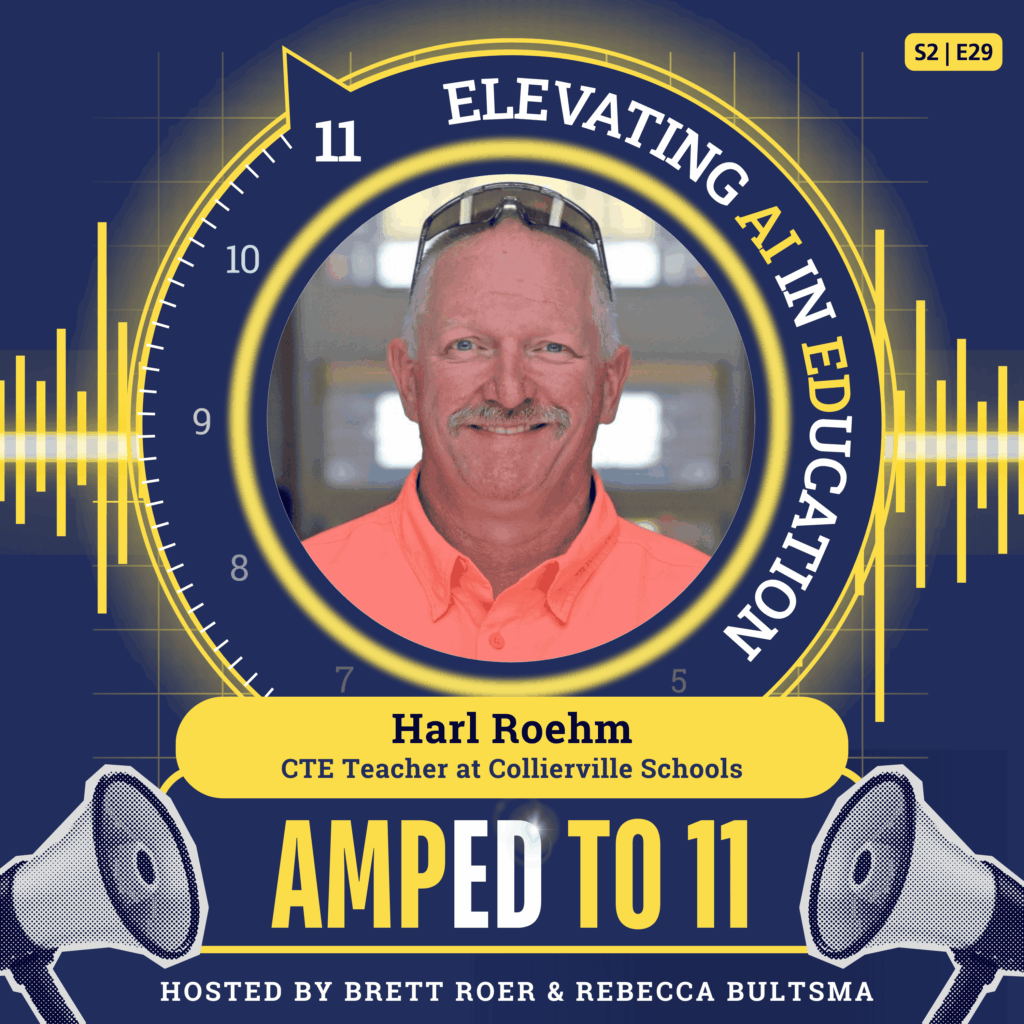
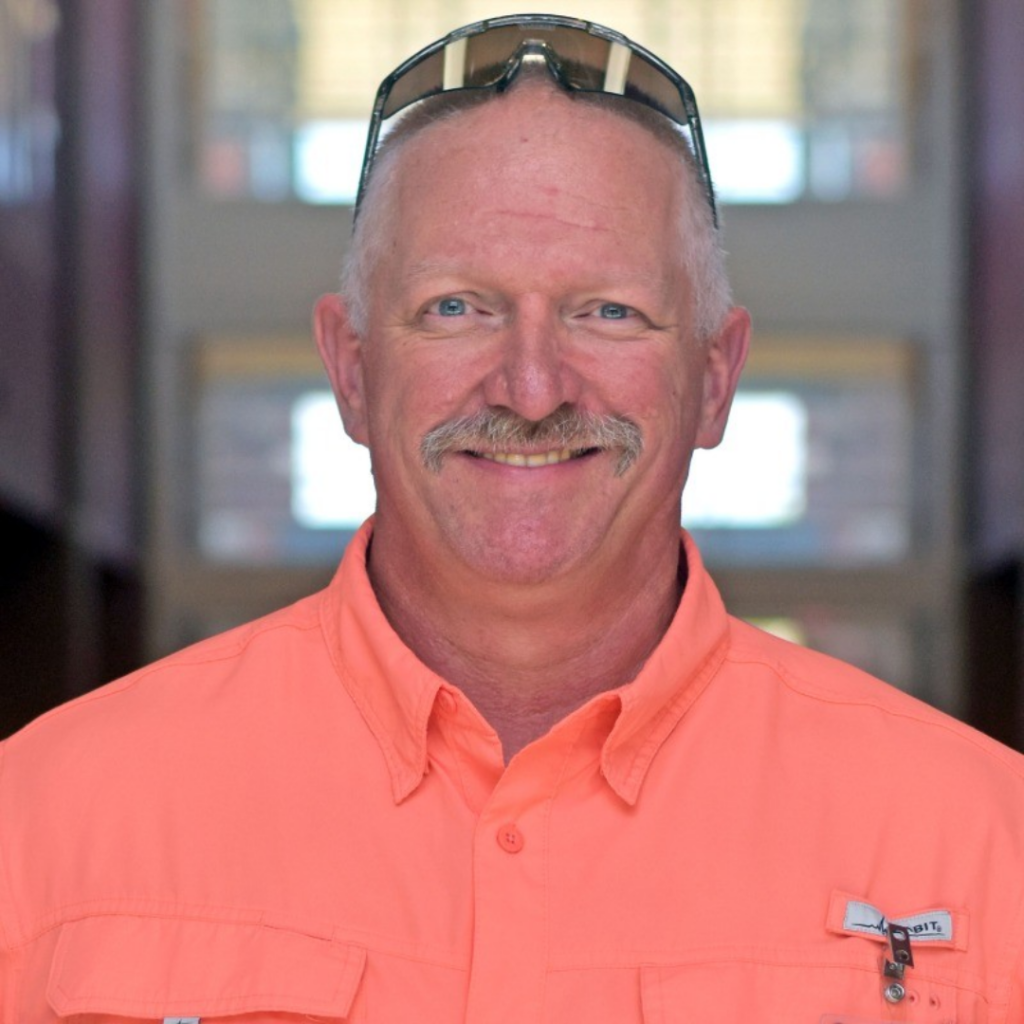
Brett Roer: Yes. I keep saying we have the best podcast in the world, not because of the output, but because of how much fun it is to create. We find these amazing people all over the world, and then we get to share them with the world. So, without further ado, we are so honored to introduce an incredible CTE teacher from Tennessee who goes by the name of Harl Roehm Harl.
Brett Roer: How are you doing today, man?
Harl Roehm: I’m, I’m loving life. I’m blessed to be here. Thank y’all both for having me. I’m really excited about this. We started talking about this, uh, when we met back at the AI summit in Nashville, and I was just a little slow pulling the trigger ’cause I was a little scared of what questions y’all might ask.
Brett Roer: And as we’ve already assured you and audiences you’re about to learn, Harl [00:02:00] is here to really shock and amaze us. He has a wealth of knowledge just from lived experience, and he is really applying it and doing great work in the field of education, innovation, and now ai. So Harl, if you could share with everyone, since we’ve met you down in Nashville, you’ve gotten the chance to just share so many amazing stories with us.
Brett Roer: Take our, take our listeners through your journey. You know, really where’d you start from in life? Kind of how did you navigate it, some of the things you learned along the way and, and what are you doing now on more of a national level than you ever probably thought possible? Take it away, Harl.
Harl Roehm: Well, first off, thank y’all again for having me.
Harl Roehm: I want you to understand this is officially my second podcast that I’ve ever done with the first one being with you at FTTC. So I’m not quite sure how well this is gonna go, but, uh, I grew up on a family farm. I’m fifth generation, small town, small community. Went to school, looked at the military, didn’t work out for me with injuries, and it [00:03:00] changed my direction because I was originally going aerospace engineering.
Harl Roehm: So I came back on the math side and started teaching. I went through the fire department to go on the volunteer fire department, get my water purification and fire suppression training because I knew that the reserves would have a reduced physical requirement for eligibility, and then I could meet that.
Harl Roehm: And if they called somebody into active duty, it would always be people with those certifications first. And my injuries just never allowed me to get into it. So I’m screaming red, white, and blue. I am as patriotic as anybody you’re gonna meet, and I’ve tried to let that bleed through who I am and how I live my life.
Harl Roehm: I went into education on the math side because I was always good with numbers. And in 2000, I took a year off and my daughter was born, so my wife could stay home with my daughter. And when I went back to teaching in 2001, [00:04:00] they walked into my classroom on a Friday and said, Hey, we’re gonna be offering this course called A plus certification.
Harl Roehm: It’s a three year course, hardware, software, networking. And I’m like, okay. They said, we have students who’ve signed up for it and we’re gonna start that and we want you to to think about doing it. And I was like, man, that’s awesome. I’m excited. I wanna do it. I wanna learn more about it. Great. When does it start?
Harl Roehm: And they said Monday morning. So I went to a yard sale on a Saturday, bought a computer for $25. It was a 4 86 dx, two processor. Brought it home, tore it apart, put it back together, and it worked. And I felt like I was the smartest man alive at that point because I didn’t let the smoke out of it. And it still worked.
Harl Roehm: And so everything from that point is focused around computers and programming. I’m 28 years in, taught 29 subjects, [00:05:00] retired from Mississippi after 25 years. Bought myself a new tractor and made it 13 days before I found a job here in Collierville. And currently this is where I’m at, at Collierville High.
Harl Roehm: I’m teaching AP Computer Science Principles, AP Computer Science, a coding one in Python coding, two in JavaScript, and dual enrollment Cybersecurity, one and two through the Tennessee College of Applied Tech. I’ve just, I fell in love with computers after I bought that first one, and I hadn’t looked back.
Harl Roehm: I probably should have seen it in hindsight because I loved messing with the graphing calculators from Texas Instruments when I was in high school, and I started writing programs for that, and I had a blast. I got to go with tq, with text instruments and present it some of the stuff and work with people up there with the little stuff they were doing.
Harl Roehm: And I’ve run around and done a whole lot of stuff, but everything I usually do is [00:06:00] one-on-one. But when AI came around to me, man, that was, that was it. I was so stoked I couldn’t see straight. So I was trying to find ways to put it in my classroom and eventually I got introduced to. Suno and I got introduced to Sora and I found out that I could make eight songs and play ’em for the students and have ’em try to pick out which ones were real and which ones were fake.
Harl Roehm: And of course, all of my Sasquatch videos, which I have made that are so horrible, and they’re always the same one with Sasquatch telling a dad joke, I don’t know what it’s, it’s my kryptonite. It goes into my lessons. I just, I have way too much fun doing it. And I don’t know, I’ve, I’ve really been blessed enough.
Harl Roehm: I hit some places at the right time. I mean, I was trying to [00:07:00] embrace AI and interactive lessons and trying to create all this stuff, and I came across the platform, Keira Learning, and Keira brought me on board and was trying to help me out with the a plus, sorry, with the AP classes. And one of the reps was like, Hey, why don’t you go to this AI summit and present a session?
Harl Roehm: And man, y’all ain’t got no idea how nervous I was when they said that. And oh, they were great. They were like, here’s some proposals you could do. And I’m trying to read through their proposals and I’m like, it’s gonna take me six months to figure out how to do that so I can even do a session on it. And Nick was just like, why don’t you just be yourself?
Harl Roehm: Just do what you do. Take all these little things you’ve been doing with folks and just put ’em into a session. Don’t worry about all that other stuff. And so I [00:08:00] did walked into, I walked into the registration that night and that’s where I met you, doc. Everybody was talking and I walked in. I’m just trying to get my name badge and I’m meeting folks.
Harl Roehm: We started talking. I didn’t know she was the keynote. I had no clue. I’m just talking to somebody about how I’m using it in my class. Just laughing, having a good time. And then the next morning she got up on stage and you wanna talk about feeling like a heel? Man, I had no clue. I was like this, you don’t need to listen to me.
Harl Roehm: I need to shut up. Listen to her more.
Rebecca Bultsma: Oh, I learned so many interesting things from you in that, at that reception though, Harl, uh, tell, tell our audience a little bit more about how you use those AI songs, the activity that you do with your students every day. ’cause I just, I still think about that. I think it’s so much fun.
Harl Roehm: Well, I started using sunna and it allows you to create based off, y’all are familiar with it, where you create based off of a genre or whatever, but you can put in your own lyrics. [00:09:00] But when you have it, write the song, you have a phrase for the week. And that phrase might be something like, I don’t, I don’t know.
Harl Roehm: Meat Loaf. It could be pickled Pigs feet. It could be Athlete’s Foot. I dunno. You come up with something horrible and you have it work that into a song. When you pick the genre, you’re playing that genre all week long and the kids are trying to listen to the music, but they’re also trying to pick out the tendencies that AI has that we’ve been identifying.
Harl Roehm: And as the, the generations continue to build, it continues to get so much better. They have a hard time telling the difference between which songs are AI and which ones are real. And they’re trying to guess it because the first ones that guess it, they get a prize. And I’ll be honest, with high school students, they respond mostly to Reese’s Peanut Butter Cups, kit Kats and Rubber Ducks.
Harl Roehm: Those are pretty much the three things that push them over the edge for me [00:10:00] and, and it gets kind of cutthroat at times trying to do it. Don’t get mad if they don’t get it right. We’ll be in the middle class and I’ll have that plan while they’re doing their independent work and then all of a sudden you’ll hear that word.
Harl Roehm: And I mean, it’s like they’re slamming each other’s lids to keep the one next to them from getting on there because they’ll close the lid on the, on the laptop next to them to keep their neighbor from putting in the answer first to try to, to win the candy and stuff. But it’s just a lot of fun and it helps them understand that there’s just certain tendencies and stuff that you find.
Harl Roehm: And I dunno that I just, it was something fun to get them on board and get a good laugh at the same time.
Brett Roer: So for our listeners out there, you know, we always talk about keeping humanity at the center of education and ai and that’s really why we brought Harl on because you know, I got the chance to really interact with Harl that the following day.
Brett Roer: But I had been clocking Harl because you know, when you see some of these video clips, Harl’s wearing what he wore, probably he very similar outfit to the day. You know, we saw him, he’s wearing this amazing cowboy [00:11:00] hat. He’s got these great overalls on. He is a. You know, if he was, uh, playing in the Super Bowl last night, he probably wouldn’t play an offensive tackle.
Brett Roer: I would say he’s a fairly large man and, uh, so he really stood out and not what you typically see people wearing, especially presenters to an AI summit. So I was already like, oh, I can’t wait to see what this guy’s gotta say. But the next day is when I really got to listen and learn because we played, we played the Rhythm project and we played it with, you know, educators at each table.
Brett Roer: And that’s where right afterwards, me and Harl really started to connect. ‘Cause Harl started talking about how much that resonated with his own upbringing and some of the ways he’s using AI as you’re hearing to build connection. So, Harl, before we, you know, move on from this amazing way you’re using AI now, how are you seeing, it’s really bringing your own community, other communities?
Brett Roer: Like what are some of the things you’d hope our listeners could learn from you today about how are you using it to build community and to really inspire your students?
Harl Roehm: Well, like when you and I talk, I helped you understand that not everybody’s got that perfect upbringing. [00:12:00] Like I did growing up on the farm, I didn’t have a social life.
Harl Roehm: I mean, my near right now where I live, my nearest neighbor’s a mile away, and that’s my little sister. So it wasn’t like you went and hung out with your friends. We didn’t have cell phones and social media and all this kind of stuff. We were on a party line. If you wanted to make a call, you had to wait for Memaw to get off the phone because she was talking to Virginia down at the beauty shop and they would be on it for hours.
Harl Roehm: So growing up, you know, those of us that qualified for those gifted classes and stuff like that, we didn’t understand how to socialize with people and everything else. We were always socially awkward and no matter how much we tried to fit in, there was no real spot for us. Sports helped me, it gave me an outlet band, stuff like that.
Harl Roehm: Any [00:13:00] extracurricular activity gave me a, a chance to, to socialize with other people and feel like I had a place. But in the grand scheme of things, when you look at your friends that you develop in your lifetime, if you can count real friends and you can count ’em on one hand, then, then you’re blessed.
Harl Roehm: ’cause most people don’t have that many. And so when AI came around, you and I talked about how through the, through the Rhythm project that AI’s done so much to bridge a gap for people like me, for those of us who don’t know how to interact and don’t pick up on social cues like we should and stuff like that.
Harl Roehm: And the usage of that AI makes us feel like there’s hope and that we can be normal, if you wanna call it normal. I mean, to me, I’m fine. It’s all these other people that got the problem. But, uh, I mean, I’m, I’m unapologetically me. Okay? That’s just the way it’s gonna [00:14:00] be. You know, they talk about normalcy and fitting in and how to respond and what you should do, and AI has been a tool.
Harl Roehm: But as we move forward, it’s trying to convince these kids that we need to develop agency. It’s not, it’s not the fact that it’s there. It’s how can you use it? How can you own it? How can it make you a better person? As long as it doesn’t replace thinking? ’cause those critical moments have got to happen.
Harl Roehm: You have got to fail. You have got to discover. You have got to create. I don’t need you to be an AI editor. I need you to think for yourself and. Ai when it first came on, we used it as a souped up Google and everything was there. And now it’s trying to teach the kids that there’s a time and a place for it and how you use it and what you can do with it.
Harl Roehm: But it’s not a substitute for thinking. As we get our communities on board, I’m [00:15:00] trying to teach them how to build agents and gyms and things like this to automate different aspects of their life, the little tedious things that, that need it. But you gotta understand at some point there are some things that you cannot pull the trigger on.
Harl Roehm: You’re like, this should never be replaced. This has to happen the way that it does. So it, it’s a, it’s a long conversation, but it slow process. I mean, AI still in its infancy and no matter how much we try to think about how much we’ve accomplished in a short amount of time. We still got so far to go.
Harl Roehm: You’re watching all the bots and everything that’s coming around, but we’re looking at the, the good things. Oh, what was it yesterday? On the 20th, they announced how they had done that study with a hundred thousand women that had, they had used AI to help look at the, uh, mammograms to try to determine breast cancer and, and the likelihood of developing, [00:16:00] you know, an area like, Hey, you’ve got a 70% chance that this area has the potential to develop a lump and stuff like that.
Harl Roehm: Well, if we can use AI for that to automate that and weed out all the ones that are normal and give those results back, and then anything that has a potential flag it for a radiologist to look over it, now we’re getting those results back to the women faster. We’re getting a chance to help save them.
Harl Roehm: And I mean, that to me is what AI is for. It’s not to have it write a research paper. It’s not for anything like that. And so it’s taken a little time to convince the kids because they wanna do everything with it and they gotta understand there’s a time and a place. So, I mean, I don’t know, it’s, I hope that makes sense.
Rebecca Bultsma: It does make sense.
Brett Roer: Yeah. Harl you, I think one thing that our listeners, you know, again, just to highlight, like I can only speak for myself and I do wanna segue to something that made me think you this morning in preparation for this. [00:17:00] I don’t think I would’ve ever thought at any of the things I’ve seen you in person at that you would suffer from.
Brett Roer: Like not being able to feel like you know, your authentic self and included in conversations. But I think that’s actually something I wanna just highlight and recognizes. Rebecca and I show this all the time, like we are pretty much faking it till we make it in public. And then we like, you know, need our time to ourselves to regroup and reenergize and mask some things that are going on in our heads.
Brett Roer: But I’m so glad to hear that like, AI makes you even feel more comfortable in those situations. And maybe this is a different horror than we would’ve seen, you know, in a different time. You did say something I just wanted to highlight, I read this this morning and I’ve been quoting it all day, but what you just said, I, I really wanted to shout out because there’s someone who’s been on our podcast, Dan Fitzpatrick, and he wrote something today about a study of 12,000 students across 20 countries and had over half a million individual student reflexive pieces.
Brett Roer: And it was basically like, what if you just teach kids to think about their own thinking? And so all I kept asking them to do was use a see, think wonder protocol. Like [00:18:00] what do I notice? What does it make me think, and what am I still wondering about? And the more frequently they used it, the greater the increase they saw in students feeling more independent, understanding their own strengths, being able to do better on certain tests.
Brett Roer: But it said something here that you just said, it was like, like, let’s start outsource the doing, not the thinking when it comes to living in this AI world. And so that was one thing I heard today that was like, wow, I like really thought about you and some of your life stories. And I heard this other thing.
Brett Roer: A really amazing writer wrote an obituary for her father today. Her father immigrated here and was this hardworking man and they sold their home so he could buy his own business. And then they had to live in a very tiny apartment above the business and they had a mouse in the house. And so the way that the father tried to think of how are we gonna solve this was he’s, he would create all these mouse traps and he’d write ’em out on napkins at dinner.
Brett Roer: And then he started telling his daughter, okay, we need to start thinking like the mouse. What would the mouse be thinking right now? How are we gonna catch that mouse? Anyway, when she said like, what he [00:19:00] really taught me most in life is, it’s important, is like curiosity and like never like settling and just keep being a deep thinker.
Brett Roer: And that seems to be like what seems to be your secret for success. So right now, like what are you most deep thinking about? What is still the most curious thing you’re finding in the world of education that you really wanna like keep going deeper on and trying to figure out for your community. And then just in general
Harl Roehm: there, there’s so many different aspects.
Harl Roehm: When you’re thinking about education and you’re going at it, I’ve looked at these AI schools where they come in and the kids do their training on an AI module that’s customized to them for a period of time. And then they go into the classroom with the teachers and there’s their test scores are going through the roof.
Harl Roehm: And then I’ve got these others that are using AI models where the interactive standpoint, kind of like what I was doing with Kira, where it would lemme put a text and chat feature into there. So specified readings were put there and then the kids had a personalized chat window and then I can put into it to ask them multiple choice questions and only expand with a rationale if they [00:20:00] got it wrong.
Harl Roehm: And they’re showing that that’s bridging the ability gap and they’re closing in those standards where the kids are struggling there. But then, I dunno, man, I get stoked reading about the entire schools that are done in Roblox, where the kids can log in and their entire lesson is taught in Roblox and I’m like.
Harl Roehm: To me, there’s not an answer. We haven’t gotten to that point yet. We’ve got the potential to do so many great little things. We’re an inch wide. We might be a mile deep, but we’re only an inch wide, and we’ve gotta start putting all of that stuff together to come up with something better. ’cause education hasn’t changed.
Harl Roehm: It’s still somebody standing at a podium and preaching their guts out and they’re expecting kids to put down phones and take notes. And this generation grew up with a cell phone in their hand. YouTube taught ’em how to do whatever they wanted to do. They have had it’s constant, constant validation from TikTok and Instagram [00:21:00] and everything else, and you’re trying to take that away from them in a classroom.
Harl Roehm: And I don’t get it. If we can’t embrace that, if we can’t allow them to use that, then we’re doing them an an injustice. And if you found out I was a visual learner and made me wear a blindfold to class, that’s pretty much how I feel. What we’re trying to do to kids today. And we’ve got these people who are stuck in the mud and the people who make decisions don’t like change.
Harl Roehm: And the only thing they want you to incorporate is whatever they saw at the last conference, which is what they thought was a cool idea, they want to tell you about it and then tell you to incorporate it. But they don’t give you any training or anything to go with it, and they wish you luck. And it’s, Hey, we want you to use this platform.
Harl Roehm: This is the official one that we’re going by. Unofficially, use whatever you need to to get it done, but officially, this is what we’re gonna do. Well, no. If you’re gonna do it, pour your heart into it and do it right. If you’re gonna, we gotta revamp things from the start. I tell [00:22:00] folks it’s about moonshot thinking and I make all my kids watch the moonshot thinking video.
Harl Roehm: If I want my car to go from 30 to 33 miles to the gallon, I can tweak some code, I can change some settings, I can do something. But if I want my car to go from 30 miles to a gallon to 300 miles a gallon, I gotta throw it away and start over. And that’s what we’ve gotta do. We had a generation of great thinkers that invented stuff because necessity was the mother of invention.
Harl Roehm: And now we got people who live and die by Uber Eats and Amazon, and they never have to really do anything for themselves. Trying to get kids to think about it from a different perspective and create something. That’s the biggest problem I’ve got with programming because the kids come in there and their program looks different than the kid next to ’em, and they don’t understand how they can both be, right, because they’ve been conditioned to do it this way.
Harl Roehm: And circle your answer, and every step should be the same. And I feel [00:23:00] that if we don’t change something and shake it up quick, then we’re all working towards the movie Wally, where we’re riding around in the little chairs on a ship and letting robots service because nothing else matters. And I’m just, I get really frustrated by those people who are unwilling to change or to see that education has not grown with the way that technology and the workforce has, and that not everybody needs to go to college.
Harl Roehm: People need certifications, micro endorsements. These things are massive. If we’re gonna get these kids up to speed with where they need to be for tomorrow, and it’s what the jobs want today and. We have people in com in control and they’re running administration and they’re sitting over there in an office and they’re making decisions, but they’re not in touch with what’s really going on.
Harl Roehm: And they’ve read really good articles. They might’ve read a good book about it, but we’re the ones in the trenches. We see what’s happening. We’re the ones dealing with the businesses, knowing what they need. But I [00:24:00] don’t know, it’s, I feel like there’s so much we gotta do and I think that we’ve got great ideas and we gotta start putting them all together and to make something that’s gonna work to really get education up to where it needs to be.
Rebecca Bultsma: I could listen to you talk about this all day, every day, Harl, like, we’re on the same page with this and you’re having the same experiences. We are where we’re running into, um, people who are hesitant for a lot of different reasons, right? Like, like you mentioned, a lot of people just don’t like change.
Rebecca Bultsma: And some of those hesitations have to do around. The concerns that, uh, kids are never gonna learn anything. But we both know there’s lots of different ways to learn. So I’m curious about what your advice would be. I’m gonna ask you kind of for three different levels of advice, what your advice would be to the people making decisions in school systems, like the superintendents, the state level leaders, your advice to them on how we should move forward, your advice to teachers, and then [00:25:00] maybe your advice to students.
Rebecca Bultsma: Take your time. Go wherever you need to go. Meander along. ’cause like I said, I could listen to you all day, every day.
Harl Roehm: Okay. Well, students wise, I’m, I’m gonna deal with them Last as far as administration and government officials go. Policies and procedures are there and they’re handcuff in the public school system.
Harl Roehm: Independent school systems and private school systems have the freedom to look and expand and explore different avenues to find what it takes for kids today to be successful, but the public school’s trapped. I gotta be on a vendor list with a state, and then I’ve gotta get on a book adoption list with that district and then I’ve gotta get on a supplemental adoption list With that district, science comes up for adoption every six years.
Harl Roehm: That means we can get a new textbook every six years unless we’re able to get one of these online [00:26:00] curriculum to come in on that. The process they do to get on board takes forever been, that’s what I’ve been working. They’ve got contracts with El Salvador and Brazil and Vietnam, and they’re jumping on board and countries are understanding that that’s what’s happening.
Harl Roehm: But it takes them 18 months to get the privacy standards and everything done just through New York. And then they’ve gotta get on the book adoption list and the supplemental curriculum adoption list. And again, every six years you’re gonna give us a chance to rebid for that. People use these names of these books that they’ve used, the book books that they had when they grew up, when they were in school.
Harl Roehm: They know the same manufacturers have been behind it all. They buy a cookie cutter curriculum and they put it into a classroom and teachers are told, use this curriculum. And these are the supplemental tools that we [00:27:00] have available. Now your emerging teachers are doing everything that they can to get through that curriculum.
Harl Roehm: Some of your, your good teachers are embellishing that curriculum a little bit with some of these things. And, and your teachers, your standout teachers are the ones who have honestly probably thrown half of that curriculum away, supplemented it with what the kids really need, found it, begged, barred, and stole stuff from other people, because teachers are horrible about that.
Harl Roehm: If I see something that somebody’s got and I like it, I’m gonna use it, but I’m gonna tell them, I’m not just gonna take it. I’m gonna tell them, but I’m like, I love that idea. I wanna work that in here, and I’ll throw out a lab and I’ll use this one instead. And my kids score, well score. And it’s not administration’s fault.
Harl Roehm: It’s not the principles. They’re the ones that are trapped by the rules that are put in place, but everybody’s so [00:28:00] scared to say something or do something that they won’t put themselves out there and give something a chance. And they’re so afraid that a score is gonna drop. It quit being about education, and it started being about test scores.
Harl Roehm: They started running schools like a business. Everything’s a dollar. They’re worried about the vouchers because students can go to private schools or stay at home, and then that money doesn’t come to the public school. Well, yeah, that’s what happens. But when those kids go to the private school and they can’t cut it, or they stay home and they can’t cut it, and they’re put back into the public school, that money doesn’t come here.
Harl Roehm: It stays where it originally went, which means we’ve got even less money to do our job with, and everybody’s trying to cut corners. We’re shutting down schools constantly. It’s a, it’s, it’s a big deal. I understand that the government has its rules to put in place to make sure that things are done the [00:29:00] right way, but sometimes you can micromanage something to death.
Harl Roehm: I feel that we’re at about that point. When it comes time to try new things, something’s gotta go behind it. We’ve got great administration. I know that they would be on board with trying stuff, but they can’t. As far as the teachers go, how do you get them on board? You grab some of the new ones. You grab some of the ones in the middle that have been there for five years and they’ve got some experience 15 years, and they really like what they’re doing.
Harl Roehm: Somebody new to a subject and you expose them to what could happen. You give them those pinnacle examples. You let them see the performance of those students. You let them see the aha moments and remind them why they fell in love with teaching. Now you’re gonna have a few standouts where the teachers have been there a long time and they’re just passionate about it, and they don’t care what they gotta do.
Harl Roehm: They just want [00:30:00] their kids to be successful. Those you get on board. It’s the teachers. See, the kids love this class because this teacher is, is doing it the right way and they’re either gonna have to get on board or they’re gonna have to step away. We’re gonna have to revamp the way that we look at teaching.
Harl Roehm: The whole deal of 20, 25 kids in a classroom may have to change using an AI platform that assists with auto grading of multiple choice and auto scoring of short answer. It might be the way to go so that we can increase the number of students that are in a classroom so that you have one teacher and then you have a facilitator or you have an assistant that’s gonna walk around and help out.
Harl Roehm: Whether I teach 35 kids in my, in an AP class, or I teach five kids in an AP class, I’m covering the same material.
Harl Roehm: Exposure to these platforms requires that we need to change the structure of the way the [00:31:00] class is done, the delivery of it, things like this. Then that’s what needs to happen. Teachers will get on board with it. This new generation of teachers we have in schools phenomenal. Like I said, I’m 29 years in, excuse me, finishing my 28th year, excuse me.
Harl Roehm: My wife finishing her 27th. My daughter left med school to come back to be a teacher. She teaches science and she coaches right here in Collierville. My son is a junior in college. He’s gonna teach math, he’s gonna coach, but I wouldn’t have really expected anything else. Both of them tried to get away from it with everything that was in them, and they realized during their career that this is where they were being drawn back to.
Harl Roehm: But my mother was a teacher. My grandmother, my sisters, nieces, nephews, I mean everybody. We’ve been in education. Because that’s the one thing that you do that [00:32:00] it affects everybody. And I know that when my grandmother taught things were different, when my mother taught things were different. And if I look at where it was when I started in 1997 to where it is today, drastically different.
Harl Roehm: I remember being part of the ONE initiative in the state of Mississippi where we built the desktop computers so that every teacher would have a computer in their classroom. I did that with my a plus class while I was teaching at Horn Lake Hospital. And I look at where we are and the possibilities that these kids have.
Harl Roehm: We restrict their usage of their cell phones at school. There’s only one reason why we restrict their usage, and that’s social media. And it’s because they weren’t trained how to use it well and held responsible for their actions. In other countries when kids grow up, alcohol serve with the meals, you know, they, they, they have a drink when they’re younger, stuff [00:33:00] like that because they’re brought up with it, it’s part of their culture and they’re trained how to, how to use it responsibly and what’s going on.
Harl Roehm: Then it’s not an issue. It’s a non-starter and, and therefore it’s not abused and taken outta context like that. Social media is still so new that the parents and grandparents have have no clue how to teach proper usage. We tell folks to act, right, but I mean, what good does that do when there’s nobody there monitoring what’s happening?
Harl Roehm: So social media causes the kids not to use their cell phones, which in itself is a device. It’s hundreds, thousands of times faster than the computer they use when they went to the moon. And to have that at the palm of your hand at any time when you need solutions is phenomenal. So how do we take the kids and the teachers and the administrators and get ’em all on board?
Harl Roehm: We get the administration and the government [00:34:00] to realize that it’s no need to micromanage. I understand you’re watching numbers and you’re balancing budgets and everything else, but you’ve gotta give us some freedom to trust something that’s gonna work and benefit the kids in the best way. Look, PII first, okay, guard it, protect it.
Harl Roehm: I don’t want my child’s social security number getting hacked because somebody put information into an AI platform because they were trying to develop tendencies or whatever, and all that’s in their personal file. I mean, kids, birth certificate, social security number, immunizations. I mean, everything’s in there.
Harl Roehm: So keeping these kids while they’re in school and is a number one priority. If they’re jumping through, if they’re, they’re FERPA and COPA compliant and they’ve got everything else taken care of, and the platform integrates with the school and they’re willing to do a pilot, why not go ahead and try it [00:35:00] out?
Harl Roehm: What’s it gonna hurt? I mean, I’m pretty sure within a nine week term, you’re gonna be able to tell if you’re, if it has the potential to move in the right direction. So bring folks on board to evaluate it. We have so much stuff out there with generative ai, and you’re talking about right now, the, one of the big buzzwords with education is hq.
Harl Roehm: Im, oh, I gotta have high quality instructional material. Well, you know what, what deems it high quality.
Harl Roehm: Because half the time when you look at these online textbooks, if you pull the sections out of them and you put ’em into a AI detector, it’s gonna show what percentage of it was actually written by ai. So they can’t sit there and tell me that AI doesn’t create high quality information. So where do you draw the line and what do you, you know, what rules are you gonna put in [00:36:00] place to govern this if you wanna make it so I have to use copilot because you’re one of those people and you’re done.
Harl Roehm: If that’s a restriction, then anything I create with copilot that I’ve gone through and I’ve vetted and I’ve verified and I have the receipts to prove it, then I should be allowed to use that in my classroom.
Brett Roer: I, I want you to keep going, but I wanna make sure for listeners out there, like if you’re also like, you know, Harl started by telling this story about growing up on a farm, Nemo’s on the party line.
Brett Roer: He said very clearly he loves this country. You’re probably thinking like I am, like, yeah, why? Like, are we witnessing the launch of a presidential campaign? Like if you’re not listening to this and being like, this is who needs to be run in this country as someone with all this lived experience and like, can empathize with all these things.
Brett Roer: I, I really do wanna say something. You know, you’re a, a veteran teacher, you’re, you know, you’re a parent of adults, so you’ve seen it all. And like, one thing that you keep saying that I just really want people to hear, because it’s, it’s agnostic of age, but you have lived experience. Like you can [00:37:00] both love our country and want to see it improve.
Brett Roer: And like you’re talking about both things, like you love what it’s created and the opportunities, but you also see we’re at an inflection point and we’ve probably been at other times in our history, but not everybody can do both things as like, love something and somehow realize you have to leave some of it behind to keep that love and moving it forward.
Brett Roer: So I just wanted to say that because you’ve said it so eloquently, I just wanna make sure, uh, that that’s really just commended. So I just wanna say thank you for saying all that knowledge.
Harl Roehm: I, I, I, I appreciate that, but I don’t understand how you can love something without wanting to make it better. I mean, I was blessed when I met my wife and she was the one, it was on her, she said, I do.
Harl Roehm: And I told her, I ain’t signing no papers. So that’s till death. But there’s not a day that I don’t work to make our marriage better, that I’m not trying to show her how much she means to me and that I love her. I mean, I’ve never let my kids go to sleep at night [00:38:00] without me telling them I love them. I mean, my daughter’s married.
Harl Roehm: She, she’s been married since last March. I still text my daughter every night before she goes to bed to tell her goodnight and that I love her. You’ve got to constantly work to make things better. If, if you love something, it’s your duty to make it better. And that’s the way I feel like I do about, you know, education and like you’re talking about the country.
Harl Roehm: If you’re not working to make it better, then you’re part of the problem. You can’t be stagnant. You can’t get complacent. If that’s the way that you are, then you, you need to move on. Your time is over, and that might not be retirement to retire. It might just be time for another career. But if you’re not pushing people to be the best versions of themselves, then then I’m sorry.
Harl Roehm: You’re not passionate enough to be somebody I need around me.
Rebecca Bultsma: Harl, I have a question. What would you say to people who are not [00:39:00] moving forward or the teachers that we see who are afraid, who are not moving forward out of fear? Maybe they are worried AI is going to replace them, or that they won’t need teachers.
Rebecca Bultsma: This is, these are the fears that we hear all the time. Spoken and unspoken, right? Like that seems to be kind of the, well, if I adopt this, then AI is gonna take my job and we won’t need teachers anymore. That’s the root of all fear. To, what are your thoughts on, on that? And it’s a real feeling, but, and it comes from a, a real place and it impacts how people operate, but I’m curious, uh, what you think about that.
Harl Roehm: Is AI gonna take our jobs? I like to look at it and think about Henry Ford. When Henry Ford built the assembly line, people were petrified it was gonna take their jobs and they were all against it and everybody protested. Nobody wanted it. But what it did until that point was somebody would start to build a car and they would take it from initial point to endpoint [00:40:00] and there was no consistency or quality control in what was being built.
Harl Roehm: By installing an assembly line, he then let workers specialize in one component of it. He produced a consistent quality product that therefore made customers happier, he increased his effectiveness and people. Found out that their jobs had been elevated. They had, they worked in one specific area. They had to be trained.
Harl Roehm: They made more an hour. When we brought our assembly lines on board and our robotic systems and our, uh, computer control conveyor systems and everything like this, people thought that was gonna replace ’em. FedEx workers, I remember this, FedEx, UPS, everybody was panicking at these automated systems. All it did was allow them to specialize.
Harl Roehm: Now I’ve got people who are over preventative maintenance and they’re over quality control, and they’re over this, again, specializing. They’re making more money. Now, as we bring AI [00:41:00] on board, it’s not gonna replace you. It’s just gonna allow you to specialize. You talk about how jobs that are gone. Yeah, jobs are gone.
Harl Roehm: 75% of the jobs can kids in programming and the CTE classes are gonna work in, haven’t even been created yet. They’re just being replaced with something better. Our, our coders who used to come out with A-P-C-E-P get that entry level Python certification companies just, you know, you never had, you don’t have to go through the ap, you don’t have to go through the professional anymore.
Harl Roehm: They want somebody with a basic understanding, and now you’re getting degrees in prompt engineering and vibe coding. Okay? So use the AI habit, write the code for you, and then use your training to help put it all together. We still need you, we just need you in a, in a different role. And teachers talk about how they’re gonna be replaced.
Harl Roehm: Sorry to tell you, teachers have been replaced for years. Brick and mortar schools are here just simply [00:42:00] out of courtesy. But everything that we do can be done online. I can zoom and have my classes with the kids, teach the conferences, use interactive lessons, and use AI assistance and grade and all that.
Harl Roehm: What it means is that we can reach a bigger audience now. How is it gonna replace teachers in the school? Now it’s not, AI is gonna assist. AI might have you working with a larger class or in a different capacity, but it’s not gonna take your job. You know, for those kids that I teach all the time that are worried about AI taking their job, I tell ’em, you know, it’s like I’ve never seen AI work as a plumber.
Harl Roehm: I’ve never seen an AI electrician and I’ve never seen an AI welder. So you can say what you want and they might have ’em flying the planes and y’all might try to put me in one of them little cars that drives itself, and I ain’t gonna do that either. Yeah, [00:43:00] it, it, it’s definitely a little different. So for the parents and the people worried about losing their job, it’s not gonna happen.
Harl Roehm: We just need you in a different capacity. You gotta be willing to, to learn and specialize and, and do something even better. Give it the chance to help you be more than you thought you were capable of. That’s the biggest thing. People are finding out that their limitations are only there because of fear.
Harl Roehm: And you know, fear is a mental construct. Fear doesn’t exist. Your mind creates fear to keep you normal. Best things in life are on the opposite side of fear. I mean it, it’s only the bravest people who embrace that fear, let it drive them and push themselves beyond it to get blessed with some of the greatest things.
Harl Roehm: Put yourself out there. What have you ever been so afraid of? You wouldn’t want to do it. And you hesitated and you waited and you waited. And then when you finally pulled the trigger and you built up the guts to do it, you found out how much fun it [00:44:00] was or how exciting it was. Now I say that, but I’m gonna tell you straight up, I got a fear of snake and I don’t get on planes now.
Harl Roehm: Other than that, I, I conversation things big. I don’t fly.
Brett Roer: Then Harl, please do me a favor. Never, never watch this movie called Snakes on a Plane. You’ll really not like this movie.
Harl Roehm: Already tried that. I had to fly one time for a company I was with and they flew me on one of those little king air on a little 10 passenger planes. And the night before I left, they rented that final destination and had me watch that,
Harl Roehm: that, that, that was not a, that was not a good flight. I’m gonna tell y’all,
Brett Roer: well, I’m not worried about ai my job, but I’m worried about Harl taking my job on this podcast. ’cause this has been just. [00:45:00] Incredible. This has been so interesting to listen to. I, I have, I just wanna say for the record audience, if you don’t hear me again, because I’m officially telling Rebecca, I just wanna listen for the rest of this podcast.
Brett Roer: So Rebecca, you are in charge of all next questions. I’m just sitting back here with a big grin on my face. Take it away.
Rebecca Bultsma: Well, I’m, I’m just sitting here loving to listen to, but Harl, we appreciate all of your learning and I think my favorite thing about you is how understated you are. I love your, I’m just a, a country boy, but then you are brilliantly wise when it comes to integrating technology and messages for education, and I appreciate that.
Rebecca Bultsma: I want you to think with me for a minute, if it all goes right, let’s say everything goes well, everything goes right, and we’re sitting back here again in 20 years having this podcast and holograms from our rockers on our front porch, uh, from each of our respective farms. And we think we got this right.
Rebecca Bultsma: [00:46:00] It all went right. What does that look like in 20 years?
Harl Roehm: That it all went right?
Rebecca Bultsma: Mm-hmm.
Harl Roehm: I dunno, that’s kind of hard to say. When you talk about what went right, you have to think about so many different steps to it. Are you talking about it went right with education, it went with AI integration. Are you looking at the business sector?
Harl Roehm: Are you looking at the way that we use AI to help assist us right now with fighting type three diabetes and dementia and the elderly? Are you looking at things like this? I mean, what went right? I mean that that’s, that’s real broad.
Rebecca Bultsma: If we’re looking at a school, if we’re taking a peek into a school 20 years from now that has adopted ai well, or a school system.
Rebecca Bultsma: Its school system in the United States of America that did a good job of integrating AI and it is churning out kids on the [00:47:00] other end who are well prepared to meet the demands of society. What did we do right to get there? What’s happening in those classrooms of the future? Maybe that isn’t happening right now?
Harl Roehm: Well, I’m sad to say say it’s probably not starting with me, but it’s starting with my kids. That generation that’s in their, their late teens to early thirties, they’re the ones that are gonna be having the kids, they’re gonna be in school at that time. It’s gonna be on that group of individuals to realize that we have to, it all comes down to how you use it.
Harl Roehm: It’s the empowerment of it, the control. It’s understanding that there’s a time and a place for everything. It’s, it’s taking the teachers out of it and putting the learning into the student’s hand and having them become facilitators of their own success and holding them [00:48:00] accountable for it. It’s parents that are actively involved in every aspect of their lives.
Harl Roehm: It’s teaching them the right and wrong way to integrate and do stuff, but it’s embracing it and its potential in your life. The schools themselves, I think, will look drastically different than the way they are now. I don’t wanna see any projectors. I don’t wanna see. Um, I mean, I guess you can have a Apple TV somewhere hooked up if you want it, but too many people use those as just a old school projector.
Harl Roehm: I want the lessons to all be labs. I want it all to be project-based learning. I wanted everything to be around what’s gonna actually facilitate that kid and put them in a successful position when they get older. You know, when we teach science in the schools right now, the first science we teach is biology.
Harl Roehm: Right? What comes after biology? Chemistry? [00:49:00] Then you talk about your earth sciences, right? And then you go into physical science and physics. Well, just because somebody 200 years ago, 200, you know what I’m saying? Because somebody a hundred years ago decided that we should teach the sciences alphabetically.
Harl Roehm: Doesn’t mean that we should still do it. Have you ever been stopped on the street and asked to tell somebody what the mitochondria is? It’s the only one I know. It’s the powerhouse of the cell. I can remember that. But nothing else. Physics is the science that you were taught to love when you were a kid.
Harl Roehm: When you took cardboard and tape and made all kinds of inventions. It would work one outta every 100 times. Not a little marble of that hot wheel would run down there and do something. Slinkies, string cup phone, stuff like that. There was the science when you had fun with it, you know, swings and stuff.
Harl Roehm: That’s the science you use every day. So why [00:50:00] is that the one we teach last?
Rebecca Bultsma: Hmm? Rethinking. Rethinking.
Harl Roehm: Bring the stuff back, project-based, problem-based, real world activities. Put in the kids’ hands to where you are dealing with a lab class and get away from, work it this way and circle your answer.
Rebecca Bultsma: Hmm. So let’s say Harl, you have inspired people who are listening to this, educators who’ve maybe been hesitant to.
Rebecca Bultsma: Start experimenting with ai, where are you telling them to start?
Harl Roehm: First off, start small. Okay. Baby steps gotta crawl before you walk, so we’re gonna at it that way. I like to think about AI as the old, uh, question. How do you eat elephant?
Rebecca Bultsma: One bite at a time.
Harl Roehm: That’s it. So when you start with ai, start with something small, help it create a bell.
Harl Roehm: Work that’ll allow you [00:51:00] to te to evaluate the kids’ understanding of the material. I flip my classroom now to where my kids do the reading at home, and then when they come in, the very first thing they do is they take a check for understanding. It’s a little five question thing to make sure that they understand the material so that when we’re having lessons, I’m not lecturing, we’re having a discussion.
Harl Roehm: They’ve already got a little bit of knowledge about it, and then we talk about how we incorporate it together, and we build simulations and stuff like this around it so they can actually see it happen. They’ve got the vocabulary established so they can actually talk about it. If you’re trying to teach material fresh every day, then they’re trying to not only understand the concept, they’re trying to get the vocabulary in place, they’re trying to understand how all that stuff works, and that’s, that’s not what they need.
Harl Roehm: These kids have had the time to do all this. They like to watch video clips. They want the stuff together. Give them a little 10 minute video to watch, give ’em a little something to, and when they come into class, use AI to help understand where they’re at. Use AI to help build exit tickets so you [00:52:00] can evaluate what they learned from the lesson.
Harl Roehm: One of my, one of my partner neighbor teachers, math teacher loves dad jokes. 100% loves dad jokes more than anything in the world, so I, I built him an agent. So that he could get dad jokes for when the kids come in for remediation, it generates math problems for him as dad jokes. And then he picks a difficulty level based off of Taco Bell Hot sauces.
Harl Roehm: So if it’s no sauce, it’s easy, mild is medium, hot’s hard. Then you got fire, which is your AP level, and Diablo, which is your dual credit level. So he puts it in there and he helps generate the questions for him and it provides the rationale so that he can personalize the stuff to go with the kids. Now, I’m not expecting teachers to get to there, not from the start.
Harl Roehm: They gotta start small. They gotta find one little thing that they can do to incorporate in there that gives them control over something and when they feel like they can control it, then [00:53:00] they’ll expand it. So start with a bill work. Start with a, uh, have it build an activity. Five minute activity about how to integrate this into your life.
Harl Roehm: Give, have it generate real world scenarios where they would use this and help them make that connection. Then once they do that, they’ll start to embrace it more and more. They’ll find ways to help out. They came at it the wrong way. When they came at teachers, they said, here’s ai. Use it to write your letters to your parents to, to, you know, write your IEPs and help come up with all this.
Harl Roehm: No, that’s not the way it works. That’s important stuff. I’ve gotta know what’s going on before I can write that. Use the AI to help me automate the little trivial daily tasks. When I get that under control and I feel like I have a little bit of my life back and I start to see some separation between my work life balance, you know, [00:54:00] then, then I can do more.
Harl Roehm: As it is, I, I’m blessed that my wife likes to sleep 10 hours a day or whatever. I don’t know. She falls asleep every night around 7:30, 8 o’clock, and then I stay up and I’ll work till midnight and then I, we go to bed. But I mean, that, that’s it. It gives me time to sit there and do stuff, so I’m always reading up on things.
Harl Roehm: I got so tired of the podcast. That’s something that you can teach ’em how to do podcasts, man, it takes forever to listen to these podcasts. I’ve got like 12 podcasts I like to listen to, and they’re an hour a piece. You know that, that’s a ton of time, so why not write something so that it goes ahead and summarizes it for you and finds out the important information and keeps you up to date.
Harl Roehm: I got one that I run every day. Tell me the latest advances in AI in the last 24 hours and the latest advances in CTE in the last 24 hours so that I can stay on top of it and send it out to [00:55:00] my crew and let all my CTE teachers here at the school know what’s happening.
Rebecca Bultsma: What are you using to build that?
Harl Roehm: Honestly, I’m using Gemini because it was best price point. I know you’re a GPT. I know you. I’m
Rebecca Bultsma: actually a Claude Code Girly. I am a hardcore Claude Code pills. Yeah.
Harl Roehm: Oh, Claude’s phenomenal for coding. Don’t get me wrong, but we were already purchasing storage space with Google for our photos.
Rebecca Bultsma: That’s the thing.
Harl Roehm: I went to upgrade from the hundred gig I had, excuse me.
Harl Roehm: I had the 200 gig space and we were full because we’ve recorded a ton of videos and I looked and I was like, okay, we’re gonna pay a hundred bucks a month. I mean, a hundred bucks a year. Well, for 200 bucks a year. I get Gemini Pro, I get vo, I get their, I get all, everything. Nana Banana. I get all of it. I get that from me.
Harl Roehm: I get two terabytes of storage space and all the pro features go to my entire Google family. So my [00:56:00] son, my wife, my daughter, everybody. We all get all of that for $200 a year total. To me that was a no brainer.
Rebecca Bultsma: You bring up something really good. I think it was Kip Glazer who was one of our other podcast guests who said that too.
Rebecca Bultsma: You don’t have to try every single AI tool. Pick an ecosystem. Yeah. Like Google that you’re already using. They all do more or less the same things and just get to know that one really, really well and how to use it and how to work it in a way that makes sense with your life. You don’t need every single shiny bell and whistle.
Rebecca Bultsma: See what the one that you choose is capable of. So that’s perfect
Harl Roehm: and, and it takes time and trying to convince people, like I know that your experience with this and you’ve got you, you’re rep repertoire when it comes to AI is like through the roof. And some of us will never get to where you are.
Rebecca Bultsma: Carl, we know, you know.
Rebecca Bultsma: I put together.
Harl Roehm: But I tell you, I play with it and I tell the teachers, don’t try to reinvent the wheel. Find one little thing that makes you happy. And if that’s all you ever do with it, [00:57:00] then great. But you can’t, you can’t shun it. You can’t shut it down. You can’t block it. You can’t will it out of existence.
Harl Roehm: AI is here and for anybody to try to dodge it is a detriment. I mean, we’ve got, we’ve got the potential to do some really wonderful things in this world, and I understand that with every great thing, you run the risk of something bad happening. And people talk about, oh, well, when AI comes on board, it’s gonna get hackers to come in here and do this, and they’re gonna use AI to hack you.
Harl Roehm: You know what, that’s a risk I’m willing to take because if it’s saving lives on this side, I’m willing to take that risk on the other. And if it can help these kids that have never had an outlet and then have something to do. Great. Now we got folks talking about how we’ve gotta limit their exposure to it.
Harl Roehm: We don’t want ’em to have access to it outside of schools because we’re afraid they’re gonna develop a relationship [00:58:00] with this chat bot. And I’m like, you know what? They’ve been catfishing people on these social dating apps for years. I mean, y’all knew this was coming. This is nothing new. Why didn’t it all start back at the very beginning, training the kids on what they can and can’t do, holding them accountable for their actions.
Harl Roehm: Quit blaming everybody else when something doesn’t go your way. And just owning up, you know, when I was young and I did something wrong, I got a whooping. And I knew, now look, don’t get me wrong, there was times my buddies would be like, Hey, you wanna go do this? And I’d think to myself, is this wor worth the whooping I’m fixing to get?
Harl Roehm: And I decided it was, and I went ahead and did it. Knowing full well I was gonna get tore up when I got home. That’s a decision that you make. You make that every day when you get in your vehicle, you got a speed limit. If you choose to break the speed limit, when you get pulled over by the cops, don’t yell and holler and whine and belly ache and complain that you getting [00:59:00] a ticket.
Harl Roehm: You took that risk. But you, you get what? You get what you get.
Rebecca Bultsma: Yeah. That digital literacy piece is huge, right. We gotta just teach kids to be responsible with it. And that starts with us understanding it ourselves and using it so that we can be good, um, role models.
Harl Roehm: Oh yeah, we gotta be good stewards about this and it’s gotta start in the elementary levels.
Harl Roehm: We’ve gotta work with those kids from the time that they can first start playing games and getting on those iPads to understand what you should and shouldn’t do. And the whole concept of waiting doesn’t work, you know? And in these other countries around the world, they teach English. They teach English from the time they first start in school, you know?
Harl Roehm: Why is it here in the states are we wait until you’re in high school to start to teach you a language. By that point, you’re already, you know, behind.
Rebecca Bultsma: And I think what you’re talking about is making it a real like partnership with the parents too. I think we all all need to [01:00:00] be teaching responsible technology use from a very young age.
Harl Roehm: That’s the key. When you get them during those influence, those moldable influential years, those that is the key. And if we’re not doing that, then again, really what are we trying to do? Are we trying to look good on paper? Are we trying to make sure that we’re securing ourselves and keeping ’em protecting ourselves?
Harl Roehm: Are we trying to do what’s best for the kids?
Rebecca Bultsma: Brett, we’re gonna bring you back into the conversation here and you can ask a final question here.
Brett Roer: Alright. Alright, well that was again, if you’re not just so inspired by this, I don’t know. Harl also, thanks for telling all our podcast audience, they can just summarize our podcast again.
Brett Roer: You really are trying to make, Hey guy’s, not replacing jobs. Harl is taking away our jobs. He’s gonna be a better host. And he’s already like, don’t even listen. Okay. But Harl, um, Rebecca, we got, we got two things we sometimes end with, but maybe we flip it around. I don’t know. We usually ask a question for us.
Brett Roer: But Harl, do you have a [01:01:00] question for us that you’d like to ask that we can give, like, we’ll give our 32nd version of a response to? So what’s a high level, quick hit question. You wanna hear a snapshot from me and Rebecca on
Harl Roehm: You know, as, as leaders. As leaders and AI and everything. How are y’all gonna be represented as like p pedagogical auditors and narrate your logic so that the people who come behind you can.
Harl Roehm: Build off of what you’ve started. I mean, in science, everything we do is standing on the shoulders of greatness. Okay? We didn’t have anybody do anything with the DNA structure that was done by the scientists that came before them. You’re the pioneers, you’re the ones that are setting this up. So how are you going to devise this in different stances so that the people who come behind you can continue to [01:02:00] branch in your fields and, and push the envelope so that we can actually build and do something great?
Harl Roehm: Because I don’t, I don’t know. I just, I feel like you can’t just be like this overall entity like y’all are, like when people hear your name, they know who you are. But how are you gonna break that up so you can find a couple people to follow in your steps and take what you’ve started doing and expand on that?
Harl Roehm: ’cause what you do. It won’t be able to be completed by one person as we move forward. ’cause as they continue to build, they’re gonna have to multiply and it’s gonna grow exponentially. So two people will follow each of you and then four people following them. And so how are you gonna break that up? What are you gonna use as a standard to help guide those people as they move forward into what’s best for not only our students, but our communities and our schools and [01:03:00] education as a whole as we move forward?
Rebecca Bultsma: Hmm. It’s a great question and I see the same thing. Everything’s kind of disjointed and there’s different people doing different things and how do we glue it together and build something that snowballs and cascades in the right direction? You know, I think our answers will probably be very different, um, because I.
Rebecca Bultsma: Go a lot of the academic route. I’m choosing existing research and pedagogy research and trying to build on some of that existing research that’s already established and look at it through new lenses and existing lights. Um, to, I learned a long time working in education, not as an educator, that educators, like, like you mentioned, pedagogical basis.
Rebecca Bultsma: Right. And so I, my goal is to build on existing recognized pedagogical frameworks and adapt them for the AI era so that we’re [01:04:00] not reinventing it from scratch. And people are more willing to accept new ways if they are at least based in old proven ways. And so, and things they already understand instead of reinventing an entire.
Rebecca Bultsma: Build on existing research that people already know and understand and is already credible and trying to, instead of trying to throw brand new things at people and use examples that make sense, take what’s working and build on it and adapt it so that you’re not overwhelming people. And like you mentioned, kind of talking about baby steps, but lately I’ve been really feeling passionate about building curriculum for students that teaches them about how to use AI responsibly from a first year of college, right?
Rebecca Bultsma: Like instead of just putting in all of these different syllabus, um, don’t use ai, do use ai, use it in this way. Use it in this way. Let’s just have like a class. And at a high school level, maybe that’s just a mandatory type class or a module that everyone has to take. So everyone at least understands some of the basics.
Rebecca Bultsma: And the [01:05:00] kids understand the expectations and the why behind the expectations, and let’s nail those down first so that we can at least start building everybody from the same place, but also having a. More support for the parents who need to be giving the support at home, uh, because they don’t know what’s going on either.
Rebecca Bultsma: And so, shared ground and understanding
Harl Roehm: this AI literacy that you’re talking about, you believe it should be mandated for all students?
Rebecca Bultsma: I do, I do.
Harl Roehm: Now, when we provide this to students, at what age do you feel they need to start this?
Rebecca Bultsma: I think there should be digital literacy curriculum, as you mentioned, from a very young age.
Rebecca Bultsma: Um, as soon as kids, I have a friend who works in technology in a school district, and she goes in to third grade classes when the kids get their email address and their password sets up and does a whole, like, um, your secret agents, here’s your secret password. You never share it with anyone and gives them a full lesson in that.
Rebecca Bultsma: And so I think there should be elements of that all the way through. But I think specifically using ai, standalone AI tools [01:06:00] specifically, I think that should be a curriculum that’s introduced maybe like. Freshman year in high school, you know, like this is, you’re gonna start using it now. Here are, here’s responsible and ethical ways to use this to be helpful or ways that it might cause harm or detriment.
Rebecca Bultsma: And I think it should be a mandatory intro college class as well.
Harl Roehm: Right. Well, I have a follow up for you on that. Now in Australia, they passed a law to where you can’t have social media before you’re 13 and you can’t have email addresses and stuff like this before you’re 13 and it’s verified by identification and they’re supposed to be doing all this to keep you off of it.
Harl Roehm: Do you feel that by restricting access to it, that it would have any benefited whatsoever? Now this has come up many times because the way I looked at it was, would restricting or banning AI usage and stuff like that in, in children under the age of 13, [01:07:00] would that be beneficial? I don’t know how you feel about, I have my feelings.
Harl Roehm: I’m curious to see where you’re going with this.
Rebecca Bultsma: I hadn’t heard anything about like not using email because I think like, at least here where I live, the kids kind of get assigned an email address, like that follows them through their whole school experience. So I can’t speak to that. I have done a lot of research into specifically social media impacts and I do think social media is terrible and horrific and I don’t think kids should have access to it.
Rebecca Bultsma: I think it’s designed to exploit them and um, I think it’s designed to harvest their data and I think it’s designed to manipulate the way they think and be addictive. And so I don’t think kids should have social media before a certain age personally. Do I think that’s enforceable? Probably not. I think ideally maybe they would be super responsible and a little bit older and there would be some changes at the core level of the social media development process to not make it [01:08:00] as optimized for engagement and addicting as it’s, I think there’s a lot of real harm that we’ve seen come from social media and I don’t think that has been addressed.
Rebecca Bultsma: And I worry that a lot of that same harm will be perpetuated into the AI tools that are being optimized to make you rely on them and addicted to them and trick you into thinking they care about you and things like that. So like anything else, I don’t think the tool is inherently bad or wrong. I think there’s pros and cons.
Rebecca Bultsma: I do think we’re unprepared to manage the risks. I don’t know if kids are. Capable of defending them against some of themselves, against some of the risks of addiction and the algorithms that will just feed them eating disorder content over and over and over and over and over again without maybe them realizing what’s happening.
Rebecca Bultsma: So it’s complex and nuanced, but a lot of the issues I see that stem from social media problems for youth in society, I am worried about a lot of those same things when it comes to, uh, unbridled generative ai. And I think even if you have [01:09:00] literacy and you understand the risks and know how to use it, the way these tools are designed by their very design is to make you rely on them and addicted to them and to show you what you want over and over and kind of damage your attention span.
Rebecca Bultsma: I just dunno if kids are capable of controlling themselves. I don’t think adults are capable of controlling themselves around social media often.
Harl Roehm: Oh, no. I’ll be honest. TikTok is a rabbit hole that I’ll fall down to and lose an hour or two if I’m not careful.
Rebecca Bultsma: So it’s, there’s arguments on both sides, right?
Rebecca Bultsma: Like, you know, I, I see what you’re saying. I think. In a perfect world, kids are ready, they’re supervised. There’s no bad things. There’s no bad actors that are gonna exploit them. They’re not being manipulated so that they wanna buy more stuff on Sephora. And you know, like we’re not, but I just don’t trust the people building this stuff, honestly.
Rebecca Bultsma: It’s not necessarily don’t trust the kids or the teachers or us to train them. It’s just, I, I don’t like the way they’re designed sometimes. And I worried we’re gonna see some of those same problems in generative ai. [01:10:00]
Harl Roehm: That’s, that’s what I was afraid of. Look, that’s what I was afraid of. Because you know, people talk about banning it and keeping folks off of it.
Harl Roehm: And I was like, well, you know, banning drugs and banning guns works so well, you know, just ban social media again, you’re not gonna control it. If they want it, they’re gonna get their hands on it. But it’s,
Rebecca Bultsma: yeah. And what’s interesting is that gun debate, I think is so relevant, right? Because, you know, if something goes wrong, we blame the individual.
Rebecca Bultsma: We blame maybe the parents we blame maybe. An organization, we blame the person, the manufacturers, or the government for not having the laws. And I think that this is the same because when something goes wrong, we don’t know who to blame. There’s not a lot of accountability. But chatbot does tell a child to harm themselves and the child does.
Rebecca Bultsma: Um, and it’s tragic who’s responsible, right? Like even if we told that kid that was a risk, were they capable of getting out of that themselves from a machine that was designed to exploit their emotions? It’s [01:11:00] hard to know. It’s a really complex conversation.
Harl Roehm: That gets back to what we were talking about when I was telling you about me growing up, coming on board with ai, helping me learn how to actually communicate on different, different wavelengths that I’d, I’d never experienced that before.
Harl Roehm: I always ran through every letter or response through ai and I was like, Hey, what does this sound like? Does this sound like I’m doing this? I don’t wanna sound pushy. Hey, what does this mean on this? Now you start to build a relationship on that. It’s just like what you’re talking about. These kids start to rely on it.
Harl Roehm: So it’s, it’s,
Rebecca Bultsma: yeah. And what’s interesting is you and I at least have the benefit of, we’ve grew up without the technology, so we have the benefit of understanding what functional in personal relationships should look like. A lot of these kids have grown up fully with, especially during the pandemic, with all of their friendships already being with real people, but through a device.
Rebecca Bultsma: And so I wonder if they have the same object perme of, you know, like not necessarily making the connection or they’re so [01:12:00] lonely that this cares about them and it must know and it’s given them good advice before it’s really complex. It’s, there’s no good answers, obviously, but I think the goal is to educate people, spread AI literacy, um, identify the harms the best we can.
Rebecca Bultsma: I dunno,
Harl Roehm: you saw where they brought around the, uh, counselor. The AI counselors where they’re gonna go around and do this, and they’re bringing it into our healthcare. They’ve opened up some AI clinics that they’re now using in remote areas for people who can’t get into, so it it, it’s here, but it’s how, how do, how do we develop that sense of responsibility for not only the people who are establishing it, people who are governing it, the people who are using it, because ultimately, the people who pay the, the, the price are the end users.
Rebecca Bultsma: The vulnerable users, right? You’re vulnerable if you’re seeking that kind of support. Right.
Harl Roehm: It, it doesn’t matter how much we wanna blame somebody else, blaming a company or [01:13:00] blaming somebody who coded it or blaming the people who allowed it to be put out there is not gonna help that person. That was hurt.
Rebecca Bultsma: Right. Right. So then how do we avoid the harm? And that’s kind of the root of all of the research I do. And that’s the big questions that I think we’re all working towards. We don’t want kids learning to be harmed. We don’t want people to lose their jobs and have harm. You know, there’s all these, all these things people worry about and all of them are a little bit valid, honestly.
Rebecca Bultsma: And I don’t, and none of them have great answers. So, so much for my 32nd answer to your question. Sorry.
Harl Roehm: I’m sorry. Look, I’m serious. We, we, we get into this deep because I wanna know how you prepare people to take up your fight and continue on. You know, there’s a lot that goes with that.
Rebecca Bultsma: Yeah. Well, I, at a foundational level, like from a first principle’s perspective, I tell the story a lot, but do you remember the Dr.
Rebecca Bultsma: Seuss story of Horton? Here’s a who
Harl Roehm: I do.
Rebecca Bultsma: So ever since I first picked this up. Saw the amazing things and I saw the risks, which is why I started researching them. And every time [01:14:00] I go and speak to a group, I try and help them understand some of these risks. And Horton had this little village on a flower that needed help and they were all yelling, we are here.
Rebecca Bultsma: We are here. But nobody could hear them until one little voice joined in and suddenly other people were aware. And I just think my role, whether it carries on or not, but from my moment in history and time here, is to help bring awareness, help people understand, at least be informed on the basics and how this can be helpful and harmful so that they can have informed opinions.
Rebecca Bultsma: And if there are things that are really risks, we can collectively join our voices together for things like data centers that might ruin the farmland or whatever it is for a specific area. And at least we can all like collectively yell, we are here and hopefully somebody listens and we can affect change when there needs to be real change to help prevent harm.
Rebecca Bultsma: So my cause really is just kind of right now at the very baseline, just helping bring awareness to people and helping empower people like you are harl with, [01:15:00] oh, okay, now I feel better about this. It’s not as scary to me because I understand. And so now I’m prepared to actually take a baby step. And once you take a baby step you get better.
Rebecca Bultsma: And then they each help maybe a hundred students and that’s the snowball. And maybe my little part of it is just helping. Same as yours. People feel empowered enough to get started.
Harl Roehm: Well I hear you. Thank you
Brett Roer: man. He’s so good at this. Again, why did we give this guy our show Harl? I’ll say like, the thing that I’ve learned, the thing I’ve learned I don’t know how to do yet is say, I do this one thing and it helps achieve this one challenge in education.
Brett Roer: And I don’t know if I’ve ever been good at that. Like, you know, even in the 16 years in public education, that’s probably always constantly changing what I thought was the most important, impactful thing. One thing I’m really grateful for is that I did name my organization Amplify and Elevate Innovation because that is truly like what I care about doing.
Brett Roer: And I’ve learned sometimes I’m the amplifier of other amazing [01:16:00] things like what you lead or if there’s an innovative solution or Rebecca share something or someone I see online does something. I want people to know that exists. ’cause my current locus of control is not, I don’t have my hands in in a classroom.
Brett Roer: I don’t have my hands on a district or building. So I know my current lever is getting good ideas, good practices into others’ hands. But also just before this, like I was just working on Zoom with 25 teachers, teaching them how to create their first ever G and like getting them to metacognition. Think about like what if I was your perfect co-teacher and like just by using Voice Memo, watching this woman say, oh my gosh, this is incredible.
Brett Roer: I can just talk and build my lessons. Like that alone is like, that’s gonna sustain me and make this feel like a great, very productive day. I just changed a really passionate educators, like got them their life back by doing what, you know, like I wish more people knew how to do, but I’ll just keep spreading that gospel.
Brett Roer: And then finally what we’re doing in a lot of districts around the country is making these community playbooks and we’re [01:17:00] kicking it off in an area where, in Ohio, in two weeks. And I’m like, the, the, the schools I’m working with are the districts where I keep saying like, we can give you all the frameworks.
Brett Roer: Like we can give you all that stuff. You have to look inward now about what your community actually values. We’ll give you guardrails, we’ll give you everything. So like, it’ll be safe. Like you’ve, you’ve been saying all day are like, there’s some best practices and guidance where it exists, but to make it exist in work, in your community, look inward first.
Brett Roer: And we’re just teaching you how to talk and collect evidence that just mirrors back actually care about. So I think that’s probably, that’s it. That’s what I would like to hopefully continue
Brett Roer: doing.
Harl Roehm: What I was gonna tell you, and you don’t realize this is that. You’re the right things, but part of the reason why it works is because you are on the outside.
Harl Roehm: Okay? People get numb to the stuff that’s around them. I can’t tell you how many times I’ve told my kids to do things and it didn’t, didn’t sink in. But this is a [01:18:00] perfect example because I was talking to my son the other day because, I mean, I’m sorry they’ve heard your podcast. Okay, my, my kids have heard y’all and I listened to make sure that we’re good ’cause I listened to my kids when we drive in podcast play.
Harl Roehm: My son told me, he was like, Hey, uh, the other day I was headed to the gym and I was talking to Gem. And he said I was. He goes, I was doing what the what? He said he didn’t know your name. He couldn’t remember your name. Because I was doing what he said. I turned it on, I put it in the passenger seat and I just talked to it while I was driving.
Harl Roehm: And then when I got to the gym, I told it to just summarize our conversation and gimme the top 10 things from it. And I’m sitting here going, son, I swear I told you that 50 times. And he heard none of it. But he remembered that from the talk about using AI to help you know better you as a person and how you can think better when you’re doing stuff like that and to use it to be your assistant.
Harl Roehm: And he was talking about how you said you turned it on when you talked to people so that you could focus [01:19:00] and keep eye contact and maintain that communication, that connection to him. And that’s resonated with him. So I was letting you know that it works because you’re on the outside. That’s why you have to come in and do those community.
Harl Roehm: You know, playbooks is because when people in the community talk about what needs to change, it’s just another squeaky wheel, and people can tolerate that for a long time. When they bring you from coming outside to get that new perspective, then people open up their eyes and listen. So don’t negate that.
Harl Roehm: That is so, so massive that you’ve got to keep doing that. You’ve got to keep going to these communities and being that voice and being that inspiration that leads people to it because they don’t listen to those of us who are there. They listen to y’all.
Rebecca Bultsma: You can’t be a prophet in your own city. I, you know, I’ve learned that, and that is direct from the Bible and it is true.
Rebecca Bultsma: It’s hard. People don’t listen to the people who’ve always been around, even if they know what they’re talking about. [01:20:00] We’ve lived that
Brett Roer: Harl Harl son whose name I don’t, don’t know either. Listen to your daddy. This guy is a wealth of wisdom, but I also understand, don’t listen to him. Then listen to the M two 11 podcast.
Brett Roer: I’ll just text him before. What do I need to make sure your son hears? And I’ll say it Har. Thanks for like, that was an amazing question. Again, you’re either gonna join the podcast or eat us up. So why don’t you end with our favorite question. You know, you’ve given us so much knowledge. Just also listeners, if you couldn’t tell, Harrow produced a 53 page prep document for this.
Brett Roer: He told us before. So as you can tell, he was ready. Like he knows this is his moment. Well, we are ready for our final question. You know, can you kindly give some flowers and speak good about behind people’s backs? All the amazing people, the Ocean’s 11 team that’s really doing great work in education from your vantage point and society at large.
Brett Roer: Take us out on this. Go ahead. Har floor. Is yours
Harl Roehm: a I was trying to think about some of like my [01:21:00] favorite things. I don’t know. I talked about, you know how I use social media and I love it, but we talk about different champions of equity and justice. That was one of the things that y’all mentioned in there.
Harl Roehm: And I listed a couple of people that I, I really liked and you know, you talk about innovators in the classroom and stuff. Shannon Kirkland-Butts, she’s the director of innovation and education at the St. James Day school in Texas. It was, it’s just the way that she and embeds invention into the education process that she’s been recognized.
Harl Roehm: I think she was like the nub teacher of the year or something like that last year. So that’s a big deal. And folks don’t understand is that by bridging that gap and getting those kids on board, that’s huge. You had Wanda Carter, she’s a gifted services coordinator at the Bel Air Intermediate School in Ohio.[01:22:00]
Harl Roehm: She had a, she has a, what she’s known for is a failure positive classroom and under getting the kids to understand it’s okay to fail. I love that. ’cause back when I taught math. I made my kids come in the very first day and I let nobody use a pencil. I made ’em all use pens and they had to work these problems out, and I put ’em, I took all the pages, I cut their names off the top and I stuck them all over the wall.
Harl Roehm: So whenever they looked around, all they saw was math problems with scribbles everywhere, and people keep working out to the side. I kept showing nobody’s perfect erasers. Try to make you feel like you’re perfect. I don’t want anybody to use a pencil in here. I want you to use a pen because when you make a mistake, you erase it and then you may keep making that mistake over and over again.
Harl Roehm: If you make a mistake, leave it in pen, put a X to it, move next to it. You won’t make that same mistake twice. Learn from your mistake if you erase ’em. If you try to delete ’em, you’re destined to repeat them. You’ve got to embrace it and understand that failure’s part of life. So she got picked up for that, and I thought that that was [01:23:00] awesome.
Harl Roehm: I mean, there’s just, there’s so many different people you’re talking about, like, uh, Dr. Monique Chism with the Smithsonian Institute. I mean, just the work that she’s, she’s doing, I mean, cultural heritage and stuff, it’s, it’s massive. We’ve got so many great people out there that fly under the radar that we’ve got like, no idea who they are.
Harl Roehm: What is it? Doctor of Sasha Luccioni.
Rebecca Bultsma: Mm. Yes.
Harl Roehm: I mean, come on. I mean, and the things, these aren’t names that you hear all the time where you’re talking about like, stuff that I like, I love TikTok. I’ll be honest, I probably shouldn’t. I love it way more than I should, but it’s because it’s quick. I get that, I get that feedback and I get to move on.
Harl Roehm: And so people like Matty McTech, who’s on there, or Andrew Davies, uh, uh, Sophie AI education and, and, and Brittany Teacher Burnout Tips. Those are great people that are on there, and they make a difference because they’re [01:24:00] reaching teachers at the fundamental level and they’re helping them bring themselves back from the brink in their fighting map.
Harl Roehm: We’re losing too many quality people three years in because they’re overwhelmed and they’re burned out. They don’t know how to get by because they’re given a textbook and a stack of resources, and never taught how to implement it. Never taught how to incorporate everything together. Never taught about how to embrace AI and use it for the betterment of themselves and their students.
Harl Roehm: And I just can’t stand that. There’s no need for that. And I’m at the point now that I can be as loud and as squeaky a wheel as I wanna be. And if they don’t like it, they can tell me to go home and I’ll just climb on a tractor or I’ll go somewhere else. I mean, there’s, I mean I’ve, I’ve got a paycheck coming in so I can, like I said, be unapologetically me and somebody’s gotta stand up and be an advocate for them because it hasn’t been in the past.
Harl Roehm: And when I started, I was in one of those [01:25:00] toxic work environments, and I didn’t know what was going on. I constantly felt like I was about to be stabbed in the back. And I. I, every day I came home I was pretty much a wreck. Had to take a nap on the couch when I came home from work before I could wake up to spend time with my kids and stuff.
Harl Roehm: And you know, I finally came around to realizing that the only person that’s gonna help me get better at anything is me. ’cause there was nobody out there to be my advocate. And now we’ve got these young kids, so we’ve gotta do what we can to help ’em out. So that, that’s why I’m getting a little vocal because I don’t want my kids to have to go through the same thing I went through.
Harl Roehm: But I mean, I don’t know if you’re talking about podcasts, I mean yeah, there’s a bunch of different podcasts I like I told you that and, and you got a bunch of them. But what qualifies as somebody who’s changing the game? Are you talking about the library down to elementary school who finally convinced this kid that they have a passion for [01:26:00] reading?
Harl Roehm: Are you talking about the art teacher who convinced her student that graphic novels are a form of a form of entertainment and to follow it. And now that that graphic artist, she’s published three books and I mean, we change one person at a time. And while we can talk about these folks that have accomplished great things, it’s only because they were in front of the right people at the right time.
Harl Roehm: We got folks around us every day who are changing lives and making huge advancements for us, but we don’t know it and we won’t know it for 10 years. And, and that’s the thing that excites me and scares me at the same time. ’cause I feel like I’m wasting an opportunity to find out these things and get on board with them now.
Brett Roer: No, I think that was an incredible answer, Rebecca. I’m sure you have thoughts. That was, that was best. Good as it gets har. So thank you for that.
Rebecca Bultsma: No notes. That was great.
Harl Roehm: I, I, I appreciate everything [01:27:00] y’all. I, I do. I mean, ever since I was young, I’ve just wanted to, to do something, to push the envelope. I never wanted anybody to settle, and that was one of the things that I’ve always tried to do.
Rebecca Bultsma: Well, you’re doing it.
Brett Roer: Yeah. Yeah. That was, you taught us a lot about life values, how to be a good parent, how to be a good educator, how to be a good person. So AmpED to 11 listeners, I’m sure you are already, you know, just wondering how can I just, how can I have harl on my podcast, be my keynote speaker, be my local congressman, you know, show up on the ballot box.
Brett Roer: So Harl, could you let everyone know, like, how can they interact with you? How can they find you? How can they keep this conversation going with you?
Harl Roehm: Well, I mean, I’d prefer not to give my personal cell phone number, you know, not, not right off that, you know, just, just ’cause I do wanna be able to eat dinner and I do like living in my house, and if y’all started calling at [01:28:00] all hours of the day from everywhere, my wife would get kind of hot,
Brett Roer: maybe a LinkedIn account or maybe a website even.
Harl Roehm: I just started building my website, but I’m, I’ll give you my email address. I don’t care about that,
Rebecca Bultsma: Harl. You need to start a TikTok account. You know, you just need to open it up. Talk to your TikTok and we’ll get you a million subscribers.
Brett Roer: That’s also true.
Harl Roehm: You know, when, when we were up there, we started talking about how if I stayed where I was in teaching, I’d reach 150 kids a day.
Harl Roehm: But if I started sharing this with everybody, I could reach 150,000 a day.
Rebecca Bultsma: And a tiktoks faster to build than a website. And kids don’t go to websites.
Harl Roehm: Well, I, I just bought my domain and I just built my website.
Harl Roehm: [redneckEdTech.com](http://redneckedtech.com/)
Rebecca Bultsma: Sounds like a TikTok handle.
Harl Roehm: So I’m I, I’m creating everything else that goes with it.
Harl Roehm: But if you need to reach me, it’s Harl Roehm at [redneckEdtech.com](http://redneckedtech.com/). I’ll do everything I can to help you all out. I don’t gate keep any [01:29:00] information because it ain’t gonna do me no good. Like I said, never seen a hearse with you all behind it. So share what you can with everybody while you can and make the world a little bit of a better place.
Rebecca Bultsma: That is the best thing I’ve ever heard.
Brett Roer: Oh my gosh. Oh, okay. So yeah, follow redneck EdTech. Really everywhere, across all platforms, you can get more life wisdom and knowledge from Harl because an hour and 35 minutes doesn’t even do it justice somehow. So, Harl, on behalf of our listeners, on behalf of the AmpED to 11 podcast, thank you so much for everything you do and all the wisdom you just brought to the table to share with others And to our listeners, um, reach out to Harl.
Brett Roer: You know, if you wanna continue learning, continue listening, continue laughing, and you know, as we say, as we say in the AmpED to 11 podcast, take us out. Make every day. A jumbo, cannoli worthy day. Go live life to the fullest like Harl would. All right, y’all have a great day. Thanks for listening. Take care now.