Brett Roer: [00:00:00] And we asked the audience, these students just created rigorous California state standard aligned curriculum that was engaging. Raise your hand if anyone in this room has ever created an AI assessment rubric about how much you could use AI and, and when and how. And the only people in that room that raised their hands we’re those students.
Marisa Janicek: The higher universities need to pay attention to what we’re doing. It’s, we are changing education in a way that fits our students and they learn and grow and develop, and then they go back into rows.
Rebecca Bultsma: I’ve come to recognize people aren’t using AI, not because they don’t want to, or they’re against AI.
Rebecca Bultsma: People are overwhelmed. They don’t know where to start. They don’t understand the change management strategies involved in that. Change is hard. Change is hard in education. Right? There’s a lot of factors.
Brett Roer: Welcome everyone to the AmpED to 11 podcast. My name is Brett Roer. I am joined as [00:01:00] always by my incredible co-host, Rebecca Bultsma. Rebecca, how are you doing today?
Rebecca Bultsma: I’m doing great. I think we’re all doing great. ’cause individually, we’ve all spent time in San Diego this week, even though Marisa gets to live there, so I’ll let you introduce her, but it’s been a great week for me.
Brett Roer: You are right. We’ve all got to spend time in sunny San Diego, uh, and have all returned back to the frigid cold northeast for, uh, myself and Rebecca is representing Canada. We are about to hit a major cold wave up here, but these are things our amazing podcast guest today does not have to worry about because she’s the proud superintendent of Del Mar Union School District.
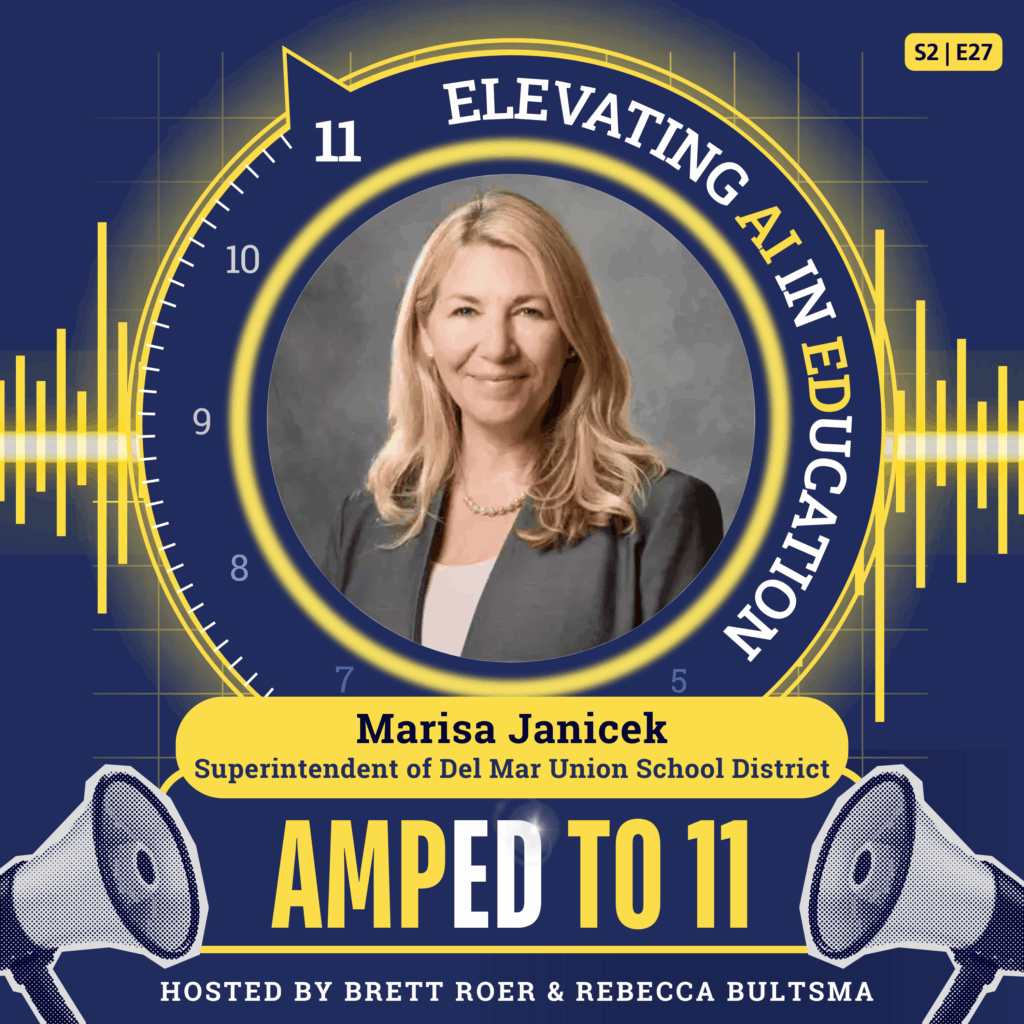
Brett Roer: We are joined today by the incredibly innovative and proud superintendent, Marisa Janicek How are you doing today?
Marisa Janicek: Thank you for the nice introduction. I am doing fabulous in sunny San Diego that I will not rub in anymore in this podcast, but yeah, no, I, I’m doing great. It’s an honor to be here and I am very grateful to be in San Diego as well.
Brett Roer: You [00:02:00] should be. It is a beautiful place to be. And,
Marisa Janicek: sorry, I won’t say anymore, a place to be.
Brett Roer: Exactly. And you are going to share a little more about, even more so about one of the amazing schools that you lead. But first, Marisa, we’d love for our audience to get a sense of who we are interviewing today.
Brett Roer: Rebecca and I are so honored that we’ve had the chance to work with you and your students, but please share for our audience, your journey, your story, and your why. How did you wind up being the superintendent of this incredibly innovative community in Del Mar?
Marisa Janicek: Well, I have always wanted to be in education.
Marisa Janicek: Starting in third grade, I told my third grade teacher, I wanna be a teacher just like you. And that was never, it never wavered. I went straight into every job I had leading up to college was working with kids in college. I became an instructional aide and I just kept that path Moving forward, I became a teacher.
Marisa Janicek: After graduating, I had my multiple subject and I also had my special education credential. And so it just [00:03:00] was really important to me to work with kids. And then as happens with most people, somebody tapped me on the shoulder and said, we think you might be good in a leadership role. So I took on teacher leadership roles, and one of my very first one was, you’ll laugh the computer lab.
Marisa Janicek: So I was a computer lab teacher on special assignment where I’d go to my, some of my favorite teachers that were so talented, they’d tell me, my computer’s broken. I’d say, okay, we’re gonna try plugging it in first. And every time it was just something so simple like that. And I think how far we’ve come since that moment where you just had to simply plug in your computer and then you knew how it worked.
Marisa Janicek: But yeah, I, I was a teacher then I became an assistant principal and a principal, a director and executive director. I have had the joy of being in many different roles, working with many different incredible educators. And along this journey, I landed in El Segundo for 20 years. In the past 10, I [00:04:00] really worked, I think.
Marisa Janicek: High school students became a passion of mine that I hadn’t known before, and listening to them and learning from them and just hearing their voices coming through what was important in education just really helped kind of form more of who I became and who I am now. So I. Led in El Segundo for 11 years and you know, met many wonderful people along the way.
Marisa Janicek: And a couple people sent this job opportunity in Del Mar to me, and I thought, well, that’s far away. I love El Segundo and it’s a K six. And I thought more about it. I started to learn about Del Mar and I thought they are top-notch educators. They’re doing the right things for kids. It’s K six. And truly, as much as I love working with high school students, elementary is my passion.
Marisa Janicek: That’s where I have always just believed you can start the foundational work and really help form their path in a progressive [00:05:00] positive way. So I applied and I have been here, this is my sixth month in Del Mar, and I could not be happier. It is an incredible school district. And I think another important piece, and I know we’re here to talk a little bit about ai, but I think nature is an important element and they have a lot of outdoor education, and we’re really talking about how to balance the two and make sure we’re keeping our progressive learning while really human connection and outdoor learning and just wellbeing because, uh, you cannot focus or learn without feeling good.
Marisa Janicek: And so I’m really proud of the work we’re doing at Del Mar. Sorry, little long winded.
Brett Roer: No way. You have an illustrious career and we wanna give everyone the, the context, um, it deserves. And in a moment we are gonna talk more about this, you know, um, I had the chance to visit Marisa in person just last week and view one of her schools.
Brett Roer: And I said, what a beautiful school. And I think you said at one the, can you just state what was the award that it [00:06:00] recently won in terms of architectural and innovation?
Marisa Janicek: Yeah, the San Diego Architectural Award of the Grand Orchid, they give out, they have a, a fun award system. It’s called the orchids and onions.
Marisa Janicek: And, you know, you don’t want the onion necessarily, but, um, we have won in orchid for one of our other schools. But the Grand Orchid is the award of the evening. And it was quite an honor and privilege to be there, to see just all the work that went into it before I came, and to see how it’s being utilized today with students really creating their own space.
Marisa Janicek: Brett, you got to see our decentralized libraries and how students really had autonomy and trust and respect to deepen their learning. It’s, it’s a magical place.
Brett Roer: Yeah. And that’s when I got a chance to recap and write about it. You know, not only are they so fortunate to have a leader like you, but truly it was a space where I felt like all the, every teacher deserves to work in a space like that.
Brett Roer: Every student deserves a chance to go to school in a setting like that. It was, uh. [00:07:00] It was truly unique and special, and we’re gonna talk much more about that and how you’re, you know, the work ahead that you have in building your, uh, community for the age of AI and continue the great work down there. But I thought it’d be really interesting to share, both myself and Rebecca have had the chance to work with you, uh, in your former role in El Segundo and even more impressively with your amazing students and teachers and staff.
Brett Roer: So I’d love if we could kind of just share, you know, again, just the last few years where AI has really taken, uh, the forefront and you’ve been leading that work in your former role in El Segundo and now in your current role. I’d love to share where I remember meeting you and then kind of what happened since then and kind of the lead you’ve taken.
Brett Roer: So I think we met almost four years ago through the League of Innovative Schools through Digital Promise. So, you know, in a moment I’d love for you to share what that is for people who might be listening and the amazing work they lead and then. Once we had the opportunity through, um, ASU and GSV for the AI show, how we were able to bring your students really to the forefront of what’s [00:08:00] happening in the world of ai.
Brett Roer: So if you don’t mind just sharing with folks about that work that you’ve been leading in El Segundo and then how it led to us getting to work together with your incredible students and community.
Marisa Janicek: Sure. Yeah. No, I, I remember meeting you, Brett. We connected instantly and had such great conversations about the future for our kids and how to support learning and just how to create the best environments across the nation.
Marisa Janicek: And you jumped right in and offered support for some of our college and career programs. And so we just, we hit it off right away because we both believe in education and how powerful it is and how everyone deserves that experience. So. Through the league. That’s how I met you. The League of Innovative Schools has been instrumental in my life and career.
Marisa Janicek: We joined in, I think, wanna say 2016 with Dr. Moore and I attending all of the conferences and connecting with innovative leaders that cared deeply across the country. And I think that’s what really [00:09:00] sparked my interest. I recall we hosted, um, over 300 guests from the League of Innovative Schools that come together.
Marisa Janicek: They come together for deep conversations, professional learning together, and connection. So it, it really is much more than I’ve just given it. But we hosted over 300 people in El Segundo. We co-hosted with Compton Unified, and I remember we were walking up the steps, and this was in 2022, I believe, and someone said, do you know what chat GPT is?
Marisa Janicek: And I looked at him and I said, no. I remember thinking, I should know this. What is this? So I went home and I did all this research, and that was the beginning. The, the next day, Dr. Moore and I were like, what is this? We, I need to get in front of it. We need to find out more. We need to start talking about this.
Marisa Janicek: And sure enough, it, it came along rapidly and like everything, you shouldn’t be afraid of it. You should learn about it and think through how to, um, bring everybody together to have the [00:10:00] conversation. So we started off with, you know. A big community forum where we had Richard Culatta come in and speak. Dr.
Marisa Janicek: Moore, Eric Burmeister. Also, we met through the league and presented on what AI is, what so much more than chat, GPT and the direction it’s heading, how it’s gonna help our students, what we need to think about. And then, so that was kind of the what and why. And then we started to have focus groups. So we led focus groups throughout each one of our school levels.
Marisa Janicek: We had a high school focus group, a middle school, and an elementary. Anybody could attend any of ’em. You didn’t have to stick to those. But we invited teachers, we invited students, and we invited parents all together in those focus groups. And they were powerful conversations and really helped shape the direction we headed.
Marisa Janicek: Um. In my head. My, my fun takeaway from that honestly, was I went into it thinking high school students were gonna say, okay, let’s go, let us, let us use this. They were the harshest critics. They said, it’s [00:11:00] cheating and nobody should use it, and it’s wrong. And it was, it was fascinating to hear them because they are so strong in their ethics and morals, and I was so proud of them.
Marisa Janicek: So I’ll get to where we went with the students. But then on the flip side, at the elementary level, the parents, I thought they were gonna say, please don’t, please don’t do anything. And instead they said, please go move forward. This is the future for our kids. And so in thinking, reflecting on it, those are digital natives, the parents are, that we’re talking to.
Marisa Janicek: So it, it just was interesting hearing input and what we heard loud and clear is. Please move forward. Please do it safely and please involve us. And so that’s exactly what we did. We started slowly, we performed a teacher group. I, if anybody is an educator and has tried to get people to volunteer on a committee before, they know that it’s hard.
Marisa Janicek: It is really hard to get people to participate, [00:12:00] and I sent out an email and asked for volunteers, and I had people I had to turn away. I have never in my life had to do that. So that tells you it’s important. It was really an important conversation. So we had teacher leaders from across the district coming together all the long, bringing ideas, thoughts from their schools, and so we built a roadmap.
Marisa Janicek: Alongside. At the same time, our board was working on policies. So we were leading policy work and then what we’re doing for the practitioners. And we, we built, like, I wanna say, guide rails, a roadmap for teachers, and we also did one for students. So the teachers were, first, we really needed to make sure the teachers felt comfortable, understood everyone’s at a different level of understanding AI and comfort.
Marisa Janicek: So we worked with them and then we started with our students. We had a high school club team, and once we learned a little more, I was very fortunate to have support from our board of education. We were able to hire aa, which [00:13:00] is a teacher on special assignment specifically for artificial intelligence.
Marisa Janicek: And she is outstanding. We were lucky with the individual that took the position, but also the position itself because that allowed teachers to have conversations individually. In a safe way saying, I don’t really understand. Or in a group way saying, we really want this unit. She worked with special education teachers, she worked with parents, she worked with anyone, you name it.
Marisa Janicek: We had professional development going out throughout every school at whatever level was needed. And then we consistently brought them back to the roadmap that we had developed with teachers. And I think the important piece with the roadmap was we tied it to our graduate profile so that you had a talking point, a connector, and then it wasn’t something else coming on.
Marisa Janicek: It was a way to enhance something you’re already doing because teachers have so much on their plates already. But the year we brought on the teacher on special assignment, actually before that, it was the year before that [00:14:00] in the spring, Brett called me, I think you gave me one week’s notice. I think you only had one week’s notice and said,
Brett Roer: thank you for clarifying that.
Brett Roer: Yes.
Marisa Janicek: Yeah. He said, we have this amazing opportunity. It’s probably too short of a notice, but I think we can do it and kids can, we can hear kids’ voices and we can elevate them and we can showcase them. And I said, okay, why not? Let’s see what we can do. So I brought it to my teacher leader group and I said, what do you think?
Marisa Janicek: Can we get students to participate? And I said, let’s try. Let’s do this. It was outstanding. We had guidance from Brett. He met with our kids via Zoom. They came up with ways AI should be used in education, and they knocked it outta the park. And this was student driven, student focused. Everything about it was just magical.
Marisa Janicek: They still talk to me about this. I’ve written several of them who are now freshmen in college, letters of recommendation. This, this told them [00:15:00] their voice mattered and it was so, so important. And then the following year we had them come back again and they had their own, I guess, speaking session throughout the conference the first time it was more of like a science fair type approach where people could come through and meet with everybody.
Marisa Janicek: And the second year it elevated to, we had our students on the stage with microphones saying, this is what we learned. This is why it’s important. This is what you should do. And here’s a unit I’ve developed for teachers to take and use. And one was on financial literacy, one was on the stock market, one was on environmental water shortage.
Marisa Janicek: And I, it just. It was there. And one another one was sports casting and how you could enhance with ai, it just, it was personalized, it was elevated, it was deep learning, it was connection and it was collaboration because they all worked together and practice. And actually that same year, we hosted our very first, and I don’t think [00:16:00] either of you were Nope.
Marisa Janicek: Rebecca, you were there.
Rebecca Bultsma: I was there.
Marisa Janicek: You were there. Our very first student led conference where we had, we thought a long and hard about it and we decided our best audience was our teachers. So our, our high school very kindly dedicated a couple hours of their pd, which is very magical time and you know, preserved quite carefully.
Marisa Janicek: But they allowed us to have the students speak and teachers, after going into each one of the sessions said, wow, I think I’m gonna try that. That was really cool. It was just, it was. Flip the switch and saying, teachers don’t have to have all the answers and students should be able to have a voice in their learning.
Marisa Janicek: And it was just, it took off from there. And I’m, I’m not there this year, but it’s continuing on and I just, I can’t wait to talk to them. They’re gonna be in Anaheim again, some of our student leaders, and it just continues to grow and build. And I think that’s the [00:17:00] model that I would recommend to anyone and everyone is get the students involved, start, start with the policies and the guide rails, but then get them involved and nothing has to be perfect.
Marisa Janicek: Just let them try.
Rebecca Bultsma: I’d actually really like to just tell our listeners a little bit more about that student led AI conference because it’s something that I think about a lot and it’s actually an approach that I recommend to a lot of the leaders in the schools that I work with because it was so powerful.
Rebecca Bultsma: All of the students put together some sort of multimedia presentation. They were all dressed in like a shirt and tie and, and dressed well, and they were assigned different classrooms all over the school. And we as participants got to go to different sessions where the. The kids were the teachers and presenting about AI to us and I just thought it was a great approach and I recommend it for the exact reasons that you’ve said.
Rebecca Bultsma: Right. Getting the students involved, the student voice. Um, I even recommend have your students teach the [00:18:00] younger students or teach the parents because that ends up being a great opportunity. It doesn’t all have to be on the teachers knowing everything because we know they don’t. And it gives, I think just even as like leadership and speaking opportunities and taking initiative, it was just really, really well done.
Rebecca Bultsma: So I just want you to know it’s something I think about and talk about a lot still. Plus, I think I got to meet my first robot dog at that conference because I think it was a Chevron that was there and brought some of the robot dogs for demos and that was actually really amazing. I do have a question for you.
Rebecca Bultsma: You mentioned while you were, you were surprised at. These student attitudes towards AI early on how they were like, no, this is cheating. This is, you know, whatever their views were. And I’ve been thinking about this actually a lot, so I’m glad you brought it up. And curious about how their early interactions, or what they’re told, they were told early, early [00:19:00] on by teachers or whatever, whoever in their life, how that impacts how they think about ai.
Rebecca Bultsma: Do you think that was something they arrived at on their own, or do you think it was a message from maybe the adults in their life right away that it was cheating? And that’s something that they internalized because this generation that we’re talking about, we notice through the research a huge difference in their attitude towards ai, which is exactly what you said.
Rebecca Bultsma: It’s cheating. Um, it’s wrong all of these things, but it’s just kind of this high school, early college. Age. And outside of that, everybody’s kind of a little bit more open to it. So do you have any thoughts or, you know, ideas about that attitude specifically? Do you think it’s because they tend more towards an ethical perspective or point of view, or do you think it’s something else?
Marisa Janicek: Uh, I think that’s, uh, both. I think it’s both, to be honest. I think we teach them early on that, you know. You should always use your own work. We’re not, we’re gonna [00:20:00] check you for cheating and for looking up answers. And you know, paraphrasing is still cheating. And I, I think we have been trained so carefully in school that sometimes that’s how we share back with our students and the world is changing to certain degree.
Marisa Janicek: I do think they’re using it, but I also think they have some feelings about it that I shouldn’t be using it. And I, I have two college age kids and I remind them, please use it. It’s a tool. You are the human creating. Work through that tool. Please don’t stop using it because you think it’s wrong. Don’t ever take it and turn it in as your work.
Marisa Janicek: But, but use it. It’s there for a reason. And it’s fascinating ’cause I just led a Women in leadership conference presentation I think two weeks ago. And in the room we were talking about who’s using it and who’s not and who’s rolling it out. And it, it. Scared me a little bit to see how many people weren’t touching the conversation.
Marisa Janicek: And I [00:21:00] also find it very fascinating how many people also aren’t using it or have this moment, and we have this great conversation about, oh, they use chat GPT. So I don’t think it’s a hundred percent accepted yet on any level.
Brett Roer: Mm-hmm. Yes. So first of all, Marisa and Rebecca, I do want to continue to push on this because one thing that.
Brett Roer: I’m talking about this happened two years ago where, where your students first presented on this, uh, very short notice. I want to like tell you what really has always stood out to me those past two years. ’cause I still reference this conversation. I still show that video. Your students made this short five minute video, one of your many teams made that makes me laugh still.
Brett Roer: Like, because they were just so excited, so happy, so funny, and how quick they made this thing that well beyond exceeded my expectations or what was on the rubric. So I just wanna share like what Marissa just shared with our listeners is literally a [00:22:00] roadmap that she created over two years ago. And she also kind of ended in the current day where there’s still many districts that still don’t even have that roadmap or even these initial steps.
Brett Roer: So like, we’re going back to go forward, but I wanted to share two things that stood out to me. And I also would love if Rebecca, ’cause as she mentioned this really unique. Flipped model that your school put on, not just for students, but as I recall, parents came in, um, community partners like Chevron came in.
Brett Roer: So you really created this unique scenario that, again, that’s a long time ago and I still don’t see these kind of things. I just wanna make sure people like really learn some more playbooks from you. But what I remember is like a peak moment from that day was, imagine for our listeners you had, we had in total two, two communities, two districts, um, and about.
Brett Roer: I dunno, like 50 participants total from these schools. They showed up some of your students in Avengers outfits with masks and capes and doctors. Uh, they wore scrubs. They dressed up as sportscasters. They wore [00:23:00] sports jerseys, like they really played the part. And we were in a room, we had one of the largest attended sessions at the AI show, and we were in a room where you had district leaders, you had the founder of Magic School, you had a IDU, who was one of our key partners.
Brett Roer: And we asked the audience, these students just created rigorous California state standard aligned curriculum that was engaging. Raise your hand if anyone in this room has ever created an AI assessment rubric about how much you could use AI and, and when and how. And the only people in that room that raised their hands were those students.
Brett Roer: Now we’re talking two years later and I just led a PD yesterday for a number of New York City leaders. And we’re still trying to move people towards that, like having assignments that are based on that. And your students were doing this two years ago, so that has always stood out to me is how quick your students with one or two weeks notice had never used magic school, had never used Chat GBT, and they were able to do this and immediately share with leaders across the country how helpful this was for their own learning to be like, [00:24:00] this is why this is so important.
Brett Roer: ’cause we understood the rules, we now see the value in it. It’s not just cheating. And it changed their mindset just by making one assignment that way. And they, they’ve been on fire ever since. In the following year, like you said, they came back and led an even more amazing presentation teaching people the tools they made and helping you diagnose yourself with medical records.
Brett Roer: I remember it asks you some. Symptoms and it did it. Financial literacy, I learned, I, I invested my money differently after talking to your students. And, uh, just wanted to say how quickly that let that spark. So just wanna acknowledge for people out there, give some power and guidance to your students and just wants them take off.
Brett Roer: Um, they’ve presented at Isti since then. They’ve been quoted in national publications, and so that has always stood out to me. And then now Rebecca, I’d love if you could share some more of your thoughts about like, why that experience that you were able to attend that unfortunately didn’t. Um, like what else really stood out that maybe our audience should listen for about how to make something like that so special in communities.
Rebecca Bultsma: I think really as I reflected on it, it’s more of a mind [00:25:00] mindset shift, right? Which starts with, uh, good visionary, strategic leadership. And so I applaud you for that, Marisa, because I think that’s, uh, not necessarily what we’re seeing all the time for a lot of reasons. I, I’ve come to recognize people aren’t using ai, not because they don’t want to, or they’re against ai.
Rebecca Bultsma: People are overwhelmed. They don’t know where to start. They don’t understand the change management strategies involved in that. Um, change is hard. Change is hard in education, right? There’s a lot of factors, but I think my biggest takeaway was just how important it is to even just have one leader with vision who’s willing to hand the, the reins and give a little bit of freedom to.
Rebecca Bultsma: Students. But I do recognize, and this is where a lot of the gap comes in, you have to have somebody in your school who’s passionate about that. Maybe it’s not even the leader, but you have to have like a teacher or somebody who is, uh, willing and has the time and the passion to be able to take on [00:26:00] something like that.
Rebecca Bultsma: So what would you recommend for a school who wants to do something like this but doesn’t necessarily have, doesn’t necessarily have somebody who they feel like can take it on? Where would somebody start, uh, who wants to do something like this? What advice would you have for them?
Marisa Janicek: That’s a great question.
Marisa Janicek: I think one of the biggest things that helped us was collaboration. Talking to people like Brett and Rebecca talking to other districts that are doing things. And I did not emphasize enough. Our teachers, they jumped in and they supported it. And our teacher, without teachers willingness and open-mindedness to trying new things, they’re overloaded already.
Marisa Janicek: And these teachers, just, their, their encouragement for the students, their follow through and saying, great job. I mean, all of those little nuanced things meant everything to this whole situation. And I, I just, I can’t state it enough. The [00:27:00] teachers, the educators that opened their doors in their classrooms to allow students to thrive and take the lead to some degree, um, I, I think that made a huge difference.
Marisa Janicek: Sometimes it’s very scary to allow that to happen. Because there’s so much curriculum, there’s so much accountability writing on every single teacher. So I just, I was really lucky to have incredible educators, incredible thought partners. I think being a part of the League of Innovative Schools, we shared different ideas and approaches.
Marisa Janicek: Yeah. So I, I think I would recommend anyone that’s trying to get started, talk to somebody that’s done it. And I actually, I, I remember talking to Orange County Department of Education, Wes and Kunal, they, they Kunal, they were incredible. They said, Hey, we’re doing stuff like this. Let’s connect, let’s talk. And so it’s just reaching out to people that might be doing it.
Marisa Janicek: And I, I can speak for myself, I would talk to anybody, share anything because it’s [00:28:00] exciting, fun, and everybody should be allowing these opportunities for kids.
Brett Roer: Well said. And speaking of, we’re gonna, we’re gonna take one moment to speak good about some people’s backs. I’m gonna start. So yesterday, Kunal.
Brett Roer: Big shout out, uh, for dad duty and being an innovator. He got on a call with us, which was like way before kids start school in California. He came on and taught a bunch of New York leaders about agentic ai. So one like mind blowing really changed where people recognize the future of AI is we taught them like how to use AI for a single task, how to use an agent for a reit, a repetitive task, and how to use agents to have, you know, a really systemic change and analysis.
Brett Roer: So if you could Marisa share who are, you’ve named some of these people, but if you could kind of take a moment on your AI journey, speak good about who are some of these other people that, if folks wanted to learn more about, who should they be reaching out to? What are some of these organizations or [00:29:00] institutions that have been instrumental to you?
Brett Roer: Really, this is a chance for you to speak great about people. And then we’re gonna talk more about speaking great about your community you’re leading now.
Marisa Janicek: I, I would say, I’ve already mentioned the League of Innovative Schools and Digital Promise, that that is absolutely a strong connection. I would say Dr.
Marisa Janicek: Melissa Moore for, you know, getting us into the league and starting the conversation around ai. We, we led this together and it was a lot of fun. I think, gosh, the teachers, I don’t, I don’t wanna name ’em by name because then I’d leave someone out and I’d feel awful. But the teachers that jumped in and spent hours after hours outside of what they’re already doing, and Rebecca, you mentioned Chevron and I should have, I think we were very fortunate in the fact that I went to Chevron and said, I have this crazy idea and I’d love a grant.
Marisa Janicek: And they said, this is gonna impact kids. This is gonna be positive. We wanna support you. So just outside of education too, I [00:30:00] think every one of the things I would also encourage people to do is ask. Businesses to be a part of it. Everybody wants to be a part of the future and doing good. So I really believe if you ask the questions, sometimes people want to jump in.
Marisa Janicek: It just enhances it even more. Whether monetarily, whether they want to volunteer, be a part of it, they might have ideas for how we can enhance it even more for kids’ future. So talking good about people Too many. Sorry, I could go on and on about all the great people and Brett and Rebecca, you are two of them also.
Marisa Janicek: But you’re here so I can’t say it behind your back.
Brett Roer: That’s okay. We like it face to face too. So this is what I would love, ’cause Rebecca highlighted it about this idea of giving up control is one of the hardest things for leaders and teachers and education to do. But you’ve done it so well. Now I’ve seen it in two different uh, versions, both at El Segundo and now at Del Mar.
Brett Roer: When I got a chance to walk around one of your campuses. I would love for you to share some of the initiatives that you’ve either inherited and are [00:31:00] continuing to build on, or you’ve brought, but like you mentioned, this decentralized library, just the autonomy that students have. I got to walk around and I felt like it was like watching kindergartners on a college campus and I loved it.
Brett Roer: And like, I got to just interact with your kids and play a game because it was figured out Friday and just there was just, it felt like being on a really, a college campus, watching young people learn the way that they’re going to learn in the future. So if you could really share like some of these really amazing initiatives you already have there, that would be amazing.
Brett Roer: And, um, like how you, how it’s come about and how it’s helped your, uh, community.
Marisa Janicek: Well, I would say there’s a lot to talk about with Del Mar and I’m every day uncovering even more. It’s, you know, I knew I was applying to work in an incredible school district and now that I’m there and leading I am. Just I, I’m more and more impressed with the thoughtfulness, the intention that was put into their instructional program, their community, their collaboration.
Marisa Janicek: It’s a really special [00:32:00] place and that doesn’t happen overnight. So I know my predecessor and all of the people in Del Mar have done a lot of great work. What I’d have to speak to, I think that really. Connects everybody ’cause it’s nine schools and they’re all different. They have their own culture, their own community, but the intentional professional development around cultures of thinking and the design of space.
Marisa Janicek: The design of space didn’t happen just by an architect coming in. It was done with student voices, it was done with teacher voices, it was done with parents’ involvement. So it was very collaborative and it, it’s different. It’s different than what most people experience. There’s not a row of chairs anywhere.
Marisa Janicek: There’s not a central place where you always go to learn at a certain time. It’s transformable. You can develop your learning. People can be comfortable in their space and it’s. Really exciting to see how kids thrive in that atmosphere. I did [00:33:00] shine, dream, uh, shine, shift and dream activity when I came in.
Marisa Janicek: So I met with all the parents at every school I met with all the students at every school, well not all the students, but a focus group of students and then staff at every school. And so I wanted to hear what, what they love that was the shine, what was the shift, maybe what we could shine up a little bit more or rethink, and then what was their dream?
Marisa Janicek: And it was. So fun. What I heard loud and clear at every single focus group was they loved their community. And that doesn’t happen just by PD or anything. It, it’s intentional in other ways, like getting people involved, having voices heard, having students involved in their own environment, their learning Kindness was another theme that came across happiness.
Marisa Janicek: Steam Plus, Brett, you got to see our Steam Plus teacher and her, she, we just have incredible educators that are thinking outside of the box and really applying innovative learning into [00:34:00] their current curriculum. ’cause that’s the challenge for teachers too, is you have your state standards and where do you fit it in?
Marisa Janicek: And in Del Mar, they take time to work together so that the curriculum is being enhanced by the innovation rather than. They’re doing innovation in a silo and curriculum in a silo. It’s coming together and they’re all working to support students and it’s, it, it really is magical. It’s also a great intentionality in using outdoor space for learning.
Marisa Janicek: And again, I’m not gonna say it again. Well, I will, but San Diego has great weather, so why not use outdoor and really connect with nature? So our, uh, I went to one of our schools and a second grade teacher said, oh, I’m sorry, I’m wearing tennis shoes. I, we were just doing an erosion walk on the hike. So things like that is what, what students connect to, what they remember, what they.
Marisa Janicek: Internalize. And so it’s just, it, it’s an incredible district. It really is. And the direction we’re gonna [00:35:00] continue to head is building on this and building in an intentional innovation. It’s so that it’s supporting their learning, developing who they are as humans and allowing them to move forward in a confident path when they get to seventh grade and beyond.
Brett Roer: Yeah. I’m gonna just highlight something I saw in person and then, um, and then I think we’re gonna transition. Rebecca has some amazing questions lined up around just how are you thinking about all of this ethically and moving forward, but two things I saw, one unrelated to the amazing weather you have is some of the furniture that you had.
Brett Roer: So I have, uh, you know, as you know, as everyone here knows, our millions of listeners, we’ve got Annabel and Sammy over here, kindergartner and third grader. They love their school and I love the school they go to, but I got to show them some pictures of like, what’s happening in Marisa’s school. So one, the decentralized library, literally students just.
Brett Roer: Type in some identification, like their name and they have a little like QR scanner, which my kids love. Like they pretend to play a grocery store ’cause that’s what they do on Bluey two with the beep beep. And so they can check out books. So [00:36:00] like my children, if they’re into a book, they’re voracious readers.
Brett Roer: They have library once a week to think they could just walk up and take a new book. And the level of trust, incredible. But you also had like, um, really cool like cozy corner things where students could kinda like get in there and like snuggle up with a book. You had this great idea called Figure It Out Fridays, which really just felt like free time.
Brett Roer: But like students were still like so quiet using outdoor shared spaces, uh, like outdoor shared space of their classroom. Still inside of this really great building you’d built like a common area where kids were playing like. Board games, but then they like would invite me who had never met them before to play with them.
Brett Roer: So this like the level of comfort they had of like, oh, who’s this person? Doesn’t matter. You’re up next. And truly like that, within two seconds I’m high fiving them playing a pancake flick game, which I’m still gonna buy from my family. But you also had like, um, a. Tables that had whiteboard on it, which I’d never seen.
Brett Roer: I took pictures of just like the furniture, which you know, are available anywhere. But I also mentioned for our cold weather friends, that there’s this amazing, [00:37:00] um, community, a middle school, high school here in Westchester, New York called Briarcliff. And their high school had a similar area, which they said was like dilapidated and was not really being used.
Brett Roer: And so instead of having this space that wasn’t inviting, they completely renovated it. So it was a shared space in every classroom. And science lab and guidance office all faced inward with glass doors. And they said, and I shared this with Reese on the walk, just by having their innovation spaces be open, kids would walk by and see like, cool science experiments happening.
Brett Roer: And they said that tripled their, uh, preference sheet registration for those courses just because kids could now see what was happening. So this idea of like removing barriers just led to like a transformation of their, uh, community. And so I saw that with you, with your elementary school students I saw with a high school space.
Brett Roer: So the idea of re-imagining space. If you have the weather outdoors is great, but even indoors, just opening up barriers and repurposing space is just so tremendous. So just, just wanna say kudos again to you and your team for leaning into that. [00:38:00] It was truly incredible.
Rebecca Bultsma: Marisa, I’m, I’ve been thinking a little bit about how amazing your K six school is, and I’m thinking about these kids who are having this great, um, immersive self, self self, others self nature kind of experience.
Rebecca Bultsma: And then when they get to college, if things stay the way they are, traditional universities say they end up somewhere that’s a more traditional university. How can we fix that before they get there? What do you think needs to happen at the high school and the post-secondary level to make sure that when these kids get there, all of that creativity and innovative thinking and autonomy that you’ve worked so hard to foster isn’t.
Rebecca Bultsma: Pushed aside to fit them back into a traditional mold. What do you think needs to happen there?
Marisa Janicek: I would say, and I don’t mean this to sound critical in any way, I just think conversations need to take [00:39:00] place. I think the higher universities need to pay attention to what we’re doing. It’s, we are changing education in a way that fits our students and they learn and grow and develop, and then they go back into rows and, and maybe not at all, I’m making a blanket statement that could not fit all universities.
Marisa Janicek: But watching my two kids and the experience that they’re having, it’s more sit and get again, and we’re not tapping into the learners that are coming into their classrooms. So I would think it would be a conversation where higher education should come visit, come see what’s happening. I know with our high school we, we had a small district, so it was a little easier to have the conversation, but it was a K 12 and so we had four schools, so we were able to have in intimate conversations where I’d have a kindergarten teacher talking to an AP US history teacher, and they could make connections in learning and developing.
Marisa Janicek: So we had a more innovative ability, whereas some [00:40:00] just need to make those connections. If it’s a high school unified, they should be going down and seeing what’s happening. Whereas we should also be going up and seeing what’s happening there too, to help prepare. It just needs to be a connection and a conversation, and there do need to be some shifts taking place.
Rebecca Bultsma: And I also have kids in college right now, so you’re probably seeing a lot of the same things that I am. Um, but how are you, how are you thinking about things like AI detectors and these things that are being used to kind of mitigate AI use in high school and post-secondary? Is that something that took place at your high school when you were there?
Rebecca Bultsma: Is that something that your kids are experiencing? And what are your thoughts on how we’re managing cheating in the age of ai?
Marisa Janicek: It’s a great question. I definitely don’t have the answer. I do think some of the approach has been wrong. I won’t name the school, but when AI started to come about as cheating and chat GPT and no one’s gonna think [00:41:00] anymore, one really well known college posted that they were gonna go back to paper and pencil.
Marisa Janicek: And I thought, wow, what a horrible response to an evolution of learning. And I think if we’re teaching kids how to. How to cite, how to understand when it’s their work versus a robot’s work a tool. It that’s what we need to be doing is trusting kids, empowering them to use tools in the right way, not trying to catch them.
Marisa Janicek: I just think that’s the wrong approach and that’s probably some of the reason our kids were saying it’s cheating, it’s wrong. Um, we need to have the conversation with them and empower them to use these tools. Every adult I know uses these tools in some way or another, and not all of them admit it. I think as a society we need to say, this is okay, and it’s okay that you are using it, but you the human are the important piece.
Marisa Janicek: And I think the human element is the most critical. [00:42:00] But I, I don’t have the answer yet.
Rebecca Bultsma: Yeah, I don’t think anybody does. Again, just something I think about. I ask about, uh, now just a more specific question about you. How are you. How are you using AI in your everyday life? What do your workflows look like?
Rebecca Bultsma: Because I think we all talk about how everyone should be using ai, but I think we don’t talk about how, how we actually do that, how we’re actually getting benefits from it. Because there’s a lot of studies that are coming out saying, no one’s actually getting any real benefit from this. And so I just, I like to hear a little more specifically like what your personal AI use looks like, what tools you like, what it looks like in a day for you.
Marisa Janicek: That is so funny. I have this conversation with our leadership team, my district office team all the time because I, I love hearing how other, I’m not the expert. I am not, and my husband and I laugh ’cause I, I love AI and I think it’s really important, but I, I don’t know all the different tools. How I use it right now is brainstorming.
Marisa Janicek: It’s a thought partner for me sometimes I don’t, in my own mind, I [00:43:00] have my own personal. Experiences, perspectives and I’m not knowing what something from Saudi Arabia or China or elements from other cultures and communities might know. Sometimes it’s a brainstorm, sometimes it’s refining something I wrote to make sure I’m connecting with the right stakeholders.
Marisa Janicek: Sometimes I, in my mind, am communicating very clearly, but it’s not communicating as clearly as it needs to be. And I may have forgotten an element. It’s always my thoughts and my writing, but it allows me to bring in or connect deeper. I also use it my personal life for just what would be a great adventure to go on a three day weekend and where would be a great hike within that walk.
Marisa Janicek: Or little things. What are some holiday party ideas I could use? So I am not expert level, but I definitely use that. I use it to analyze, I use notebook LM a lot for reading and understanding. When I don’t have the time to thoroughly read something, but I can find the highlights [00:44:00] or match my thinking to see if it is where I’m going in this understanding.
Marisa Janicek: So I, I also like the images this year, my holiday card, I tell everyone this story because I, I didn’t know I could do this. And my daughter told me, but I, I had a picture of my son and my daughter and I was gonna put it on the holiday cart and I was like, it’s the only one I have. And he’s not wearing a shirt.
Marisa Janicek: He had just gone for a run, so I can’t use it. My daughter said, just put it in chat. I was like, oh. So I put it in chat and I said, put on a T-shirt. And I, I one try and it was my holiday cart. So
Brett Roer: can that make, okay, here’s a question and I’ve never done it, but this is like my biggest pet peeve. So I presented yesterday and a former colleague of mine’s in there and she took a great picture and she put it on Instagram and my eyes are closed, but it’s like the best picture you’re gonna get of me.
Brett Roer: But with closed eyes, ’cause you know that happens Rebecca or Marissa? Can we like, can we fix that in post, can I make my eyes open somehow?
Rebecca Bultsma: Yes, definitely.
Brett Roer: Oh my goodness. All right, well shout out Julia Taylor for her photo skills and watch what happens next. Marisa, I’d [00:45:00] love to share three things with you that we actually did yesterday because this is, this is happening in real life and I’d love to ask your response to this.
Brett Roer: So I’m sharing this, you know, this is not for our listeners to see. I’m showing it to Marisa, but Marisa, feel free to be like, wow. But this is one thing I wanted to get a sense of these following things from you. ’cause we just presented. So one, the future is here with nano banana. So I made these great images of, this is myself and my amazing chief of staffers.
Brett Roer: She mushi south. But um, while I was in San Diego, Joseph South presented. He gave like a keynote session and two things that he said. I am, um, proudly sharing with others and attributing. So one was the Harvard Business Review recently shared, right. There’s four permutations of how you could be using AI in today’s society in for workflow, an individual, a team, an individual with ai, and a team with ai.
Brett Roer: And maybe this is no surprise to our current listeners, but, uh, what they found was in 2025 that the individual with no AI comes in last place. So for, you know, [00:46:00] Marisa and Rebecca, you can see I’m looking pretty despondent. Third place is two colleagues working together without ai. Second place is an individual with ai and then first place is teams using AI in collaboration.
Brett Roer: So one, I’d love to hear from Rebecca and Marisa, right? You’re both leaders in this field like. How could that look in education today, both for students or for staff? Like what would resonate with you? And then Marisa, another thing I wanted to show, and you can see here, I adopted this in ai, missed one of the five, one of the 10 skills.
Brett Roer: But this idea that right now the World Economic Forum, future of jobs report, right? Current students that you have in your K six district or those students from El Segundo already graduating and your own children, there’s three top technical skills that employers are looking for, and all the rest are human centered skills.
Brett Roer: So we asked this question to principals yesterday, and I’d love to hear your response, Nick. We say, we want kids to be college and career ready, but how are we really preparing them? So like, [00:47:00] how does someone like yourself when you make your portraits of a graduate, portraits of an AI graduate, take new information like this and make sure these skills are intentionally showing up in your classrooms.
Brett Roer: I know that’s a big question, but would love to hear just how you, as a leader, even just embracing this or hearing this for the first time, might wanna think about like how, what would you do next now that you know this?
Marisa Janicek: Well, we are doing this. It, it, it, it is. I mean, it, it, it, we’ve been looking at the workforce and in just really in general what humanity needs and what our kids need for the future, and it’s confidence and compassion and what they used to call soft skills, but now the durable skills and, and then the tools to go with that.
Marisa Janicek: So it, it’s the wellbeing and unit design with bringing in tools to help support their learning, and then the learning to be applied to a. For a lack of a better term, a better world, a better place, and really understanding that we are a community that comes [00:48:00] together and we need to always be thinking in the kind and caring ways, while having confidence to assert your voice and to apply it.
Marisa Janicek: So I think there’s a lot of work already being done in that. I’m very proud of our teachers. I have walked into all of our schools and have seen intentional lessons of learning where students are owning what they’re learning and adapting it so that they are giving back in some way, or deepening their own personal skills where they need to or where their interests lie.
Marisa Janicek: It’s really powerful to see kids feeling trusted and respected and having the ability to have some voice in what’s happening. And I think, Rebecca, to your point earlier. That’s not always what happens in higher education, which is where I see the biggest flip needing to take place.
Brett Roer: Yeah. Yeah. Rebecca, I, and I know our listeners know this, you’re already following Rebecca probably, but your hot takes when things come out.
Brett Roer: Like [00:49:00] I’ve been reading everything you’ve been writing recently, like with Google today, with SAT prep, you know, obviously some of the wins, the big concerns, it’s all happening simultaneously. How do you make sense of it? So like when someone like you sees a report like this, we just love to hear like, what, what surfaces, what, what should people be thinking about Big picture that they might not, when they see something like this?
Rebecca Bultsma: Honestly, I think the report you’re talking about, if I’m not wrong, is, uh, was done like with Proctor and Gamble came out in 2025, is that the one and I, stuff like this I’m very cautious about because, um, it feels like propaganda a little bit and there’s like a lot of nuance I think that needs to go along with it.
Rebecca Bultsma: If I remember properly, the individuals with ai, um, perform very, very closely to the teams with AI and almost as good just because it was more agile than trying to coordinate a whole team. Um. But also I think it’s really important that we give some context to stuff like this, because there’s, that would be maybe on very, very specific, highly [00:50:00] routine, um, execution focused tasks.
Rebecca Bultsma: I think that teams with AI would come out on top, but there would be very specific things that would need to be human only, that would need to be, uh, individual only. So I think like the context matters. I think there’s a lot of places where teams without AI or teams with AI might, it might change, but I think the, the undercurrent of it all is learning how to partner with ai, but also have the ability to discern when that’s necessary and when it’s not.
Rebecca Bultsma: Right. Because not every task is made better with ai. In fact, very, very few. In my everyday life anyway, like there’s a few things, but there’s a lot of things that I don’t need AI for. And I think we just need to refine our messaging to tell people it’s okay to not to use AI for everything, and that in fact they [00:51:00] shouldn’t.
Rebecca Bultsma: And so I think if kids are getting that message, and I really think there needs to be like, you know how there’s certain classes in university that are mandatory for everybody? Like everybody has to take some sort of a psych class or an economics class. Like I think everybody should need to take a responsible, um, innovation in society course as like a freshman level course or as.
Rebecca Bultsma: In high school or in university that teaches them things like this, this discretion and discernment and leaning into, and I actually hadn’t heard that term before, um, Marisa, the durable skills. And so I’m planning to use that for the rest of my life now. So thank you because that’s exactly, that’s exactly what matters.
Rebecca Bultsma: And so I think to add nuance to that study, just that combination of durable humanity skills with strategically placed AI throughout a workflow is the best possible scenario.
Brett Roer: Yeah, I say this without sarcasm. I think colleges do need that and um, I think Rebecca should be the course creator [00:52:00] of that syllabus and it should be shared with every higher ed institution.
Brett Roer: Then they can train some adults to do that. But yes, I completely agree and people like you should be curating that curriculum. So well said. And this is why I like, uh, shifting it over to you. ’cause I speak in highlights and you speak in, in depth, context and nuance. So thank you for that perspective, Marisa.
Brett Roer: We’re gonna let you choose your own adventure. We got three things and then you’re out. So here’s the three things you choose. One, when we were, when I was fortunate enough to visit you last week, you already talked about how important these conversations are and you saw we did just literally right in one of your principal’s offices.
Brett Roer: We played the AI effect game for a moment from the rhythm project. So I just had an opportunity this morning to do that with about 50 district leaders, directors of technology across all of New York state. It’s the New York state. AI consortium, which I didn’t even know existed until I met someone at FETC, Dan Friedman from Long Island, New York.
Brett Roer: So I’d love to play one round of that with you and [00:53:00] Rebecca. Two. There’s also the part in our podcast now where we get to, you get to be the host of the M two 11 podcast, and you get to ask Rebecca and I any question you want, and we have to answer it no matter what, unless we don’t want to. And the third one is we also finish with just like some AI hopes, um, AI hopes, fears, and who else should people be really thinking about?
Brett Roer: Who are some of your Avengers, like you mentioned, the Women’s in Leadership Organization you’re part of. Who else should we be amplifying and elevating on this podcast? Just people doing amazing work just in general. So you pick, where would you like to go first? Marisa?
Marisa Janicek: Uh, the game.
Brett Roer: The game It is then to the game.
Brett Roer: So this is, uh, a game that we’ve played for our listeners. You might have heard these last few episodes. The Rhithm Project is a nonprofit. Their mission is to find ways to strengthen human connection in the age of ai, especially in the world of education, but also beyond in society in general. So Marisa, I’m just gonna share some of the, uh, potential questions or scenarios.[00:54:00]
Brett Roer: And then as you remember, we should
Rebecca Bultsma: put a randomizer together for this. We should just throw ’em a notebook LM and create a randomizer. You know what? That we don’t even have to have them pick.
Brett Roer: Marisa, I’m already one step ahead of you. We actually there. I’m gonna shout out another gentleman. I met Michael Dia from New York as well.
Brett Roer: He was at iste. I shared that. We played this game before his, uh, he lists, he follows us the AmpED to 11 podcast and saw that people were playing it at FETC and he said, I actually made my own website with this so we can randomize it and play it. So he was on this call today and I shouted him out. So I’m gonna use that and I’m gonna randomize this right now.
Rebecca Bultsma: The suspense is killing me.
Brett Roer: I know. Alright. Alright. I got a good one that just came up. I wanted it. I will say just, you know, because it’s for our millions of listeners, I wanna make sure we did find one that was a little juicy. So I hit, I hit it twice. Okay. But the second randomized one. Marisa, would it strengthen or erode human connection if you used a hidden AI companion in your ear, which as we know is already happening to [00:55:00] suggest topics, questions, and responses while you are in conversation with your staff and students within your school?
Marisa Janicek: I think it would erode. I think you’re not participating in the conversation as fully. I, I feel like AI should be used as a collaborative tool in that space, not a secret tool, if that makes sense.
Brett Roer: Of course. Um, Rebecca, your thoughts? Anything regarding that?
Rebecca Bultsma: You know, my answer is always, it depends. I don’t know.
Rebecca Bultsma: Like, it, it depends on the scenario, right? Like, if it’s like a. Uh, support for executive function or if it’s something that I, I kind of always strip it back to like, what’s the intention behind it and why would you be using this? And so if it’s depending on the intention and as Marisa mentioned, depending on the clarity or the transparency around it, or, and or it could be either of those things, I could see it being [00:56:00] beneficial if you have debilitating stage fright or your mind goes blank, or, and you have the ability to be able to be wearing a pair of meta ray bands not filming, but that can be giving you prompts.
Rebecca Bultsma: I don’t know, like I feel like that happens already at like major political events when people are trying to, uh, be present and I don’t know, I, I can think of lots of scenarios where it might be good and where it might, uh, be. Obviously, ideally we would not be using AI for things like that. You know, we wanna be in the moment present exactly what Marisa said, but never say never.
Rebecca Bultsma: There’s always a gray area. That’s my response. Well,
Brett Roer: I’m gonna push Marisa then, ’cause something we did do today, uh, at this workshop that I was honored to lead was we’re also going to work on counterclaims. So, Marisa, while I, there’s no, there’s no, there’s total validity that it could erode, uh, connection, play devil’s advocate, come up with a scenario where, as Rebecca said, it could strengthen human [00:57:00] connection and, uh, it has a good intentional rationale for why you might use it.
Brett Roer: I can lead that if you like, but if you’re ready, go for it.
Marisa Janicek: Well, listening to Rebecca, I, I was thinking in my own mind of myself, I was not thinking on a broader context, so I apologize for that. Do your points. I, I do think if it’s helping someone with an area that they need to be more participant in the conversation to be more involved, to understand better than, that’s completely different.
Marisa Janicek: We just have been playing with a, an app called Kudo for a translation tool, and so we’re, we’re experimenting with parents coming in ’cause we have over 40 different languages and they’re coming in and it’s translating in real time and so they’re coming. That’s not an erosion that, that’s a deepening of the connection that’s bringing people into the conversation.
Marisa Janicek: So I absolutely see where it could be useful, but for myself using it, it would absolutely take me away from the conversation.
Brett Roer: Yeah, I, I [00:58:00] obviously. Can see both sides of it. So a good example just yesterday, right? I was again presenting in the building where I was a principal all these years. And some of the people from my critical friends group was there.
Brett Roer: Like when I was a new principal, you’re like moving a cohort. And I actually apologized because I said, you know, something I’ve learned about myself since being a principal is how if I was always so afraid I was gonna forget wisdom, I would be typing constantly. And I was actually told by my coach, like, that could come across as disrespectful to your peers.
Brett Roer: You’re at a meeting. And I was like, I know, but I’m always worried I’m gonna forget stuff. So I’m constantly typing. And now with AI I can have a recorder. So even in this thing where like, um, maybe I could train that tool to notice some of my executive, uh, dysfunction. And it could be like, this person just said that reminder like.
Brett Roer: You know, like here’s something you could add onto that, that validates their opinion based on your own personal thing. So I’m trying to think like using like the AI sandwich strategy, if I was like to train a tool like that to be like, Hey, some of your biggest personal areas of growth are executive functioning, [00:59:00] like staying engaged in a conversation, adding notes and training it in advance of like what I value.
Brett Roer: It could show like alignment but get the other person to speak more. So one, like I’m not speaking over them. And more importantly there I’m showing I’m truly engaged. And I could also see how people could use that to manipulate a situation. Maybe you’re a salesperson and this will help you close a sale quicker.
Brett Roer: So like, you know, as always when these conversations go, it really does depend on the context. But I do try to think of ways it could help someone, um, in need, whether it’s myself or others. But these are the great questions. And, and Marisa, you said it best. Thinking about how it could either help or hurt you is perfect ’cause people need to learn your scenario in a conversation, but also it allows you to hear other perspectives.
Brett Roer: And now. Your mind’s a little bit bigger and you, you’re a little more open to utilizing AI in different ways. Thank you everyone for participating in that round this week.
Marisa Janicek: Yeah. I’m gonna give it more thought. I’ll be coming back. I’m sure. And sharing.
Brett Roer: Yeah.
Marisa Janicek: Well, because it definitely is thinking about the future and the apprehension people have, and [01:00:00] I always need to think from a different perspective of, some people are not aware that it could be beneficial and more coming from a fear-based of how it’s going to change people.
Marisa Janicek: But what you just said about training it to know you, to know ways that it can strengthen you but not dictate for you. I think that’s the key component to it. Yeah, the the adaptability portion.
Brett Roer: Thank you. Right. And this is the kind of things also that’s a free tool. You know, I’ve already shared it with Marissa and her team.
Brett Roer: Like these are things that you can use to start your staff PDs or your principal PDs or family workshops as we mentioned. You can embed that anywhere and just. That wisdom and just gives you just a slightly different perspective than you might have had prior to one of those kind of icebreaking questions.
Brett Roer: Marisa, are you ready to take the reins at the AmpED to 11 podcast and, uh, ask either Rebecca and I the same question or two different questions at this time?
Marisa Janicek: I think my biggest question for you two would be how do you, what do you think would help [01:01:00] slow down and continue to lead in a responsible, timely manner so that our students are closing the gap and being supported in innovation and we’re able to lead them authentically and responsibly?
Brett Roer: It’s a great question for Rebecca to lead. Rebecca, take down, man, I cannot wait to hear what you say. That was perfect.
Rebecca Bultsma: I have an answer, but it’s not a great answer and it’s not going to happen. Uh, I think these are things that need to happen at a massive governance level way beyond us, right? Like I think the decision to slow down has to come from governments, you know, that care about safety and bringing people along and giving everybody a chance to learn at a similar pace and or massive like investment into widespread training and funding for everybody to be able to slow down and maybe develop a course for high school kids or university kids [01:02:00] or give everybody the chance to learn and not just be limited to the early adopters who can pay for paid subscriptions.
Rebecca Bultsma: Right? So unfortunately, just based on the work I do, I would say that would be. Something that we need to do as a society in general, but again, that’s not likely to happen. I think, and I’ve been thinking about this a lot, I, I’m trying to be more intentional in the language and the messages that I share, especially with educators, just telling them it’s okay to slow down, like I mentioned before.
Rebecca Bultsma: People on the ground in organizations are not seeing widespread benefits from ai. Like I think that we’re telling them they will, or we’re expecting them to. And I think that alone is telling us that it’s okay to just be infusing this a little bit into certain things that we do. But I don’t think there’s any expectation that we’re gonna be using it for everything and it’s gonna change our lives forever.
Rebecca Bultsma: And I think we need to be very careful with that message. Like, okay, people know like AI’s here to [01:03:00] stay. I need to figure this out. I should be using this. But I think we’re making it sound like they should be using it all the time and in everything, or else they’re not doing it right or they’re behind.
Rebecca Bultsma: And I just don’t want that to be the message anymore. I want it to be like, you know what? Do this or don’t. Knowledge is power. At least understand it and how kids are using it. If you choose not to, that’s fine, but you may find one little area where it can help you here and maybe in your personal life here, but you don’t have to.
Rebecca Bultsma: Join the AI cult, like to get the benefits and always feel like you’re behind for the rest of your life. So I think we just need to be more intentional in what we’re telling people and that’s what I’m telling people now, like, you’re not behind. Uh, and just using it a little bit where it works for you is okay.
Rebecca Bultsma: That’s enough.
Brett Roer: That was tough. Act to follow there, Rebecca, as always. Um, I think what you just said that the thing I’ve been most trying to emphasize in whoever I’m speaking to in the field of education, but also like I help many people outside of [01:04:00] education just think about it and the mindset. So, you know, I use this term the AI sandwich strategy, which I adopted off of Rebecca’s Oreo strategy, which is like the very top.
Brett Roer: We did this yesterday with, uh, principals again in New York City around observation cycle. So the very first thing I have them do is first just like, what fills your cup, what drain your battery about being a leader in general? Then we even narrowed it to like the observation cycle, what fills your cup and drains your battery.
Brett Roer: And so because I have this wisdom, I’m gonna share it. You know, seeing kids get something in real time. Seeing a teacher implement a strategy that you coach them on or continue to improve their craft and practice almost everything. And also student measurable outcomes obviously is the result of like the, the, the, the planning, the coaching, seeing classrooms in action, analyzing student work, and then, um, like seeing teachers internalize and move their practice forward.[01:05:00]
Brett Roer: And so what we started to say is, okay, if we now know what we enjoy about it and we can, we know what things people didn’t enjoy. It was like. The things that are within their local control is like how quick, uh, the, the, the delay between like getting all the evidence, putting it together in a way that’s like well written, coherent, impactful, if you don’t get it to someone in time, therefore is it as meaningful, right?
Brett Roer: ’cause now they’ve like, they’re separated from the experience. So once we did that and kind of like mapped out all the steps of an observation process, then we said, okay, for each person here, there’s a different point that is slowing down or draining your battery. Let’s find that one part and let’s see if that is something that AI can support with.
Brett Roer: So like we played a game yesterday where everyone passed a microphone and we recorded a transcript and I said, would anyone like to try to type as fast as the microphone? Because everyone here takes low inference notes and observations. And everyone’s like, no one can do that. Okay. So we said, so if that’s your biggest pain point is capturing the evidence in the first place, what are some AI tools that are [01:06:00] ethical, that are compliant for you to do so?
Brett Roer: Then it was, once you have all the evidence, what things, what frameworks and what things do you wanna make sure you align it to so that you’re not like every time is just in isolation. It’s very clear that you’ve thought through what scaffolds and supports all teachers deserve. And then we talked about the seasoning.
Brett Roer: Before you send that observation, we literally had them think about, think about this specific human. Are they a new teacher? Are they up for tenure And they’re super worried about it. Are they the kind of person that needs to see their results if it’s an observation before they like will listen to your feedback?
Brett Roer: Or do they wanna hear the feedback and then get their results? Like you know the people you’re interacting with them. So those are the kind of ways an AI tool might help you just like formulate individual thoughts and take some of that. You still have to think through that and provide your expertise, but you might not have to like readjust everything and make it the final product.
Brett Roer: Look as. Perfect as you want because you’ve already done all that and you have, you know, your own human context. So I would say that would be the way to slow down to speed up for me [01:07:00] is just ask people what’s the biggest challenges they’re facing and then walk through one protocol and show them how it could help you get better at points in it, not the whole thing.
Brett Roer: And then like, apply that strategy to anything else in your life and, you know, get help when you need it. But that’s how I’ve been helping people think through their own workflows of like, don’t use it all the time. And if it’s not broken, don’t fix it with ai. If it can be better and you know there’s an as an issue, then this is one new tool that you should try to embrace, um, in your workflow.
Marisa Janicek: Thank you both. I, I think those were great answers, both of you.
Brett Roer: All right, we’re off the hot seat. Thank goodness. Well, Marisa, thank you for everything. We always end on One final question. You’ve already done an amazing job of, again, highlighting the people who have gotten you there, here on your journey.
Brett Roer: We always like to end on this final note or question of the AmpED to 11 podcast, right? We’re always here to think about who’s our Oceans 11. Who are other people in the field of education, industry, technology, society [01:08:00] that people should know about, right? So if you haven’t already named them, by no means you have to think of 11 more, but like just a kind of final thought of who should people be trying to engage with or just learn more about their work that are doing great things in the field of education that you, that are some of your ride or dies.
Marisa Janicek: I just spoke with Wes Kriesel from Orange County Department of Education yesterday or the day before. I think he’s one that is always great to speak with and learn from and share ideas. We already mentioned Kunal, and I think Marissa from, I can’t remember her teaching strategy. She’s engaging, empowering, and I think, and I’m naming people that I’ve spoken with and connected with that.
Marisa Janicek: Ha. We have had great conversations about the classroom and AI and building up students, so she’s one. Marissa Handler, I believe.
Brett Roer: Marissa, yeah. Marissa. Marissa. Sadler.
Marisa Janicek: Sadler. Yeah. Yeah. And [01:09:00] she, she just really has a great perspective from the educator’s lens that I appreciate every single time because the educators are the ones that are in the classroom doing the work, and I just think their, their voice is incredibly important.
Marisa Janicek: I would also say Devin Vodicka, he is definitely someone I always talk to and love brainstorming and learning from. Gosh, students, I students, if I could name all the students in the world, I would, because those are the ones we should truly be talking to.
Brett Roer: This is obviously just to get people thinking, and you’ve named some of the most incredible leaders out there.
Brett Roer: And obviously it sounds like just go listen to your students and capture that wisdom is another key point. Rebecca, any other final hard hitting questions we need to, we don’t get Marisa this often, so anything else before we, uh, before we let our guests learn more about where they can learn more about Marisa?
Rebecca Bultsma: Nothing from me. It’s always great to talk to you, Marisa. It’s great to see you. It’s great to learn from you and thank you for all the work you’re doing and giving us good content to tell other people how they should [01:10:00] be doing it, so we appreciate it.
Marisa Janicek: Yeah. Well, thank you. It’s always nice to see both of you and thank you for sharing the great ideas I learned from you too and your podcast all the time.
Marisa Janicek: And I will be playing the AI ethic game, so looking forward to sharing back how that goes. But yeah, thank you both for everything.
Brett Roer: Yes. So thank you once again Marisa, for taking time outta your very busy schedule. We look forward to hearing more about the work you’re leading and where it’s gonna take this current community.
Brett Roer: Thank you to all our listeners, right? You can check out what Marisa Gen X is doing at the uh, Del Mar School district website. You can check out that amazing school we just talked about. You can see what innovation looks like when you put architecture to good use. And thank you everyone for continuing to, uh, amplify and elevate great work out there.
Brett Roer: Thank you for listening, and we’ll catch you on the next episode. Have a great day All.