S1Ep5 MikekConner
===
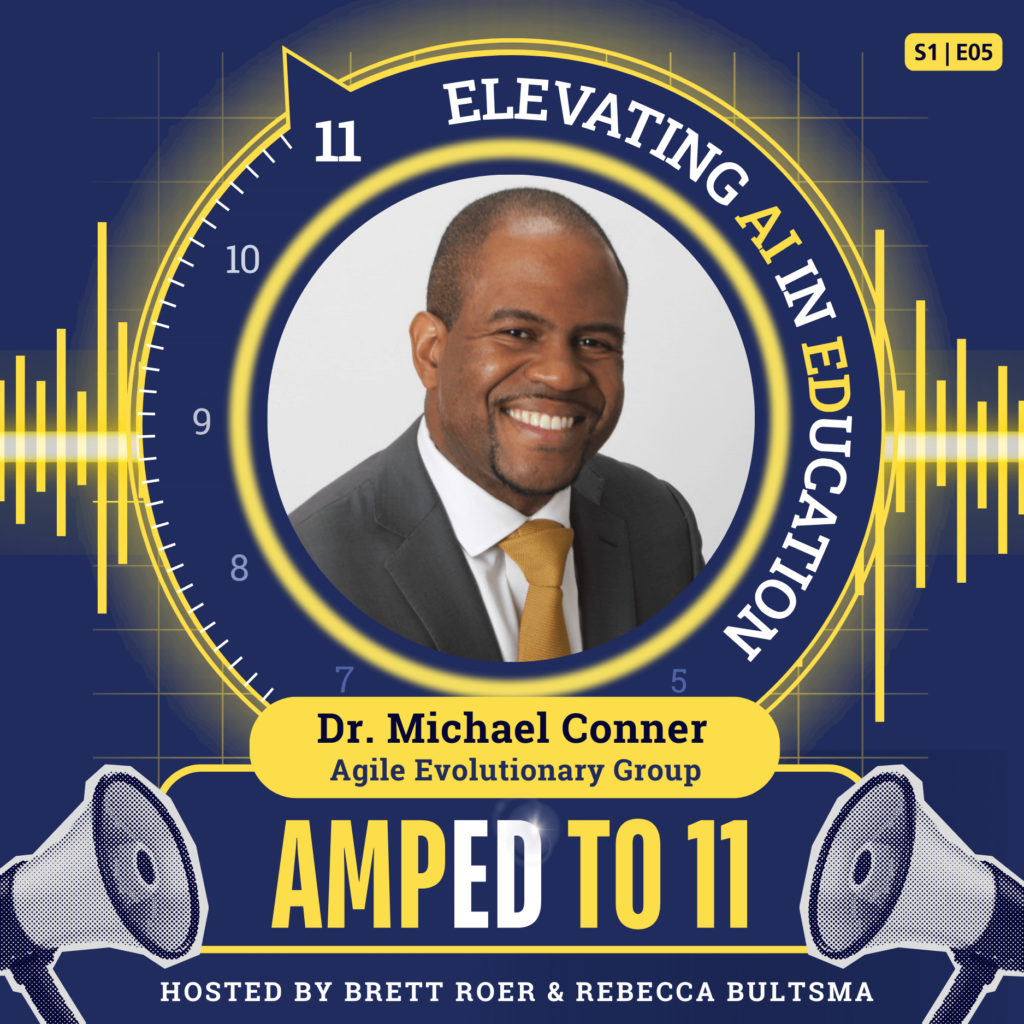
Rebecca Bultsma: [00:00:00] Today, our guest on ampED to 11 is Dr. Michael Connor, CEO and founder of Agile Evolutionary Group. Michael is completely revolutionizing education with his very innovative approach to AI and strategic change. Over the past year, he launched the Agile Diagnostic and AI Platform, which is a groundbreaking tool which is designed to help level the playing field in education.
Rebecca Bultsma: And his platform uses AI diagnostics to empower schools across the U. S. driving excellence in inclusion, equity, and student empowerment. So we are thrilled to have Michael on the show today and dive into AI innovation and his bold vision for the future. Michael, welcome to our show.
Michael Connor: Thank you, Rebecca.
Michael Connor: Thank you, Brett, for having me. Such an honor to be here. Happy New Year.
Brett Roer: Happy New Year to you as well. Michael, it’s an honor and a pleasure to have you on today. I’ve been so fortunate that I’ve got to see your journey over the past few years as you’ve built out this [00:01:00] You know, amazing philosophy to meeting the moment in education through AI and other, uh, areas that you’re truly an expert in.
Brett Roer: I’d love for you to kind of let, let, um, let our listeners know a little bit more about what it is you’re up to, what it is you’re building and kind of what is your mission and goals with what you’re doing.
Michael Connor: Yeah. Brett, thank you. And Rebecca, thank you again. Brett, it’s just been an absolutely extraordinary honor to have you along this journey, uh, for the past couple of years, but yeah, my corporation, agile evolutionary group, um, We just recently launched.
Michael Connor: And as you know, Brett and Rebecca, the future of education is now campEDaign. And what we did was we unpacked or essentially conducted a roughly around 16 months of research of what do schools or what would schools look like the future, the future of the world, future of the work and future of schools.
Michael Connor: And we took all of that data and all of the research And we [00:02:00] created what we’re calling the 22nd century education model. It’s essentially a systems learner framework and experiential learners framework. It outlines indicators of what this 22nd century learner ecosystem looks like. And then also too, as you know, to be in alignment with our 22nd century education model, we Uh, just launched or last year, I should say within the past six to eight months, we launched the agile diagnostic and AI platform.
Michael Connor: And as Rebecca stated, it is one of the only software solution tools that incorporates research, artificial intelligence, analytics, and science all in one that basically, um, is trained models around change management to what we’re calling the 22nd century learner ecosystem, which is underscored within the 22nd century education model.
Michael Connor: So. Uh, we’re doing a lot with that. So as you know, we’re focusing a lot on Ed tech. We’re also building a second software solution as well, and that will be released [00:03:00] sometime in the middle of spring. So we’re doing a lot with an agile evolutionary group around software solutions, design, product design, AI launching, and then also to, as you know, some of our groundbreaking work around instructional and educational leadership.
Michael Connor: So. It’s been a lot, Brett and Rebecca, but again, a journey that is, um, I, I think is intoxicating and invigorating at the same time.
Rebecca Bultsma: Dr. Connor, uh, tell us a little bit about the disruptive effect model.
Michael Connor: Yes, the disruptive effect model essentially It is a conglomerate of research and science interfaced together.
Michael Connor: Rebecca, think about the disruptive effect model, the anchors of innovation science, which are the five pillars that you see that leads to, I like to say, a systemic 22nd century transformation. And then also the disruptive excellence framework, which is three value features that is a competent, but basically codified into one and what I like to the [00:04:00] exampEDle I like to use is that the anchors are the pillars within the anchors of innovation science.
Michael Connor: That’s more of your systems thinking. This is more on the lines of this diagnostic lens around what to re author, then structures and systems, and then also identifying what those systems are, and then the long term pattern or phase pattern of transformation, uh, that accomplishes that. That’s the anchors of innovation science, right?
Michael Connor: That’s the systems thinking. The systems shifting. is encompassed within the disruptive excellence framework. So that’s where now you see that reciprocity of systems thinking and system ship systems shifting. But it’s more in the lines of that research and science working in reciprocity with one another.
Michael Connor: So it’s a it’s a mouthful Rebecca. A lot of, uh, it’s research latest scientific or science related. But again, it provides, I like to say this step function around what transformation Uh, systems thinking and systems shift and look like. [00:05:00]
Rebecca Bultsma: So I have one more question before we turn it over to Brett. Uh, one of my favorite prompts in AI is to explain it like I’m five.
Rebecca Bultsma: So if you were to explain what you do to me like I was five, how would you explain it to me like I’m five?
Michael Connor: So explain it as if you were five. In essence, it takes foundational practices. Of what we are, what we’re looking at within the standardization, uh, traditional practices, traditional systems, and then it interrogates them so that you can be able to move and shift towards these innovative structures and innovative systems that underscores A.
Michael Connor: I. So it’s taking pretty much your traditional practices. And then looking at them in this microscopic lens and then moving towards innovation that underscores artificial intelligence.
Brett Roer: Thank you. Brad, over to you for the fun stuff. Thank you, Dr. Conner. Before we, before we get to [00:06:00] our favorite part, the 11 questions that we’re going to be walking our listeners through and putting you on the hot seat.
Brett Roer: You know, you’re an international keynote speaker. You’re leading this work around the world, around the United States. Maybe just share briefly, you know, your own educational background in terms of kind of the communities you served and the work you’ve led on the educator and leadership side.
Michael Connor: Yeah, yeah.
Michael Connor: Great question, Brett. So I like to say that I’m speaking two languages at once and why that’s kind of like the best analogy to put it when speaking from the context of, you know, the standardization of a of a language. Uh, my English language is more in the lines of ed leadership, research background with that, also former superintendent as well as chief academic officer, principal, assistant principal, curriculum specialist, teacher, so that lineage, right, within the pre K.
Michael Connor: Uh, 12 model where I served all the way up until the superintendent role. But then also too, I like [00:07:00] to say this is my second language is this ed tech background that I have, uh, went back to school and got, uh, got a degree in business analytics as well as in information technology and management as well.
Michael Connor: So it’s kind of like that. Analytical statistical modeling training models on the back end around advanced analytics, incorporating technology as well as as management practices around technology. And then so what I’ve been doing essentially, Brett, is I like to say spanglish right where we’re interfacing both the standardization of ed leadership as well as some of the traditional theoretical underpinnings as Theories and concepts and then bridging that with the advanced analytics technology and management aspects of it to create one.
Michael Connor: So yeah, two different silos of, you know, educational background and attainment, but now trying to be creative and innovative to interface both. [00:08:00]
Brett Roer: Yeah. And again, just want to say thank you for that, because we know in education and in ed tech, sometimes the leaders in each of those sectors are not able to code switch, are not able to relate to the other.
Brett Roer: And that just comes at, unfortunately, the price of innovation and access for students and educators. So again, thank you so much for going through all that hard work and earning Um, your reputation well deserved for being an expert in all of these different fields and bringing the right stakeholders together for the right reasons.
Brett Roer: So thank you.
Michael Connor: Thank you. Thank you. Great. Thank you for the work that you do.
Brett Roer: Appreciate it. All right, here we go. We are going to start question number one. As you know, ampED to 11. We’re going to walk you through 11 questions that we feel are the most important ways to get from you. What is going on in AI and innovation in education today?
Brett Roer: So number one. We’re all familiar with the Netflix hit stranger things. And one of the main characters is called 11. She has these supernatural powers. That are going to leave everyone in awe the first [00:09:00] time that they see them. So taking a step back, Michael, what’s been your most jaw dropping AI moment?
Brett Roer: That first time where AI really did something so unexpected that you couldn’t believe it had that capability.
Michael Connor: Yeah. And Brett, this goes back to when I went back to school for my business analytics degree back in, I think it was 17, right? 17, 18. This was before the pandemic. And one of the, I would say, jaw dropping moments was my first encounter, and this is why I went back to school for this, is my first encounter with AI was, it was on a platform and it was a recommender system.
Michael Connor: Right. And it was when recommended systems when they first came out and I was like, wow, the sophistication of the actual AI to pinpoint books, uh, and movies that I actually liked or piqued my interest. I’m like, At the time, I was like, wow, how, how do they know this? How does this, you know, [00:10:00] how’s this technology or this, or, or, or, you know, the, the, um, the platform know what I like to, or what I want to prescribe or might potentially buy.
Michael Connor: I think it was at that moment where it was kind of like this weird moment, but it was kind of like my epiphany of like, oh wow, this has taken off in our naturalized economy. How can we make, how can we emulate AI practices like this in education? This was a while ago, you know, with that. So I would say, you know, my first encounter with a recommender system on a platform and targeting, identifying the recommendations based off of previous historical data that it was collecting on me.
Michael Connor: But I didn’t know that at that time. So I would say that my weirdest moment was that first encounter with the recommender system.
Brett Roer: Yeah, that’s, that’s definitely one that this personalization and trying to figure out how it does it, uh, for many of us has been a mystery, but, uh, it’s become so ubiquitous now [00:11:00] that like now we can almost probably take it for granted.
Brett Roer: But at the time, yes. What a, what a transformational moment. The namesake for our podcast comes from the, the classic film spinal tap, right? There’s iconic scene where. The musicians talk about their ampED. They can crank it all the way up to 11 when they need you to go past the limits of what’s expected, uh, from their band.
Brett Roer: So Michael question to you is. What’s that AI tool that you’re using right now that really allows you to push past the limits? You just got to get things done or you got to meet a deadline?
Michael Connor: What’s funny about this, Brett, it’s the same thing that, you know, everybody, the tools that everybody else is using.
Michael Connor: I would say Claude, uh, Claude AI is one and Gemini AI is one because I always like to, now that we have a generative AI to be able to Test and challenge ideas, uh, to synthesize new information in ways that it hasn’t been generated. I would say that pushing those two tools to its limits, right? I always, [00:12:00] uh, prompt it with whether it be specific research questions or specific questions around AI and different platforms and, and emerging technologies.
Michael Connor: So I would say, you know, uh, Claude and, and, and Jim and I are my two go tos right now, uh, per se.
Rebecca Bultsma: Claude is actually one of my favorites too. And I, I. Was looking at, I read an article in New York times a couple of weeks ago about how Claude is almost everyone’s favorite because they’ve invested a bunch of time and money into this emotional intelligence training some way that it’s, it’s got this it factor that makes it feel like friendly, but it challenges you.
Rebecca Bultsma: And because of that, it’s becoming a lot of people’s favorite kind of go to tool. But as a researcher and. Somebody who thinks at a PhD level. Uh, have you tried the O1 model from ChatGPT that is supposed to give PhD level reasoning abilities? Have you experimented with that from ChatGPT at all yet?
Michael Connor: I haven’t Rebecca, but now that you mentioned it, I will be exploring that.[00:13:00]
Rebecca Bultsma: I think you should. Anyway, let’s carry on.
Brett Roer: I also want to say, I think this is what we hope our listeners get. I mean, this is what we get to do when we catch up in person, right? We just kind of swap. What are you using? Um, what’s the best tool? Have you thought about it for this application? So I hope our listeners, this is generating for you as well.
Brett Roer: If we got some researchers out there, different ways to, uh, to elicit research and use AI to power your next steps. We’re used to rating things 10 out of 10, but we know. There’s so much amazingness happening right now in AI and innovation that sometimes things are just off the charts. So what’s an AI tool or something you’re using right now?
Brett Roer: That’s AI backed. That deserves an 10 rating right now. Why
Michael Connor: there’s so 11 out of 10, right? I’m sorry, but I got to do this with Rebecca as well. I’m going to have to go with the agile diagnostic and AI platform. And the reason why I say that is because, and there’s others obviously, Brett, but you know, I want to be able to put that out there because it is one of the first [00:14:00] tools.
Michael Connor: You know, uh, that empowers, uh, executive leaders, superintendents around change management and continuous improvement that is AI driven, analytics driven as well, and then incorporates the research and science, and then it provides that prescriptive step. So provide the prescriptive steps. And recommended actions to make those, uh, change management or transformative processes.
Michael Connor: So I would have to say that is one, but you know, defined learning has a great product that’s out there, uh, that’s doing well and shoe that we both know, uh, around school joy, having really, really good cataclysmic impact from a positive context with that as well. Uh, Kai with Kai XR. That’s another good solution that’s out there.
Michael Connor: I mean, there’s many, many, many solutions. Another solution that is about to be out there now is the AEG IE Pathways. That’s a ML tool that’s being developed in product development [00:15:00] stage or design stage right now under AEG. So there’s a lot of solutions and products out there that’s incorporating AI. Uh, that can really make a positive impact transformative influence on learning organizations as well as impact on students as well.
Michael Connor: So those are the software solutions. I would rate 11 but again, I’m not being pompous by, uh, putting the agile diagnostic out there. I’m trying to promote it as much as I can.
Rebecca Bultsma: So with that said, if we have superintendents and system leaders listening to this, who want to know more about where they can go or how they can.
Rebecca Bultsma: Find more about your platform or to contact you to try it out. We will add in our show notes, you will send to us, wherever they can go to make that happen, correct?
Michael Connor: Absolutely, Rebecca. Thank you for that as well. Provide you the email, uh, information where to be able to go with that. I’m just very in Brett knows Brett was a part of the initial discussions in the fall of 2024 [00:16:00] when this was in design.
Michael Connor: And a lot of people that I spoke with education stakeholders, leaders across the world. It’s just fascinated by it. Because again, you don’t see research, science, analytics and AI all in one that can Prove or I should say inform on empower leaders around change management and continuous improvement. So we see a lot for the classroom dynamics, right?
Michael Connor: For practitioners as well as site based leaders, instructional leaders at their school to incorporate different solutions that are out there, but from a broad systems dynamic of change and transformation is one of the only tools out there. So Uh, really excited about that. And, and of course, um, we’d love to be able to help, you know, organizations move to that 22nd century education model.
Brett Roer: Some things that I want to share, you know, Rebecca said this to start us off, you know, Michael, you’re, you’re sometimes way up here in terms of your background, your expertise, both education and ed tech and research. One thing I saw [00:17:00] when I was fortunate enough to be part of some of these preliminary discussion groups is.
Brett Roer: Not everybody’s there in education, but you’re able to take them on the journey. You’re able to make relevant points that they are aware of. You know, we know what some of the challenges your district faces are, uh, for some of the education that you had, how can you use a tool like yours to move the work forward?
Brett Roer: I think that’s been the biggest key is you’re able to talk to people wherever they’re at and get them to where they, you know, hopefully get to in the near future to empower their students in their community. So again, kudos to you and thanks for shouting out some of these other amazing 11 solutions out there.
Michael Connor: Hey, yeah. Yeah. And again, Brett, I just want to say thank you again for being a part of that in the fall as well, because, um, you know, to your viewers out there, there was a collection of leaders that I trust as well as a tech experts out there. And Brett was a part of that discussion, provided feedback and also two ways to improve the solution from a market standpoint.
Michael Connor: So again, Brett, thank you [00:18:00] for your support with that going way back into the fall of 2024.
Brett Roer: So here at Mto 11, we are big fans of 11Labs, which is a great tool. Um, it’s known for creating AI voices that are, you know, truly next level amazing. So, Michael, similar to a question you ask on your podcast, right, what is your go to song?
Brett Roer: If you could have anyone, fictional, uh, historical, dead or alive, you know, kind of read your daily emails, who would you choose to do that for you and why?
Michael Connor: Yeah, this is a great question. And Brett, when this, when I was reviewing this question, I said, wow, who would that person be? And the one voice that always came to my mind, and I was actually reading an email, and what voice would I want that to be?
Michael Connor: And one voice that always captions me is Maya Angelou’s voice, right? And when she reads or unpacks her poems, um, it’s [00:19:00] just kind of like this soothing, Auditor speaking to you and you can actually visualize when she’s actually reading her poems. So if there was one person that I want to read my emails, um, it would be Maya Angelou and her voice.
Brett Roer: Absolutely. Yes. She’s, uh, obviously a towering figure in literature, but yes, the way that she delivers her words, not only the way she writes them, but the way she delivers them. Absolutely. So powerful. That might, that might be the champEDion so far of who’s, uh, might be the winner.
Rebecca Bultsma: That’s a great choice, honestly.
Brett Roer: Yeah, yeah.
Michael Connor: When I saw this question, Rebecca and Brett, uh, and I said to myself, wow, who would it be? And then, uh, her words were piercing words of, you know, when she was on, on video or sorry, on audio, I know why the caged bird sings and how provocative her voice is in the tone, in the diction of how it [00:20:00] goes up and down.
Michael Connor: Um, just absolutely phenomenal, phenomenal. Just since chills down my spine right now,
Brett Roer: you know, Michael, I know this just from our shared history together, but maybe could you let folks know where were you born and raised?
Michael Connor: So born and raised, uh, New Haven, Connecticut, you know, spent most of my life there.
Michael Connor: And then, um, educated in the Boston area, spent a significant amount of time in the Boston area, uh, Cambridge area being educated. And now up here in Rochester, New York, uh, we’ll snowy, but it’s, it’s, it’s, it’s okay. We, we, we, we, we love our snow. We love our weather and we love our bills.
Brett Roer: Well, I ask this because I know, you know, I think we share a passion around, uh, sports, especially the NBA.
Brett Roer: And so generationally, this probably resonates with you and a lot of our listeners. I’m a New Yorker, a huge fan of the mid nineties Knicks. That’s like my team. And uh, fortunately they suffered a real shocking defeat at the hands of Reggie Miller, right? NBA [00:21:00] legend. Proud wear of number 11, most famous for, you know, eight points in eight seconds.
Brett Roer: Uh, I’m doing the clutch. So this question I always love asking, but I also really brings me back. But Michael thinking about now AI for a second, right? What’s a moment where an AI tool really came through for you and went beyond your own expectations about like how it could empower the work you’re leading or the work you’re leading, uh, in collaboration with others.
Michael Connor: Brett, I have to go back to this. Well, when I was a superintendent where essentially what my theory was, right, that if we wanted to close the achievement gap, the achievement gap is a symptom, uh, we had to get to the root cause to close the preparation gap. And my theory was that, and I’ve built out a strong hypothesis with this, is that if we close the preparation gap by grade, by grade one, with regards to the literacy, building up the [00:22:00] foundational literacy skills of our three and four year old students, and then that will be able to now close that gap, not at that third grade benchmark, but Uh, much, much faster or earlier, I should say, than grade three.
Michael Connor: So we built a strong hypothesis with that. And what I did was I built a multi tier system of support, an MTSS model at the pre K level, but complemented that with an AI software, was more on the lines of an adaptive tool that gets to that level of, I like to say, to get to that level of The prescriptive foundational skills of students so that now what we were doing is we created that K through five literacy model Operating model I should say that in conjunction with an AI tool that’s embedded in there So we did that for the pre k classrooms universally All of them.
Michael Connor: And in essence, [00:23:00] students were coming into kindergarten, quote unquote, meeting benchmark for kindergarten readiness. So they didn’t have a gap going into the pre K 12 or K 12 sector with that. But the AI solution or software that we identified Uh, to compliment core pedagogy was that. So what I saw are the determinative factor based off of my hypothesis was that we were able to close gaps specifically using AI foundational literacy gaps, uh, at the pre K level three and four year old level.
Michael Connor: So that students were coming in benchmark ready or meeting the specific absolute scores of kindergarten right when they start day one. So ultimately those students. That were at that benchmark on day one, we were able to close the quote unquote achievement gap by second grade. So in essence, it was that AI tool, that solution that complemented the instructional model that we put [00:24:00] in or literacy model that we put in for all our pre K students.
Michael Connor: So it was kind of like that Reggie Miller eight points and like 30 seconds that all of us Nick fans dread to talk about. It’s kind of like the wide right. If you live upstate in Buffalo versus the Giants, right? So it was, so, uh, that tool, um, really created or created a level set so that students would be on target and continue that trajectory, uh, in the K 12 setting.
Brett Roer: So I really want to make sure our listeners hear this, right? We know that it’s been a generational issue, closing some achievement gaps among different demographics in the United States. Everyone wants to find that solution. So I’m so impressed that, you know, even pre when many of us started to embrace AI, you were already incorporating those tools in your role as a superintendent, and you were able to meet the moment.
Brett Roer: Um, so just first again, kudos to you for realizing technology can be that leverage to addressing, um, educational inequities and closing achievement gaps. [00:25:00] I also just want to give you some flowers and also let you speak for a second. Cause I know this is obviously, um, a subject matter that’s near and dear to you.
Brett Roer: You’re leading some work in New York, especially in upstate New York. I believe you’re one of the founding members of NABZ in the upstate New York chapter.
Michael Connor: Yes. Yes. Yes.
Brett Roer: Would you mind just sharing with our listeners like a little bit about what you’re trying to do in your new home, you know, your new adopted area of Rochester, New York, what you’re up to up there and addressing some of those gaps there.
Michael Connor: Yeah, no, it’s been, it’s been great. Some of the colleagues that I’ve revered for such a long time Uh, when I was a superintendent, chief academic officer, actually, uh, get to work with them up and close and personal, you know, being here in the upstate area and yes, you know, one of the founding members of upstate new york appsy, which is a state affiliate of of Napsi, our upstate new york appsy president, dr barbara mullin is leading us and leading that work and doing some phenomenal work with some of the founding members that are up here.
Michael Connor: Awesome. You [00:26:00] know, it’s a who’s who with superintendents, former superintendents as well. Dr. Sean Nelms, who was at the University of Rochester. Also, Dr. Lubell Brown in Ithaca. I mean, it’s just been a great, great, great time being up here. Uh, working with my colleagues as well, and then also to enhancing and promoting each other’s work.
Michael Connor: And I think that’s the goal, right? You know, with, uh, whether it be Dr. Mullin’s work, or whether it be Dr. Brown’s work, or any of the founding members and members of, of State New York Advocacy, we support each other, uh, 100 percent. And I think that that’s, you know, uh, what we have to do in education.
Michael Connor: Specifically now, uh, we’re seeing these rapid times of change and we have to be able to now pull together in the synergistic, uh, aspects so that we can now, uh, strengthen as well as deepen the work.
Brett Roer: You know, you’re all looking to become more innovative, to really introduce cutting edge technology, especially around AI, [00:27:00] but it’s always rooted in this core mission and value of addressing.
Brett Roer: You know, uh, inequities and addressing the achievement gap and trying to close it. So again, thank you for being at the forefront of that and pushing the work forward and building these amazing coalitions wherever you are. And I think that question that we just asked and your response really ties into what we’re doing next.
Brett Roer: So we’re thinking about the 11th hour, right? It’s that last second. It’s that crunch. It’s crucial that you get it right. So right now, what is the latest AI breakthrough as we kick off 2025 that educators, You know, people in society in general, families, students, they need to know about right now. What is the need to know 11th hour AI tool and breakthrough that folks need to know about that you can share?
Michael Connor: Yeah, I think you, you touched upon it. Um, Brett and Rebecca kind of said it earlier, uh, in this implicit way that AI and technology is becoming this ubiquitous utility within our [00:28:00] ecosystem. And I think that now what we have to do or what the biggest breakthrough is, is that we have to be able to now intentionally and strategically scale what A.
Michael Connor: I. Looks like from a learning organization standpoint. I think that we’re having an excellent and amazing conversations at the classroom level, how to support classroom practitioners with it. A variety of different diverse intelligence systems that are out there, generative forms or platforms that are out to machine learning.
Michael Connor: I think there’s a lot of breakthroughs with that. But I think what we need to do to push the next level is what does this look like from a change management continues improvement lens, right? What is innovation in a I looks like as we continue to iterate Right. Iterate some of the standardized systems and structures on education as well.
Michael Connor: So I think that what we need to do to continue to push these breakthroughs is to [00:29:00] continue to experiment, tinker as well as explore this continuous innovation around learning. So AI is going to continuously to rapidly change, right? As we’re speaking right now, AI is becoming much more sophisticated. Uh, when I think about, you know, when we look at what are some of the new breakthroughs and this is probably Brett and, uh, Rebecca probably made about five years out is what does a G look like within the education ecosphere and we’re still at this rudimentary level of understanding what AI looks like in the classroom and in a broad systems context.
Michael Connor: So I think some of the breakthroughs have to be around broadly scaling this. With a level of organizational or strategic co occurrence amongst classrooms, schools, and districts across the, um, across the world.
Brett Roer: Yeah. And I think that’s something you’re doing a great job of trying to do is systematize this, meeting people where they’re at and then making it scalable.
Brett Roer: Cause as you said, there’s a lot of [00:30:00] classrooms, there’s a lot of really innovative pockets. You’re not going to really address the systemic issues unless you can really bring, you know, more stakeholders together and, uh, and systematize it so that you can scale it. So. Well said, and that’s hopefully the goal for 2025 and beyond.
Brett Roer: Thank you, it’s a cross, Brett. Well, that’s actually, you know, something we talk about a lot, right? It’s 1111, right? It’s a term we used to say, let’s make a wish, let’s give it some extra magic. So I think you’re hitting on it, but I’d really love you to even expand upon it further, right? You have one wish for how AI can truly shape education and society, you know, the work you’re leading right now.
Brett Roer: What would it be? What is that wish at 11 11 that you would use to shape education and society to the power of AI?
Michael Connor: Yeah to create a model in Alignment with the students that were educating my one wish is I think that this is the most pivotal time generation alpha [00:31:00] right and their core attributes as well as their dispositions and characteristics that they display It’s the antithesis of any generation in mankind, right?
Michael Connor: We still have a standardized model that we’re still underscoring. And then just, um, this, this new year, we welcomed into the world generation beta. So we’re educating generation alpha generation beta. Right. And I, and I can’t wait to unpack the research themes around the attributes as well as the characteristics of generation beta as they immerse themselves in the economy.
Michael Connor: But what I hope that we can do is that we’re starting to see radical shifts within everything regarding demand. for our natural economy. Um, we’re seeing industry shifts because of A. I. In various emerging technologies. My one wish is that we’re able to shift over [00:32:00] time. Our operating model, the apparatuses and elements of our traditional fossilized industrial model that we underscore to what I’m calling this learning ecosystem that is adaptive and transformative, but prepare students For the future of the world and future of the work.
Michael Connor: So if I have that one wish is to radically skip the model so that we’re adequately preparing generation alpha and generation beta.
Brett Roer: I think that, uh, you know, with the dawn of a new generation, that again, leads to a lot of promise, right? Here’s to hoping that we get it right for them and we’re, you know, what you’re leading is really moving us forward into that.
Brett Roer: So speaking of the next generation, you know, you’re a proud parent. So first just want to, if you want to give a shout out to your young one and maybe tell us their name and their age and a little bit about them, we’ll, we’ll kick off our next question with that.
Michael Connor: Yeah, Brett. So, um, my one son, I always say that my son is keeping me abreast of generation alpha.
Michael Connor: [00:33:00] And, um, I think that’s the best data collection with that because I have a nine year old son who is the polar opposite of me. And what I mean by polar opposite, uh, the kid is, he’s a very, very, and I’m not saying this because I’m his father, but he’s a very, very smart kid. But his intellect is around coding.
Michael Connor: His intellect. Is around gamification, multiple languages, three languages as well. And then also really unpacking. Uh, dense concepts in this really deep conceptual manner. So I’m used to, you know, hey, procedural fluency with math. Give me, you know, the algorithm, I’ll be able to solve it. But he’s unpacking that.
Michael Connor: But again, that is who we’re educating generation alpha, right? And that’s a part of their attributes. So He’s keeping me abreast of how to be able to now align some of those micro elements, uh, some of those, uh, micro levels of [00:34:00] innovation to now deepen that for broader levels of, uh, innovation. What I like to say coherence process three.
Brett Roer: Your son does not sound that different from you in terms of his intellect and ability to navigate multiple languages, but Kudos to him. And it sounds like you’re raising a great, a great young, young man there. And it wouldn’t be too far a leap. You know, he’s going to be 11 year old. He’s going to be 11 years old soon.
Brett Roer: So really thinking about him and obviously the broader spectrum of society, you know, imagine that there will, there are 11 year olds out there who’s going to, who are going to grow up, never knowing a world without AI. So what are the messages that you would give to those young people today about their future in an AI driven world, whether it’s cautions and also, you know, some of the, uh, the hopes you might have, uh, for them and deliver to them in a message.
Michael Connor: Yeah. Yeah. One message I would say that is that two generation alpha is how to create that equilibrium between how you using AI different, um, modes and variants of tech variants of [00:35:00] technology in your natural life, right? One thing, Brett and Rebecca, that is It’s obvious is that there has to be this kind of like this, this continuum of human intelligence and artificial intelligence in every step and form of our life.
Michael Connor: I think that we’re at a time, uh, where AI is a part of every single. I would like to say endeavor second of our life, whether we have our phones in our hand or something that we’re using of artificial intelligence. So I think that one of the main messages that we have to communicate with besides the ethics on it.
Michael Connor: I think that’s one of this very critical. of how to be able to underscore and utilize A. I. In a positive way in their life. But also, what does a human intelligence and artificial intelligence continuing in equilibrium looks like within their life and how to appropriately navigate the nuances of A. I.
Michael Connor: And the [00:36:00] novelties as well. So I think if we continuously to have that message to our students, generates an alpha of that. Yes, AI and technology is going to be part of our everyday life, but how to create that balance. It’s gonna be critical because we can’t, you know, there’s various elements. I like to say human elements that we can’t forget, right?
Michael Connor: And we also can’t have our, our students forget. One thing that is, I think it’s comical, Brett, is that one thing that my mother, um, with my son that she didn’t want him to lose was cursive. And right. And, um, that was one of the, uh, of the things that my mother, she was like, yeah, you know, with AI and, yeah.
Michael Connor: You know, this whole, uh, she lasts about the 22nd century. Every kid needs to know how to write cursive. So, you know, yes, my son knows how to write cursive with that. I always said that’s kind of like a lost art, you know, within education as we speak, but those are the things, right. [00:37:00] That we can’t lose. And even though, yeah, I might be a futurist in a seller and an accelerate, um, acceleration with regards to moving towards the future, those are some of the, I like to say, standardizations that we can’t forget.
Michael Connor: So making sure that messages. What’s that equilibrium between some of the standardizations and human intelligence with some of the future outlooks and A. I. as well?
Rebecca Bultsma: And you touched on it briefly, uh, the idea of A. I. ethics, and that’s where I spend my time researching and something I’m fascinated by. But if you had to identify some of like the core ethical issues that we need to be prioritizing right now as a society in education.
Rebecca Bultsma: I know we didn’t send you this question ahead of time, but I am curious about what you think about that. What you think some of the biggest ethical challenges we’re facing right now connected to AI might be.
Michael Connor: There is, uh, there’s this common. Notion. Um, this common dialogue around, um, students were cheating and using different [00:38:00] softwares and platforms.
Michael Connor: I think that conversation needs to continue, but also ethical utility of a I think that’s going to be Very foundational for it. That’s very abstract. I know, Rebecca, uh, that I’m describing that, but there’s multi, I like to say multi variants of what ethics look like in the utility of it, whether it be classroom dynamics, whether it be phone dynamics as well, whether it be interaction amongst students, you know, cyber bullying, uh, is one.
Michael Connor: That we have to be able to take a look at, you know, cyber security is another with regards to, you know, where to appropriately go from a security standpoint with our students. So it is multivariant, and I know it’s very abstract, but again, really extracting those nodes around what ethics look like with A.
Michael Connor: I. Integration and utility. And really building student capacity around it, because I think one of the [00:39:00] misnomers is, yes, our students understand and know how to navigate through AI, but when it comes to this really didactical, linear focus around ethics, we still have to build their individual capacity around what that looks like.
Rebecca Bultsma: We’re always working on that digital citizenship, aren’t we?
Michael Connor: Absolutely.
Brett Roer: Yeah. And cheers to the finest people that hopefully are leading that charge for the upcoming generations because it is so crucial. We get that right. Michael, I’m going to give you two, a two part question kind of here. Okay. We hear all the time, right?
Brett Roer: Today’s AI is kind of the worst AI we’re ever going to experience in our lifetimes, right? It’s at level one in terms of the way that we’re utilizing it today, especially, you know, since the last few years. What happens when we finally crank it up to 11? What does that future of education really look like when AI reaches its full potential?
Brett Roer: What’s kind of possible that feels almost like sci fi today. [00:40:00] And the second part to that question is what’s something that even though, you know, we’re at the infancy stage of AI. Where you’re like, how do we not know how to do this yet? Or what’s one thing that kind of still frustrates you that AI can’t do in its current state?
Michael Connor: Great question, right? Two parter. The first part, right? I, I, well, going back to the second part, what frustrates me about AI is that, again, it’s expanded, uh, capabilities around how we’re able to close some of these persistent opportunity access gaps, right? And I’m looking at this from a selfish context because I want to be able to try to mitigate all those gaps that we see within our students despite, you know, where a student might come from, um, background, educational, um, baseline.
Michael Connor: Uh, I want to be able to close those gaps and to ensure that there’s that level of personalization that we’re reaching all of our students. [00:41:00] So one thing that I, you know, that continuously frustrates me, and I think that that’s going to be a continuous frustration, is how do we use AI to Create more access and opportunity for those that have been traditionally disenfranchised.
Michael Connor: We’re now going back to the 1985 study with Benjamin Bloom, where it’s not a two sigma problem anymore. It’s this level of this two sigma prosperity. We’re now we’re accelerating students at this exponential rate, but this whole sci fi right with this mission looks like kind of goes back to my 22nd century education model create in this 22nd century learning ecosystem where.
Michael Connor: Systems and structures are loosely tightly coupled, where now we have decentralized curriculum where AI, a variety of different intelligence systems are being underscored, uh, within the classroom at the site based level. We’re creating, I like to say, these micro hubs that incorporates a variety [00:42:00] of different technologies and AI solutions or software solutions, where now students have that experiential learning.
Michael Connor: Whether it be through machine learning or the mixed realities, incorporating that students are co designing and co authoring their learning experiences, where now a I and very diverse emergent technologies are being able to support classroom practitioners with regards to pedagogy, where it’s adaptive pedagogy.
Michael Connor: And the context of getting to that level of customization for students, but also truly practitioners are acting as facilitators of learning as students are co designing these experiences, utilizing the their court’s talents, right? Utilizing these core skills. In their naturalized world that compliments AI.
Michael Connor: So if this kind of like this sci fi experience, like I said, go back to the outset, this loose, tight coupled system where students are navigating their own [00:43:00] learning through path, pace, place, and time.
Brett Roer: Just can you restate that last part? Because I think that right there is a quote that I want to make sure our listeners really heard.
Michael Connor: Yes. Um, AI reaching this level of synergy where now. It’s facilitating and guiding students with their own indirect or independent learning where it’s path, pace, place, and time. I always like to say, uh, three Ps and a T.
Brett Roer: Thank you for that, because I think that is something that Is a true equalizer for able to achieve that vision that you’re setting forth there.
Brett Roer: So appreciate that. And, uh, hope our listeners heard that and they know who to reach out to. If they want to learn more about that, shockingly, we are at our final question, right? We’ve all listened. We’ve all learned from Dr. Connor. Now it’s time for you to answer what I think is really my favorite question.
Brett Roer: Because we’ve just listened to learn so much from you. Um, one of the things we’re always trying to do at ampED to 11 is ampEDlify and elevate [00:44:00] all of the people making a difference in this space, uh, in terms of AI, ed tech, education, innovation, and access. So in the film oceans 11, the crew pulls off the impossible, right?
Brett Roer: They build the ultimate dream team, all these one of ones, these unicorns. And by working together, they pull off the impossible. So, you know, if you were able to assemble a team right now to tackle. Kind of, uh, the biggest challenges in education, who are your must have experts specialists, uh, in the world of AI education, innovation, and access.
Michael Connor: Well, well, Brett, you and Rebecca would be one and two, obviously when I think about it, right. And I always like to say education, um, is laid it with domain experts, right. And in order for us to really move. The education ecosystem or the model we have to move from technical and domain experts to what I like to say now is this divergent [00:45:00] level of expertise that is trying to solve some of the most persistent issues or questions and education and we need edtech experts, right?
Michael Connor: That’s going to be a part of this. We need our standard education leaders are researchers are experts. Also, too, Brett, within the equation, I think that we need statisticians and psychometricians as well, because we need to be able to now look at data in a variety of different analytical perspectives and views.
Michael Connor: And then also, too, you know, we need our experts that, you know, bring in the technical expertise as well. But edtech experts, software designers, engineers, statisticians, psychometricians. Uh, as researchers as well. We need that conglomerate, right? And I like to say that that conglomerate that brings the divergency of expertise because linear and domain experts is not going to solve the education equation or [00:46:00] questions that we have, because again, we’re so used to traditional Uh, linear expertise and strategies that we have to be able to move beyond that.
Michael Connor: So I always like to say the divergency of expertise and experts that need to be involved to solve this, to bring it into this interface context.
Brett Roer: Absolutely. And you need so many of the types of thinkers, the types of skills and roles that we’re going to need to really make big things happen in the world of education through AI and innovation.
Brett Roer: Don’t feel bad if you forget anyone because we’re putting you on the spot here. But who are some, you know, who are some educators, leaders, innovators? That you would want to just name check and shout out right now. But I know and I’m giving you cover right now if he forgets someone’s because he’s on the spot.
Brett Roer: So anyone he forgets, he’ll text us later and we’ll make sure we throw them back in later. But we’ll AI it in. Go ahead.
Michael Connor: Right. I work with so many people. You’re gonna put me on the spot. No, there’s Brett. There’s so [00:47:00] many people to be able to mention if I want to, you know. Uh, obviously the superintendents across the country.
Michael Connor: I don’t want to mention any names because I don’t want to leave any out, but they know who they are, whether it be upstate New York, California, Texas, across the country, uh, superintendents that I get to work with and speak to from the EdTech world. Obviously, you know, you, Brett, uh, Matt Monge and Jacob, uh, Kantor, um.
Michael Connor: Max Brooks. I mean, these are some of the, the James, Dr. James Lane. Um, you know, these are some of the individuals that I respect, you know, across the board. And then also to, uh, so many of the partners that, you know, that I work with as well. I don’t want to seagull anybody out, but Brett, yes, there’s, there’s a ton of people that mean the world to me, uh, that challenges my thinking, that challenges my practices.
Michael Connor: Yeah. Um, not only as a, as, as an ed tech leader, but [00:48:00] I always like to say as a transformers as well, but I want, I want to mention 111. So everybody, you know who you are.
Brett Roer: Well done, Michael. Wow. You really threaded that needle. Well played, sir. You know, I do want to just give again, some flowers to a couple of orgs that I know Michael does work closely with.
Brett Roer: And I recognize, you know, uh, he’s, I don’t want you to feel like you’re overlooking anyone, but I want to shout out, I know you work very closely with. Again, affinity group organizations such as, uh, Kalsa. So I know you work really closely with Zandra and I know you work really closely with a lot of different affinity groups to try to really bring transformative change at scale.
Brett Roer: So that’s the state of California’s Latino school administrator affinity group. So again, just want to thank you for really helping so many people reach their goals, especially as it comes to empowering and diminishing the achievement gaps. So I just want to say again, thank you, Dr. Connor. And if you could please just take a moment and let folks know where they can find more about the work you’re leading.
Brett Roer: about these initiatives you’ve discussed and how they can get in [00:49:00] touch with you if they want to further the discussion with you or find ways to collaborate with you.
Michael Connor: Yeah. No, this has been great. And, um, Brett and Rebecca, thank you for the platform. Thank you for the opportunity to time again, you know, Brett and Rebecca, uh, love the work that you’re doing, Brett, again, you know, Few years now that we’ve been connected and really trying to change the ecosystem to create more opportunities for our students.
Michael Connor: But to reach me, Brett, easy, um, everybody can reach me on LinkedIn, uh, as well as Twitter. You can look me up at LinkedIn, Michael Connors and an er, uh, ed dot d. You have to put that in X or Twitter X, I guess, is at dot Connor, uh, 13. And you can reach me by email. At M dot Connor, C-O-N-N-E-R, at agile evolutionary group.com, all one word, M dot [00:50:00] connor@agileevolutionarygroup.com.
Brett Roer: Amazing. So again, thanks for, uh, joining us. Thanks for being so insightful. And for our listeners out there, thanks again for turning it up to 11 this week with us. Let me turn it over to Rebecca. What are some tools that we have in the spotlight this week that you’re going to share with us?
Rebecca Bultsma: Your tip of the week this week is how to use Google’s deep research to do research for your job or for topics of interest to you. And there are a couple of kind of funny, finicky things about how to access this tool that I’m going to walk you through in about. So first of all, you need to know that Google has this deep research product that allows you to do a deep dive on any topic.
Rebecca Bultsma: And it’s using almost what we understand to be agents to go off, do work for you, and then come back. What makes it confusing is that A couple of [00:51:00] weeks ago, OpenAI also released a tool with the same name called Deep Research, uh, but currently that is only available to people on the 200 a month plan. So your best option is going to be to use the Google version of Deep Research.
Rebecca Bultsma: Uh, something else that you need to be aware of if you’ve been looking for this tool and trying to figure out where to access it. You can’t access it if you have a Google Gemini workspace for business. You need to have a personal Gmail account with a personal Google Gemini subscription. And much like ChatGPT, there is a drop down menu with all of the different models listed.
Rebecca Bultsma: In that drop down model, and you have to have Gemini Advanced, which has a small cost associated, there’s a list of all of their different models. And in that list, you’ll find 1. 5 Pro with Deep Research. And all you have to do is type in a topic that you would like to [00:52:00] have research done on and Google Gemini will ask you a few clarifying questions and then go away for 5, 10, 15 minutes.
Rebecca Bultsma: And when you come back, it will have written a research report for you. I’ve had some that had 90 sources. It’s all cited, you can check all of the sources, and it ends up being great. A mind blowingly amazing tool. One of the limitations that you should be aware of, something that I’ve encountered and that I’ve noticed, is because a lot of really good academic journals and academic research is paywalled through institutions or published magazine paywalls.
Rebecca Bultsma: It doesn’t have access to absolutely all the information in the world to be able to give you the best possible research report. So you may want to augment something like this with something like Google Notebook LM, where if you have 20, [00:53:00] 30, 40, 50, uh, academic sources, You can quickly, uh, query through and pull, uh, supporting evidence and information from scholarly sources to work into the research that Google, uh, Gemini’s deep research does for you.
Rebecca Bultsma: So, next time you need to deep dive on a topic, give it to, uh, 1. 5 Pro with Deep Research. This is a perfect exampEDle of something that used to take us, you know, days, weeks, months, being able to be supported with AI in five minutes or less. Something that was never possible even a month ago, two months ago.
Rebecca Bultsma: So definitely a tool worth checking out. Just see how it does on a topic that you already know a lot about so you can sort of gauge how well it does. But definitely a tool worth checking out. Adding to your toolbox.