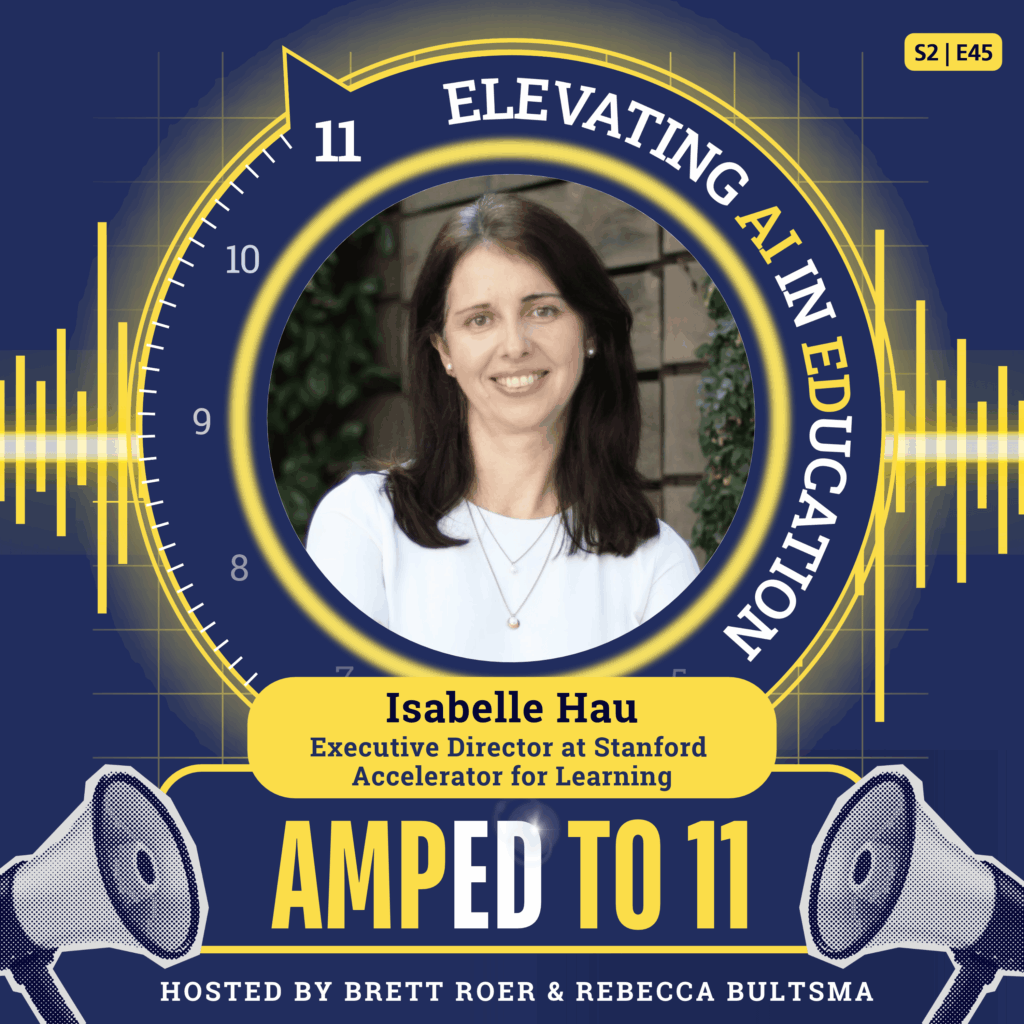
Brett Roer: [00:00:00] Regardless of where you are in the world, there’s kind of like three camps: embracing AI but not sure how, just kind of like, “I don’t really know what to think, uh, ’cause there’s… I don’t know what I don’t know,” and then people who are, have made a decision that, like, just full, full stop, this is not good. We need to stop everything.
Rebecca Bultsma: I think it’s the most ethical thing that we can do in the age of AI, is protect relationships at all cost, and I think that is the best way to prevent harm. I… You know, harm is so many different things, but it’s very people-centered.
Isabelle Hau: Right now our lives do not have some of those playful moments and, um, and those moments of human connections that actually drive our brain and our learning and wellbeing.
Brett Roer: Okay. Greetings and welcome everyone to the Amped to 11 podcast. I am joined as always by my incredible [00:01:00] co-host, Rebecca Bultsma. Rebecca, how is everything in snowy Canada today for you?
Rebecca Bultsma: It is snowy and it’s early, but I’m happy to be here to be warmed by the, the glow of Isabelle’s brilliance. We’re so excited to have her here all the way from sunny California.
Brett Roer: Yeah. So for our guests, we have a very special person joining us today, someone who is leading some of the most incredible work in the country and the world when it comes to education, innovation, and really keeping humanity at the heart of it all. Uh, it’s a pleasure to welcome Isabelle Hau, the Executive Director of the Stanford Accelerator for Learning.
Brett Roer: How are you doing today, Isabelle?
Isabelle Hau: I’m doing very well. It’s such a pleasure to be with the two of you
Brett Roer: Same here. It’s really an honor for us as well. We just had a brief introductory session where we learned so much about you, and we are so excited for you to share that with our listeners. We always love to let our guests kind of have the stage and just share a little bit about their journey.
Brett Roer: How did you [00:02:00] get from your start to now being the executive director of the Stanford Accelerator for Learning? And what’s your why? Why is that so important in all of the fields you could have chosen? Why this, and why now? Take it away, Isabelle.
Rebecca Bultsma: I just wanna ask, too, how you ended up from the south of France in California as part of your story.
Isabelle Hau: Very nice. Okay. So there is a big why. Um, when, um, when I was a very young child, when I was three years old, um, I was what you might call late everything. I was a late, uh, talker and a late walker, um, kind of late, late everything. So my parents were naturally worried, and they had me take a psychological test.
Isabelle Hau: Test came back and said that I had low academic aptitude. Um, so essentially not a great, uh, you know [00:03:00] profile, uh, uh, for, uh, what, uh, you know, what parents may, may, may think about at three years old. My parents kept on track with their love, uh, and their, uh, you know, great, great, uh, great nurturing, uh, for me.
Isabelle Hau: They also did something at the time that I don’t think, um, they fully realized would be transformational for me as a child. They enrolled me into a high-quality early childhood, um, setting where I received some incredible, uh, uh, specialized supports and a lot of love, uh, from, uh, multiple educators, including, um, a very, very special one who still lives in the same village where I was born, Mrs.
Isabelle Hau: Combs. Um, anyway, I think those, uh, very early moments in my, uh, education trajectory, if I may call it that way, uh, were truly [00:04:00] transformational. Uh, so much so that years later I would end up, uh, you know, graduating from Harvard University and then now working at, uh, Stanford. So anyway, all this low academic aptitude is well behind me.
Isabelle Hau: But when I think about what changed and what had an impact is, uh, not only the, um, uh, ability for me to have these early, uh, experiences in, uh, incredible settings paired with a lot, a lot of love and attention and, uh, feeling seen, supported by not only my, my family, but also very, very special educators.
Isabelle Hau: Um- So that really, um, you know, has led a lot of the things that I’ve done, uh, in my, uh, career, including my focus now for many years on education with, uh, uh… At, at the Stanford Accelerator for Learning, we have a broader focus [00:05:00] outside of early childhood education, uh, but early childhood education is part of my work, which I’m very proud of, uh, and very, very important to me personally, uh, given, given my background and my own, own story.
Isabelle Hau: So you can see throughout, uh, this story that, um, there’s one, uh… In, in addition to starting early in someone’s life, there’s also another big theme that I think is really important, which is the importance of human relationships, which is what I’ve been literally, you know, obsessing on now for, uh, a long time, uh, uh, through, um, you know, a lot of the work I had done at Omidyar Network and Imaginable Futures, through philanthropy and impact investing, through my writing, whether it’s Love to Learn or more recently the, the work that I’m doing on relational intelligence, and then, uh, through a lot of my work at, [00:06:00] uh, Stanford Accelerator for Learning.
Brett Roer: I, I wanna just echo, like, one, I loved even from the moment you’ve jumped on this recording, like, your enthusiasm. It’s so clear that people is what fills your cup, and, like, helping them be the best versions of themselves. So kudos to your parents for being so forward-thinking and, and then obviously yourself.
Brett Roer: I find a theme, and Rebecca, I’d love to hear from you as well. I feel like a lot of our guests have that kind of what you just said of, like- The education system may have, like, mislabeled or, like, not seen the value of them, and really then you were so fortunate that your parents didn’t agree with that label, but unfortunately, that does sometimes happen.
Brett Roer: Uh, I just love that the power of your family led to you being now a leader in this field who can transform other people’s lives and make sure they don’t have those same mislabels. That’s just … It’s incredible. Rebecca, what stuck out to you that you really wanna, you wanna dig in on now that we know this incredible journey?
Rebecca Bultsma: Well, I think [00:07:00] I’m really interested in how right now in the age of everything artificial, you’re leaning into the relational element. We’re seeing, uh, more people being desperate for that, especially children right now, and a lot of conversations around, um, where technology belongs and its impact on relationships potentially.
Rebecca Bultsma: I am, uh, I am a little curious about your take on what’s happening with AI in education right now and, and how it, it might be showing up in your work, or maybe it’s not intersecting yet. Maybe we’ll just get the fallout and people will come to you once they’ve realized kids have missed out on some of these relationality or relational experiences.
Rebecca Bultsma: But I’d love to get your take on the landscape right now of, of AI in education and, and how it may or may not be impacting your work.
Isabelle Hau: Thank you, Rebecca. So it’s impacting my work deeply, and at least at, uh, two, uh, levels. Um, so let me speak first about the [00:08:00] work that we are doing at the Stanford Accelerator for Learning.
Isabelle Hau: We are, uh, leading, um, a, a lot of, uh, research projects on AI and education. The belief is that, um… We have actually three big beliefs at the Stanford Accelerator for Learning on AI and education. One is that we need to have more research on learning science at the center of everything that’s happening in AI and education.
Isabelle Hau: Two is that it needs to be human-centered, so we believe in the power of teachers and human teachers, uh, in particular. Um, we can come back to that. And then three, we have, um, maybe a differentiated perspective on, uh, we believe in learning through creation with AI. Um, so ensuring that, uh, learners are creators with what– with technologies as opposed to being passive users of, uh, those [00:09:00] technologies.
Isabelle Hau: Um, we have, um… We just published earlier this summer a summary of the state of research in, uh, AI and K12, ’cause we have this repository where we aggregate all research on AI and education, where we now have a, uh, a little bit over 1,000 reports. And what, what we’ve shown is that we have, um, far too few at this point, and it’s normal.
Isabelle Hau: It’s a kind of a normal state of, uh, research and the time that it takes to conduct, uh, serious res-research. Um, and we’re only three years after all, uh, into the introduction of those generative AI tools, so takes a while to do quality research. But right at this– right– Well, right at, um, not quite at this moment, but earlier this summer, ’cause now it has actually progressed a little bit since then.
Isabelle Hau: But earlier in July, we had only 20 causal research, not only from [00:10:00] Stanford, from all global, um, uh, colleagues in, in research on this, on, in this, uh, on this planet. Only 20, um, of the high-quality research reports on, uh, the impact of AI in education. So all of this to say that we need to do a lot more, um, and accelerate a lot more of the research on what works.
Isabelle Hau: We are– We have, uh, in my team at least six, uh, randomized controlled trials, uh, ongoing, two with OpenAI, two with Gemini, and two with Anthropic. The one that’s furthest along is the one with OpenAI in Estonia, which, um, I’m very, um, keen on seeing the results, which we are planning to release pretty soon, um, because this is a, um, a research that’s done at scale, at a national scale, um, for all 11th and 12th graders in the country of Estonia, [00:11:00] which, um, which is– gives us an opportunity to, um, to look at what is the impact of introducing such a technology at national scale.
Isabelle Hau: And also, the other interesting thing about this, uh, particular research is that because Estonia is, um Uh, always one of the top ranked countries, uh, in the world in terms of quality education. They, uh, were very interested in, um, looking at higher level order, um, skills, uh, such as metacognition, curiosity, and other skills as part of this research, which also will be really fascinating, um, to, to see what the results are.
Isabelle Hau: Um, so that’s one. And then briefly, uh, the other one, Rebecca, is, um, uh, my work on relational intelligence. And my work on relational intelligence is to… I- is a, there are lots of [00:12:00] intersections with AI, um, but also saying, um, what, what do we want, uh, all of us to be as humans, um, in this age of AI? Our systems, um, and certainly our education systems, have been very, uh, anchored into a past, uh, revolution, the Industrial Revolution, where we needed, uh, a certain number of skills for all of us humans to prosper and thrive, which were largely cognitive skills.
Isabelle Hau: Um, and so those had been generally summarized under IQ. Where do we want us, where do we want our humanity to become in this new AI revolution? Anyway, I will stop there. I’ve been very… But that’s, uh, AI is everywhere in my life right now.
Rebecca Bultsma: Yeah. That’s fascinating. I, I had a couple of thoughts, the first [00:13:00] being, um Uh, y- it’s exactly what I’ve seen.
Rebecca Bultsma: Like, I feel, I know that New York City public schools, Brett can probably speak to this, has introduced a moratorium on AI, student-facing AI, and one of the reasons they cited for that is the lack of credible research that exists that kind of shows whether or not this is helpful for children. And I’m glad to see that you’ve seen the same thing, and I’ve seen the same thing.
Rebecca Bultsma: I, I really, the more I look, the more I’m like, there’s like, there’s a handful, there’s a lot of pre-published papers, but there’s, like, not a lot of credible research out there that supports this. And so I’m, my personal opinion is that it’s probably wise to wait until we have a little bit more of that.
Rebecca Bultsma: But I also wanted to ask you, because this is something I run into in my work as well with ethics and, and relational work. In a, a system like education, we really love things that we can measure, and that’s part of the reason why it’s hard to talk about things like, um, you know, character development and [00:14:00] building this, quote-unquote, soft skills and relational intelligence.
Rebecca Bultsma: How do you reconcile those things? Because it’s not necessarily something we can measure, or is it? How, how do we decide when someone has a certain level of relational intelligence or what their RQ might be, um, so that we can give the people what they want, which is let me measure this so that I can, I can categorize this
Isabelle Hau: That’s a beautiful, another beautiful question.
Isabelle Hau: Um, so I’m actively working on this particular topic at the moment. As a matter of fact, we are hosting a convening at Stanford where, uh, this will be a big topic, um, alongside what are, um, interesting practices that we can develop in schools, uh, and in our education systems to have, um, uh, education to be more relational.
Isabelle Hau: Uh, but measurement is a big area. So, uh, and we are [00:15:00] actually assembling with a number of colleagues a white paper on this topic, which I’m, uh, eager to, uh, to share when, uh, when ready, uh, in a few weeks, hopefully with a first draft. In it, we have a frameworks, um, uh, for not only, um, what could be domains that would need to be f- validated by psychometricians, uh, of what a, um, a, a measure of relational intelligence could look like, and some early ideas on how we could also, um…
Isabelle Hau: So not only the what, but also how to measure it. How to measure it is actually both, um, uh, beautiful and extremely, extremely complicated. Uh, so we are opening essentially a complete new, um, uh, scientific domain, uh, which is both exciting and a little daunting, uh, because, um, here is why. For, uh, if you think [00:16:00] about measurement and assessments, uh, most, not all of them, but most of, um, most of them are individual.
Isabelle Hau: So it’s essentially a child taking– child or an adult taking a test or filling a survey. Yeah. Those have a lot of merits, but they also, in the context of what we are discussing, which is relationships, they also have obvi-obvious limitations because they are individual, uh, based. So how can we think about, um, measurement and, um, and assessment in very different ways?
Isabelle Hau: Um, and that’s actually an area where, uh, AI could provide some new affordances maybe, and there may be also other ways to, um, to do this anyway. So that’s an area where we are launching some exciting new work, and that’s where I’m excited to, uh, also, you know, where we need a lot of, um, researchers to be excited about, um, uh, thinking a [00:17:00] lot more about this.
Rebecca Bultsma: I’m looking forward to reading that white paper, that’s for sure. I think this is very needed. Go ahead, Brett.
Brett Roer: Yeah. I put on the screen, and, um, you know, I’m not naming the district, but this week in New York, I spent eight hours in one room, and I got to speak to every single teacher from K through 5 in the district.
Brett Roer: And we always … We, we do wisdom collection. We don’t collect any PII, but we just have a free-flowing conversation, and I always end with like, “If we get it right, what are the values that you hope students leave your classroom/the district with?” And what we really found was, as you see here, like most of what they want is for students to be like kind, to persevere.
Brett Roer: One person said they teach their own children and their students, they always say, “How are we gonna fail forward?” That you have self-belief, that you’re, you can decide and be an independent thinker, and you can own it. But what I found was, because we surveyed the whole community, with hundreds of survey responses [00:18:00] and this anecdotal evidence There wasn’t really a correlation between how you felt about AI and these values.
Brett Roer: So what I’m really hoping to learn more about, and I’d love to hear your thoughts on this, is like when they talk about the most precious commodity being time, and then obviously the impact it’s gonna have on children, I actually showed this to my son last night at bedtime, ’cause he’s always like, “What do you do when you go talk to teachers?”
Brett Roer: And I was like, “Well, we made this.” And I, before I showed it to him, I said, “What do you think they care about most?” You know, he’s in fourth grade, and he’s like, “I don’t know, that we’re smart?” I was like, “No.” I was like, “Look at these.” And he’s like, “Yeah, I guess these…” I was like, “Do your teachers tell you this stuff?”
Brett Roer: He’s like, “Yeah.” I’m like, “So does any of this matter?” Like, ’cause he’s good at math, I’m like, “But one day you’re gonna take a math problem that’s really hard, and if you can persevere and try it and bounce back when you get it wrong, that’s more important than one day taking a math problem and you’re really smart and getting it wrong and then giving up, right?
Brett Roer: Which do you think your teachers care about?” And I was like, “Which do you think I care more about?” And it, I don’t think they’re really, like, trying to find that [00:19:00] correlation and measurability is what I’m… You’re at that perfect intersection of that. I’d love to know, like, how are you teasing out these values from educators?
Brett Roer: And then how are you trying to show them that their values do map to the impact they’re having on students, kind of what you were saying about Estonia, like those hidden values?
Isabelle Hau: Yeah. Yeah. By the way, in looking at the values that you are sharing, there are two that I, uh, uh, I, I love all of those, uh, here that you shared, um, but there are two in part- uh, some words that I, I find particularly compelling, like being a good humans who cares for the people around you.
Isabelle Hau: I mean, that’s, uh, that could be by, you know, it’s a portion of relational intelligence paired with a first one, persevere, try hard things, and bounce back. So, um, and I, I, in, in a relational intelligence context, I would add bounce back in, um, situations of conflicts and ability to repair relationships. Uh, you know, [00:20:00] like a smaller, uh, you know, small additions, but big- but that’s, I think, embedded in that first principle, first shared value.
Isabelle Hau: And that’s the f- It’s really fascinating that is the first one here, because I think this is one that we are increasingly at risk of potentially losing with AI. So right now, AI, um, if, uh, AI gives us the perception or the illusion of, uh, almost perfect inter- human interact- uh, perfect interaction, not human, perfect interaction with a machine where we have very little friction, and so we are losing as a result, and our, our research at Stanford actually shows this, uh, that literally when we come back in real life, our research shows that we find human relationships more effortful and less satisfying This was [00:21:00] done for adults, not for children, but I’m sure it also applies for, uh, children, uh, and maybe even more so than adults.
Isabelle Hau: So I love the fact that fail forward is the first, uh, p- uh, shared value here, because I think this is a human, um, trait, if you like, human, a human, um, skill that, uh, is at risk to, um, to be, uh, lessened by, uh, our, uh, our just interaction with machines that is, again, give us the illusion of perfection.
Rebecca Bultsma: I’d actually like to take a moment and just, like, go straight back to some first principles and just ask you to define relational intelligence for us.
Isabelle Hau: Yes.
Rebecca Bultsma: Thank you. Because you mentioned that some of these things are a portion of it. It made me realize, I don’t necessarily understand how you define it.
Isabelle Hau: Yeah. Uh, thank you, Rebecca. I should have started there, so I’m glad you’re asking. I jumped right in. Uh, so relational intelligence, I define it as v-very high level, [00:22:00] the capacity to relate with other human beings, okay?
Isabelle Hau: That includes our ability to, uh, manage differences, uh, to make meaning with others, to establish a sense of belonging with other humans.
Rebecca Bultsma: Oh, that’s fantastic. And just even that you use the human element in it and making meaning with other humans, it immediately disqualifies AI from the equation.
Isabelle Hau: Yeah, it doesn’t have AI at all in my definition.
Isabelle Hau: By the way, a lot of relational intelligence has nothing to do with AI. Uh, I think where AI, um, uh… There are three, three, three intersections with AI, uh, to my work on relational intelligence. One is, um, AI, um, uh, can, uh, could be used if we had, uh, more imagination about the use of this technology for, uh, [00:23:00] fostering our relational intelligence.
Isabelle Hau: For example, as a training ground for those, uh, people who have more social anxiety or have more difficulty, uh, establishing human, uh, relationships could be help… may be helpful. Okay. Two is, um, it could be, uh, used for, again, as I was alluding to earlier, potentially for some measurement. Uh, three, uh, AI itself could be, uh, a lot more relational as a technology, but that’s, uh, an aspiration right now.
Isabelle Hau: Uh, I’m in discussion with all the AI labs. They seem to be listening to me, but, uh, I don’t know. We’ll see in practice how this, uh, this is being, uh, you know, uh, yeah-
Rebecca Bultsma: Yeah, received and- Yeah,
Isabelle Hau: received
Rebecca Bultsma: and- What the incentives are … applied. Exactly. Right. All the questions. Exactly. Right.
Isabelle Hau: Exactly.
Rebecca Bultsma: All the questions.
Isabelle Hau: Exactly.
Rebecca Bultsma: I wanna actually just kind of take some of the things you’ve talked about and steer it a little bit, because you do some work [00:24:00] on, like, a more global scale, having to do with AI and, and children, and safeguarding. I’d love you to tell us a little bit more about that, because that’s a huge overlap with some of the things I’m interested in, the work that we do, and that Brett and I talk about.
Rebecca Bultsma: So tell us a little bit about, uh, some of the, the committees and the task forces that you’re on, uh, that are kind of doing some really important work around the world.
Isabelle Hau: Yeah, uh, uh, delighted to. Let me maybe speak about, uh, three ones that I’ve been part of. One is the World Economic Forum, uh, which generally think a lot more about economies and finance and all these, you know, uh, worlds, okay?
Isabelle Hau: But they have an education alliance, um, that’s thinking a lot about how to, uh, ensure that our education systems are, uh, building the, the skills of this future of, uh, [00:25:00] prosperous, um, you know, economies. So it’s exci- it’s a really exciting, uh, group, um, um, that convenes on a regular basis and anyway, um, and is advancing some, you know, big topics that I think are, are, are, um, very important because connected to, again, the economic side.
Isabelle Hau: Uh, two is I’ve had the great, great pleasure of being part of, uh, the Global Taskforce with the Brookings Institution, and now they invited me to join their new effort on the little ones, um, uh, Generation AI for the, for the young- younger children. Um, so that’s an exciting effort that, um, my colleagues Rebecca Winthrop and Sweta Shah are driving, um, which, um, uh, is very applied with a lot of, uh, exciting, um, connection with global teachers and, um, you know, so ve- very [00:26:00] exciting work.
Isabelle Hau: Um, and then the third one is a new ef- newer effort that, um, my, um, colleagues at the Yidan Prize Foundation in Hong Kong are driving, where they are in the process of establishing this commission called the Human, uh, Connection Commission, uh, to drive, uh, more of a global movement for, uh, human connection and relational intelligence.
Isabelle Hau: Uh, so I’m, um, uh, very, uh, proud to be, um, one of the commissioners of this, uh, new commission that is being established and will be formally announced, uh, in December.
Rebecca Bultsma: Wow. We’re grateful for people like you doing this work on a, on a big scale.
Isabelle Hau: But let me, let me comment on one thing that I think is fascinating, uh, on global, uh, related to relational intel- to AI and relational int- AI, lots of interest, of course, from many countries with different types of, uh, you could even [00:27:00] map like, uh, you know, I would say global south is more interested in equity, of course, uh, and, and cultural relevance and language relevance of those, uh, AI systems, in addition to h- thinking about what is the role of AI in supplementing a big teacher shortage that exists, especially, you know, on the African continent.
Isabelle Hau: Uh, Asia is… Asia and Middle East are thinking about AI in ways that are, um, a lot more about, um, how to differentiate themselves on this, uh, you know, more like, you know, competitive race type of perspective a little bit. Uh, Europe is think- is leading, uh, all of us on guardrails, um, which is, uh, and, and privacy security considerations, which we need, uh, globally.
Isabelle Hau: And then the US is, um, uh, just doing some extraordinary work on, on tech and, um, and, um, you know, with all the la- [00:28:00] major leading AI labs, so very interesting globally. On relational intelligence That is absolutely fascinating to me how, um, both in the US but even, uh, in many parts of this planet at this point, I’m getting, like, high level of resonance with this concept.
Isabelle Hau: And, um, uh, I had, um… This is now several– This is earlier this summer, several, several weeks ago. I had two almost back to back, it might have been just a few days, uh, interval, two profound conversations, one with a person who came from a Buddhist faith, um, and then another one who came from a Confucianism, um, faith and, and, and set of practices and culture, uh, value, cultural values.
Isabelle Hau: Um, and [00:29:00] those two conversations were so, um, may I say visceral about how, uh, this concept of relational intelligence was at the core of their belief systems and how, uh, those societies that have been almost like traditional communal are seeing a rise in isolation and loneliness and feeling like, okay, we need to rebuild.
Isabelle Hau: We need to have, uh, you know, more of a focus on what we have believed for, you know, s-so many years and that are still part of our, uh, profound, um, you know, society, societal s-values. It’s been, it’s been actually really fascinating. Yeah. Yeah. Fascinating.
Rebecca Bultsma: Yeah. I’ve noticed the same thing, just, um, this kind of intersection with even just spirituality and religion and even, um, the Catholic Church’s document they released, uh, [00:30:00] you know, Magnifica Humanitas.
Rebecca Bultsma: Uh, you know, like, I’m not a Catholic, but I really appreciated the focus on humanity and relationships and even relational education. There’s a whole section in there that talks specifically about partnerships and how we do this together, and how we offer children what the screen cannot, and make that the core of all we do.
Rebecca Bultsma: And so I’ve noticed the exact same intersection, and it’s– I think this is… Your topic really speaks to us on a very, uh, base level. A lot of people, especially amidst a loneliness epidemic that’s been caused by social media or detachment or polarization, everyone’s kind of looking for that thing, um, and could tell that artificial intelligence is not it.
Rebecca Bultsma: And so I think your work is very timely.
Brett Roer: Yeah. Isabelle, I… Again, I wanna first start by saying, like, we have tremendous guests on this podcast, and, like- This really feels like the intersection right now [00:31:00] that’s, like, most timely, and, uh, this is just such an exciting conversation. I just wanna actually, like, stop and just, like, recognize, like, this is the conversation that’s happening around the world right here, and you are s- literally leading this work.
Brett Roer: So just, again, that’s so incredible. But now, since I have you here, this is good for me and all the listeners out there. So you are on these world global stages, and obviously you’re interacting with educators, parents, students all the time. So when I was recently at a district, I was like, “Oh, I’m leading their next parent workshop about AI,” and ev- every single person’s like, “Good luck.”
Brett Roer: I’m like, “No, I welcome this.” Like, I need– If I’m not learning from people, I’m not here to convince anyone. I need to learn. And so you know that regardless of where you are in the world, there’s kind of like three camps: embracing AI but not sure how, just kind of like, I don’t really know what to think, uh, ’cause there’s– I don’t know what I don’t know, and then people who are– have made a decision that, like, just full, full stop, this is not good, we need to stop everything.
Brett Roer: Some version of that, and the percentages change, but, like, [00:32:00] those are the three camps when I go into any district, when I work with any stakeholder group. So I’m in front of a group of parents What should the parents of the youngest children, let’s say a four-year-old, what’s the most important thing they should leave a parent workshop in this day and age understanding about AI that most parents don’t?
Brett Roer: And then also help me, like, what would a middle, a, a upper middle s- a, a middle school and maybe a high school student parent, what are the things that if you or me or those people out there leading this work, what do you wanna make sure those different age range parents leave with? What should they understand?
Isabelle Hau: So, um, uh, for both groups, um, one big theme is, uh, the importance of human relationships. And there is one, uh, very easy practice, uh, across age groups, including for all of us adults, it doesn’t have to be only kids, is play. Play is, uh, one of those practices that [00:33:00] literally every single mammal animal species has.
Isabelle Hau: And this is not a coincidence. It’s because we as, um, you know, as humans, as one of those mammal species, need play to relate with others, to form our own identities, to understand conflict, to navigate, uh, differences, but also establish beautiful friendships. Uh, so all those things are very c- uh, uh, play is, uh, one of those beautiful, beautiful elements.
Isabelle Hau: So how can we … For yours, it’s a little easier to understand, um, because I think a lot of, uh, early childhood practices are anchored in play, although play has been receding, um, also for four years old, um, in our societies. Uh, for example, outdoor play. Uh, our children are playing, um, outdoors, [00:34:00] uh, uh, tw- uh, twice less, uh, 50% less than, uh, their parents.
Isabelle Hau: Uh, so outdoor play is in big decline. Anyway, even for four years old, I think just say, saying that play is very, very important. But, but, uh, when you touched on middle schoolers and high schoolers, uh, play is also very important for middle and, and, and high schoolers. So right now we have, um- societies and education systems that, um, uh, do two things at once.
Isabelle Hau: They, uh, we take, take education a bit too seriously. You know, we don’t have a lot of, uh, uh, play and joy. Uh, so how can we, uh, you know, put this back into, into action in our education systems? And then two, um, uh, a lot of our, uh, teenagers, and, uh, mind you, I live in Palo Alto, right outside of Stanford, which is a mecca of [00:35:00] overparenting, but I’m observing it also outside of Palo Alto.
Isabelle Hau: Uh, a lot of our high schoolers are, um, overstructured. So they go to school, and then they have a bunch of, you know, activities. Uh, and they have literally no time, uh, to, um, be bored and play with others and, yeah. Yeah. Uh, or less and less time to do so. So I think play is a big one. This may not, not have been quite the answer you were expecting, but, uh, I, I’m glad that you gave me the opportunity to speak about play.
Brett Roer: Could you… That was awe- Listen, I… So just so everyone knows, I’m gonna walk into my next contentious parent meeting- Exactly … and just tell everyone, “Just play. Everyone just play.” But could you actually, like, obviously I’m not really saying that, but, uh, I mean, I am gonna start with that, but what I’ve learned is the same way I can say, “Ah, AI can save you time,” no.
Brett Roer: Like, I like to go really deep. So for example, I spent f- [00:36:00] 40 minutes talking to the person in charge of their school who does the coverages every day. You know, like teachers call out sick. And we teased out how much of her full seven-hour day in the school is spent on just the mental load of coverages.
Brett Roer: She starts at 5:30 in the morning worrying about this, and she doesn’t stop worrying about it till she goes to bed, and there’s so many ways it can save her time. But until you actually ask her what she does, then you can tease out like, okay, this is where AI could help you just have a better quality of life and have a more playful experience in your day.
Brett Roer: What would that look like and sound like for a parent who’s like, “Great, I want my kids to play more and not do what you just said”? How? Or what does it look like so I can see they’re thriving? Like, what would be an example you’d offer to that parent?
Isabelle Hau: Yeah. So there are lots of them, um, but let me actually come back for one second about, uh, a neuroscience experiment that was done by a, a res-researcher who has now passed, who essentially showed that, [00:37:00] uh, to create a new synapse in the brain, um, it generally takes, um, a lot of repetition, and she, she, she estimated four hundred repetitions.
Isabelle Hau: But through play, uh, that number gets reduced to ten to twenty repetitions. So when we have those, um, moments of play and joy, we learn more, uh, and learn faster, essentially. So those, those v– there are lots of, there’s a lot of evidence that essentially play is learning, and sometimes we forget, uh, about that foundational concept.
Isabelle Hau: So let me, let me start there. In terms of practices, there are lots of them, uh, uh, lots of different ones. Um, given that you mentioned families and parents, let me speak about a personal example in my own family, if that’s okay. Um, we have, um, [00:38:00] we have every Sunday night, um, a, a practice that we’ve had now for years, um, since my, uh, two daughters were li- very l- very young, and they are now teenagers and young adults.
Isabelle Hau: Um, we have, um, a disco night So every Sunday we blast some music and we, um, dance like crazy. That’s the, that’s a point, okay? Uh, this lasts a few minutes, which is not, uh, you know, big party, okay? Uh, but what it does is, uh, it just, uh, relieve stress. It’s, uh, a moment of deep connection. It’s a moment of laughing and joy, joy.
Isabelle Hau: Uh, and it’s a moment where we don’t think about, uh, picking up our devices, uh, none of us.
Brett Roer: That’s wisdom right there. Like, neuroscience, you got all this stuff, but [00:39:00] ultimately at the end of the day, you’re right. Like, a one song where everyone just is present and living life, and you’re right, some of the best experiences you have is that, and especially you remember who you’re with.
Brett Roer: And the song brings back that memory, and that’s wonderful. Thank- that’s, like, great. So I’m gonna tell… Great. Parents are concerned all over the world. How do I help in this age of AI? Disco nights and play. Done. Bam. Disco and play. Headline. No, uh, that’s really incredible. Thank you for sharing.
Isabelle Hau: But, uh, uh, putting those more in our lives, uh, while, um, uh, you know, I’m not…
Isabelle Hau: They sound very, uh, maybe almost, like, trivial and, um, you know, but they are actually really, really important at a moment where a lot of kids, uh, feel, uh, either isolated or have mental health, uh, concerns. So those things actually are very, very important. So, um, uh, I’m not dismissing the importance of academics and more, more serious business, if you, if I may call it that way, but, uh, also right now our lives do not have [00:40:00] some of those, um, playful moments and, um, and those moments of human connections that actually drive our brain and our learning and wellbeing.
Rebecca Bultsma: I’m just really struck by the contrast between the messiness of humanity and relationships, and how we have over-structured kids and the order of AI and statistics and data versus the messiness that is relationships and what makes, um, people people, and how we’re even polarizing that a little bit. And kids aren’t necessarily used to the messy interactions.
Rebecca Bultsma: They, they stress them out. Kids have social anxiety in real time interactions with messy humans and are turning to something more predictable sometimes, like an AI agent or something that, um, is, yeah, is more defined and predictable. And it’s a good reminder that that unstructured, messy part of humanity is really what builds and feeds us.
Rebecca Bultsma: Uh, [00:41:00] even though it’s not neat and tidy and doesn’t fit, uh, onto a nice schedule or into a nice timeframe, I think we can all agree the best kind of relationships and conversations you have with kids are 11:30 at night when they get home and they wanna talk, or you’re in the car and you’re talking. You know, they’re unscripted, uh, unscheduled kind of moments that builds, that builds relationships.
Rebecca Bultsma: And, uh, so I- I’m just struck by the contrast, um, of all of that and what makes us people isn’t easily defined or measured or scheduled. And so thank you for that.
Isabelle Hau: No, I was going to comment on, um, a beautiful, uh, pilot that, uh, I’m, uh, driving in one of the local, uh, public, uh, high schools, um, in Redwood City.
Isabelle Hau: Uh, that high school is called Design Tech High. It’s a charter public, uh, high school. And we are testing right now with an amazing teacher and with a principal, Ken Montgomery. [00:42:00] This pilot, what we call the Relational Intelligence Lab, uh, with ninth graders. So the idea or the big question that I personally have is, can we actually teach and increase the capacity to, to relate?
Isabelle Hau: Which is a big, big question. Generally, the science suggests we can, um, but I don’t– I think it’s– we are a little bit in untested territory right now in this, uh, age of AI. So I wanted to retest it and, you know, do, do a little bit of a, of a pilot, and this was amaz- this has been an amazing opportunity also for me, Brett, to connect a lot more with teachers and kids and, you know, and, uh, be on the ground if you like, when sometimes I feel like I’m, uh, uh, you know, in those other big rooms of thinkers and, yeah.
Isabelle Hau: We just finished, uh, the first cohort. Um, we are now in the second cohort. Um, so we are rolling out this little, [00:43:00] uh, set of workshops to all the ninth graders in that high school and seeing what is working or not, and we are doing it 16 kids at a time, uh, so cohort by cohort. Um, and the first cohort had, um, some fascinating, um, themes, um, may I call it that way, on the very positive side, um, when I was– So I, I, I went to the– I, I didn’t teach myself the class.
Isabelle Hau: I, I partnered with an incredible teacher, and we co-designed the program. But the teacher invited me to join the last class, so I was, uh– And he, and he, he turned the mic to me at the end, um, and, and I asked the, the ninth graders what they had thought about the experience and what they would improve for the next cohort.
Isabelle Hau: Um, and one of the kids, um, ver- in a very vulnerable way, uh, but also beautiful way, shared that, [00:44:00] uh, he had learned how to apologize Which I, um, don’t take lightly because, and, and it reinforces maybe the need to do more of those, uh, uh, you know, kind of programs and trainings on supporting our, um, our, our, our young people with, uh, these capa- relational capacities.
Isabelle Hau: The other really fascinating, uh, takeaway, uh, is a class that I was not part of, but the teacher was, uh, Joe, Joe Schneider, the amazing teacher that I partnered with, was sharing, uh, after every class a lot of his notes and takeaways, and shared… So he had done an experiment on values, Brett, on your point about that will be very interesting for you, uh, given all your work on values.
Isabelle Hau: And, uh, he shared with me, like, the list of values that the, the ninth graders had [00:45:00] expressed, and the top one was not necessarily one that I thought was a value, and I was very surprised about, uh, about it. So the ninth graders put as, but far of number one, there was no, uh, no close contender, uh, they put power as number one.
Isabelle Hau: Really interesting, and, uh, Rebecca, given your ethicist- … uh, background, you might, uh- That’s
Rebecca Bultsma: the number one for us, right? It’s all about power dynamics, power, everything comes back to power.
Isabelle Hau: Yeah.
Rebecca Bultsma: Interesting.
Isabelle Hau: But I didn’t myse- I, I, I, I had to E- e-expand my, my own thinking about what are values, uh, a- and, uh, is power a value?
Isabelle Hau: Well, clearly the kids are telling us it’s their number one value. [00:46:00] But I, you know, being a l- maybe, maybe older or, uh … And I don’t know, I just never thought about power as a value. And so it, it led me to think about why is it and why, um, why are ninth graders thinking that, um, you know, their world is probably a lot of influencers, a lot of, uh, um, you know, big figures right now, whether it’s in politics or in technology or in business that have a lot of power.
Isabelle Hau: So anyway, I just, I just think it’s a really interesting, um, uh, observation and a big consideration for us, um-
Rebecca Bultsma: What’s your read on that? Do you think, like, in your mind, is your interpretation, like, they mean empowerment or, like, self-mastery? Like, what, what’s your hypothesis on that? What do you, how do you interpret
Rebecca Bultsma: I’m, uh, curious for both of you, um, because I’m the same. I wouldn’t, you know, that is top of mind for [00:47:00] me in most conversations. But if I’m a ninth grader, and I’m listing that, what’s in my mind? Because I don’t think it’s necessarily … I don’t know if they’re thinking about it the same way that we are.
Isabelle Hau: Yeah, that’s, you’re raising a profound question, Rebecca.
Isabelle Hau: Um, I don’t think they mean em- self-empowerment. I think they mean, uh, societal power. Uh, so power, more like the power dynamics. Um, yeah. But with the
Rebecca Bultsma: way- That,
Isabelle Hau: that reminds
Rebecca Bultsma: me, that book is trending again on TikTok. You know the book I’m talking about?
Isabelle Hau: Yeah, yeah, yeah,
Rebecca Bultsma: yeah. It is, it is everywhere, and it’s trending on TikTok.
Rebecca Bultsma: It’s flying off shelves, and you’re right. It is really about power dynamics, and the kids are the ones buying that book
Isabelle Hau: Yeah. And so, it, it would probably merit doing more work on this with the ninth graders to validate what I’m, uh, what my intuition is. But, uh, that’s, uh, yeah, that’s, um, my sense. Yeah.
Isabelle Hau: Mm-mm.
Brett Roer: Yeah. Rebecca, [00:48:00] you, uh, the way I … As, um, Isabelle was explaining her beliefs on this or what this findings were as, you know, someone who spent 16 years with ninth graders especially, but really all students, one of the things I always share with people is, like, look at the three of us, and obviously anyone you work with, in a classroom, in a family.
Brett Roer: Everyone has different levers of power, and so, like, the amount of power you have, like a, a child, the amount of agency they have is very minimal, right? And I think about that all the time when, like, you see a dysregulated child. Like, they’re put into situations, and it’s the adult’s job to recognize, like, whether that is the right amount so they can fail forward or the amount that, like, there’s no way they’re gonna be able to handle this situation.
Brett Roer: The child has no lever of power there. And so now when you’re talking about, like, societally, if you’re a child or now a ninth grader, how often do you see people with levers of power? And then what they choose to do with that, I find, is a reflection of their values, right? ‘Cause you can use that lever of power to help others.
Brett Roer: You can [00:49:00] use it to help yourself. You can be selective in who you help and who you, um, like marginalize. I personally feel like when I talk to students about relationships, what they ultimately value most is people who are there to help others, and I think that’s what most teachers and most people want.
Brett Roer: Like, they’re doing it for the right reasons. Whatever power they have, people can hoard that power, and I remember this. One of the first things I learned as a teacher, someone once said to, like, someone they said, they told, they pointed at a secretary, and we walked away, and they go, “Remember this, Brett.
Brett Roer: The less power people have, the more they hold onto it and the more they hoard it.” And I just never forgot that. That was like 20 years ago. So I feel like that’s, I, personally, that’s how I would interpret as students ’cause when they would come to my office and say, “This is unfair,” usually it was like, “This person is using their power to not let us do something that is obviously for the greater good.”
Brett Roer: So that’s how I’m interpreting it, but I would love to, I would love to look where the research goes. Yeah.
Isabelle Hau: Yeah, that’s beautiful, Brett. That’s a beautiful interpretation.
Rebecca Bultsma: Mm.
Brett Roer: I hope that, I hope that’s, uh, I hope that’s [00:50:00] where society goes, where you view people for how, what they did with the power they had when they had it, not any, you know, not other things, but we’ll see.
Rebecca Bultsma: Um-
Brett Roer: Or
Rebecca Bultsma: hold people in power accountable, right? I think that’s a l- a lot of that in this generation is thinking about, um, holding the accountability piece.
Brett Roer: I wonder if we could map values at some point, and this is something that I’m actually trying to build I’m working with someone on not connections, but values.
Brett Roer: And if you could map out values to whatever charts or whatever, uh, whatever theories are out there, how far can different stakeholders or communities move forward if you knew which values, not that they align, but even what dynamics of values allow two people to look at the same endpoint, and they might have completely different value or the same, what will allow them to go furthest together?
Brett Roer: And what would allow you early on to say like, “Yes, you both sound like you want this, but your values might not let you get over these certain hurdles that lead to actually systemic change”? I have no idea how to do that, but [00:51:00] if anyone here is listening or people on this literal podcast know how to do that, I wonder if that could have a societal impact and change at a scale.
Brett Roer: Like, that’s marrying relational intelligence with the power of AI and like, you know, analy- a- analysis that we just can’t do at scale.
Isabelle Hau: I love this part, and I think there’s a, uh, this is a little bit beyond what I’m, uh, you know, focused on, but, um, um, I think there may be also, or, or at least realizing on my end that, or questioning, I’m like, well, where, where are, where do kids actually discuss about values?
Isabelle Hau: Um, and traditionally, uh, there have been, um, a lot more time for many people in, um, faith-based settings, uh, different faith. Um, but certainly a, a, you know, whether some institutionalized, uh, places for practicing faith, [00:52:00] which, um, generally have a very, very strong set of values that are being discussed and, and then, uh, taught and yeah.
Isabelle Hau: Here, um, uh, you know, with, with a decline in the practice of many religions and, um, and, and, and just wondering actually where, where is a place, uh, for discussing values? Um, uh, you know, it just, I, I think, I think what, what you’re doing with the work that you are driving is very, very important in this regard, so I’m excited.
Rebecca Bultsma: I, I wonder, and I see this sometimes, if sometimes those discussions are happening in comment sections, which is fascinating.
Brett Roer: Mm-hmm. Mm-hmm.
Rebecca Bultsma: Right? In the public sphere, um, or it’s happening through like one-way communication. You know, they’re just assuming the values or believing what’s being told them by an influencer, uh, without the dialogue piece or having dialogue in comment sections with complete strangers, which also isn’t a great way to…
Rebecca Bultsma: It’s better than nothing. You know, it’s a good way to challenge your own belief system and with people who might not agree with you if it’s done in [00:53:00] a healthy way. But there’s no real structured way to do it to ensure that it’s done in a healthy, beneficial way. So it’s, it’s a fascinating concept.
Brett Roer: Yeah, that’s a really good point.
Brett Roer: Isabelle, for our listeners out there, you know, we, we wanna make sure we give the levers of power to the people who deserve it. So as a guest on the Amped211 Podcast, you get the chance to now have the full lever. You are now running the Amped211 Podcast. We’re turning over the power to you. You get the chance to ask each of us one question that we both answer, or two questions for one of us to answer, you know?
Brett Roer: You’re in charge. Take it away, Isabelle. Use your power wisely.
Isabelle Hau: Thank you. So, uh, Rebecca, um, fascinated by, uh, your work on ethics. What are the, uh, ethical principles that you’d like to elevate, uh, in this age, um, that we are in?
Rebecca Bultsma: I think a lot about, again, sort of value-based [00:54:00] ethics. That’s kind of the direction I go, so that’s a good segue.
Rebecca Bultsma: And I’ve realized, um, I- I… Brett will know this, my answer to everything is it depends, or it’s complicated, or it’s nuanced. Those are, like, my favorite phrases. I think the more I do in AI ethics, the more I’ve had to kind of segment it a little bit. Like, obviously the, the big field of AI ethics talks on a bl- big scale about power and accountability and the technology ethics and who builds it.
Rebecca Bultsma: But I’ve realized that people also wanna have conversations about how individual organizations adopt and use AI ethically, and their responsibilities for fairness and, you know, all of the ethical principles towards their employees and towards the society. But I think on an individual level too is something I talk about a lot more than I thought I would.
Rebecca Bultsma: People need to understand what their spheres of control are, and there’s many things we can’t control with AI and with other people. And so I think I like bringing things down for regular people to help them feel empowered. Like, what are ethical practices for you as an individual when you use [00:55:00] AI? What can you control in terms of fairness or bias?
Rebecca Bultsma: It’s all way beyond you, but you can make specific choices about how you use this technology, how you adopt it, how you think about it, how you use the outputs and think about what you’re given, um, which I think is aligned with all the work that we do, and making sure that you’re using AI in ways that don’t cause harm.
Rebecca Bultsma: Which is so general, but even harm to yourself, harm to other people, harm to your relationships, harm to your own development if you’re still developing. So again, it’s, it’s big and philosophical, but I think what I… The whole core of ethics is do no harm, but I think that can mean many things on many levels, and we all have a part to play in making sure that there’s no harm caused on any level, even if we think it’s all bigger than us, and it’s not fair, and it’s out of our control.
Rebecca Bultsma: Keeping, uh, relationality and human focus in everything we do, I think is the most ethical thing that we can do in the age of AI, is protect relationships at all cost. And I think [00:56:00] that is the best way to prevent harm. I… You know, harm is so many different things, but it’s very people centered. Um, so those are things that I think about a lot and, of course, big things like which tech companies have the power, which people have the power and which don’t.
Rebecca Bultsma: But I think if we reduce it all down to people and relationships, I think everything we do in ethics should be to protect those things. So I think our work is very well aligned
Isabelle Hau: Brett, my question for you as a, um, uh, I’m going actually to ask you a question that we are putting a lot of thought into right now in my team at Stanford.
Isabelle Hau: You have been a teacher for a very long time, and you’re te- you’re, you’re talking to teachers on a very, very regular basis. What would make teaching the best profession in, uh, in the world?
Brett Roer: Wow. That is an [00:57:00] excellent question So this past two weeks, having interviewed so many teachers, and also just like you talk about like the shared space and like how it’s dissipating.
Brett Roer: At my church, you have like coffee afterwards, and one of my friends, uh, is a teacher, and I just asked her like how it’s going, and the way she talked so passionately with like very basic like human needs not being met in her current role, and the people at the table, like I’m like, it’s like you, I’m like so fascinated.
Brett Roer: I’m like, “Okay, well, like why?” Or like I’m asking details to like learn more. And other people are like, “This is getting way too intense.” And as soon as she left, people were like, “What was that?” I’m like, “That’s teaching in America in 2026.” Like that was it. And so what I try to do everywhere I go, I al- And Rebecca’s seen this, like what fills your cup?
Brett Roer: What drains your battery? And so anywhere I go, like I just led this at ISTE. I led their Generation AI cohort last week in Arizona, and I had 30 leaders, and we all [00:58:00] stand up, and we all stand in a circle and make eye contact, and I just pass my phone. And then with AI, I, I can show you after this, what fills our cup, what drains our battery?
Brett Roer: And I say, “The only reason I want you to use AI when you solve your problems or practice is the things that are draining our battery, if they do not require your deeper thinking, can we offload those? And then what are you doing with that deeper thinking that’s helping the people and more aligned with your values?
Brett Roer: Like why do you show up every day?” And so that is what I constantly make teachers explain to me. I can see your frustration, and there’s some things I can help you with, and there’s some things I can’t. But if the things, as Rebecca said before, they’re in your locus of control, if I can help you do those things, and they are not hard.
Brett Roer: Like these sound so basic, and it’s like I’ll beat this drum until everyone does it. I had a married couple who happened to be on the same grade team, and I was like, “On the ride home, do you guys talk a lot about work?” They’re like, “Yeah.” I’m like, “Do you talk a lot about like the cognitive things that you have to do as parents?”
Brett Roer: Like, “Yeah.” I’m like, “Do you think the both of you could like just [00:59:00] agree to talk and record it, and then that way the…” They were going to their daughter’s track meet. “Then you could like shut down and think about just your daughter and be a great fan and mom and dad, and then later just pick it back up?”
Brett Roer: They’re like, “Yeah, I don’t know why we don’t do that.” It’s like, great. So little things like that on finding safe people, just their mental space and energy. That would make teaching better, and having leaders understand you don’t need to have whole scale things. You need to teach people little things they can build upon, and the biggest theory that I keep pushing is don’t use AI to solve a problem.
Brett Roer: Use AI to really think about the parts you don’t need to be a, a data analyst in. It can do that. Check the analysis and see if that gut checks with you as a, as an educator. But don’t spend all that time building these spreadsheets And that was even that, just one grade team. They all spent 30 to 45 minutes a week decoding reading, reading the student’s work, and then putting it into a spreadsheet.
Brett Roer: And I was like, “Those three hours, what could we do back with it?” And everyone of them’s like, I’d like work with kids one-on-one [01:00:00] about the data. It’s like, “And does that more fun?” They’re like, “Yeah.” So that, that was what made teaching much more fun.
Isabelle Hau: Nice. Oh, that’s a really nice answer as well. Hmm.
Rebecca Bultsma: This is what I love about Brett.
Rebecca Bultsma: He’s, like, interacting. He’s, like, the most pro educator person you’ve ever met. He’s been there. He knows the work. He hypes up the teachers, and he’s all about just making it better. I, you know, like, I just, I love– I’m, I’m like a big picture kind of skeptic, but he’s like, “Let’s make this awesome.” He makes people feel good.
Rebecca Bultsma: He makes people excited about the future, and he really understands educators. That’s the best part about him.
Brett Roer: Thank you. That, that’s very high praise. Thank you. The last thing, and you’ve done a tremendous job of this, right? You’ve– People listening are now gonna be frantically looking for some of the research, the books, those, uh, those, uh, teachers and, uh, schools and leaders who are doing great work.
Brett Roer: We always love to culminate by allowing you just a space to really think about What are some other areas that if people leave here and are just so ready to dig into [01:01:00] the work you’re doing or the work others are doing that you really wanna make sure get elevated right now, who might be some final people that you’d want to, uh, lift up right now?
Isabelle Hau: So, so many, um, so many people are doing incredible, incredible work. But let me, uh, let me, um, pick on, um, uh, three very different ones. Um, one is, um, the work of The Rithm Project, uh, with my dear friend Michelle Culver. Uh, so very, very connected to my own beliefs, of course, on the importance of human connections.
Isabelle Hau: Um, so we are collaborating, um, and hoping to collaborate even more in the future. Um, um, but this is a one that I would love to elevate. Uh, just very important work that Michelle is driving. Um, two, I mentioned this school, uh, Design [01:02:00] Tech High, uh, but let me, uh, emphasize how, uh, highly I think about their work.
Isabelle Hau: They put, um, human agency at the center of what the school is driving and, um, relational intelligence is, uh, i- is a part of that. But they, um, really, um, you know, believe that, um, our young people need to be those creators, those designers of their future. Um, and, um, as a result of this, they have great academic outcomes at the school, so, uh, they are– they do not start with academic, uh, I mean, they, you know, they, they have, uh, uh, they, they, they have other things that they do, but then we see extraordinary outcomes, so it’s a very interesting school, um, uh, that’s really inspiring for me.
Isabelle Hau: And then, um [01:03:00] The third one that I want to elevate is, uh, the incredible work of my dear friend Erin Mote at, uh, another extra- extraordinary nonprofit. Um, well, she has multiple efforts, but InnovateEdu and, uh, uh, the one that I’m the closest to is EdSafe AI Alliance, which is promo- promoting a framework for, um, uh, guardrails and, um, and safety in, um, a- and equity and fairness in the use of AI.
Isabelle Hau: So, uh, Erin Mote is, um, another… And, and the organization that, that she leads is another extraordinary effort that, uh, so both way.
Brett Roer: Well, we are very honored that we have had many of those as our guests on our podcast, and I think it keeps going back to, like, you know, I- I’ve been really trying to share, like, an uncomfortable truth I- I’ve been really working through, which is like, who are the right people, [01:04:00] who are the right rooms, and who are…
Brett Roer: And what are the right reasons? And that’s really validating. I wanna give a shout-out and flowers to one person who just joined the EdSafe Alliance from, uh, officially is Matt Winters.
Isabelle Hau: Yes. Yes. So excited.
Brett Roer: Yes. So I was- Yeah … so fortunate. I’m gonna give some shine to Rebecca here. Rebecca was on a panel in Boston last week on emotional intelligence, EI over AI, right?
Brett Roer: So again, very, very aligned with what we talk about here. And I was fortunate enough I got to be a guest there, and I sit down, and right before I sit down, this educator’s like I think we have a really big, uh, connection in common. And I’m like, “Oh, what’s that?” She’s like, “Matt Winters.” And I was like, “Oh, he’s one of my favorite people.
Brett Roer: I presented with him in Utah.” And we… Then the person next to us was like, “Matt Winters?” And she’s, she’s also a huge fan. So like in that moment, everything we talked about, I was like, “Okay, I know these are my people because Matt cares about things for the right reasons. He brings people together. We’re in the right room.”
Brett Roer: We take a selfie, we send it to Matt, and we make a group text called the Matt Winters Fan Club. So if anyone wants to [01:05:00] join that, I can ma- add you to the group text. You know, I’m sure they got some Matt Winters fan clubs. But what made it so validating was, and he’s part of the EdSafe Alliance, is like as soon as we all knew that, like why we loved Matt, we immediately were like, “Okay, let’s fix education.”
Brett Roer: And the reason we all came to that room that night was for people like Rebecca talking about EI over AI. And I was like, that is the perfect progression of these things in real life. So I was, I just wanted to share like those three people are, exemplify what it means to do this work for the right reasons, and obviously you being in community with them and everything you shared today really echoes that.
Brett Roer: So I wanna say thank you so much. This was really just a really passionate podcast that makes me feel really good about the future. So just thank you so much for your time and wisdom today.
Isabelle Hau: Thank you, Brett and Rebecca. Really an honor to be with you.
Brett Roer: Yes. Thank you. And for our listeners out there, if you could share one more time, if they wanna stay in community with you and continue to learn and grow alongside you, where would be some places they could find out more about your work and the organizations and initiatives you’re part of?
Isabelle Hau: Yeah. [01:06:00] So Stanford Accelerator for Learning, we have a, uh, website and a newsletter that comes every two weeks with, uh, summarizing a lot of our work and things that are, that are happening at Stanford that people can join us for, so very easy to find us. And then, uh, on relational intelligence, um, I have, um, uh, multiple sites that I’m building.
Isabelle Hau: One is, uh, isabellehau.com that has a lot of my thinking there, and then I have another one called relationalintelligence.world where, um, I have other, other thinking. Uh, anyway, um, the main piece on relational intelligence that I would point out to, for readers is one from the Stanford Social Innovation Review.
Isabelle Hau: Uh, it’s, um, it’s a nice piece, but, um, easy to read and a good framing for, um, for, for this future [01:07:00] that, um, I’m dreaming of, and that we need a lot more dreamers, uh, and, uh, you know, uh, to join.
Brett Roer: Thank you again. ~Um,~ For our listeners out there, I hope you really find this. And for everyone out there, you know, keep doing the
Brett Roer: Keep finding your people, keep being in the right rooms, and keep doing it for the right reasons. Thanks everyone for listening. Have a great day.
Displaying Ep45 IsabelleHau Youtube.txt.