John Schembari: [00:00:00] Who among our students have been trained to use it to augment their thinking as opposed to students who have not had that training or that instruction and are using it to replace their thinking? I see that as an equity issue too.
Rebecca Bultsma: I, I have to wonder, and I’ve been thinking about this a lot lately, if we just over-corrected so far in the direction of screens that maybe it is good to kind of take a break and reevaluate at how many vendors are in schools.
John Schembari: Maybe we have gone too far now looking at bans and moratoriums, but what is that middle ground? To me, that middle ground is guardrails
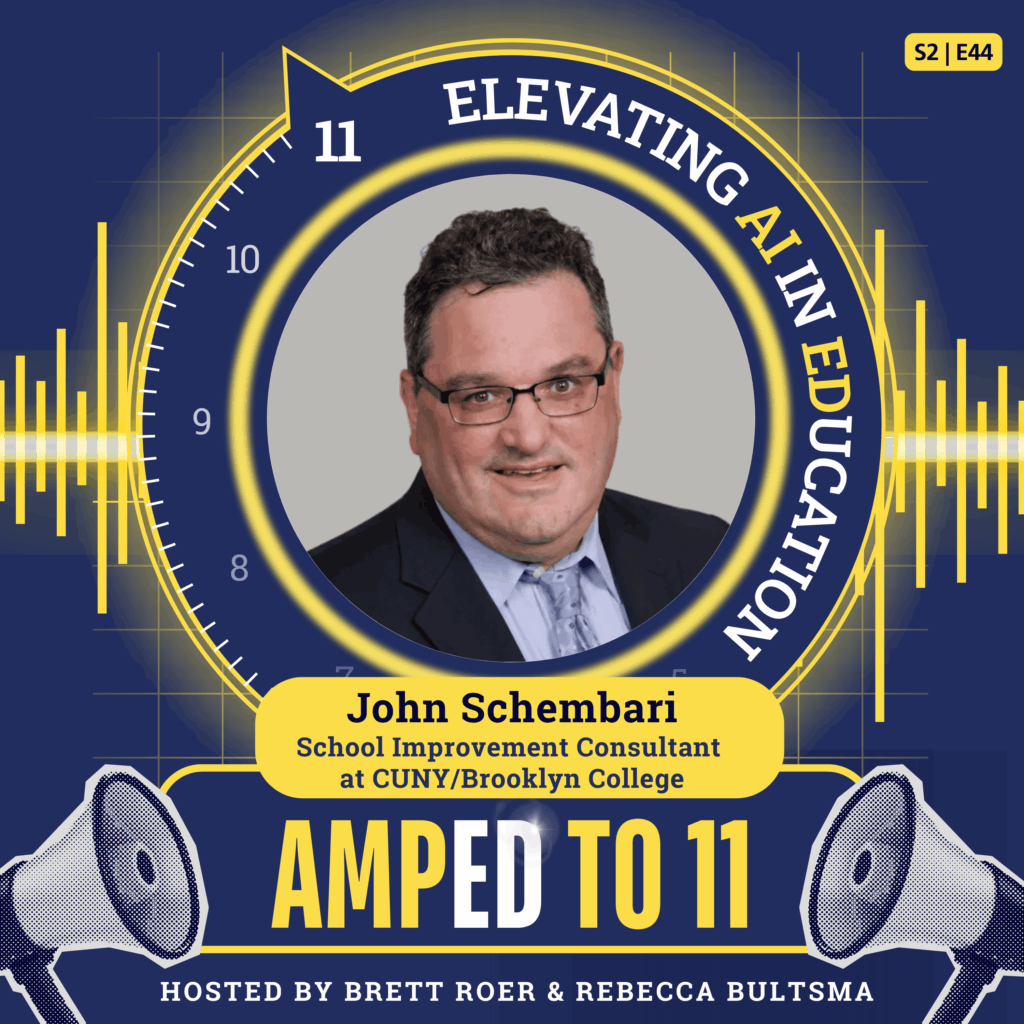
Brett Roer: We are live on The AmpED to 11 Podcast. We have an incredible special guest today, John Schembari, how are you doing today, John?
John Schembari: I’m doing great, Brett. Great to see you again. Rebecca, nice to see you as well.
Rebecca Bultsma: Such a pleasure. So [00:01:00] excited that you’ve almost been to Alberta.
John Schembari: I have almost been to Alberta.
John Schembari: Before we went on mic, I’ve been to North Dakota, so-
Rebecca Bultsma: Basically the same …
John Schembari: I’m told it’s very similar, yes.
Rebecca Bultsma: Very. Very similar. Brett, what’s new in your world?
Brett Roer: Oh, well, I just got back from another part of the Pacific Northwest, Seattle, where I was part of an amazing agentic AI workshop and got to work with some of the leading state senators and education leaders, and we learned how you could use agentic AI to help you solve a lot of the organizational challenges that your community might face.
Brett Roer: And it was the most fun thing I’ve ever done because I watched people in real time figure out how they could solve some challenges that they otherwise had really been grappling with and couldn’t, and just the look of joy on their face when they realized this could actually be a solution for getting more people’s insights in solving community problems.
Brett Roer: So [00:02:00] cup is full. And also just what a beautiful, beautiful, beautiful place, and I got two days straight of just sunny, gorgeous 70-degree weather, and it was awesome. And shout out to Juliana Finnegan for being the best tour guide in the Pacific Northwest and giving me a few hours of her precious time.
Brett Roer: That’s what’s new.
Rebecca Bultsma: Sunny days in Seattle, you should buy a lottery ticket. Two in a row. Good for you.
Brett Roer: It was incredible. It was truly incredible. Um, so that being said, we have an amazing guest from this neck of the woods, the Northeast, New Jersey’s finest. John, if you could let everyone out there know a little bit about yourself, your background, your journey, and what is your role right now at the intersection of education and innovation?
John Schembari: Definitely. And Brett and Rebecca, thank you for having me on the show. Brett and I w- Rebecca actually know each other in the quote, unquote, “real world,” so it’s nice to actually connect on your podcast. Similar to Brett, I do some work around AI use in education, [00:03:00] and I’m an education consultant working largely in New York City, but wherever the need is on curriculum instruction and assessment projects.
John Schembari: Do a lot of work around teacher coaching, but getting really excited about … And yes, I know that there are downsides to it. Believe me, I know. But I’m really getting excited about h- how A- AI can really help to really help improve student thinking and learning, and really putting the ownership of learning, uh, or helping students to still maintain their ownership of learning despite AI and with AI.
John Schembari: So, excited to chat with you about that.
Brett Roer: That is the hot topic. Yeah. So Rebecca, I’m gonna, I’m gonna turn it over to you because, again, before John arrived today, we had a really great conversation. You know, there is so much happening, uh, whether the term being used right now is ban, moratorium, just [00:04:00] updated guidance for the ’26, ’27 school year in some of the largest districts around, uh, the country.
Brett Roer: Rebecca, I’d love for you to share a little bit about, like, what you’re seeing there, and then John, I’d love you to chime in on how that is influencing your current practices or your beliefs on what we should be talking about when it comes to AI in education. Rebecca?
Rebecca Bultsma: Well, this is actually something that I’ve been thinking about a lot and been on quite a few panels and podcasts about lately as I’ve kind of tried to understand it.
Rebecca Bultsma: But as a researcher, I think the way that I’ll understand it will be much different than what’s happening on the ground there, John. So I’m actually really interested. Uh, I think when the moratorium in New York was announced, uh, the mayor indicated that there wasn’t a ton of research that supported, uh, AI to support younger learners that existed yet.
Rebecca Bultsma: But you’re close to the ground, and you said you’re helping encourage AI to help support learning. So I would love [00:05:00] to know a little bit more about what you’re seeing, uh, real, in the real world firsthand and, uh, if it’s different than, say, the news that’s making it all the way over to Canada might be.
John Schembari: Indeed. Indeed. Well, I generally think there is reason to be aware and concerned about the power of AI. I often say, you know, fire is technology, and if we didn’t learn how to hire-harness fire, we would have never left the cave. But yet, fire can also burn us and kill us. So I actually look at AI in a way, in a similar way.
John Schembari: And if we actually look at any technology, there’s always a positive, or there’s usually a positive side to it and a negative side to it. So I do understand the concerns, particularly around the fear that AI is going to take away student cognitive thinking, especially with our youngest learners, where the brain is still developing.
John Schembari: [00:06:00] So I’m not pro-AI that I’m not looking at those things, but I think when we start thinking moratoriums, bans, forbidding, that doesn’t really work either, because we’re in a world where it’s been unleashed, it’s here. How do we use it effectively so it supports student thinking as opposed to taking away that student thinking?
John Schembari: So that’s one distinction I would make, where a lot of the work I’m doing is in helping educators to understand how it could not only augment their work, I know Brett does a lot of work on that end, but also, if you’re gonna put AI in front of students, how does it support, again, that student thinking as opposed to taking it away?
John Schembari: Now, the other piece of it is even if a district or school is banning AI My fear or my question around [00:07:00] that is, well, what do you do if a student still uses it, particularly at home? Because then it becomes an equity question. Because if you don’t catch it, then that student has an advantage over another student.
John Schembari: And even if you do catch it, what is the reaction? Is it discipline, or is it actually taking a step back and going, “Okay, you used AI. You weren’t supposed to use AI for this assignment, but how can we reclaim your thinking in this process?” So with all this talk, Rebecca, about bans and moratoriums, it’s really focused me on thinking more on not a ban and not free rein use or, or free-willed use, but again, how do we use it in connection with promoting that student thinking?
John Schembari: And I would almost argue even before AI, I wonder how many of our classrooms are [00:08:00] really maximizing student ownership and thinking whether or not they’re using AI or not.
Rebecca Bultsma: It’s a good take. I have some questions just because these are things that I’ve been thinking about as well and, and hearing some of the same, the same good arguments that you’ve made.
Rebecca Bultsma: I’m always curious about the equity question because I understand it rationally. But help me understand, uh, where- how it becomes an equity issue if, say, it’s something that every person in the world has access to for free anyway, and is it the school’s job to police that use outside of school? That, you know, social media might not be allowed in the school, but the school can’t police it on people’s personal time.
Rebecca Bultsma: I’d love your thoughts around that.
John Schembari: Yeah. So I will say I’m not as much of a fan on bans and moratoriums explicitly for, for some of these reasons, particularly because teachers have so much on their plate. I [00:09:00] don’t want them to become the AI police. But yet, I do think teachers have a responsibility to teach its effective use.
John Schembari: Now, we can go into a little bit more detail about what that looks like at an elementary school level and what that looks at a middle school and a high school level. But ultimately, again, whether your district is promoting it or banning it, you as an educator still need to understand it because of that equity piece.
John Schembari: So this is what I think of when I think of the equity piece. I already mentioned there’s equity or disequity in who has access to it and who doesn’t, right? Especially if you are banning it, but your student is going home and one student has access and the other student doesn’t have access. That’s gonna give a student that has access more access to resources, information that again, the student that isn’t using it has access to.
John Schembari: So that’s [00:10:00] gonna be a dichotomy.
Rebecca Bultsma: But is there a situation where that’s al- that already happens, um-
John Schembari: Of course …
Rebecca Bultsma: with technology, right? And AI really is free and readily available really to anybody with a cell phone, right?
John Schembari: Yeah. So this is why it’s really important for teachers to teach how to use AI effectively, right?
John Schembari: Because even if you have access, Rebecca, it doesn’t mean you’re using it appropriately or in the best way to promote your own student thinking. So when I coach teachers Again, regardless of the political backdrop, if they are using t- uh, AI with students, or even if there’s currently a moratorium, are they still having conversations with students about, all right, whether or not you’re using it in the classroom context or you’re using it at home, are you questioning the feedback i- or the information it’s giving you?
John Schembari: Is it giving you evidence? Can you go and find that other [00:11:00] evidence? Are you opening up those links? And then that gets into a conversation that we’ve been having for years, which is, is information on the internet valid, or is that website valid, or who created that information? Do they have a stake in this, or do they have a background in this information, or is it just anyone posting anything?
John Schembari: So the way that we work through teaching students, again, how to maximize or utilize information on the internet, I think applies here. I think the other questions that come up or teachers should ask students is, all right, do you agree with the information it gave you or not? Where do you agree? Where do you disagree?
John Schembari: Or if the student is gonna use AI, uh, AI, how do we use it perhaps as an exemplar with another topic? But yet, for example, if it’s a writing piece and you’re asking students to, you know, create an argum- or write an argumentative essay, could they [00:12:00] prompt it for an argumentative essay on, you know, whether or not the school color should be blue and red?
John Schembari: And then their actual lesson might be about school uniforms, right? So how can they be using the internet to be, again, providing exemplars of best practice and models that then they go and do their own student thinking around. So the equity piece, to your point, Rebecca, going full circle, isn’t just who has access and who doesn’t, but the equity piece is also who among our students have been trained to use it to augment their thinking, as opposed to students who have not had that training or that instruction and are using it to replace their thinking.
John Schembari: I see that as an equity issue too
Brett Roer: You know, I wanna bring up a case that’s obviously one of the larger, uh, topics right now is the New York City moratorium. So I met today with a principal [00:13:00] and an assistant principal, specifically the assistant principal today, um, because we had built an accompaniment guide to last spring’s AI guidance from the city.
Brett Roer: And again, similar to any other guidance in a large district, you know, this was guidance for 1,600 schools approximately, so it was really now what does that look like, sound like, feel like in a building? And today we looked at the new updated, uh, guidance from the city and took the old playbook, and this is specifically a middle school, and saw what does that mean?
Brett Roer: And it was sobering because this is an assistant principal. This is a, a p- a moratorium policy that came out right before school started, so they’d spent all summer working on this, and then they said, “We’re gonna pause introducing this because we’re not sure what it means.” And even though they have been getting guidance at the district level, they weren’t sure, for example, the exemptions for students with IEPs or 504s, what does that exempt them from?
Brett Roer: And they’re about 25% Els and 25%, uh, students with [00:14:00] disabilities. In middle school, the recommended device limit is 45 minutes a day, and I wanna say similar to John, like- As always, it doesn’t matter whether I agree or disagree with that. But this person was like, “But all of our curriculum we’ve purchased is on screens, so how do we do that?
Brett Roer: Like, how do we pivot that quickly,” right? Again, so I’m not saying that’s good or bad, how much time. I’m more like the actual logistics of asking a school on a dime to change, and it’s two weeks into the school year in New York City at this time of, of doing this. That was really scary because there’s no guidance on that.
Brett Roer: And also, the idea of you can’t use AI to grade student work, monitor behavior, develop SPED plans, mental health, great. But then it’s like, well, can you use it for AI detection then? Is that grading? And we already had, like, a clear, like, disclosure system for how students are supposed to talk about it, and now basically they can’t even say they’ve used it, [00:15:00] even if they use it.
Brett Roer: So it was really like … And we had had students and staff align on what they wanted it to look like. So again, obviously policy at the district level trumps, uh, school guidance. But we did talk about then where can we help? And so Rebecca, to your equity question, AI literacy for parents. You know, like, because nothing is stopping them from going home and using it, and I’m not saying that means go home and use it, but now there’s so many safety precautions that you were supposed to use a tool that’s been approved by New York City as a student.
Brett Roer: Well, now you can’t use that, so you’re gonna go use a tool that no one has vetted and doesn’t know what information you’re putting in. Rebecca, you’re an expert in this field. So anyway, it was, like, very scary to think about things that felt more or less solved, at least for this one community, is now not.
Brett Roer: And how do- where do you move forward to make it equitable and to just [00:16:00] let parents know, like, “Here’s what you should be doing at home if your child is gonna use AI”? And we were thinking about, well, how do we get that to parents from an AI literacy lens of like maybe here’s ways you could be using it that’s impactful, and then, like, how could that look?
Brett Roer: Because the only place technically students can’t use AI is for their schoolwork. So we’re trying to think not to get around the rule, but actually like how do you teach people this and then not get the kids in trouble for using AI on school assignments? So that’s some, that’s some insights from New York City today that were a little bit unsettling
Rebecca Bultsma: The timing is definitely, uh, leaves for a bit of a scramble for everybody, I think.
Rebecca Bultsma: Uh, it’s all been very interesting to watch. John, what are your thoughts?
John Schembari: Yeah, I mean, I’m not gonna lie, I’m not a, a huge fan of this moratorium for some of the reasons that Brett is saying. I think it could’ve been thought out a little bit more, and did need to have a little bit more of that nuance embedded for the fact that [00:17:00] so many of the instructional materials, particularly New York City uses, is, are, are digital.
John Schembari: So that is a challenge. I don’t know if I necessarily have the answer for that, given how much money and time over the last several years that schools have invested in New York City in digital resources, right? Because this is a very abrupt shift from what was not only just approved, but actually encouraged and promoted, particularly, you know, working with certain companies that were promoting these digital resources.
John Schembari: So it, it is a challenge that I don’t necessarily know if I have an answer. Like, what is the answer? How do you pivot immediately? I would imagine some of it could be in your PLCs, take a look at what is digital in your curriculum, and as with your colleagues, [00:18:00] and figure out how to do that analog, right? So, you know, for years in teacher colleges, I teach, uh, student teachers.
John Schembari: Student teachers do need to learn how to write a lesson plan. So in some ways, teachers, at least teachers who’ve been trained, you know, prior to the use of AI, which is most of our folks still with, with, you know, some of our new people coming in using AI with our student training. I use it with our student teachers.
John Schembari: But what is an effective lesson? You know, what are the effective parts of a lesson? And then how would you use that curriculum to augment that? And what parts of that digital resource could be, say, downloaded, where students are still engaging with the concepts and the content, but not necessarily on a screen.
John Schembari: I mean, that’s what I would say in a short term, a short-term fix. But Brett’s point is well taken. I don’t think [00:19:00] there was the guidance around how to make those shifts quickly. The moratorium was put in place, but again, these questions weren’t answered necessarily at the same time that, you know, the city did.
John Schembari: And it’s not just New York. LA did something very similar. You know, whereas if you look at, and I’m not an expert at it- But I was really intrigued. I saw recently, I think it was Dubai, actually put out another AI use policy, but that one that actually does look at screen time and how much time students should be spending on a screen.
John Schembari: But it’s, it looks much more thought out in the sense of there are things we do to prepare students for using AI in elementary school. Then they start using it a little bit more with guardrails, you know, with that teacher support helping them. And to Brad’s point, you know, also how do we educate teachers?
John Schembari: [00:20:00] I mean, sorry, how do we educate families around that? And then lastly, how do we start having students in high school owning more of their AI journey? Brett’s points are well taken. That’s how I would address if I was coaching folks to make the shift back to analog during the moratorium. But in the long run, I definitely think it’s worth looking at Dubai’s AI policy because it does seem to be more thought out while still considering the, the, the challenge points of using AI in an educational setting
Rebecca Bultsma: I think it’s interesting to take a look at kind of the backdrop that all of this is situated against and wonder how much of that has an impact, especially around, you know, uh, Brett was talking about the guidance that was released by New York in the spring and, uh, the overwhelming amount of parent feedback that [00:21:00] came in from that, that likely had an impact.
Rebecca Bultsma: And then I have to wonder if the, uh, social media litigation and stuff that’s come out of that, uh, may be impacting decisions here as well. And interestingly, it’s not even just K-12. Chicago, um, University of Chicago Law School has banned screens completely from their first-year law students, like all screens in all classrooms.
Rebecca Bultsma: Uh, so it’s interesting to, to see the reasons maybe behind this. It will be interesting. Um, I’m proposing research right now about examining what that impact is, if it’s helpful or harmful, and the rationale behind all of it. I’m interested in looking at the Dubai guidance and wondering what they’re basing that off of, because there is kind of a gap in the research as to how useful AI is.
Rebecca Bultsma: And I, I have to wonder, and I’ve been thinking about this a lot lately, if we’ve just over-corrected so far in the direction of screens that maybe it is good to kind of take a break and reevaluate at how many vendors are in schools [00:22:00] and how much money is being spent on this stuff, and what really matters and what actual results we’re getting from all of this, and maybe move forward once we know that there’s actual benefits and documented positive results for any of the technology we’re l- using in classrooms.
Rebecca Bultsma: And I, I think this might be a good opportunity to do that. That’s part of the reason I, I’m supportive of the moratoriums for s- for some reasons. I do think, uh, we’ve gone pretty far down one path here, and maybe it’s time to kind of take a breath and evaluate. Although I do recognize too that it’s inconvenient and it’s, it’s tricky on a lot of different levels.
John Schembari: But you know, Rebecca, you bring up a good point. Not all tech is good tech, and should some student– or should students still have access to some tech using screens and not others based on the efficacy in terms of is this actually helping them i-im-improve their learning? I mean, I’d be interested. I’m not an expert on it, but in New York City, [00:23:00] when we’re looking at reading Lots of schools are using i-Ready and creating individualized reading plans, you know, for students using
John Schembari: And then they’re going on during win periods, you know, what works for individuals, to utilize i-Ready and their individual reading plans. Is that a good use of screen time or not a good use of screen time? So, and again, that’s middle school on, and they might even be using it in elementary school. I’m not sure about that.
John Schembari: But again, is that a good effective use or not? Because so many schools are using that in that way.
Rebecca Bultsma: And then the ethical questions behind that are who gets to decide that, and what are we basing that on? What is the evidence that we’ve collected that demonstrates that this is a good use? What are the criteria?
Rebecca Bultsma: And I think we need to develop that maybe more around the tools that are already [00:24:00] in our schools, because if they’re not … As education system, the goal of education is to prepare students and for the real world they’re entering on many different levels. Uh, but if we don’t have evidence that that’s actually contributing to that bigger goal, I think we need to reevaluate it and maybe pause before we have any evidence that AI is contributing to that as well, or AI-based systems or programs.
Rebecca Bultsma: Because if they’re not benefiting students and they are financially benefiting ed tech companies, I don’t love it, right? I think we need to take a look at them.
John Schembari: And I think that gets to that point of which ed tech and which screen time, or which ed tech deserves screen time. Because again, and I’m not an, a, I’m not a, you know, a rep for i-Ready, but I do know we do have some evidence we can compare it against, and that’s are students improving in their reading ability, right?
John Schembari: So if, if they’re, if schools are not only doing [00:25:00] diagnostic assessments, or if they are doing diagnostic assessments several times a year, looking at their students’ reading scores, looking at their Lexile levels, looking at their ability to decode and comprehend, if that is increasing, I mean, although you can’t determine causality, one would argue from a common sense perspective that, yes, maybe this is having an impact.
John Schembari: Whereas maybe another ed tech tool that uses screen time doesn’t have that same underpinning of results. So I think to your question or to your comment, Rebecca, yes, we do have to see what the evidence says, but in some cases, we already have that evidence. We just have to make that connection, that crosswalk.
Rebecca Bultsma: And get it for AI then too before we, we fold it on in.
Brett Roer: You know, Rebecca, one thing you’re saying and like [00:26:00] You’ve, uh, you should run for Canadian Parliament, Layli Rebecca, the way you are just dodging these questions. You know, like, good question, Jon. Good question, Brett. Jon, what are your thoughts on this?
Brett Roer: But I’m starting with you because it, it does provide a counterweight, and, you know, Jon is in classrooms. You are researching these impacts, so I, I am trying to get both opinions here. So please, uh, Madam Parliamentary, and if you could answer this one. Think about, like, what you just said about the University of, of Chicago is such a, it’s such a great example.
Brett Roer: We’ve done this. Like, we’ve all been at these, some of the, uh, PDs that we’ve either co-led or led or you’ve been– I’ve led with this Pass the Mic, and like, I think that is so interesting imagining a law school classroom where there’s no screens, but what if the whole lecture’s being recorded? And so afterwards, you know, if you’re someone like you– making you more present.
Brett Roer: Like, yes, do the reading, come ready for, like, an actual authentic dialogue, discussion, whatever happens in first-year law school. But then, like, you have those resources for later when you’re by [00:27:00] yourself to study. Like, I wonder if there’s a way forward, something like that, that’s kind of the best of all worlds, where you’re making the human connections when you’re around humans, and when it’s time to go study, you have access to these tools, and I don’t know.
Brett Roer: But I’d love to see a world like that, but I would like to hear from your perspectives if that could be a way forward in K12 and higher ed that kind of marries the technology with, uh, being more present in classrooms.
Rebecca Bultsma: As with all of my opinions, I have, I have lots of thoughts wearing lots of different hats.
Rebecca Bultsma: Obviously, I have, um, a lot of, like, data privacy concerns around now that we’re recording everything and, uh, what happens there, who has access to it, what it’s used for, you know, all of this recording. I’ve noticed with myself, and I don’t– I haven’t read any research on this, but if I know something’s being recorded, sometimes I’m less present sometimes, even though, like, intentionally, like, I should be more present.
Rebecca Bultsma: But also in the back of my head, if I know I can just listen to it [00:28:00] again later, and PS, I usually don’t. Uh, I, I would say for myself, I’ve learned that, uh, it’s better for me to be presently in the moment, fully engaged, knowing that there may not be a backup. And that I have learned for myself, uh, is a bit better for me.
Rebecca Bultsma: And arguably, we’ve done that for centuries, like, and it’s been okay. Uh, that’s, like, my personal experience. But we are gonna move to a society where everything will be recorded, and we can access what we need, and I have mixed feelings about it based on my own experience and kind of my own research. I don’t know if I have a good answer.
Rebecca Bultsma: Obviously, the best answer is a middle ground, for sure, like finding a way that kind of works for everybody, uh, especially with adults. But I think, uh, when we’re dealing with children, we have higher, more serious obligation to get this right and maybe to teach them to be in the [00:29:00] moment and not, uh, you can always…
Rebecca Bultsma: There’s always a backup. Like, there’s always, you know, you don’t really have to pay attention, or you can do this later, like this delayed gratification. Yeah. I don’t know.
Brett Roer: Before… Yeah, before John, you answer that, maybe I’ll give a, a good use case, right? Um, I was not a law student, but I went, I studied history, so there’s a lot of facts, right?
Brett Roer: There’s a lot of like s- similar, right? And you do, you do look at a lot of like laws and policy and how it impacts society. So like What I wonder is I remember both as a student and a teacher, a lot of times you’re like trying to explain like why people did this. You’re trying to get students to think about like, what might you do in that situation?
Brett Roer: And a lot of times they’re just like copying the notes off the board because that’s your one shot, right? Like we don’t have other notes. They can’t– So I always think about like there’s the fact and then there’s the idea. And I find, at least myself, if I know that I don’t have a backup plan, then I’m furiously typing or writing when I was a student because I know those facts are [00:30:00] gonna mean something and I gotta like understand and apply those facts, and I might be missing, what is it?
Brett Roer: The forest for the trees is the analogy. So like you’re right, I don’t have any research on that, but like having taught that and that was like how I had to re- recall stuff, I always found it so like disheartening where like you get excited as the teacher and a lot of kids are just like writing and they’re like, they think they’re doing a really good job as students because we train them to be like, “As long as you copy the notes, you’re learning.”
Brett Roer: Obviously, that’s not good education either, but like, uh, that’s the fear that a lot of students have. Like, “If I don’t copy this, I won’t have it for later, and therefore, like how will I learn?”
Rebecca Bultsma: And I think that’s where like a flipped classroom idea comes in, right? Like you learn, you do the readings, like before university, you do the readings and you come and you learn from the lecture, or you learn using whatever AI tools at home, and you come back so you can be fully immersed in the ideas and the creative human-to-human Socratic kind of in-person oral experience of learning that’s immersive and maybe more valuable, knowing that you have a book or you have [00:31:00] already had access to the materials and you don’t– Maybe the problem is that you feel like you have to be furiously writing everything down.
Rebecca Bultsma: Maybe that’s where it’s wrong. I don’t know. John, what do you think?
John Schembari: I think it’s a blend really, because the other way that I’m using AI with my student teachers, for example, is in helping to evaluate their lessons, right? So they videotape themselves. They submit those videotapes to me, and then we– I mean, I look at them and I have a pretty good idea of where their strengths are and where their opportunities are.
John Schembari: But AI has enabled me to give them a report that’s much more detailed than I could ever give any one student, just in terms of the time constraints. And I have found that it has extended their thinking. It hasn’t replaced it. Because then they can go back, not only can they see their video, but they see the [00:32:00] evaluation, and then we could start having conversations around that.
John Schembari: “What do you think about this? Do you agree with this?” Or the one area where it says you can get stronger, “What are you thinking about that?” Because I will be honest, Rebecca, there are even times– I mean, like I said, I have a pretty good idea of what the strengths and the opportunities are for my students, but I will, I would be lying if I said the AI didn’t pick up on some other things that I might have missed.
John Schembari: So it has actually also made our feedback much richer, our conversations around that feedback much richer, and more comprehensive because it has provided us with so much more data that we as humans might not have noticed. Now, if they just take that report verbatim and go, “Okay, then I’ll work on that,” then no, it is taking away my thinking and it’s taking away their [00:33:00] thinking.
John Schembari: But I know I don’t structure my class that way, where I do want them going back, and then also I use the AI to help me actually get quantitative data around how my students are growing. So for example, my student teachers tend to struggle with questioning and the level of rigor and questioning that they’re asking students.
John Schembari: But with the use of AI, it could actually help me get some actual percentage numbers of who was doing that well in their first observation versus their second observation. And not only do I worry about bans, but I, uh, I mean, and I understand the bans are for students, but I also fear that this will convince some adults not to use AI to help them do the more– the m- the work that’s [00:34:00] more about efficiency, and then using their human thinking skills around the actual thinking about next steps.
John Schembari: So I, I know we-we’ve talked about a lot and I, I’ve circled around, but I think getting back to the original question, I think it’s, I think– A-again, I’m not a real fan of bans, but I do understand those concerns. So I think it’s, again, going back to how do we teach students to use that AI? Again, whether those students are children or adults, how do we go back and help them to use AI efficaciously to increase their thinking?
John Schembari: And also the prompts. We haven’t even talked about how we’re training folks to prompt AI and push back on AI, because it can present us with information that we ourselves didn’t think of in the time. So, so I, I, I think I’m in the middle. [00:35:00] Maybe I lean more towards Brett, but I’m somewhere in the middle.
John Schembari: I-it’s, I’m not blind to, to the concerns and particularly the privacy issues. I, I, I do understand that. But again, I think it’s nuance here. And, uh, Rebecca, you said this before, maybe we have gone too far now looking at bans and moratoriums, but what is that middle ground? And to me, that middle ground is guardrails, and having discussions around what should we be teaching people, whether, again, students or families, how should we be teaching people to use this technology?
John Schembari: Because it isn’t going anywhere. And if we ban some folks from using it, that doesn’t mean others aren’t gonna use it. And again, that gets to that equity piece and that– And I’m afraid that it can also lead to, uh, an additional learning gap to increasing the learning gaps that we already actually have if we just ban [00:36:00] technology use for the sake that we don’t know everything about it, as opposed to actually thinking about how to use it with more circumspection, if that makes sense.
Brett Roer: First of all, you used two words that at some point I am gonna go find AI and figure out what those words were. Those were really good. Those are two words I definitely do not know the answers- Which words were those? The definitions of. Well, the one you just said, and there was another one in this, in your soliloquy.
Brett Roer: Look that one up, AI. Um, that you said really good. Efficaciously maybe? I, again, real … My dad’s from Queens. As he would say, “You speak real good.” Um, those were really good, Jon. And I do agree with you that, uh, you know, something that you’ve actually, both of you, Rebecca as well, have, like, really pushed my thinking on is, and I should know this, is like, I just gave an example of New York City where it’s like one out of a couple hundred middle schools, and I’m like, “Oh, man,” like that’s a real
Brett Roer: That is a step back for this one community, but that is like one out of hundreds. And even [00:37:00] like, I was just thinking as you’re saying that, and Rebecca, some of your points, like, you know, when I was, uh, down at ISTE and leading this AI pavilion and coaching these really great teachers, one of them also happens to be a New York City teacher, 100% ELs at one of those bi- uh, a bilingual newcomer school, and like kids were saying like, “I’ve never understood math in English or Spanish, and now I’ve like mastered it But again, that’s like one classroom out of, you know, hundreds of thousands, if not millions of classrooms nationwide.
Brett Roer: And so like, yes, those students are about to lose something because they’ve been given a really great tool and gift. But you’re right, so many people haven’t gotten that guidance, and that kind of teacher hasn’t had that kind of support to learn how to use it. And so, yeah, I guess I have to realize, like, it’s easy to cherry-pick the best examples and say they’re losing something, but most of the people that are using AI right now are not using it effectively, and they’re not discerning what’s the good use and bad use, quote unquote.
Brett Roer: So you’ve really pushed my thinking here in a way that I wasn’t hoping to be pushed, so thank you both for that. [00:38:00] John, you’ve been a wonderful guest. It’s time to turn the reins over to you. You get to ask Rebecca and I any question you’ve ever wanted to. Um, you are a seasoned veteran, award-winning podcast host in your own right.
Brett Roer: Why don’t you tell everybody the name of your podcast, and then put on that hat and ask away.
John Schembari: Sure. So, uh, thank you for that segue, Brett. So I am the host of Have a Life Teaching, the Have a Life Teaching podcast. I do also host some episodes on AI, but it’s a little broader than just technology. It’s anything and everything to do with technology– I mean, I’m sorry, with instruction, curriculum, and assessment, right?
John Schembari: Uh, largely school-focused, teacher and admin-focused, but I do also like having more of those philosophical episodes too. For example, I, I spoke with a woman who swam the English Channel and what she learned about failure the first time she did it, and then what she learned that [00:39:00] ultimately led her to be successful.
John Schembari: So I try to balance those episodes around, “Here are five ways, teachers, to use whiteboards,” with those more philosophical, big-thinking type questions about what we should be using education for and what is the purpose of teaching and learning, right? So thanks for that plug. You know, questions for you. I would say, and Brett, you’ve already been bringing in what you’re seeing in terms of the use of AI in particularly New York schools.
John Schembari: Rebecca, what, what’s going on in schools in, in Canada with AI use? Is, is it such a, a stark yes or no approach, or is it more nuanced? What, what are your thoughts on that?
Rebecca Bultsma: You know, I don’t even know if I can speak much to the Canadian schools. I do the majority of my work down in the US all over the place, so I can speak to kind of– I’ve done a few up here.
Rebecca Bultsma: I think what I’m seeing in general, it’s just a microchasm of what we’re seeing everywhere, which is [00:40:00] people have really mixed feelings. And I think if we take even just a look more broadly at the last two weeks in society, how people are feeling about AI and some of the fear and the, uh, reservations that people have, I think that’s exactly what we’re seeing in schools.
Rebecca Bultsma: I think I’m seeing more of a divide there between, um, teachers who– and people in the workforce in general, like I do a lot in the public sector and the private sector, who c- almost resent that they’re being expected to use AI, and they don’t want to. And just some strong feelings about AI in general, and I, I doubt it actually has anything to do with the actual technology, ’cause I think we all recognize that it can be very useful, and I can take anyone and show them how this can be useful for them.
Rebecca Bultsma: But people are having a lot of, um, fear and uncertainty about what this means, and then resentment over what they’re just being forced to accept as a new normal and use in their practice, and except for data centers going in their communities, like all of these things that [00:41:00] feel out of people’s control.
Rebecca Bultsma: Uh, there, there’s starting to be a real pushback, and my message really is like, “Here’s how you can leverage this,” but also like, “You don’t have to. If you don’t want to, like don’t.” Um, because I think that’s what people wanna hear, that it’s okay to take a minute, and maybe that’s the message they were trying to send with the moratorium.
Rebecca Bultsma: Maybe internally that was the feedback they got. I have no idea. But there’s been a real sentiment shift in the last six months about AI and AI in the workforce and in schools, and, uh, it’s interesting to watch, and I’m seeing that in schools as well, and not only from teachers, a lot from students. I make it a point to meet with student groups every time I go work with a district, and students have very strong feelings about this as well, feeling like it’s being imposed on them, that they adopt it, that they use it, that they learn it.
Rebecca Bultsma: So I think everybody’s feeling a bit of that kind of tumultuous, um, [00:42:00] unsettling, and it’s, it’s been a, a weird kind of vibe.
John Schembari: Yeah, I would– I, I can understand that, and I see that too. I guess my question to that would be All right. An adult is fearful of it, and, you know, there are some real concerns about it, but what fear is justified?
John Schembari: What, what fear is just that this is a new tool? And my other question around that, and I don’t know if we have the answer to it, is what responsibility do the adults have to at least still teach its effective use even though they themselves might not wanna use it? And then even with students, okay, you don’t wanna use it, you don’t have to use it, but should you have a competency around how to use it, you know, if you are going to be exposed to it?
John Schembari: So how do we [00:43:00] allow people the agency to not use AI who don’t wanna use it, while still teaching people, again, the skills of how to use it, I’m gonna use that big word again, Brett, efficaciously? Where, again, it’s not taking away your thinking, but expanding what you are able to think and then how you’re able to act on it.
John Schembari: And it’s an answer I don’t have yet myself either. But I wonder in your coaching work how you navigate that, and this could be for Brett or Rebecca.
Brett Roer: First of all, can we all just take a second and realize, like, how we don’t know the answers to these things, but at least we, like, get to ask them and, like, have, like, actual use cases?
Brett Roer: So one that I wanna share and give some flowers to is, uh, Briarcliff School District, which is here in New York. Uh, a year ago, almost exactly in October, it was the first time I met some of their students, and we did a wisdom collection session, and that’s where we coined this term, the AI rollercoaster, right?
Brett Roer: Like period to period, the, [00:44:00] the way you’re being asked to use AI or not asked to use AI or the information or the, the sentiment from the teacher was really guiding what each period was like. And without a coherent guidance, it really was a rollercoaster. So it’s– fast-forward a year later, we spent, like, eight months working with them, and last week I interviewed 10 of their high school students.
Brett Roer: And we spent… You know, we’ve made multiple drafts of this policy, and it’s now been released publicly, and I’m actually going there for a listening session tonight with their families. When we asked students, “What has the first two weeks of school been like, and, like, how is the AI rollercoaster?” They’re like, “There is no AI rollercoaster.
Brett Roer: Every teacher went over it with us. We know when and– We know when and how we can use it.” But some of the students said what you said, John. Some of them were like, they came up with a four-point scale, FAIR, from, you know, like, no AI use to total AI use and then two middle ground ones. A lot of them were like, “You know, now our teachers tell us we can use it in these exact ways,” and they’re on the assignments, and they’re like, “But, like, I don’t even [00:45:00] think we need AI for that.”
Brett Roer: And I was like, “Great.” I said- Now that you’re over, like, when you can use it, do you think … ‘Cause they brought up, you know, some students are s- still gonna say you can’t use it, they’re gonna use it. I said, “Do you think now if a teacher was able to break down their lesson or their, uh, assignment or unit and be like, ‘So here’s why we’re saying don’t use AI for this portion.’”
Brett Roer: Because, like, to Rebecca’s point, our really great, uh, researchers out there could say, like, at this exact point in learning the facts or whatever, or applying them, if you use AI here, you’re offloading the, the thinking, the, the productive struggle. But then, like, before a test, using AI to study might- science might show it helps retain it because you’ve thought about your learning styles.
Brett Roer: And they were like, “Yeah, I wanna learn that.” Because that’s what they’re gonna be grappling with for the rest of their lives and careers. So, like, that is what I hope we do in year two there is start to get teachers to wonder why are you [00:46:00] giving it the level you’re giving it? Why- how do you metacognitively explain that to a student and say, “This is why”?
Brett Roer: And then obviously parents too with these concerns be like, “Here’s an example of a unit that you, you might have done, you know, writing an essay in high school literature like ELA. Now here’s how it looks in the age of AI, but here’s why it looks that way. And, like, wouldn’t that be more engaging for you?
Brett Roer: Or wouldn’t that be … Wouldn’t you have wished someone had taught you these skills if you had access to AI?” So that’s where we’re trying to go I hope that works. Um, but that’s, that’s kind of, I saw in one year that difference, and it has really been heartening to see the same … One of them was the same student, and she’s like, “Yeah, we don’t worry about that stuff here anymore.
Brett Roer: The teachers taught it really well, and now we’re moving on to this.” So that’s, that’s what I hope starts to happen in more places.
Rebecca Bultsma: I just think that that sounds a lot like, um, nurturing curiosity and building critical thinking, which is what I think we can all agree should be happening in schools. And I think that’s the goal.
Rebecca Bultsma: That should be the goal. I think [00:47:00] if teachers are hesitant and critical of this technology, we should lean into that. And there’s a, there was an article in The New York Times a few weeks ago that talked about one teacher who is teaching kids technology civics, like leaning into, “Well, what do we know about this?
Rebecca Bultsma: Who’s building it? Who’s benefiting? Who’s harming? What are the opportunities? What are the risks?” as a class, like, as like a, a course. And so I think what we need to lean into is that critical thinking and curiosity, nurturing that in teachers, uh, instead of, “Here, you have to learn this because XYZ tech company said this is the future of work, and you have to then tell your kids to learn it this exact way.”
Rebecca Bultsma: Um, I realize that’s … I realize I’m coming from, like, a bigger picture place, but I am seeing it practically happening, and I just think that’s even just a better approach than, “We’re having this PD. You’re gonna learn this tool, and you’re going to use it now, uh, for everything or for this particular thing whether you want to or not.”
John Schembari: So then maybe we have come up with, [00:48:00] quote-unquote, the answer, and that is taking, you know, each piece of technology on its own merits, you know, and then leaning into that curiosity, leaning into, you know, those, again, not having the technology, in this case we’re talking AI, replace the student thinking but extend it.
John Schembari: Now, and also recognizing, I think too, the shift, right? So maybe it’s also about not just helping students, but helping adults realize there’s a shift in where we’re, we are doing the thinking, right? So maybe, just throwing this out as a case example, s- the student is getting information using AI or, you know, asking their Gemini Notebook, you know, the teacher gave them the, the chapter, and they put it on their Gemini Notebook.
John Schembari: Maybe the student is offloading some of, or getting some of that factual information [00:49:00] that Brett was talking about before. But if they’re then taking that information and creating new things with it, where then they’re doing a presentation to their t- their, you know, fellow classmates, where they’re really showing that they actually understand the material Right?
John Schembari: They got those facts. They didn’t spend a lot of their cognitive thinking collecting the facts, but they’re spending their cognitive thinking around that analysis, the curiosity, and how they are communicating what they have learned using AI. That’s something else that I do do a lot of work with folks around.
John Schembari: How are students communicating what they learn from the AI? So again, it’s not taking away their thinking, it’s just shifting the thinking, if that makes sense.
Rebecca Bultsma: And I’m gonna bring this full circle back then. I think the best way to determine whether or not these moratoriums or [00:50:00] bans are successful is what we do with the next 12 months, and how we measure whether it was successful or not.
Rebecca Bultsma: And if we spend that time leaning into building teacher curiosity and capability, helping inform parents, building curiosity, and maybe redesigning how we think about some assessments or whatever that looks like, or increasing digital citizenship conversations, whatever that looks like, um, at the end of a year, how do we know that it was successful?
Rebecca Bultsma: How do we make sure it was successful or worthwhile? Um, and then how do we continue on from there? So really, whether a, a moratorium is a good thing or a bad thing, I think ultimately depends on what has happened in that time and what things look like in a year from now.
John Schembari: Uh, I love that Rebecca, and if we to, to, you know, extend on that, if we use this moratorium to do nothing, right, and then we’re gonna never solve these dilemmas.
John Schembari: But to your point, if we use this moratorium for good, which is teacher training, [00:51:00] teacher practice, having these conversations, I agree with you. Hallelujah. Brett, I apologize. I think I cut you off.
Brett Roer: John, you’re the host. You’re doing a great job. You’ve only been the host for a few minutes, and you literally just solved the AI solution, the AI challenge in public ed.
Brett Roer: I wish. So like, no need to apologize at all. But, you know, John, I wanna actually make sure I, I ask you this. So I know you’ve already mentioned, besides the work you do at the, you know, in schools and districts, you also, you mentioned you teach teachers, right? You lead, you lead PD and also you’re a professor, correct?
John Schembari: Correct. At CUNY. City University of New York.
Brett Roer: Which one? Which, all of them?
John Schembari: Brooklyn College.
Brett Roer: Nice. Okay. Well, good job. I’m a Hunter, I’m a Hunter man myself, the poor man’s Harvard, as they call it. I think what we just talked about, we have people who are on the fence about, right, the ethical reasons to use AI, to not use AI.
Brett Roer: But I’m gonna quote, you know, a modern-day hero in education and equity, Mike Yates, who, you know, he leads a lot of work [00:52:00] for TFA’s Reinvention Lab, and something he talks about a lot is If you’re gonna serve students and you’re gonna, like, pick up the call to action, and to Rebecca’s point, obviously this has to be research-based, but if the research shows X is the best way to go forward, let’s just say that was AI, I’m not saying it is, and you have moral qualms about that tough, right?
Brett Roer: Like you took– You’re here to serve students and like, you know, something Mike always says is like he leaves a lot of his, a lot of his personal beliefs and philosophy at the door for the sake of students because that’s not fair, right? Whether he’s right or not. And I really appreciate that ’cause Mike is a brilliant person with really strong personality and opinions, and he knows that like ultimately he has to check his ego at the door ’cause that’s not what’s best for students if the research shows otherwise.
Brett Roer: So that is all to say, if somebody was learning how to be a teacher, I wonder if the best way to get them to think about AI is kind of what we just said. What I like to do [00:53:00] is break down whatever the task is and say, “At this exact moment, which of these,” whatever scale you’re using, “would you want and why?
Brett Roer: If you were the student, would this help you learn? Would it not?” And obviously codify that with research. But like, is anything like that happening at the teacher preparatory level to the best of your knowledge, John?
John Schembari: Well, I, I’ll tell you how I use it and how I answer that, but definitely depends on the professor.
John Schembari: Because higher ed teacher, you know, teacher supervisors are grappling with these exact same questions. Nobody has the answer. I have found when I’m using the AI with my students that there is a tendency to just take what it says and go with it. So that’s a concern I have, where I’ve actually worked with them to go, “No, I want you to go back and try one thing or two things it recommends and have a dialogue with it.
John Schembari: Did it work? Did it not work? What part worked? What part didn’t [00:54:00] work?” I do also ask them to do that anonymously, like to code their students, not put their actual names in. Uh, I, so to answer your question, ’cause I think I lost the plot a little bit, you know, definitely I’m doing that with students in terms of where to use AI, where not to use AI.
John Schembari: So I’ll give you another example. I’m starting to investigate and utilize Gemini Notebook a lot in the class. And so the Gemini Notebook is where we’re putting all the articles and the chapters that we’ve been reading. So that’s the, the knowledge site or the knowledge side using AI and technology.
John Schembari: ‘Cause don’t forget, a Gemini Notebook could also help you create study guides, you know, flashcards, all those kind of things. As a teacher, it could even help you create, you know, a mini, mini lecture PowerPoint, although I think we do kill kids too much with PowerPoints, but anyway. And then the AI [00:55:00] agent I’m using, my AI agent, is more the analysis.
John Schembari: Okay, what do you do with this information? You know, or what is this information telling you about what your next step should be as a teacher? So I have found that in using AI, when the AI comes back and says, even though I tell them the same thing, you know, “Well, your level of questioning could be more rigorous here,” or, “How are you going to push the student thinking here?”
John Schembari: It has gotten me to have better conversations with them when we do our pre-conferences and our post-conferences. It’s moved beyond, “Okay, you really should do turn and talk,” or, “Okay, you know, what level of rigor would you say that question is?” It’s really gotten them to think about, “Okay, John, well then, what should my questions be?”
John Schembari: Right? And then I’m like, “Well, in your intro, this is the level of questions you might ask. You’re not gonna get into deep thought, right? It’s just to get the [00:56:00] student into the learning.” The explicit instruction, it’s gonna be about do they understand? Could they, you know, do they understand what you’re actually teaching them before you release them?
John Schembari: Then in the practice, that’s where you’re really getting into deep questions around student thinking, thinking about the student thinking, and then the summary could be a mix of all of those. So if they’re using the AI to help them craft those questions before they actually deliver the lesson, because we all know in the moment of the lesson, when you’re running around trying to deal with 30 kids, you’re not gonna be thinking about those higher level questions.
John Schembari: But if you use the AI to help you craft those questions, and then you practice them, and you remember them, and then you continue to use those questions in that way, I would argue you are gonna become a better teacher on your own without the AI, because you’re gonna learn how to, again, really question students [00:57:00] that gets at the student thinking.
John Schembari: And one last thing I’d say is to, to Rebecca’s comment about how we use this moratorium. Again, whether or not we’re talking about using this moratorium to think about how we are preserving student thinking with AI, I would argue we should always be, whether it’s with AI or technology or not, how are we pushing student thinking in the classroom?
Brett Roer: Like a true professor, you leave me inspired, you leave me with clarity, and you leave me wanting to know more.
John Schembari: Did I leave you with clarity, or did I just give us more questions to ponder?
Rebecca Bultsma: I love questions. That’s what I like. Ask Brad. All I do is ask questions. I never have the answers. I know. I just like to think about questions.
Brett Roer: No, but John, I do think, I mean, you gave very concrete examples of what, um, teachers should be doing in teacher preparatory programs in the age of AI. And again, it’s discernment. It’s … No one is pushing one tool or one solution, but be [00:58:00] able to think through, as you said, like the goal isn’t that you use AI unless it’s something that will make it better for students or, or your pedagogical practice.
Brett Roer: So yeah, I think that’s … You can’t become a great teacher until you can internalize some of these things. Again, AI could be a great tool of being more effective and efficient or differentiating, but if you don’t know why you’re differentiating or how, really the why being more important I think there, then that’s what I hope teachers are learning in preparatory programs, and then learning is there a tool or technique that can scale that?
Brett Roer: Because again, just thinking of my own practice, you know, 150 something students, like that could’ve been really helpful to actually authentically reach students that probably never got reached, not just in my class, but probably over four years at that school.
John Schembari: I use the AI agent with the students to do
John Schembari: create the pre- and the post-assessment that is aligned to the standards that they’re teaching. And then if they [00:59:00] upload that data to a Google form, again, with anonymous, you know, indicators for names, you could take that CSV file with the AI agent I’m using, not only … and then put your lesson plan back through that to get even the differentiation for your specific students.
John Schembari: But again, if you know that you need to do that without the AI, and you could do that on your own, do it on your own. Uh, ’cause it’s not about the AI or the using AI or not using the AI. It’s about the outcome for the student. And whether or not you’re, you’re learning it quicker using AI, or you wanna do it analog and, you know, research what are the best differentiations or scaffolds for students based on such and such a need, I’m all for it.
John Schembari: I don’t care, as long as the bottom line is students get that quality education that all of our students need and deserve but don’t often get
Brett Roer: Okay, that’s the mic drop moment. [01:00:00] Great job, John. That was perfect. Like a true podcast host. Look out, Rebecca and Brett, not for AI, but for John Schembari.
John Schembari: I don’t know.
John Schembari: I thi- I think you guys have a pretty nice forum here. I like, I like the forum, and I liked you kept me on my toes. I didn’t exactly know the format or what to expect, so I like that. As a host, I can appreciate that.
Brett Roer: Well, much respect. That’s, that’s real recognizing real here on the, uh, AmpED to 11 podcast.
Brett Roer: So John, if you could let everybody kind of know just, again, I know you’ve shouted out your podcast, other ways they can keep in contact and community with you, continue to listen and learn from you, be inspired by you, take a class with you if you’re based in Brooklyn. Let everybody know how they can do those things before we, uh, before we wrap it up today.
Brett Roer: Sound good?
John Schembari: Sure. Definitely. Yeah. So you can reach me on LinkedIn, JohnSchembariEdd. Brett, you mentioned the podcast. They could find my podcast. I also do do a newsletter off LinkedIn, so connect with me, get the, get the newsletter, especially if you’re a school… I mean, [01:01:00] it’s great for anyone, teachers or school leaders, but it is geared more towards leaders.
John Schembari: And I don’t know when this is gonna air, but I am doing more trainings around preserving that student thinking, whether or not you’re using AI or not using AI. So I’m doing a training with Power Tools, uh, September 28th. Again, if this airs after that, that’s fine. I, I hope that this will not be the only training I do around designing lessons for student thinking, ’cause it’s more critical than ever with these technology tools.
John Schembari: Whether you use them or not, how do we preserve that student thinking? So that’s where people can find me.
Brett Roer: Thank you so much, John. Rebecca, do you have any closing thoughts, words of wisdom, questions for our audience to ponder until our next episode?
Rebecca Bultsma: No, it’s been a thoroughly enjoyable discussion for me. I appreciate it, John.
Rebecca Bultsma: It’s great to have these conversations. I loved your insights. Thanks so much for being here.
Brett Roer: Yeah. Yeah. Well, for everybody out there, I hope these questions continue to spark your curiosity. You know that you have some great experts here, [01:02:00] Rebecca and John, if you need help navigating these tricky questions for your school or district.
Brett Roer: And as always, I hope to see you or listen to our next episode, and I hope everyone goes out there and has a jumbo cannoli day. Thanks a lot. See you soon