00:00:04:05 – 00:00:17:07
Rebecca Bultsma
Welcome to AmpED to 11, the podcast where we crank up the volume on AI and education to the absolute Max to help you stay on top of what’s happening in AI and why it matters.
00:00:17:09 – 00:00:33:18
Brett Roer
I’m Brett Roer CEO and founder of Amplify and Elevate Innovation. And every week at AmpED to 11, we’re going to put our guests through 11 questions designed to uncover the jaw dropping stories, the bold ideas and the insights that are going to push the boundaries of what’s possible in AI and education.
00:00:33:20 – 00:00:46:13
Rebecca Bultsma
And I’m Rebecca Bultsma here to break it all down and make sure we leave you with practical, actionable takeaways in AI and innovation. Every single week.
00:00:46:15 – 00:01:05:15
Rebecca Bultsma
All right. Well, first up, in the world of AI news this week, I want to talk about something that Google dropped in the last month that I think should be getting a lot more attention. If you’re a teacher or a student or really anyone who does research, you’ll probably be interested in this. But it’s called Google Deep Research.
00:01:05:15 – 00:01:18:06
Rebecca Bultsma
And honestly, it’s like Google gave everyone their own personal research assistant. And I’ve tried it out this week and it’s actually really, really impressive. Have you heard of this at all yet?
00:01:18:08 – 00:01:28:06
Brett Roer
No. But it is very timely based on some conversations I had today. So I’d love to listen and then I’ll share where I think this could fit into the both educator and student experience.
00:01:28:08 – 00:02:03:04
Rebecca Bultsma
All right. Well, it’s a new feature within Google’s Gemini advanced, AI that will basically autonomously or on its own, conduct in-depth research for you by scanning multiple websites 40, 50, 80, 100 different websites, conduct in-depth research and synthesize all of the findings into a comprehensive, well cited research report for you in just minutes. So this is great because unlike a regular Google search that just gives you a bunch of links back or dumps you back, a bunch of things to check out.
00:02:03:06 – 00:02:27:13
Rebecca Bultsma
It actually goes off on its own. First, it creates a research plan with a focus and a sub focus, and gives you the chance to edit the focus and the sources, and you tell it exactly what you’re looking for. And then the wild part is it just goes out on its own. It keeps digging deeper and deeper. It follows leads and then it connects dots and it goes down these rabbit holes, like we would do over the course of a three hour research session on Google.
00:02:27:15 – 00:02:52:13
Rebecca Bultsma
But it just does it in the background. It says come back in about five minutes and I’ll have this ready for you. And so it’s just kind of like having this really enthusiastic grad student or student teacher that, never needs a coffee break. It’s just doing the work in the background. So what’s kind of neat about this is it’s this first kind of teaser, or look into what we’re hearing a lot about in the AI space, which is this idea of AI agents.
00:02:52:19 – 00:03:13:14
Rebecca Bultsma
Right? Having these AI tools that can go and do work on our behalf in the background, without us having to supervise it and prompted along every step of the way. So this agenda guy just kind of works more independently. It does the legwork, but I think really the possibilities are huge. Tell me, tell me. Give me your initial reactions here.
00:03:13:14 – 00:03:15:09
Rebecca Bultsma
Brett. What are you thinking?
00:03:15:11 – 00:03:34:17
Brett Roer
One, this is a great tool. As someone who was a, a history major in college and did a lot of deep research, this would have been so incredible to have that at your fingertips and then to really be able to analyze the the data instead of scouring for the data. That’s a totally different, tool and skill.
00:03:34:19 – 00:03:57:12
Brett Roer
And, I always think of this analogy they talk about you’re doing research, right? You either fish for your research and whatever you catch, that’s what you use. And so if you don’t have access to great databases and tools because of paywalls, or you have a massive equity issue, or if you have a wide, deep, base of knowledge, it really comes down to how much time and capacity you have to actually engage with all of it.
00:03:57:12 – 00:04:14:16
Brett Roer
So again, it’s another constraint. And that could be an equity issue as well. So I think this is something that could solve for some of that inequity in higher, higher ed research and even research for, you know, high school age and middle school age students, potentially. So I love that aspect of it, but I’d love to hear like your thoughts.
00:04:14:18 – 00:04:21:09
Brett Roer
What are we not thinking about that could be, an unintentional consequence? Maybe if something like this.
00:04:21:11 – 00:04:51:00
Rebecca Bultsma
Lee actually made me think when you talked about that equitable access in the paywalls. Because I do wonder, I think one of the limitation of these AI tools that are connected to the internet is they also don’t necessarily have access to paywalled resources. So we’re not still having equitable access. And we don’t anyway. If we’re being honest, the average person who wants to use academic resources but isn’t a university student, there is an equitable access to information anyway, and so that will be something interesting to look at.
00:04:51:00 – 00:05:19:16
Rebecca Bultsma
I know Google has Google Scholar, which basically just returns the scholarly results, but doesn’t necessarily give you access to them. So that’s something really, really interesting to think about. I think we all talk a lot about this equitable access idea of everyone has to have access to AI in the same level, and people can be disadvantaged, but we forget that there’s educational resources out there that are not able to be accessed by everyone, and that will actually continue to be a problem even with this amazing technology.
00:05:19:16 – 00:05:42:09
Rebecca Bultsma
And I think one other thing that we need to put a little asterisks or disclaimer on is obviously with the AI reality check. It’s a tool, not a magic wand. It’s still super important to think critically about what it finds, what it returns. Check your sources, which I actually have a great story about, checking your sources coming up in a couple of minutes here, but that’s kind of a few of my initial thoughts.
00:05:42:09 – 00:06:00:14
Rebecca Bultsma
I’ve given it a try. I actually on my LinkedIn, had it do a research report on itself on Google Deep Research, and it did a pretty good job. It came back with 40 sources and wrote a summary report with full citations in with a reference list that was perfectly formatted. So I think, you know, this will be pretty handy.
00:06:00:14 – 00:06:14:23
Rebecca Bultsma
There’s the risk that people will engage deeply with sources. And but this is part of the landscape scan. This is what’s out there. And if you’re a teacher trying to dig deep on a subject or a student, this is a tool you’ll probably end up experimenting with.
00:06:15:00 – 00:06:38:13
Brett Roer
Yeah, well, you said something in the beginning that also made me, you know, I’m starting to realize more and more. I attended a VR and AI symposium last night in New York City, and one of the statistics was, you know, the post AI world. You know, in a just a few years, right? Everyone has a different timeline, but somewhere many of the leaders in AI are saying, you know, AI right now is generative.
00:06:38:13 – 00:06:54:18
Brett Roer
One day it might have the ability to reason. And now that there’s just going to be so much change in the coming years because of AI and so even what you said, like this is almost like having a teacher assistant or to that never needs a coffee break. Well, that makes me think like, will there be less Tas in the future?
00:06:54:20 – 00:07:19:15
Brett Roer
Right? Like, what is the element like they or will they be repurposed? Right? You still need like people to help and support, you know, the students in the class and providing like office hours and doing that at scale. But again, it’s one of those things where how would we don’t know this, right? Because we know the quality of this and we don’t know which things it can replace about the human experience and which seems it will augment, and that people can use this as another valuable tool to be a better T.A..
00:07:19:17 – 00:07:40:15
Brett Roer
We will find out. But that’s the kind of stuff. Now I’m realizing all these qualifiers that we really need to be mindful of. And, I just a question for you, because you’ve been exploring it and it comes back, are you able to say, hey, that’s not a good source for the future? Like, don’t give me things from that database or that website.
00:07:40:17 – 00:08:01:12
Rebecca Bultsma
Interesting. You know, and I don’t have the answer. I know that. And things like ChatGPT, there’s a memory function. I’m not sure if that exists within this particular program yet. But let me, let me check into it, because that’s something good to consider for the future. And again, our third story, I’ll tell you a little bit more about an experience I had with that recently, but not with Google.
00:08:01:12 – 00:08:29:12
Rebecca Bultsma
But we’ll circle back. We’ll follow up on this, deep research. But your comment actually leads me perfectly. It’s a perfect segue into the next headline story that I grabbed that I really think our, our Ed community will be interested in and it’s about an AI pilot program, from the world Bank. And they just released results of the study that showed students using AI tutoring made up two years of learning progress in just six weeks.
00:08:29:14 – 00:08:52:22
Rebecca Bultsma
So Connor Brennan, who’s someone I follow religiously on LinkedIn, he said, chief architect at the NYU Stern School of Business. He posted about this. And so it triggered my deep dive. But it was a study that was randomized controlled trial of students using GPT four as a tutor in Nigeria. And they use Microsoft Copilot and the teachers provided guidance and initial prompts.
00:08:53:03 – 00:09:17:07
Rebecca Bultsma
So this is a really important part of the story. But six weeks of after school teacher led AI tutoring increased the test scores by an equivalent of two years of typical learning gains. And so it outperformed, I guess, benchmarks of 80% of other education interventions, which is huge. It worked for everyone, but actually girls gained even more ground than the boys.
00:09:17:07 – 00:09:44:24
Rebecca Bultsma
And the cool part is that the skills that they learned through these tutoring sessions extended beyond what they were actually being tutored in to their other subjects, because they were actually learning how to learn, instead of just learning how to better memorize facts in that particular subject. And the reason why Ethan Malik says that this works. Another great person to follow, on LinkedIn, a thought leader in the space is because of this idea of personalized action that we hear a lot connected to AI.
00:09:44:24 – 00:10:10:20
Rebecca Bultsma
And honestly, like if we think about why tutoring works in the first place, traditional tutoring, it’s that one on one personalized for you experience, right? But the important part here that Ethan Malik points out is that, the fact that it’s teacher led is important because he’s done a bunch of research, that shows that independent student use of AI can actually harm learning, or kids become too reliant on it because it gives them the illusion of learning.
00:10:10:24 – 00:10:29:16
Rebecca Bultsma
But having teachers lead that experience, was a critical ingredient. So there will be a paper follow up on this soon, and I don’t know what it means long term. But tell me a little bit about your initial reaction to hearing something like that.
00:10:29:18 – 00:10:55:08
Brett Roer
You know, I appreciate you giving all that context, because part of me while we were doing this is like, there’s a heavy dose of skepticism, obviously. And part of me is like. That actually I’m trying to think of use cases of students in my own life or even myself of like in certain areas. You know, I like AI the amount of progress I’ve made in certain aspects of my life I don’t even think can be quantified in years.
00:10:55:08 – 00:11:17:01
Brett Roer
We’re talking decades. We’re talking late years for other things where I don’t think it’s made a big impact in my, growth and development in certain skills. So again, like, I would love to actually learn about like how if that let’s just let’s start here. It sounds like it’s well researched. It sounds like they did all the clinical, you know, data trial regulation.
00:11:17:01 – 00:11:37:18
Brett Roer
So like assume, assume best intentions and best practices. And let’s say that really worked. I mean, the first thing I would love to know is what exactly is replicable about that and what are the takeaways that you would want to embed as best practices. So you already mentioned these are teachers who are sound very well trained in how to maybe hopefully like to like, are they just highly effective teachers.
00:11:37:20 – 00:11:42:17
Brett Roer
And now they’re given a tool that turbocharge is their teaching impact maybe.
00:11:42:19 – 00:11:43:17
Rebecca Bultsma
Great question.
00:11:43:19 – 00:12:07:10
Brett Roer
We didn’t provided again like are they going from 0 to 100 in terms of like what were they previously using. Right. To have no, to not make any assumptions like were they, were they using technology already? And these students were pretty fluent or were like, they don’t have any technology now they’re given, you know, this incredible technology and therefore, like that inflated rate of progress, these are things that come to mind.
00:12:07:10 – 00:12:38:10
Brett Roer
But. I’m not skeptical about, if done well, personalized learning with an amazing, instructor and an amazing tool. I have no doubt that in certain areas you could make tremendous growth. So, something you said about the idea that you can’t like some students are using AI to cheat or to get answers. I actually used, a tool yesterday called Po for the first time.
00:12:38:12 – 00:12:38:19
Brett Roer
Probably.
00:12:38:19 – 00:12:41:19
Rebecca Bultsma
Yeah. Oh, it’s a great tool. It’s a great tool.
00:12:41:21 – 00:12:57:12
Brett Roer
Yeah. And I never had a need to use it, but I was like, this is so cool. You know, we teaching a course on AI, and, the professor that I’m planning the curriculum with was like, you know, we’re going to teach everyone how to make a bot on this because it’s free and accessible to everyone and a certain number of tokens.
00:12:57:12 – 00:13:12:21
Brett Roer
And I was like, this is great. And the only thing I wanted to try was like I explained him that many students try to do is, you know, jailbreak it immediately, try to break the bot. So it’s trying to break the bot and it wouldn’t let me do it. It didn’t matter how many I wasn’t doing this exhaustively.
00:13:12:21 – 00:13:33:13
Brett Roer
I’m sure someone else could do it better. But bottom line was it gave immediate feedback. It was an essay. It was an essay revision feedback. Bot gave great feedback, but like it wouldn’t rewrite it for you, but it would continue like very specific feedback. And I’m like, this is great. Like this is like perfect. It gave me excellent feedback.
00:13:33:15 – 00:13:44:11
Brett Roer
It put it in a way. I mean, there’s other ways you could take that feedback and then use it. Another tool, I guess. But like, I loved that that exact thing really just taught it didn’t do the work for me.
00:13:44:13 – 00:14:06:06
Rebecca Bultsma
Great use case. Yeah, that sounds great. That’s a way that can be really helpful. So it’ll be interesting to see how, this translates over into, you know, our society and what it means for, that partnership with AI, but keeping student led, education and teacher related education at the core in the forefront of everything that we do.
00:14:06:06 – 00:14:28:18
Rebecca Bultsma
So we’ll keep an eye on that story as well. So the last at the last kind of headline is, is it kind of fun? It’s, a new feature that was announced, and it’s actually within ChatGPT and it’s called tasks. So a few days ago, OpenAI announced that they’re releasing a beta version of this feature. And basically it’s a new way to ask ChatGPT to do things for you at a future time.
00:14:28:20 – 00:14:55:03
Rebecca Bultsma
So whether it’s a one time reminder or recurring actions, you just tell ChatGPT what it needs to remind you to do and when, and it will just automatically take care of it. So going back to our first story, this is interesting because it speaks again to that idea, a baby step anyway, towards that idea of agents and having an AI worry about something for you in the background, that you don’t have to be immediately dealing with at the time.
00:14:55:05 – 00:15:18:08
Rebecca Bultsma
And so here’s a quick kind of highlight of how people are using this feature. I did a quick scan, using grok on AKS, which is, you know, and I built into acts that finds you real time information on a topic. And, some people use it and had it give a task like, hey, ChatGPT every weekday at 8 a.m., help me prioritize my top three tasks for the day based on deadlines and importance.
00:15:18:08 – 00:15:47:00
Rebecca Bultsma
Or, there’s a website you found called datacamp.com, and one of his ideas was, hey, every Monday at 9 a.m., create a meal plan for the entire week, including a complete grocery shopping list. Keep the meals varied. Gave it a bunch of information in the task, and so every Monday it does that for him. My favorite, idea that I came up with was, every Monday at 7 a.m., remind me to listen to the latest episode of the app to 11 podcast and automatically give me a link to the website.
00:15:47:02 – 00:16:06:10
Rebecca Bultsma
So that could be a good task. But stay tuned for after our main episode today, our main segment, and I’m just going to do a quick step by step to walk through how to use the new feature, set it up, and then a few specific ideas of how educators and students could be using this. Right now. It’s a little tricky to set up.
00:16:06:10 – 00:16:17:04
Rebecca Bultsma
It’s not super intuitive, so stay tuned and we’re ready to head into our main segment.
00:16:17:06 – 00:16:49:15
Rebecca Bultsma
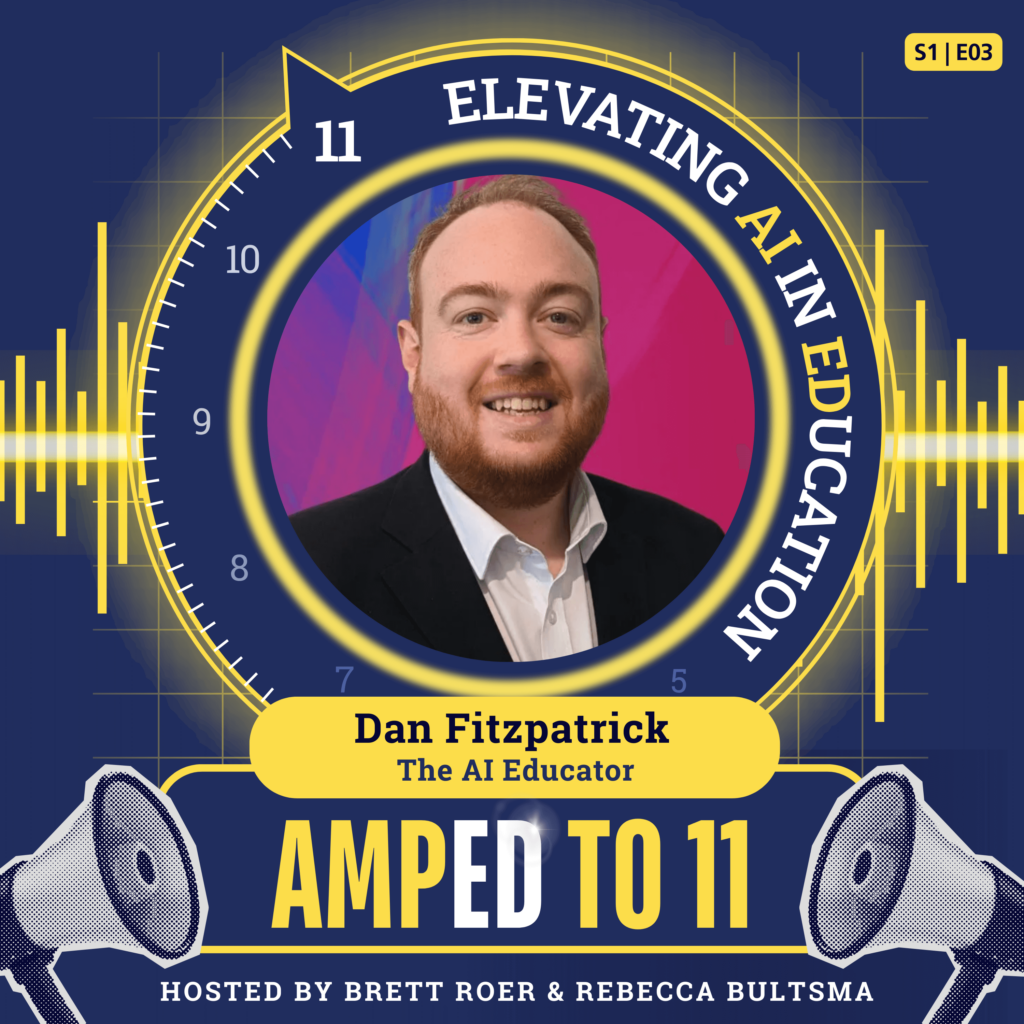
So today we have a very special guest in our podcast studio. Our guest is Dan Fitzpatrick, who is also known as the AI educator. And he is going to help us turn it up to 11 today. Dan is a teacher and he helps schools strategically integrate AI. He is a Forbes contributor. He’s a bestselling author of the AI classroom, and he has a new book that, by the time this podcast is released, will already be out called Infinite Education.
00:16:49:17 – 00:17:11:03
Rebecca Bultsma
And I personally am very excited to read this. I read his first book and fun fact about Dan. I actually had been using Dan’s videos in my AI presentations, for quite a while, and the conference in Ohio where Brett and I actually met, he came up to me and said, hey, you had that video in your presentation of dad.
00:17:11:03 – 00:17:26:15
Rebecca Bultsma
Did you know he’s speaking at this other partner AI conference? Do you remember that? Brett? Yeah, yeah. So it’s a full circle moment having the three of us together now having a conversation. So welcome, Dan. We are thrilled to have you here today.
00:17:26:17 – 00:17:43:18
Dan Fitzpatrick
Thank you. So much. It’s great. Great to meet you. Eventually I’ve been following you on LinkedIn and so on. And, Brett, good to see you again. Last time we met, we were at Cuts Deli in Manhattan. Having probably the biggest dinner I’ve ever had in my life.
00:17:43:20 – 00:17:55:19
Brett Roer
Yes, it is, our family’s favorite establishment in New York City. It’s one of our culinary traditions. And even I will say that was the most, I’ve ever worked at Katz’s Deli. Either. But you made the family proud, Dan. Daniel.
00:17:55:24 – 00:18:02:22
Dan Fitzpatrick
I think everyone around us was surprised as well. Everyone looked at our plates like, what are you guys doing best?
00:18:02:22 – 00:18:09:11
Brett Roer
And to preface, we did take about a five mile walk there. So I think we burned. We earned that plate. But yes. Even still.
00:18:09:13 – 00:18:17:14
Dan Fitzpatrick
Wait, you didn’t tell me about it? Let’s go to class. Just down here. Like two hours later, it was still walking on, like, is it round here?
00:18:17:16 – 00:18:27:20
Brett Roer
But definitely worth the walk. And, yeah, that was a peak moment, where I met culinary experiences in New York City. So it was an amazing time. Dan, pleasure to have the podcast.
00:18:27:20 – 00:18:28:06
Dan Fitzpatrick
Enjoyed it.
00:18:28:07 – 00:18:32:22
Rebecca Bultsma
Thanks for having me inspire. I aspire for that experience, that’s for sure.
00:18:32:24 – 00:19:01:12
Brett Roer
That that will be my new New York experience and for all I experts, that’ll be the walk, the talk and the meal. So we set the bar high. Dan, it’s really great having you on, I hope. Before we kick off our M2 11 series of questions for each guest. Please, could you take a moment, just kind of explain, you know, a little bit about your journey, but most importantly, the new book that you have out, if you could kind of share with, our audience what they can hope to learn, by taking advantage of your latest work.
00:19:01:14 – 00:19:19:04
Dan Fitzpatrick
Of course. Yeah. And thanks for the opportunity to to share it. I really appreciate it. I yeah, I, I was a teacher as a high school teacher for a number of years. And when I was, when I was doing that work, I, I always have an interest in the future of education. I was part of a podcast called Edgy Futurist, which is still going strong.
00:19:19:06 – 00:19:42:24
Dan Fitzpatrick
I’ve stepped back from an output. Ben and Steve who who presented us are still doing an amazing job. And I kind of it was kind of part of my mission, really, as a teacher, is always to try and push the boundaries and then moved on to, to high school leadership, senior leadership, and then moved into college education, where I was, in charge of innovation and digital strategies.
00:19:43:01 – 00:20:04:11
Dan Fitzpatrick
And it was there really that I first came across, artificial intelligence. So when I was writing the strategy I remember having, I was I would go into a lot of local industries, spend some time with them, discover what what was kind of cutting edge in terms of technology and see if we could we bring it back into the curriculum, into how we do things within college education.
00:20:04:13 – 00:20:23:23
Dan Fitzpatrick
And I remember hearing of of this was a few years ago, was Preacher Trip actually hearing people talking about, large language models and almost like as a calculator for words. And it really intrigued me. We start playing around with some early versions of this, of how it could help, lecturers and our teachers and then obviously changing.
00:20:23:24 – 00:20:53:16
Dan Fitzpatrick
It happened, just just over two years ago. And, there wasn’t much I remember the first couple of days, like the last day of November, first day of December. There wasn’t much out there in terms of anyone commenting on this, by way of education and the impact on education. So I just, I, I essentially I, I on my cell phone, I pressed screen record went to the there was no app then so I just went to the the Chrome browser phone charged me to.
00:20:53:18 – 00:21:17:23
Dan Fitzpatrick
And I think I just did something really simple, you know like which now now feels like just so simple back then was was quite revolutionary. I think I typed in like create a lesson plan, something like that on ChatGPT. Posted it and then to start doing that and then by the by the end of December 2022, I was getting a lot of requests, people saying, could you put it, could you, could you do webinars, could you do that?
00:21:18:00 – 00:21:48:14
Dan Fitzpatrick
And it was kind of explored in a bit really. And got a book deal in that time as well. And it just I kind of found a passion for it, in that time where I was I want to explore this more. So, wrote the book, stepped aside from my job, and and now I’m really lucky I get to to travel around the world, work with district schools, colleges, universities, businesses, helping them, kind of two main things, really.
00:21:48:14 – 00:22:24:09
Dan Fitzpatrick
So awareness on skills around design and then also the strategic side. So the my first book was all around kind of the, the awareness and the skills. And then I, I’ve just released this book, Infinite Education. I’ve still got the this is the proof copy, as you can see, with the label across the front. But yeah, just just being released, around how, how a school, a district to college can strategically, plan and innovate over the coming years of without official intelligence.
00:22:24:11 – 00:22:43:22
Brett Roer
Amazing. First, thanks for sharing that journey. And it’s so incredible how you know, your passions and your skills intersect with the dawn of, you know, AI as we know it now with the, you know, launch of ChatGPT and everything that’s come after that. So congratulations to you. Really excited to get, to get our hands on the book and learn about how you’re thinking more systemically about bringing it to people.
00:22:43:22 – 00:22:50:18
Brett Roer
Now that there’s this initial awareness of how to utilize AI, especially in education. So again, kudos to you.
00:22:50:20 – 00:22:52:05
Dan Fitzpatrick
Thank you. Thanks.
00:22:52:07 – 00:23:09:22
Brett Roer
All right, Dan, we ask all of our guests 11 questions at Am to 11 that we really hope will let our listeners, you know, get insights into what excites you about AI and also, some of the most important tips, tricks, strategies and best tools out there. Are you ready?
00:23:09:24 – 00:23:11:03
Dan Fitzpatrick
Yeah. Let’s do it.
00:23:11:05 – 00:23:31:21
Brett Roer
All right, well, you kind of already prefaced a little bit about the tone of AI with ChatGPT, how you were so impressed by the fact that they let you create a lesson plan, and then you shared it with the world. So we know, obviously, the hit show Stranger Things, there’s a character titled 11. She has supernatural powers. Everyone’s in all the first time they experience her.
00:23:31:23 – 00:23:42:10
Brett Roer
What was a jaw dropping AI moment that you experienced? Kind of something that you still can’t believe how unexpectedly I worked in that moment.
00:23:42:12 – 00:24:11:08
Dan Fitzpatrick
Yeah, I it’s interesting because it’s it happens regularly, doesn’t it? Because there’s so many advancements, with this technology, that the and I guess I think as humans, we do this, don’t we? We something really shakes our world. And then a few minutes later, we’re like, yeah, okay, what’s next? And it just becomes normal. And, I suppose, one of the, one of the things I really like do.
00:24:11:08 – 00:24:33:15
Dan Fitzpatrick
So if I’m given a keynote talk, one of the things I really like demonstrating this, the is the, Ray-Ban meta glasses. So I still, I still get a real kick out of showing people how those work, and, and it’s still one of the. And you guys all know from present know now you get you get those kind of gasp moments from the audience.
00:24:33:15 – 00:24:59:08
Dan Fitzpatrick
And and as time goes on they they start to fade away. You don’t get them as much because people are used to the technology. But it’s still one of those moments when I show people a lot where I still get kind of get that gasp moment when people realize just how, I suppose, I suppose the application of the technology, the fact that you can have an AI that can see what you see, hear what you hear on your face and be having a conversation with it.
00:24:59:08 – 00:25:22:03
Dan Fitzpatrick
They’re not perfect, but I think it’s it’s a real indicator of where the technology could go over the next few months and how useful they could be in our everyday lives. And kind of starts that starts to give us that vision past some of the gimmicky sides of AI that make sense into the real data. Their use of AI.
00:25:22:05 – 00:25:41:05
Dan Fitzpatrick
So yeah, I, I think that I honestly, I could, I could name probably about 50 things, under that category, but yet I think still using using the wearable AI, still, surprises me and they keep updating it regularly. So I keep getting those those moments.
00:25:41:07 – 00:25:55:06
Brett Roer
Yeah, I’ve been fortunate enough to see you do that, and I’ve seen clips of you doing that. And you’re right, the interaction of the audience, those lightbulb gasps little moments are truly incredible. Reminds me of the time we saw the, the machine, the AI, the AI robot in New York.
00:25:55:06 – 00:25:57:06
Dan Fitzpatrick
Sophia. Yes, of course.
00:25:57:08 – 00:26:12:12
Brett Roer
And how many people there you know, that was a large audience of, New York State education leaders as well as board members and how so many of them this was a true experience watching a an AI robot interact with a moderator and do like a live interview on stage.
00:26:12:14 – 00:26:38:12
Dan Fitzpatrick
When people talk about generally generative AI of the moments, most people’s minds go to go to ChatGPT. But once you start broadening that horizon of actually, of what this could are, it’s almost like showing somebody a very early email in 1995 and people have been, wow, this is amazing. We can send letters electronically and then given them a glimpse of what’s going to be coming in ten years, 15 years time with the internet.
00:26:38:14 – 00:26:47:17
Dan Fitzpatrick
It just kind of makes people go, oh, wow, I didn’t actually think that the application would would advance that fast. So yeah, absolutely.
00:26:47:19 – 00:26:53:01
Rebecca Bultsma
So for those of us who are having New York FOMO, tell me about Sophia.
00:26:53:03 – 00:27:20:03
Dan Fitzpatrick
Yeah. So me, I was lucky enough. I was I was invited to speak to the New Yorker. That’s right. New York state schools board. Association. Board. Association. There we go. So they had a conference at the at the Hilton and in Manhattan. So I was keynote on that the second day. But the first day, the the keynote was, was a robot and AI robot called Sophia.
00:27:20:05 – 00:27:47:07
Dan Fitzpatrick
So a lot she’s been around a while. She she she goes she pre-dates ChatGPT and so on, and she’s I think she’s the first ever, robot to have citizenship of a country. Was, was it Saudi Arabia or some, some Middle Eastern country? Give it citizenship. Yep. And yeah. And she’s I think she’s like the ambassador for the U.N. on artificial intelligence as well.
00:27:47:07 – 00:28:11:20
Dan Fitzpatrick
So, it’s essentially it’s yeah, it’s she’s she’s a robot, isn’t she? With like, a human like face with which the face moves a bit like a human. And she’s kind of. She works of a language model in terms of how she talks, and she’s pre-trained in certain ways. But, yeah, me, myself and Brett got a chance to go up afterwards and have a kind of one on one conversation with her, which was interesting.
00:28:11:22 – 00:28:16:23
Brett Roer
Wow. Very much so. Yeah. Yeah, that was that was unique for me as well.
00:28:17:00 – 00:28:42:04
Dan Fitzpatrick
Yeah. Yeah, it’s a bit unnerving when you first time you especially try to like looking at her in the eye and but but even again, I think, I think some of the things that we’re starting to see, being worked on behind the scenes at companies like Tesla and so on, even Sophia’s going to be out of date very, very quickly, I think probably already is to a certain extent.
00:28:42:06 – 00:28:53:17
Brett Roer
All right. For our resident UK expert here, we’re going to actually, you know, go across the pond here and talk about AMP 211 gets its name from Spinal Tap the iconic.
00:28:53:21 – 00:28:54:02
Dan Fitzpatrick
Yeah.
00:28:54:08 – 00:29:12:09
Brett Roer
Let’s go up to 11 when they need to crank it up. So you know Dan you work with so many different tools. We’d love for you to get your insights and share their audience. You know, when you really need to get something done, you need to push yourself to your absolute limits. Crank it up to 11. What’s an AI tool that you find is incredibly useful for your work today?
00:29:12:11 – 00:29:39:04
Dan Fitzpatrick
It’s. Yeah, I want to say to you, but it feels predictable. I it’s interesting because my journey kind of well, in terms of what I use as my core tools changes, and fluctuates regularly, but I always come back to try pretty, I always kind of like I went I, Claude was my was my, like, primary tool for a month or so, then chat to be updated.
00:29:39:04 – 00:30:00:15
Dan Fitzpatrick
And I just found myself gravitating back. But I think, I think so, so that I’m not given the boring answer, the one I think the tool I use the most, to get my workflow going is Google Notebook LM now it’s the popularity of no problem is is gone through the roof over the, over the last few months.
00:30:00:17 – 00:30:24:14
Dan Fitzpatrick
But, I remember I was lucky enough, I did a webinar and I, and I had Steve Johnson, the guy from Google Labs who, who created this notebook. So I had him on and I was I was talking to him about this, and his vision behind that. And it was really interesting because he told me that Google Labs employed him, purely because his background is in writing books.
00:30:24:14 – 00:30:59:04
Dan Fitzpatrick
So he’s he works for Google Labs, but he’s not an engineer. He’s not he’s not a technical person. He’s he’s an acclaimed bestselling author on many, many different books, and a bit of an academic. And he’s had documentaries on Netflix and so on. But they they hired him because they wanted this tool to be made from the ground up by somebody who understood what it meant to, to work on a, on a long writing project and, and understood what it meant to, to publish work and to research work.
00:30:59:06 – 00:31:21:23
Dan Fitzpatrick
Which really and I think, I think that that kind of shines through with this tool that it’s, it’s that it has been made from the ground up by somebody like that. And I, I yeah, I if no one’s ever come across before and, and it’s most basic form, you upload your own source material, documents, audio files, websites, whatever you want to upload.
00:31:22:00 – 00:31:45:03
Dan Fitzpatrick
And then you’re talking to a tool. But like chapter 15, but it’s Google Gemini, but it only uses those documents for its knowledge base. So when you talking to it, you only get knowledge from the documents that you’ve created. I mean, it has so many of the bells and whistles on it, which really allow for some amazing learning opportunities and some amazing research opportunities.
00:31:45:03 – 00:32:04:00
Dan Fitzpatrick
But it’s always a place I start with, especially when I’m when I’m writing, when I’m researching, which I do pretty much on a daily basis, it’s where I just kind of throw all my research and and start to get to grips with the content, and then I’ll take that, go over to ChatGPT or so on and get a bit more creative with it.
00:32:04:02 – 00:32:34:15
Dan Fitzpatrick
But it’s yet at the minute, it’s, it’s my starting point and kind of the, the cornerstone of, of a lot of the work I do. And, and I like that, you know, you’re not just chatting to this wide, vast knowledge base where you you don’t always know where it comes from. You don’t, it can feel a bit like Wikipedia sometimes, but actually you get to really hone in on what you know is good content, good research.
00:32:34:17 – 00:32:36:05
Dan Fitzpatrick
Yeah, I like that.
00:32:36:07 – 00:32:53:04
Rebecca Bultsma
But, yeah, I was playing around with the book yesterday, actually, and realized that now with the voice conversations, you can actually hop in and they’ll say, oh, we have a comment from one of our listeners. Go ahead and ask a question, and you can redirect the voice conversation, which, you know, it just gets better and better there.
00:32:53:06 – 00:33:13:24
Dan Fitzpatrick
Yeah. It’s interesting that, I love that that kind of the, the feature where you can create a podcast based on the, on your source material. And I use it a lot, especially if I’m trying to read something that I don’t fully understand, like a large document or some governmental policy or whatever, where I’m just like, I just can’t get my mind into it.
00:33:14:01 – 00:33:37:00
Dan Fitzpatrick
I’ll quickly create a blog, podcast, listen to that first, and it really helps. So I think it’s interesting when we we talk a lot only about in AI and education about AI really helping with learning. But we almost say, right, it’s it’s probably common. It’s common to like the AI tutor type thing. It’s it’s going to get better and so on.
00:33:37:02 – 00:33:50:02
Dan Fitzpatrick
But actually, I think, I think we underestimate how much a tool like notebook alone can really help with learning right now and kind of break down those barriers and, yeah, it’s it’s exciting so early.
00:33:50:04 – 00:34:05:23
Brett Roer
So much. I want to talk about notebook. But I want to get on to our next question. So, as you know, we rate things ten out of ten sometimes things are so good. They’re off the charts. They’re in 11 out of ten. Cats is deadly, for example, as we know. So let’s get the equivalent of that.
00:34:06:00 – 00:34:13:24
Brett Roer
What’s an AI tool that you’re using right now or that you’ve experienced recently that deserves an 11 out of ten? And why?
00:34:14:01 – 00:34:39:00
Dan Fitzpatrick
You know what I always feel really I always feel really guilty if I like single out one two because I work with so many tools and I know so many of the people who create these tools and they’re all amazing. But I one of the ones I always come back soon is risk. Now I just, I yeah, there’s something about it or I think it’s because of the Chrome extension at its heart.
00:34:39:00 – 00:35:11:16
Dan Fitzpatrick
I’m a I’m a real Google. I like when I, whenever I, whenever I worked in schools I always moved them to Google. I was I was, you know, you have Microsoft people, you have Google people. I was I was firmly a Google person when I was in the classroom. And the fact that brisk is a Chrome extension that works with the Google tools every time I see it, I just think, I wish I had that when I was teaching, I really and and I still get some great reactions when I show brisk in workshops.
00:35:11:18 – 00:35:38:24
Dan Fitzpatrick
And it’s a bit like a Swiss Army knife. And, and and I, I really like what they do, and I like their ethics. I like the, the way the, the approach they’re creating that they’re company and so on. And I just think it’s that really valuable. Some of the, some of those tools that they do that they have created in there, and I know I really change and, and helping educators on the ground.
00:35:38:24 – 00:36:10:18
Dan Fitzpatrick
And I think that’s the, the key here, the fact that if it’s if it’s really helping an educator on a day to day basis, then it’s got to be good. Now, I know a lot of, a lot of these tools get a bit of stick sometimes it’s a wrapper around other types of AI and more. The more frontier I, I could also go against that, to be honest, I, I kind of don’t understand that argument because, we need sometimes we need a wrapper like you don’t want to use ChatGPT and raw with your students sometimes.
00:36:10:18 – 00:36:37:20
Dan Fitzpatrick
And, and especially like you need to be able to like I mentioned other ones school I like you you could create a GPT for your students. So, you know what I mean. Like, so, but actually you you you don’t want to do that. Especially if your students are under 18. You’re going to want to use this to like school AI, where you then get insights into the conversation.
00:36:37:21 – 00:36:58:23
Dan Fitzpatrick
You get a summary, you get you can step in if something’s going wrong or if something inappropriate happened. So I think, I think rappers get a bad rap, but I think there are I think they’re essential, to be honest. I think we need them. Educators need them. If we want to keep our kids safe and and have those extra functionality so that they’re usable in, in the classroom.
00:36:59:00 – 00:37:10:08
Dan Fitzpatrick
So. Yeah. And this is, there’s so much going on there. I’m going to wrap up because I realize we’re on question three and we’re going to be here all day. So I’ll stop talking.
00:37:10:10 – 00:37:26:20
Brett Roer
There’s a lot of follow ups I have, but for folks who don’t know Briscoe. Again, just a Chrome extension predates Gemini, or at least the public release of Gemini. And, as you said, as a teacher, I was a Google person. I remember in the cab ride home from Katz’s, you were we were talking about that how finding tools that really support that meet you where you’re at.
00:37:26:20 – 00:37:46:08
Brett Roer
So as you’re saying, it’s essentially if you’re used to using, Google Docs or Google, Google Docs specifically, it really helps you build out, the lesson or find exemplar, problems or ways that you’re used to using Google. So I just want to kind of break that down for folks who haven’t heard of risk, obviously. Check it out.
00:37:46:08 – 00:37:50:02
Brett Roer
I was fortunate I got to use the beta version when it first got released.
00:37:50:04 – 00:37:52:00
Dan Fitzpatrick
So we want to,
00:37:52:02 – 00:37:52:17
Brett Roer
But it’s great, I think.
00:37:52:21 – 00:38:20:23
Dan Fitzpatrick
I think just to mention as well. Amen. Who created it? He worked, in the white House and he worked for the, the, the the Zuckerberg Foundation, Chan Zuckerberg Foundation. And one of his big observations there was that just added more technology into the workflow for teachers was actually, putting them at more of a disadvantage than not, because it was then a an extra website or an extra platform.
00:38:21:00 – 00:38:34:06
Dan Fitzpatrick
So his real vision was that he didn’t want to build another platform. He wanted an AI that would work within the tools that they were already using. And and that’s yeah, that’s what he’s done. And I think that’s that’s what makes it stand out for me.
00:38:34:08 – 00:38:52:09
Brett Roer
Yeah. So the medium is the message embrace rappers, meet your students and your educators. Where they’re at seems to be some key takeaways, from brisk learning and, from Dan here. All right Dan so here at AMP to 11, we are huge fans of 11 labs. Right. They’re known for creating AI voices that are next level amazing.
00:38:52:11 – 00:39:04:06
Brett Roer
So if you could have any voice historical, living fictional, read your daily emails or kind of be your thought partner using AI, who would you choose? And why?
00:39:04:08 – 00:39:32:04
Dan Fitzpatrick
And, you know, it’s really interesting. I do I create a podcast every day now, which is like, one of the new, like a new story of the day around AI and education. And it’s my voice, but I don’t do it. It’s it’s 11 labs that does it for me. And just because it sounds so much like me, and, and I did start off with the, the podcast feature within notebook and I’m like, we talked about and that did the podcast for me.
00:39:32:06 – 00:39:54:18
Dan Fitzpatrick
And then after a day or two, I was like, I need to move away from that. And actually that needs to be my own voice. So yeah, it’s interesting. I think there’s, you know, what I could do quite like the, the Ray-Ban meta glasses have got celebrity voices on them now. And there’s, you know, do you guys know Judi Dench?
00:39:54:18 – 00:40:09:13
Dan Fitzpatrick
The the actress? Yeah. Yeah. So one of the voices within the glasses is, is Judi Dench. So you can literally chat with the AI and it’s Judi Dench, his voice. And that sounds pretty cool. So yeah, maybe Judi Dench.
00:40:09:15 – 00:40:11:18
Rebecca Bultsma
I feel like that would like that one.
00:40:11:20 – 00:40:27:15
Brett Roer
I like that one. But also just everyone out here heard that Dan Fitzpatrick’s favorite voice is Dan Fitzpatrick. If you’re enjoying this podcast, the soothing accent, Patrick, you can can anyone find you on 11 labs? Like can you search for you or that just you made one.
00:40:27:18 – 00:40:30:07
Dan Fitzpatrick
Oh, I don’t know, actually.
00:40:30:09 – 00:40:34:18
Rebecca Bultsma
So could I have Dan Fitzpatrick read me my emails every day? Could he be miked up?
00:40:34:18 – 00:40:44:12
Dan Fitzpatrick
Let’s not just because then anyone would get me saying anything. That would be scary. Yeah. I need to check that. Actually, in the sentence.
00:40:44:14 – 00:41:05:06
Brett Roer
Dan. So again, you’ve been at the forefront of AI and innovation for years. We’re all so excited that things continue to push closer to that. 11 right? Reaching that peak state for AI and innovation. But there’s still so many gaps that still probably surprise us in its capabilities. But right now and early 2025, what’s one challenge that still makes you think?
00:41:05:08 – 00:41:09:00
Brett Roer
How is it you’re not able to do this yet at the level I expect?
00:41:09:02 – 00:41:25:20
Dan Fitzpatrick
That’s yeah, that’s an interesting question. And I think I think one of the things I’m and I think a lot of people are kind of waiting for is, is the video side of things to, to because I think it’s that’s been kind of promised for a long time as a long time. But two years feels like a long time.
00:41:25:20 – 00:41:47:08
Dan Fitzpatrick
But, it’s kind of and we’re getting, you know, a chat to be released. So, we’ve got, Google’s video tool now just been released, and they’re still not hitting the mark for me. I think they still got a long way to go. I mean, they’re amazing for what they can do. But I yeah, I can’t wait for for when that is, is really advanced.
00:41:47:08 – 00:42:16:11
Dan Fitzpatrick
And I know, I know what I kind of know what it is already behind the scenes. It’s a lot more advanced than it is that than what we’re getting. Which kind of excites me in a way, because I think how we engage and how we create content is going to vastly change in the next few years. But also what I do not like is that we’ll I think we’re going to appreciate the human side of creativity more.
00:42:16:13 – 00:42:37:20
Dan Fitzpatrick
And I’ve just this shameless plug, but in my book, I wrote a chapter called And let me, let me get it right. Finding purpose in an Ikea world. And the whole point is, I think, you know, like I went to Ikea. You can, you know, you need a table for the spare room in your house. Nobody’s going to really see it.
00:42:38:01 – 00:43:05:11
Dan Fitzpatrick
But from the odd guest, you’re going to buy probably a $50 Ikea table. It does the job. Looks all right. And I think I think that’s how we’ll approach a lot of the content and, and materials with AI that I. But I think what it will do is it will make us appreciate when the human creation because let’s say I want a nice dining room table from the dining room, something that’s really bespoke.
00:43:05:13 – 00:43:28:04
Dan Fitzpatrick
I’m probably not going to go to Ikea if I’ve got a bit of spare, cash, I chances are I’m like, find a local carpenter who makes who and then I can tell this story, I can. There’s, there’s a, there’s a, there’s a lot more there. And I suppose what I’m talking about is art, because art is, is something that tells the story of the person who made it really.
00:43:28:06 – 00:43:51:20
Dan Fitzpatrick
So I think we appreciate it more. I think it’ll become more niche, but I think we’ll appreciate it more. So, yeah, I’m kind of excited for the the video side of things because I think I’m a big movie fan. I couldn’t we could almost see a revival of kind of, like arthouse films and, and kind of the, the, the films, what we, we appreciate more.
00:43:51:23 – 00:44:12:20
Dan Fitzpatrick
I think we’ve, we kind of, I mean, I’m getting on a hobby horse here, but you know, like, look at, look at a lot of the movies that come out now, the, the franchised movies. I mean, they may as well. You could, they could be, it could be a I created them really the might get special effects and and the, the kind of predictable storylines and so on.
00:44:12:20 – 00:44:29:20
Dan Fitzpatrick
But I think I think hopefully we can we can go back to, to some more niche. Yeah. That when I started answering that question, I didn’t realize I was going to end up here. But, that’s what happens when you don’t look at the questions.
00:44:29:22 – 00:44:49:17
Rebecca Bultsma
And I actually really like your analogy. I use something similar kind of the Amazon versus Etsy. Right. Like you can order 50 of these things on Amazon for cheap, or you can get something handmade, custom by a human who created it, who you know, who created it on Etsy. And you’ll pay more for it, but it’ll mean more than getting 100 pack.
00:44:49:19 – 00:44:53:17
Dan Fitzpatrick
Yeah, yeah, hundred percent I think that. Right.
00:44:53:19 – 00:45:16:11
Brett Roer
Yeah. And I want to shout out something you just said. Right. I think as educators we often don’t think of ourselves as artists. Right. That would sound very, braggadocious. I think if I was like, I’m an artist because I’m a socially teacher, but we literally are creating lessons and really racking our brains on how to connect with, you know, our students or, you know, align with changes and innovations in education.
00:45:16:13 – 00:45:34:16
Brett Roer
I really do feel like I want to really highlight I never really felt like an artist until I came about because of the ability to now create artwork or to, you know, create, turn my words into something bigger then I probably had the capability of doing in the past year to do it as efficiently as I can now.
00:45:34:16 – 00:45:50:08
Brett Roer
So I really like that idea of thinking that for people who are more humanities based, like myself and many others out there, that I truly is a way to express yourself artistically that you just probably didn’t have before. It’s another brush. It’s another tool in the toolbox. So, great.
00:45:50:08 – 00:46:08:13
Dan Fitzpatrick
And so any you take that to the next, the next level of like accessibility. How many people out there. Because I suppose just to take the analogy further, that I’ve been an artist, it’s almost like creating a window into yourself, isn’t it? And and it’s really sometimes it’s really difficult to do that because especially if you did it through writing and you don’t have the skills to be able to write.
00:46:08:13 – 00:46:35:04
Dan Fitzpatrick
Well, but actually being able to use a tool like ChatGPT, you can get if you use it in a, in a specific way, you can you can be authentic and get it to write well, for you and give you, give you that window in that you that you didn’t have before. And especially for those who who literally physically or, can’t, can’t speak, can’t I will talk about the Ray-Ban glasses.
00:46:35:04 – 00:46:56:03
Dan Fitzpatrick
I, my sister was just diagnosed as has been blind, a year ago, and I just got us some of those Ray-Ban glasses and they’ve got a feature in them as well where you can it connects to an app, for blind people. It’ll it’ll ring somebody, like a volunteer on the other side of the line.
00:46:56:03 – 00:47:18:06
Dan Fitzpatrick
So a real human not not an eye. Although you can’t do with the eye as well. And it’ll show that person what she can see because of the camera on the glasses, and will talk us through what’s in front of her and help the eye does that as well. But, yeah, I think that that accessibility and equity piece around these tools is, is something that I don’t think is talked about enough.
00:47:18:06 – 00:47:37:03
Dan Fitzpatrick
I think we like to talk about, well, this is replacing our own artistic nature or our own, but actually we, we don’t talk about how I could actually, add to to our, how we express ourselves and, especially for those who who need it.
00:47:37:05 – 00:47:53:10
Brett Roer
Yeah. That is a wonderful example of, how I can more humanize things and provide access to people who, in the past, my neighbor is blind. And twice now I’ve had to help him. And I just wonder, like, what if I didn’t walk by at that moment? Like, how is this person literally had to walk down some stairs in the winter?
00:47:53:10 – 00:48:11:14
Brett Roer
And I’m like, how would this have just worked out if I hadn’t just randomly walked by this person? Another time using a cab, and they just couldn’t. He couldn’t explain to cab driver to get to his house, which was five doors down. But that what you just said is just a perfect use case of making the world more accessible to those that, right now there’s many of.
00:48:11:16 – 00:48:11:24
Dan Fitzpatrick
It.
00:48:12:05 – 00:48:15:03
Brett Roer
On blind spots. There’s many blind spots and gaps in making things accessible.
00:48:15:08 – 00:48:37:19
Dan Fitzpatrick
And not just, I suppose, not just those, but with those, those special needs, but also like language. I was in Madrid a few weeks ago. I went to see Paul McCartney. Live is amazing. But. But anyway, I was parking my car in, like, this underground car park in the, in the city in Madrid. And, the guy who was it was, looking after it just didn’t speak a word of English.
00:48:37:19 – 00:48:54:08
Dan Fitzpatrick
So I was able to just pull out, pull up the chat, get a voice, and say, act as a translator. And we had a full conversation. So just the ability to to bring people together, it’s it’s exciting. And I don’t think we talk about that enough with with I hope.
00:48:54:10 – 00:49:08:05
Brett Roer
When we think about where we are as a society. And I want to make sure you hear this down at the end, you will have a chance to shout out anyone and everyone in I that you feel like you’re missing when we ask you to talk about one single product or solution. So just want to name that.
00:49:08:07 – 00:49:24:01
Brett Roer
But right at the 11th hour, right? We have a breakthrough moment in AI in education. What’s something people need to know about right now? What’s a need to know AI solution or tool out there that you feel, this is the right spot to tell people about?
00:49:24:03 – 00:49:47:15
Dan Fitzpatrick
I think it’s not something that the that’s going to be useful right now, but what they what they probably need to know about and, and it stems from, I find when I work with, with educators and when I see things on social media and so on, I think a lot of people are making judgments right now based on where AI is right now, or maybe where I was six months ago when they last used it.
00:49:47:17 – 00:50:08:20
Dan Fitzpatrick
And there’s a there’s a confidence out there that they know what this is. And therefore we can we can evaluate to make judgments on it and adopt accordingly to it. And one of the things I want to say to people is kind of one of the main messages I’d given in my talks as well is that we, we, we don’t know where this is going to be next month.
00:50:08:22 – 00:50:26:20
Dan Fitzpatrick
Never mind trying to judge where it is now. And, and two of the things that I showed to that, because they have a bit of shock value and I want to try and when, when I do like a keynote talk, I want to I try to prod the audience as much as possible and one of them is is the robotic side of this technology.
00:50:26:20 – 00:50:57:09
Dan Fitzpatrick
If you just go and look at kind of how advanced the robotic side of this technology has become and it’s it’s incredible. Absolutely incredible. And we’re going to see them. But Elon Musk recently said he wants the, the the, Optimus to be available within three years for between 20 and $30,000. People are literally going to be living with robots that, that, kind of like personalized butlers, that could be become friends, that could goodness knows what they, what they’ll be capable of.
00:50:57:11 – 00:51:15:19
Dan Fitzpatrick
And that’s going to be happening really soon. And I don’t think I think the world is going to have another ChatGPT moment where it goes, oh my goodness. Because not many people know about it. Unless you’re kind of into this or you happen to just come across it on YouTube, not many people know about it. And then also the brain technology side of things.
00:51:15:21 – 00:51:37:15
Dan Fitzpatrick
I think that is it again. I hate to use, quote Elon Musk twice in the same answer, but, he’s he’s one of the guys who’s at the forefront of a lot of this technology. But he he’s predicting it’s a prediction and prediction aren’t always right. And notoriously he doesn’t always predict right. But he I think what what I’d say about Elon Musk is it doesn’t always predict.
00:51:37:17 – 00:52:08:22
Dan Fitzpatrick
Right. But he eventually does get there. Whether it’s five years later, ten years later. And he’s he’s predicting that by 2030, over a million people will have, the Neuralink. So an AI, device essentially on top of sitting on top of the brain, like, surgically implanted. So we’re going to see people with capabilities, the likes we’ve never seen before in just the next few years.
00:52:08:24 – 00:52:31:13
Dan Fitzpatrick
And I, I don’t think people that many people will know just what’s on the horizon when it comes to this. And again, even the Neuralink, even though robotics are using technology that we kind of already know about, it’s just it’s being applied in a more creative way. So I think, yeah, I think it’s not something that it’s not a take away in terms of go use it right now that you, you might not have known about.
00:52:31:13 – 00:53:07:01
Dan Fitzpatrick
But I think just having that awareness as an educator or as a leader is, is vitally important to know that just when you think you’ve grasped this, you haven’t, and, and to plan accordingly. And again, there’s a plug for the book. This is, this is the that’s what I’ve tried to do with infinite education is it’s not it’s not a strategic approach where you and I make it clear in the book that there’s a difference between strategy and plan, and we try to jump to the plan as fast as we can because it’s not it’s easy.
00:53:07:03 – 00:53:32:15
Dan Fitzpatrick
A plan’s easy because you go. Right. Well, this is where we want to be. This is how we get there. And you can work on it. You can sit on your laptop, you can type away. You can you can meet with people. You can. It’s a it’s a pragmatic thing. Actually. Strategy isn’t like that. Strategy is the step before that where you, you kind of you, I want to I want to use an analogy, but every time I use it, nobody else has ever heard of it.
00:53:32:17 – 00:53:37:11
Dan Fitzpatrick
But, you know, I talk about this with you, Brett. I feel like, you know.
00:53:37:11 – 00:53:38:07
Rebecca Bultsma
You have to talk.
00:53:38:07 – 00:53:41:19
Brett Roer
Yeah, I’m. I’m excited. Yeah. And I can’t tell you unless you tell me.
00:53:41:21 – 00:53:56:09
Dan Fitzpatrick
So I feel like strategy is my. My dad used to say to me when I was younger, like, if you ever want to do something and you feel like you can’t do it, throw your hat over the wall first. And didn’t we did we talk about this?
00:53:56:15 – 00:54:02:13
Brett Roer
I know this is where the wisdom from I did not learn about, you know, everybody.
00:54:02:15 – 00:54:26:16
Dan Fitzpatrick
And that’s I as a, you know, as you become like a public speaker and you start you, you start coming out with things and you and and, you know, like things, like phrases that you thought everybody knew would just this things your parents said that, but essentially it was like, you know, if you want to climb over a wall and you feel like it’s too, too high, if you throw your hat over, then you’ve got no choice, but you’ve got to get over it.
00:54:26:16 – 00:54:43:13
Dan Fitzpatrick
Now. We got to get you hop back. That’s the whole point of it. So I feel like strategy is more like thrown out of the wall than figure it out. How are you going to get over the wall? You still got to figure it out. But first of all, you’ve got to throw you out of it. And so I think that I’ve tried to design the book to go right.
00:54:43:13 – 00:55:02:14
Dan Fitzpatrick
Well, where do we want to be? And that doesn’t even have to be a solid thing yet, because we do know you can’t you can’t start planting foundations of the sand. Still moving, but you can still you can still kind of have an idea about where you want to be. That’s the type of strategy we need to do at the moment.
00:55:02:14 – 00:55:26:22
Dan Fitzpatrick
We need to be thinking where if the world moves as we as we think it might move, where would where would we like to be without wall for the next five, ten years, let’s say, and then be prepared to change. Change paths quite, quite often to get there. So yeah. So it’s I think we need to be aware of it and we need to we need to strategize accordingly.
00:55:26:24 – 00:55:28:02
Dan Fitzpatrick
And yeah.
00:55:28:04 – 00:55:48:15
Brett Roer
Well that and shout out to shout out to your to your father for some words of wisdom. I think the resonated. So I think this is a great segue, and I’m going to kind of riff off the question we normally ask. But, you know, there’s an expression here that at 1111, you know, someone turns to you say, make a wish, gives it that extra magic.
00:55:48:17 – 00:56:01:24
Brett Roer
Kind of where you’re talking about in the direction you’re going in the wisdom you have in your book. If you could kind of make one wish right now for how I could shape education and or society, what would that be for you?
00:56:02:01 – 00:56:25:08
Dan Fitzpatrick
I, I really would love to give power back to the students. And what I mean by that is I think the power in education is very much with the system, like student walks into class on the first day. And it’s right. This is what we’re learning. This is what we’re doing next, and this is what we do.
00:56:25:08 – 00:56:43:16
Dan Fitzpatrick
And that’s what we’re doing for 14 years or however long it takes. I love I to be able to give the power to the student to go, this is what I want to learn. And now I’ve got the tools that I can learn it straight away. I can I can start to learn it. And and it’s really interesting.
00:56:43:16 – 00:57:06:07
Dan Fitzpatrick
Again, I, I have a lot of, a lot of a lot of gripes with that social media, but, it’s it’s, I find a lot of people on social media, like to talk about, well, how do what how do we want AI to be for students? What do we want to allow in our classroom? What do we want to our students to have access to?
00:57:06:09 – 00:57:39:21
Dan Fitzpatrick
And it makes me laugh sometimes because we like like we’ve got to say it like we’ve got the power to do that, or we perceive the power to do that, because if the students is going to do it anyway, it doesn’t matter if you’re going. No, we don’t do that in this school by if, let’s say we’ve got an advanced pair of the Ray-Ban glasses in five years time, a student is going to be able to learn whatever they want on them, and they’re going to get guided through how to practically apply it and build the skills if they want to learn it.
00:57:39:23 – 00:57:55:19
Dan Fitzpatrick
You go on. But we don’t allow those in class. It’s not going to make a difference, really. If anything, it’s just going to make you look more irrelevant in the eyes of that student. And one day, they’re probably going to stop turning up, and then will power if you if you don’t, if the students are even in your classroom.
00:57:55:21 – 00:58:27:08
Dan Fitzpatrick
So I like I like the fact that the learner could take power back and that we will get and we’re already starting to say this new forms of education like, again, I write about it in the book, this I think we’re going to see more and more decentralized educational options, that will allow for unconventional ways to be educated and, and maybe even more powerful ways to be educated.
00:58:27:10 – 00:58:45:15
Dan Fitzpatrick
Yeah. So I think and that’s kind of my wish, really. I think it’s it’s the power back in the hands of the student, in the back, into the hands of the parent. Like, imagine being a parent and just thinking, well, I could send my child to the local school or this other man’s an option online. Or there’s this other option or there’s this hybrid option.
00:58:45:17 – 00:59:06:01
Dan Fitzpatrick
Or I could join a homeschooling group, at the local outdoors and, like, I’m not saying that the it the traditional local schools should be replaced, but I like the idea that there could be options, more options that could be a menu of different, learning experiences available.
00:59:06:03 – 00:59:21:21
Brett Roer
Yeah. I love that you’re talking about giving power back to students families. I think when you were talking about that, it made me think, especially the idea of like, they’re going to do it anyway. That resonates with me both as an educator and as a parent. Like there’s times where there’s unintended ways they’re going to experience something.
00:59:21:23 – 00:59:39:17
Brett Roer
So just a quick, for example, and this is segue to our question about your own children in a moment. My son was asking me questions about like, evolution. He had a he just got a book that shows all the different skulls. And he’s I’m trying to, like, just watch his face, like, crunch up. Like, I was like, okay, I’m not doing a great job of this.
00:59:39:19 – 01:00:02:07
Brett Roer
So let me tomorrow, let’s find a short video and you can watch how the humans evolve over time. And my daughter was next to it and she was watching. She goes, did this happen to girls two? And it made me realize because it’s a man in the video. And it made me think of what you just said, like, imagine if I could immediately be like, now make that same video, but have a female, person evolve and that kind of powers thing I couldn’t have done before if I was a history teacher.
01:00:02:07 – 01:00:17:17
Brett Roer
There’s just times where the picture I had was that picture, and it might not be culturally relevant to the audience. And that’s like, yeah, right. That’s the picture that I found of Google Earth that’s been in this textbook for 20 years. So I love the idea of students getting the power back and families having power to create and make it more relevant to them.
01:00:17:19 – 01:00:35:03
Dan Fitzpatrick
Yeah. No, I like that. I think that’s quite powerful. And I think I gets a bad rap for for the biased side of things and rightfully so. Sometimes. But again, I think not many people focus on the, the ability of AI to, to help with human bias as well.
01:00:35:05 – 01:00:59:20
Brett Roer
Yeah. Well, speaking of kids, this is the time of the show where we always want to make sure that if, we know we have parents who are our guests, that you get some time to give them some flowers. So in a moment, I’ll ask you to shout out your two, lovely children. And also imagine that these, children will one day be 11 year olds, and they’re going to grow up in a world never knowing what it’s like to not have AI at their fingertips.
01:00:59:20 – 01:01:08:08
Brett Roer
So what message would you give to your own young ones and 11 year olds out there today about the future of, the world in an AI driven environment?
01:01:08:10 – 01:01:37:14
Dan Fitzpatrick
Yeah. So I would say I’ve got 4 or 5 year old Matilda and Jacob and I. Yeah, I suppose I let, they play with the voice. They’ve been playing with the center option quite a bit over over Christmas time. And, in fact, we started we didn’t actually finish it, but over the summer, we started doing a project where we were going to we’re going to create a book together.
01:01:37:18 – 01:02:07:00
Dan Fitzpatrick
So like a unique book with the help of AI for the pictures and the, the, the story and so on. And I suppose that kind of encapsulates what I want them to do with AI. I want them to to learn how to create with it, how to how to how to find value with it. I think one of the things I, one of the big things I talk about in the new book as well is that I think we we need to really.
01:02:07:02 – 01:02:35:05
Dan Fitzpatrick
Well, yeah. Let me give you a bit of background. So, there’s, within like the, the philosophy of I used to be a philosophy teacher. So within the philosophy of, of of work and labor, there’s, there’s, there’s a, kind of a theory a few hundred years old that there’s four means of production. And so one of the, one of the means of production is, is around, what you already own to have your own lot of land.
01:02:35:07 – 01:02:54:21
Dan Fitzpatrick
And that’s kind of how for centuries and centuries and centuries, that’s how people were productive and gained more wealth was through the fact that they already had land and they could employ people and they could do things with that land. Then we kind of moved into the industrial age, and actually those who were the most productive had labor.
01:02:54:23 – 01:03:20:05
Dan Fitzpatrick
They had they were able to bring people into factories and, and so on. And, and interestingly, that’s when the education system kind of came into itself because it was it was a method for the industrial society to to create workers to go into those types of places. We, we moved into a new era. Now, I think that is the, the era of the entrepreneur.
01:03:20:07 – 01:03:54:19
Dan Fitzpatrick
And that is that like anybody with a, an internet connection and a computer now can create a company, you don’t need you don’t land. You could do it in a Starbucks for free. You don’t need wealth. You don’t need labor. You could literally just be with an AI. But I think so. I think the the values that we need, they are the the skills and the mindset we need to teach our young people is how do we how do we solve problems and how do we add value, entrepreneurial skills essentially.
01:03:54:21 – 01:04:20:01
Dan Fitzpatrick
And so I want to I want my kids to, to be able to have an AI for that to go. Right. What how do I solve a problem here? And then how do I do it now the how do I do it. But normally there’s normally a barrier that I don’t have the skills, I don’t have the, the upfront cash that whatever it is actually now a laptop, the paid version of ChatGPT.
01:04:20:03 – 01:04:40:08
Dan Fitzpatrick
And you could probably find a way to try and solve that if you know how to use the AI really well, by collaborating with the AI. And so I, I think I want my I want my kids to kind of, for the next few years to start learning to use AI in a way where they start to think, well, how do I add value to the world using this?
01:04:40:10 – 01:05:02:17
Dan Fitzpatrick
Because I can, I think I truly believe that the, the barriers of, of of being lowered and anybody even if you start with no skills and no knowledge, can can do something very quick because they’ve gotten a really knowledgeable assistant, patient assistants that can guide them and help them really fast.
01:05:02:19 – 01:05:11:13
Brett Roer
Well said. Yeah. That’s a, that’s that’d be amazing. If everyone can tap into that idea of the entrepreneurial spirit, even if it’s still in the traditional, yeah.
01:05:11:13 – 01:05:28:22
Dan Fitzpatrick
I think so. That doesn’t mean and I say this in the book I by entrepreneur, I don’t necessarily mean a business owner. It doesn’t mean you can you have to create a business, but you can, you can work for somebody else. You can work for a company and be entrepreneur. In fact, somebody I know used the word an entrepreneur the other day.
01:05:28:22 – 01:05:48:21
Dan Fitzpatrick
And and the first time I’d heard of it, I really liked it because it was like, it was like somebody with those skills but works within a company or works within a school or works, within an organization. But I think those skills, I’m going to be vital, and I think no longer will employers just be like, right.
01:05:48:21 – 01:05:58:00
Dan Fitzpatrick
I just need someone to follow instructions. I, I want someone to come with ideas. I want someone to come with being able to solve problems, to be able to get things done.
01:05:58:02 – 01:06:17:06
Brett Roer
Absolutely. I yeah, I hope I hope that’s the future we have. Then we’re almost we’re almost that time. Our next question is going to be we’ve all kind of talked about this. You’ve you’ve been so forward thinking that let’s just assume today’s AI is just level one, right? What’s really going to happen when we do crank it all the way up to 11.
01:06:17:06 – 01:06:37:15
Brett Roer
So like what’s possible. And you’ve kind of alluded to some of these. But like what’s something that you still can imagine a school looking or feeling like that. Right now for the average person out there would still feel like, would feel like sci fi. That’s there’s no way that’s possible. But it might actually be for our children who are approximately the same age.
01:06:37:17 – 01:06:59:10
Dan Fitzpatrick
Yeah. I mean, I don’t want to get to sci fi, but yeah, I don’t know how to I don’t know how to answer this one because I think I don’t think there are necessarily limits here. And I think especially talking about the brain technology side of things and, where things could go with that over, let’s say, the next few decades.
01:06:59:12 – 01:07:26:19
Dan Fitzpatrick
I don’t want to speculate, but it could get really, really interesting. It could be like, in fact, I once I read when I was doing my AMA back in 2010, I, my, my lecturer recommended a book called The Feed by a guy called MD Anderson. And it’s like a dystopian novel. I think it’s like a teenage novel, you know, like, like written at the level of, like, Hunger Games, that kind of novel.
01:07:26:21 – 01:07:55:17
Dan Fitzpatrick
But it’s all about a world a few decades in the future where all, all children on, have this computer chip put in their head of birth, and then how they interact with the world is all through, almost like an augmented reality, really, where they can communicate. They’ll listen to music just within their heads. They can if they’re walking through a mall, they get like adverts pop up in front of them, like an augmented reality style adverts because of this and so on.
01:07:55:19 – 01:08:15:20
Dan Fitzpatrick
And it’s about that’s all about two teenagers who decide to rebel and go and go to like a back street surgeon to get these things removed. Yeah. I don’t know why I mentioned that now, but, it’s I think I just think, I think it’d be interesting where things go. I think, to bring it back down to reality.
01:08:15:20 – 01:08:37:00
Dan Fitzpatrick
I think there’s, there’s a lot of AI companies, and AI CEOs I want to talk a lot about, AGI. So general intelligence. Now, this could just be a play to get more investment. I think I think it’s a bit more than that. I think I think I think they see it a path ahead that could lead that very, very quickly.
01:08:37:02 – 01:09:13:00
Dan Fitzpatrick
If that happens, then we’re essentially going to have an AI system that can help us pretty much do anything. And I think it can. And I know the cheek plug for the book, but I wrote I wrote about how I don’t think I will replace us. I think what it will do is it will just give us a step up, maybe five steps up, who knows, to to shift it off, focus as a species, I think and that and I say that because that’s what always happened.
01:09:13:02 – 01:09:48:06
Dan Fitzpatrick
I like, and I go even in the book, I go as far back as when, like 12,000 years ago, our ancestors started living in communities for the first time and moved away from living in caves and small family sized tribes. The, the the skills to be able to, to kill were no longer needed because they formed this the skills to be able to, grow crops not necessarily needed because there might be someone in the community who already has that skill and that’s their job.
01:09:48:08 – 01:10:13:15
Dan Fitzpatrick
So we we around that time, we started to get kind of the invention of specialization, specialized skills. We started to get, politics. We started to get education. We started to get philosophy, which turned into education, I guess. So, I mean, imagine being back then sent to. Right? You’re not going to need those essential skills that that literally keep you alive every single day anymore.
01:10:13:17 – 01:10:33:06
Dan Fitzpatrick
It the you, the the caveman, a woman, wouldn’t have went us. Okay, we’ll we’ll invent philosophy. We’ll be fine. They wouldn’t have even had a concept of that. They wouldn’t have had. They wouldn’t have known where they would have been over that over the next few centuries or whatever. So. And I think we’re in a similar position.
01:10:33:06 – 01:10:52:08
Dan Fitzpatrick
We’re in a similar liminal position where we, we don’t know what what where our focus might go next. But I do know, like just because an AI can now do what you do, a lot of things, it doesn’t mean we’re going to sit in the house and twiddle our thumbs like I think we with where humans where we we want to do things.
01:10:52:08 – 01:11:09:21
Dan Fitzpatrick
We it’s like there’s a natural thing to want to improve things to to want to work on things, to want to be productive. And I think we’ll shift our focus. Now, that’s not to say that everything’s going to be rosy, like it’s going to be there’s going to be a lot of pain there. And and to be fair, a manual labor has been going through the pain for decades.
01:11:09:21 – 01:11:30:00
Dan Fitzpatrick
So in terms of automation replacing jobs and in factories and so on, I think we’re going to get more of that is still going to be generational pain. But I think over the next few decades or maybe even longer, we our focus will shift. I think. So, yeah.
01:11:30:02 – 01:11:37:04
Brett Roer
Well said. I also want to think about you might want to rebrand yourself not as the was the AI educator, but the AI philosopher. I love how I’m.
01:11:37:04 – 01:11:38:00
Rebecca Bultsma
Saying.
01:11:38:02 – 01:11:53:00
Brett Roer
This is spanning history. You know, like a back to ninth grade global history the first semester. Yeah. That was you. Really. You really took us to the future, back to the, you know, to the past. So thank you. And that was amazing.
01:11:53:02 – 01:11:59:19
Dan Fitzpatrick
Thank you. I think that’s what that’s what happens when you just speaking off the top of your head. Hopefully it made sense.
01:11:59:21 – 01:12:21:17
Brett Roer
We got there. Okay, our final question, and I just want to make sure for the listeners out there, we didn’t hit all 11 questions today, but that’s because I think we went really deep on some of these questions in a way that I definitely was not expecting. So again, thanks, Dan, for really taking us through some processes that I don’t think most of us, were expecting to hear today around, AI and its impact on society.
01:12:21:17 – 01:12:24:11
Brett Roer
So thank you for that.
01:12:24:13 – 01:12:31:24
Dan Fitzpatrick
Yeah. No thank you. Thanks for the opportunity. And, thanks for letting me, shamelessly plug the book as well. I appreciate that.
01:12:32:01 – 01:12:51:01
Brett Roer
Of course, but now is your chance. We had the over under at 11. For how many times you’re going to talk about the book? I think you’re you’re approaching it, but now’s your chance to give some time to some other either authors, educators, innovators, leaders in AI. Right. We all know the film Ocean’s 11, right? This crew of specialists pull off the impossible, they build the dream team.
01:12:51:03 – 01:13:05:03
Brett Roer
So again, if you leave people out, we can always put them into the comments or, you know, shout them out on social media. But you’re assembling a team that’s going to tackle AI’s biggest challenges in education. Who are some of your must have experts and specialists you’re bringing along for the challenge?
01:13:05:05 – 01:13:42:12
Dan Fitzpatrick
Yeah, I think I think there’s a lot of people out there offering some, some amazing value. And if you go on LinkedIn, you go on, blue Sky Twitter. There’s great communities there of some amazing educators sharing resources and so on. A few people I want to shine a spotlight on, is I mentioned earlier, but, the two guys who I started at the futurists with, Ben Whittaker, Steven Hope, those guys of kind of the UK based, but they’ve been they’ve been really shouting about the future of education and where education needs to go.
01:13:42:14 – 01:14:04:12
Dan Fitzpatrick
Pre I operate generative AI and ChatGPT and really kind of, moving the needle on that. Some people who I work with, got, a lot, there’s a guy called Matthew Weems who’s in Romania, and, he does some amazing he writes books on. He’s got a guide for students. He’s got a guide for for teachers.
01:14:04:14 – 01:14:27:00
Dan Fitzpatrick
Is he still working within a school? And testing this stuff out day to day? Yeah. Summer. Quinn away. She she’s amazing. She’s just. She’s got a new book out called Designing Schools. Where she she really looks at how to harness design thinking in order to push the needle on the future of education.
01:14:27:02 – 01:14:57:15
Dan Fitzpatrick
Some as some as a great, a great person. Really innovative. Jason Collier, he’s a he’s a professor in, in new Jersey. He, he does some really cool stuff in the edgy, higher education side of things. So if you’re in the ag side of things, follow him. And. Yeah, and just some real practical educators like, Holly Clarke, Matt Miller, Eric, it’s people who who a lot of people have probably already heard of, but really, they’re effective at doing what they do.
01:14:57:15 – 01:15:16:06
Dan Fitzpatrick
And they, they, they really train teachers and help teachers with ed tech and AI and, on our out there, out there, doing this, they’re there. So, yeah, there’s and there’s, there’s tons more on it. Sorry if I, if I forgot, some other people and I’ll remember that as soon as I’ve, as soon as we’ve, we’ve gone offline.
01:15:16:06 – 01:15:43:14
Dan Fitzpatrick
But, yeah, I think probably the thing to take away is that there’s a community out there, and I think that’s one of the beauties of, of having a been able to have a global community on, on the internet is that you might be a lone voice in your school and it might, might feel quite lonely, but actually, there’ll be thousands of people out there who are also the lone voice in their school and and one when you find each other, it’s really rewarding.
01:15:43:14 – 01:16:01:16
Dan Fitzpatrick
And you can there’s people on I mean, just go to if you go to my LinkedIn and go to the people I follow, you’ll you’ll then start out in them and you’ll, you’ll find people who, who talk about this stuff and are helping each other out. And YouTube, of course. And the work, the the work that you guys do.
01:16:01:18 – 01:16:19:06
Dan Fitzpatrick
Yeah. And I know Brett, you are you the master connector? Really are. And, and yeah, it was Rebecca. The work that you’re doing in the. Did I read that? You do. Are you are you doing something with Glasgow University.
01:16:19:08 – 01:16:20:16
Rebecca Bultsma
And the University of Edinburgh?
01:16:20:16 – 01:16:26:13
Dan Fitzpatrick
Yeah, Edinburgh I knew was Scottish. Yes. So Edinburgh is not too far from me. Yeah.
01:16:26:14 – 01:16:31:17
Rebecca Bultsma
You have to take me to the equivalent of Katz’s Deli. But somewhere in Scotland.
01:16:31:19 – 01:16:34:19
Dan Fitzpatrick
Yeah. It’s like 100.
01:16:34:21 – 01:16:51:15
Rebecca Bultsma
I actually might be busy. Dan, we always learn so much from you. Honestly, I I’ve been following you forever. This has been so great for me. I feel like I could do this every day and we would never run out of things to talk about. But if people want to pick up your book, how do they get it?
01:16:51:17 – 01:16:57:11
Rebecca Bultsma
How do they find you? Where do they ordered? How do I order it? As soon as we’re done here.
01:16:57:13 – 01:17:18:12
Dan Fitzpatrick
If you go to Infinite Education Dot, I, that’ll get you to the, the the page for the book. But if you just go to Amazon and search it, on my main website is the I educator dot I also you can you can find a lot of information there, but yeah. If anyone wants to reach out, my email address is on there as well.
01:17:18:12 – 01:17:22:03
Dan Fitzpatrick
So, yeah, thanks very much.
01:17:22:05 – 01:17:24:14
Rebecca Bultsma
It’s been an absolute honor. Thanks again.
01:17:24:16 – 01:17:28:06
Dan Fitzpatrick
Thank you. Thanks, Rebecca. Thanks for.
01:17:28:08 – 01:17:48:21
Rebecca Bultsma
Lunch. All right. So stick around. We are going to have a quick, walkthrough of GPT tasks and tell you a little bit more about how to use this feature within your chat. GPT and Brett, you’ve probably been thinking about this during the whole episode in the background. What are your kind of initial thoughts about the GPT task features or questions that you might have about it?
01:17:48:23 – 01:17:49:14
Rebecca Bultsma
Yeah, I think.
01:17:49:14 – 01:18:10:24
Brett Roer
The way that, you know, you kind of set us up today, it gets me again. We have had an amazing guest. This really was sharing, like how incredible AI is and how quickly we get accustomed to it and start picking holes in it. And, it immediately makes me think, like, I need things to integrate better than they are right now.
01:18:10:24 – 01:18:34:10
Brett Roer
So like, I love ChatGPT and other AI tools and yet, like because a lot of it, I’m either doing from my phone or laptop, it still doesn’t like all integrate the way that my brain wants to do. Like these are great that it would like every day provide a task, but as you said, it’s not the like way I need it to be sticky with the other things that I used to tell you about, like I know that.
01:18:34:10 – 01:19:00:24
Brett Roer
So like I guess having to see does it provide a notification, could it be gamified? Could it fit in other test lists? Again, I know soon enough we’ll find data integration and all these systems are going to speak to each other. But to your point, I need like, an agent. Agent. I’m still waiting for my, like, my secret, but I need a secret agent AI tool that’s like, just gets it all and like, it can speak to everything going on in the phone and my mind.
01:19:00:24 – 01:19:07:01
Brett Roer
And it’s really like the third. It’s the it’s the missing piece of the triangle for me. It’s tagging an AI agent.
01:19:07:03 – 01:19:24:18
Rebecca Bultsma
Well, this this will not be the tool for you because like I said, it’s still in a beta version, but it’s always interesting to check out. But actually, to get started, there’s a couple kind of ways to access it in. And I will reframe this by saying you do need to have the $20 a month version of ChatGPT.
01:19:24:24 – 01:19:49:01
Rebecca Bultsma
So if you don’t already have that, it really is worth it. But it will be available in that, more plus type plan. But to access it, you actually go up to where your, you change your model. There’s a drop down bar at the top towards the left where you would pick GPT for, 1 or 1 mini where all the different models of ChatGPT available to you are.
01:19:49:01 – 01:20:03:00
Rebecca Bultsma
And actually I, I taught a group this week in British Columbia, Canada, and many people who even had the pro version didn’t know that this was there. And I like to explain it to people kind of like you have a garage full of cars that you would do for different things, right? You might need a truck for when you need to help a buddy to move.
01:20:03:03 – 01:20:25:11
Rebecca Bultsma
You might need a smart car for when you need something that on gas, but really you find it in where your model drop down is and it says GPT four oh with scheduled tasks on the model drop down. And you can just give it an instruction, you know, kind of like some the ones we talked about. Hey, every day at 7 a.m., give me a round up at the latest, say I news.
01:20:25:13 – 01:20:52:12
Rebecca Bultsma
And then to manage your tasks, you’re actually going to go to your profile picture in the top right hand corner. And there should be a menu item called tasks. And you can create a one time task. You can create recurring tasks. So I decided to, give it a try. And I said, you know, every morning at 8 a.m., send me a summary of the latest news, and I keep it brief and keep an eye out for especially surprising stories that educators might find interesting.
01:20:52:15 – 01:21:11:16
Rebecca Bultsma
That’s the task I gave it and made it reoccurring, and I actually turned on the feature that gives me desktop notifications about it. So there’s no way to have an email you or anything yet, but it will give you a desktop notification or right in chat. GPT so here’s what happened that I kind of had a bit of a my very first experience.
01:21:11:16 – 01:21:30:16
Rebecca Bultsma
It gave me a list of actually really amazing stories. And the one I picked that I wanted to learn more about was about AI in exam proctoring. And the headline was a new AI based system for eye exam monitoring has shown a 30% reduction in cheating incidents during trial. But there’s concerns about privacy and data surveillance. I was like, this is amazing.
01:21:30:18 – 01:21:51:10
Rebecca Bultsma
I clicked on the link. Nothing happened. I copy and paste it into a browser and nothing happened. Sure enough, it was a hallucination. And and so I, I asked ChatGPT, I’m like, is this a real link? And ChatGPT said, no, these sources are not real. I created them as an example to show you how you might present citations and links for your given stories.
01:21:51:12 – 01:22:09:16
Rebecca Bultsma
If you need actual sources, you’d need to consult actual education technology publications. So, it did say, hey, every time I need you to actually provide me with links, it didn’t provide me a link the first time even I asked it for a link and it gave me a fake one. And so the stories were fake, too, unfortunately.
01:22:09:18 – 01:22:26:18
Rebecca Bultsma
You need to be very specific in your task. And as with everything that we talk about, especially with AI right now, just give it a quick little fact check, a human check, because, it still gets me once in a while it will come up with things. That sounds super real and that I’m excited about. And I would think that at this point I would be more skeptical.
01:22:26:20 – 01:22:44:02
Rebecca Bultsma
But I kind of forget a little bit about what I’m dealing with. But a few other, you know, ways you might be able to experiment with this. This is not going to change your life overnight, but like, this is not the droid you have been looking for. But a few examples of how it might be helpful would be, you know, a question of the day.
01:22:44:02 – 01:23:03:24
Rebecca Bultsma
Think of fun or thought provoking questions. At this time every day before I have this class in my classroom that we can use to kick off every class, remind me to do prep for a staff meeting every week at this time. Remind me about this. Give me remind me to pause and evaluate how my teaching strategies are working this week.
01:23:04:01 – 01:23:19:08
Rebecca Bultsma
Dedicate an innovation hour for me from this time to this time to experiment with new teaching tools. Teach me a word a day in Spanish at 11 a.m.. So that’s kind of a few ideas of how it might be useful, but I will keep experimenting with that bread. Dying to hear your thoughts though.
01:23:19:09 – 01:23:41:15
Brett Roer
What made me laugh before was I again. You teach me so many things, right? I feel like you’re the agent I’ve been looking for my whole life who’s like, oh, there are people out there every time. I’m impressed. So this one, I did it in real time with you. And, I thought about my children. And so, as you know, and maybe some listeners know, my son is a very early riser, so I said, draw me.
01:23:41:17 – 01:24:04:10
Brett Roer
Create a funny picture of a dog every morning at 6 a.m. eastern time. And the picture is of a dog playing poker, smoking a cigar with sunglasses on at the table. And it just made me laugh, so that’s promising. But all the use case you just said I was in. I was in a school today. I was working with the principal in New York City, and they had a quote of the day, and I was like, looking at like, oh, that’s a cool quote is on a whiteboard.
01:24:04:12 – 01:24:21:16
Brett Roer
As you said, sometimes many teachers that do that, and one teacher I remember, like you check out, I wanted to see it every morning. I’d walk by her classroom and, sometimes she’s like, I got writer’s block. You know, this is tough. You know, school like, something like, I love inspirational quotes. I try to motivate a group of sixth grade students here in New York City.
01:24:21:18 – 01:24:41:10
Brett Roer
Can you give me one quote every day that, you know will make them really feel positive upon seeing it or reading it? So those kind of things that would be tremendous and helpful and, you know, you gave so many great use cases, but yeah, I think of it more low risk, but reduces again, mental strain.
01:24:41:10 – 01:24:45:14
Brett Roer
And like, again, when you’re a teacher in the morning and your kids expect that quote every day.
01:24:45:16 – 01:24:47:01
Rebecca Bultsma
It becomes high stakes.
01:24:47:02 – 01:24:50:06
Brett Roer
Like you have to have it on the board before they come in and, you know.
01:24:50:08 – 01:24:53:11
Rebecca Bultsma
Things like that.
01:24:53:13 – 01:25:09:06
Brett Roer
I could imagine being great where, like you said, like, let me learn a new word every day in Spanish or again, I told this, I learned I found a really funny joke last night about a duck. And I told my son at breakfast this morning, and he was cracking up, and I said, that would be a fun thing to do every morning.
01:25:09:06 – 01:25:29:07
Brett Roer
Is that oh yeah, long story. And so stuff like that I think would be like amazing. And that you’re right, it’s low risk. But then your kids will look forward to to building some really cool routines. I’m probably thinking of it in the low risk way. But you you mentioned the great use cases. That would be really cool to, to have reminders of that bring really clear things to you.
01:25:29:09 – 01:25:30:16
Brett Roer
Every day.
01:25:30:18 – 01:25:45:12
Rebecca Bultsma
And yeah, definitely, I don’t think there’s anything we’re going to want. High risk. It is in beta, right? Like they’re going to figure out ways to I think they’re kind of come in for Google with the search and the tasks and everything like this, but anything kind of high risk, I am confident that would probably remind you.
01:25:45:12 – 01:26:04:14
Rebecca Bultsma
I just I’m not confident that the information, even the quote, you know, like unless we’re very specific in prompting. So maybe something fun to try out this week or, you know, it’s tradition to start with your have a joke every morning at 6 a.m. and have it make your coloring sheets. It might be might be a fun thing to do or a fun tradition or who knows, right?
01:26:04:14 – 01:26:22:13
Rebecca Bultsma
But anyway, that is it for us this week on the end to 11 podcast. We’re glad you stayed all the way to the end. We hope it was worth it and we look forward to connecting with you next week with some more, interesting, fun tools and amplifying and elevating all the great things that are happening in AI and education.