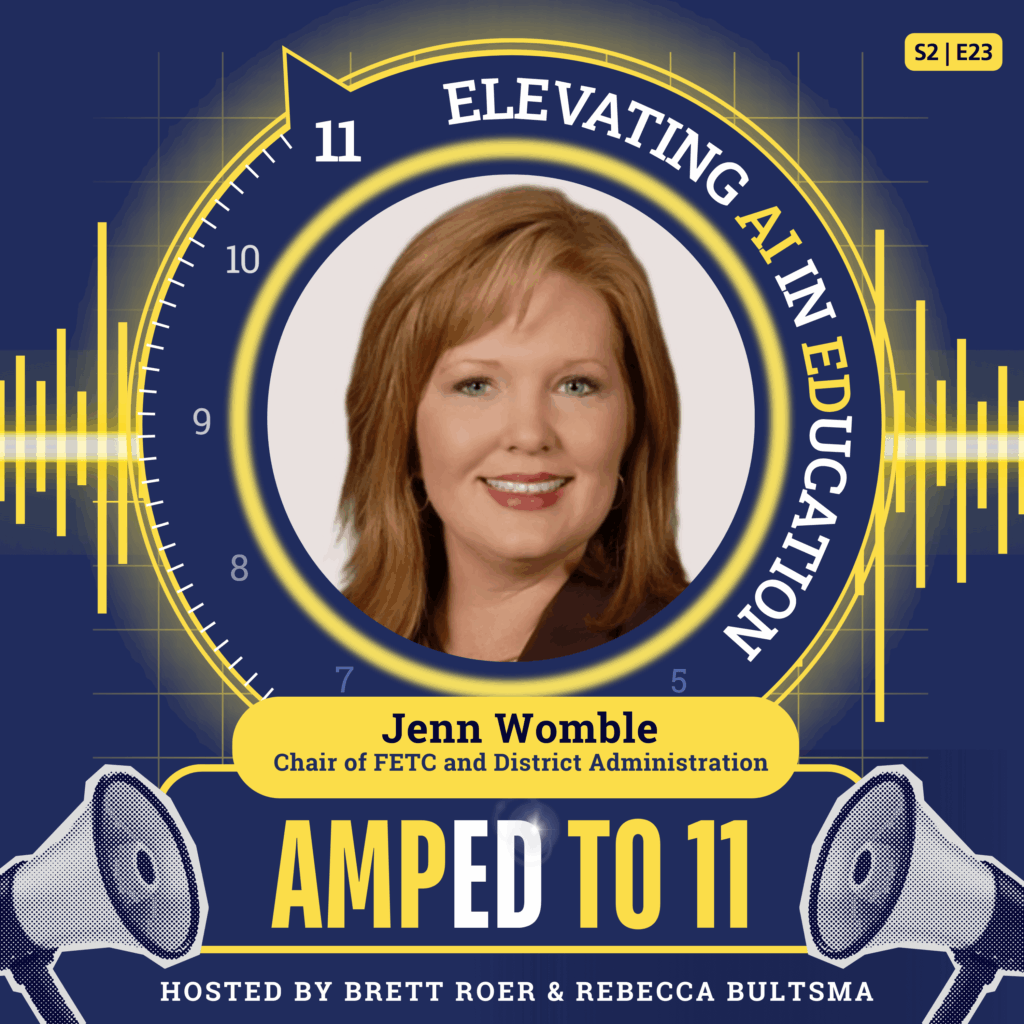
Jenn Womble: [00:00:00] I really feel for students right now who are not getting AI literacy training and they want it. They wanna know how to use AI. It’s their future, but they also are being sometimes, you know, told they’re breaking rules that they don’t know exist. Even though generative AI has been the market, while what schools have been able to do in leverage is still at the very, very beginning, the most important thing that you can learn when you leave high school is knowing how to learn something.
Jenn Womble: And I, I don’t think we actually teach that. We never even talked to teachers about how to teach people how to learn.
Brett Roer: Welcome everybody to the AmpED to 11 podcast. My name’s Brett Roer. I’m joined by the amazing Rebecca Bultsma. How you doing up there, Rebecca?
Rebecca Bultsma: Living the dream. Living the dream. I’m having the best day. It’s Friday, at least today. Probably not when the podcast released, but I’m just happy to be here.
Brett Roer: Well, if you hear that energy in Rebecca’s voice, it is ’cause we have just spent a few minutes with our guests and we are all AmpED to 11.
Brett Roer: Maybe AmpED to [00:01:00] 12 is the better term, but we are joined by the incredible energizing one of a kind, Jenn Womble, the chair of the Future of Education technology conference and data administration, which some of our audience members might know us. FETC. Jenn, it is an honor and a pleasure to have you on the AmpED to 11 podcast.
Brett Roer: How you doing today?
Jenn Womble: I’m super excited. We are gonna talk about some amazing things today with amazing people and it’s Friday for me too, so I have my FETC Friday hat on, so I’m happy to be here with you guys. Thanks for having me.
Rebecca Bultsma: Before we start, I just have to tell you that our last podcast episode, we had our guest, uh, tell us basically who their favorite human in the space was, doing great things, and it was Sabba and she said, without a doubt, top of the list 100%.
Rebecca Bultsma: It was you.
Jenn Womble: Oh, oh my gosh. Well that makes my heart very happy. Um, I actually adore Sabba and the work she’s doing is amazing to really [00:02:00] help school district leaders think about redesigning education, not just talking about ai, but what do we really need to redesign in this moment, which is a much bigger issue, and it’s really exciting.
Jenn Womble: So that just makes my heart so happy. Thank you.
Rebecca Bultsma: One of the things she said is that you had the most abundance mindset of anybody in her entire network that she knew anywhere. So I’m curious how, how you get that way, how you manifest that. What’s, what are you doing in your life and in your work that is making people see that about you?
Rebecca Bultsma: What’s your strategy for that abundance mindset?
Jenn Womble: It’s really interesting, like I will say, first of all, I don’t think there’s ever been a more exciting time to be in education. Like I loved, I was in a school district for, you know, 17 and a half years, but, and I’ve been out since 2010 doing this work, but I have never seen people as energized and excited from classroom [00:03:00] teachers trying new things to district administrators, really thinking about how to re-look at education with a new lens to tech companies who are developing exciting things.
Jenn Womble: And I think what excites me every day is like, first of all, I feel so fortunate to do something that I love, right? I am. Completely mission driven on improving education. So the fact that you get to wake up each morning and do something you love is just exciting and wonderful and optimistic. But then it’s also about connecting people in this space right now who are excited about the work.
Jenn Womble: Like this is a time, yes, there’s lots of challenges and, and there’s a lot of opportunities, but when you come together with people who are really excited and passionate about their work, there seems to be this little golden thread. And I think, you know, Brett and Rebecca, when we’re traveling and we see people at conferences, at meetings, there’s an education technology, there’s like a thread between all of us.
Jenn Womble: You walk into a room and there’s an instant connection that doesn’t happen in other industries because I think we [00:04:00] all are kind of on the same mission. You, we have something in common before we’ve even met. And so if I can find that in other people and really draw out what is your talent, what are you working on?
Jenn Womble: And connect us all together, I think it just makes our community better. So. I don’t know that I, on purpose think about abundance every day, but I definitely think about optimism and what is the path forward instead of kind of dwelling on the challenges.
Brett Roer: The other thing that Sabba, that stuck with me, right?
Brett Roer: We’re gonna keep talking good about you. She said if you could basically like put the energy of Jenn Womble, like an energy drink and we could all have that, like the world would be a better place. So one, let’s think about that. Let’s brand that the Jenn Womble energy drink, because we were talking earlier about supplements and like, yeah, if every, if I could hang out with people at every conference and just have a number of people with your energy and enthusiasm, it’d be even better.
Brett Roer: So hopefully we can figure that out.
Jenn Womble: It’s gonna be a raspberry Celsius with protein in out,
Brett Roer: with protein, with creatine, with all the supplements we talked about. A [00:05:00] one spot, how to be Jenn Womble. No other place to go. Let’s work on that. That’ll be our other thing. While we’re solving education, we’ll also solve fitness and energy.
Brett Roer: Yep. Let’s do it. Yeah, let’s do it. I’m all in. Yeah. Speaking of that, Jenn, you know, you gave us a little backstory, like we all know you as this. A credible force of nature who not only is at many events for great reasons, but also has this rich background in education, I believe mostly in the state of Florida.
Brett Roer: But can you share with our listeners, we love to hear the origin story really dive into like what is your why, your purpose, how did you transition within your life to the exact spot you are today? And also, even though they should know, let people know what is this FETC that you’re the chair of.
Jenn Womble: Absolutely. Okay, so this is, I’ll make this kind of quick. I actually just realized this through, um, some journaling lately that I, through my parents, kind of got the synergy for ed tech before I was even born kind of. And so what’s interesting is my dad actually was on the team that built the first [00:06:00] mainframe computer in Florida for the Department of State.
Jenn Womble: In the late 1960s while he was in college, that was his job, right? And so then went on to be, uh, build computer networks and, and be a race car driver and other amazing things. And then my mom was a teacher and she was a physical education teacher and went, went on to be a guidance counselor, didn’t retire until after 45 years in public schools.
Jenn Womble: So there was a synergy between them that as I was growing up, I didn’t even realize that that was kind of being infused, um, into what, how I was growing up. And I went to this amazing lab school. So universities have the opportunity to open a K 12 school and then they can conduct research in those schools.
Jenn Womble: So I went to a lab school kindergarten through 12. So I was always involved in research. So we don’t always realize that these impacts from growing up have such an influence on what you are passionate about and do. I actually thought I wanted to go and become a lawyer and do advocacy work for children, [00:07:00] but while I was in law school.
Jenn Womble: Completely accidentally. I got a job working as a substitute teacher, and that completely changed my perspective on being in the classroom. And I’m officially a law school dropout. Me and Daniel Pink can, uh, can claim that and then became a teacher. So I was a public school teacher, um, in an inner city school for eight years, which I loved.
Jenn Womble: And then also went on to be an AP teacher in a more suburb school. Did district training, did summer scoring, um, with ETS and college board. Got to know Intel very well, and was doing technology training for many years. My first presentation at FETC was in 1995, probably before y’all were born. And so, yes.
Jenn Womble: And so I, uh, got really involved with how do we better train people to teach the things that students need? And so that’s kind of been my mission all along. And so it’s particularly heightened right [00:08:00] now ’cause you guys probably know the stats on this, but 71% of teachers in the United States have not been trained on ai.
Jenn Womble: So that is definitely a huge mission of mine, is that that knowledge is power, and we need to help educators understand how to leverage tools in order to better educate our future. So that, that’s really my passion. So since 2010, I have been the chair of FETC. Um, this is our, my 15th year in this role. So I’m very excited that we are on a mission to provide professional development and training for educators and district leaders.
Jenn Womble: So at FETC, we are every January. Um, and so people are always like, why January? Well, it’s actually because of the funding cycle. So as you guys might know, in public school districts, every single superintendent and board has to bring the draft of their budget to their board each February. Then they have the spring to build.
Jenn Womble: That budget goes into effect July one, to [00:09:00] July one of the next year. So we’ve got 450 companies that come on our show floor telling their latest products, their updates, their training staff, administrators, all, what is the latest technology that could be used to really help your student outcome? We want superintendents and district leaders to see all of those tools so that before they build that budget, they have in their mind a vision for what can happen in the next year.
Jenn Womble: So that’s our timing. So every January, so next January, 11th through 14th, always in Orlando, we just signed the contract for 2037. That sounds far away, right? So we, we pick Orlando on purpose, international Airport, great facility. It’s a gorgeous white building with light, um, but also great hotels and and place to be.
Jenn Womble: So FETC has become my home base. I’m very fortunate for that. But, um, that’s kind of how I’ve traveled into this space and I feel very fortunate.
Rebecca Bultsma: Such a good story. I love it. I loved finding out how we all ended up in the [00:10:00] places we are and our paths crossing together. I’m gonna start with a kind of a softball question.
Rebecca Bultsma: It’s actually one of my favorites we haven’t used in a while. Uh, but one of our favorite. AI tools here at the show is 11 labs. You know, we’re AmpED to 11. We like 11 labs, and I just noticed this week they have added some new voices. They do realistic voices that read you anything. My personal favorite is Bert Reynolds.
Rebecca Bultsma: He reads me all my academic research.
Jenn Womble: FSU grad, where I live.
Rebecca Bultsma: Yeah. Yes. They just added Matthew McConaughey and they just added Sir Michael Kane. Uh, so they have all these voices, but the question for you is not going by any of those, but if you could have somebody’s voice read you everything for the rest of your life, whose voice would you pick?
Rebecca Bultsma: Who is your favorite and why?
Jenn Womble: Hmm. All right. All right. All right. That’s a hard one. Um, so I would say, gosh, there’s so many voices we love. I love the like, deep baritone of like the Morgan Freeman’s of the world. [00:11:00] Um, but every day I’m gonna say, oh, here’s one. I don’t know if you’ve ever had this one. Um, Viola Davis.
Jenn Womble: I love her voice. It’s like clear. She’s got clarity, she’s clear. She’s always, I feel like she’s mission driven. Like don’t you feel like she’s kind of commanding and I feel like hearing her voice would be like, get it done. Like I feel like in the different roles that she’s been in as an actress, but also I know she does advocacy work.
Jenn Womble: But I love, I love a deep voice. I love a, um, like a, it has a lot of clarity and commanding. But yeah, I’m gonna go with Viola Davis and also Woman Power. Yeah, that’s a good one.
Rebecca Bultsma: We haven’t had that one yet, so I like it.
Jenn Womble: But Matthew McConaughey, listen. Yeah. Have you ever listened to his Calm at Night? The bedtime stories?
Jenn Womble: No, that’s some good stuff right there. He does the calm bed nights, the stories that you can listen to on the app. Yeah, he’s good there. So I already feel like I have him in my life.
Rebecca Bultsma: Perfect. We’ll mix it up a bit. [00:12:00] Alright, well, let’s, I wanna transition now into something that, that I talk about. I, I’m an AI ethics researcher.
Rebecca Bultsma: I think about AI ethics, and I talk a lot about it in the education space, and there’s been a lot of research that has come out. You know, Microsoft just recently released another report about education. Google has. I’m just curious, in your opinion, what are the kind of moral, ethical questions that you’re hearing people in education ask about this technology?
Rebecca Bultsma: What are your questions about it and what are you telling people they should be thinking about in this space? Connected to ai.
Jenn Womble: Absolutely. And I love that we’re starting this because I think this is the point that we have to start at. It’s pivotal to everything that we’re doing because we’re using a technology that we’re not controlling, which is another interesting thing in education, uh, to think about.
Jenn Womble: So I really believe that we do have to train every teacher because that knowledge is power. And we really need to be training every [00:13:00] student on AI fluency and literacy, because they’re gonna be voting on and making some decisions about very serious issues with AI in the future, in their lifetime. AI will have the power to do much more than it’s doing now, right?
Jenn Womble: AI is the worst we’re ever gonna have. It’s only gonna get bigger and stronger from here. And there’s some serious ethical issues that we’re already confronting. We’re already confronting, you know. Is this real? And we, we didn’t do as good of a job with digital literacy as we should have in the past. I think a lot of educators and administrators will agree we should have been doing a much better job teaching skepticism, teaching you to question everything you see, understanding that everything you see is not real.
Jenn Womble: I mean, that has become a huge issue, not just among our students, but among our elderly. Um, we definitely have a knowledge gap when it comes to understanding what’s real and what’s not real. And I think that’s making a major play. It’s, uh, the videos that are coming out right now, this is a really serious, I just had this at [00:14:00] Halloween.
Jenn Womble: You guys all gotten, these, people were sending me the, the dms of this. Hilarious group of elderly folks in a home with their Halloween costumes. And one gentleman had on, um, a belt with a, a bunch of watches, and he was wasting time. They were all dressed up as idioms. Well, I actually looked at the site and I was like, oh my God, I want my mom to live in this place.
Jenn Womble: It’s amazing. All these people are having fun. It ended up the entire site, the name of that home, that nursing home was all fake. It was, this is what we want. Nursing homes to look like, but it is the, every single video was fake. Every single person, every single thing. And I’m like, I had been sent that video 30 or 40 times by different people who thought they were hilarious.
Jenn Womble: And I went back to them. I said, did you guys know this is all fake? It’s all AI generated video. These are not real people. And not one of them had done that. Digging into the site, digging into the Instagram and finding out. So, you know, we are often clearly fooled, whether it’s from pleasure or [00:15:00] education, work by things that are not real.
Jenn Womble: So if we don’t have serious deep conversations about skepticism and sourcing, um, you know, other countries are doing this, copywriting your own face, owning your own persona is happening in other countries. But we need to empower students and educators with this knowledge so they can. Play it forward because these are, there’s some very serious ethical issues, especially in the bio world.
Jenn Womble: What we are gonna be able to do as we start to take some of these AI features and enable them into different biological systems in the future, this is gonna be, have some major ethical implications. So this is a conversation that has to happen first in a district before. I think one of the things I just, uh, saw yesterday and.
Jenn Womble: Another report was that only 10% of school districts have a policy, like only 27%, 27 states have even passed AI policy and guidelines, but only 10% of school districts. So p we, but we know, what is it? You guys have said like [00:16:00] 80 or 90% of teachers have used something. So I’m like, there’s a huge disconnect between setting guide guidance and policy around, and ethics is the number one in part of that.
Jenn Womble: And, and then actual usage. And so what’s terrifying for me, I both my sons are in college, is being accused of cheating, right? Um, if there’s no academic integrity guidelines, it’s not fair for students. They don’t know if using AI is okay or not okay. When is it okay? And not okay? When is a district employing rules and not rules?
Jenn Womble: So a lot of ’em are saying, oh, we’re just using acceptable use policies, but that’s not enough. And, you know, I, I really feel for students right now who are not getting AI literacy training and they want it, they wanna know how to use ai. It’s their future, but they also are being, ’cause sometimes, you know, told, they’re breaking rules that they don’t know exist.
Jenn Womble: So if we don’t have this ethics conversation in every single district with your leadership, then you’re really behind the ball right now. And, and that’s the one thing I [00:17:00] hope every district will do first is have the ethics conversation.
Rebecca Bultsma: And it’s, it’s a tough one. You brought up a couple of things that are top of mind for me.
Rebecca Bultsma: My whole, like wall in front of me is actually, um, research I’m doing on ethical and epistemic leadership in the age of sympathetic, pathetic reality, specifically deep fakes and how leaders have to now add that new layer into not like, is this who’s right in this situation? Who screwed up Now this whole new layer of, is this real?
Rebecca Bultsma: Did it happen? And this idea of questioning everything from the onset. But you bring up something really interesting about the academic integrity piece because that. New Microsoft, um, AI and education report that just came out. I just read it and the top concern of educators and education leaders is academic integrity.
Rebecca Bultsma: The number one concern far away from students is being accused of cheating when they didn’t. And so it’s this disconnect because the truth is with deep fakes and with the, um, kids using AI to [00:18:00] do stuff for them, there’s no way to prove it. We will never know for sure about either of those things. And so how do we move forward and exist in a world where truth maybe cannot be established?
Rebecca Bultsma: And what does that do to kind of. How we think about truth and how do you even write rules about something like that? So you’re right, it’s gonna take a re-imagining for sure.
Jenn Womble: Clarity is the most important thing. I mean, students want that clarity. They wanna know what the rules are, they wanna know what the outline is, they wanna know what the structure is.
Jenn Womble: I mean, students will rise to meet whatever your expectations are, but right now, not enough teachers or districts are even telling them what they expect and they don’t, ’cause they haven’t even kind of decided that either. So we really need that clarity coming from the. The leadership in this group. So I’m excited to see that work that you’re doing.
Jenn Womble: But yeah, we’re hearing the same thing about that, you know, what’s happening there. And then the other thing is, is what is true learning look like and what does assessment look like? And until we have [00:19:00] some serious conversations about assessment and redesigning evidence for learning, you, if you’re using a multiple choice test, yes, chat, GBT can give you all the answers.
Jenn Womble: But if you’re asking a student to analyze and then create a video based on their personal reflections and analysis, that’s way different. So we, but we haven’t trained teachers to look. Create other forms of assessment. So we’ve got, that’s where we got training too. We need teachers to understand what is evidence of learning look like.
Jenn Womble: That’s not, you know, just a, a standardized test. So we’ve got some work on that end too. But that assessment piece is definitely top of mind. Um, and what does learning look like and what should it be? But I hope that creating a culture of skepticism also creates a culture of curiosity because that those two things would go hand in hand and that would really engage students.
Jenn Womble: ’cause then they can start thinking about things they’re curious about and being more skeptical at the same time, which I think would, would more engage our students than [00:20:00] just seeing a black and white, here’s what the rule is.
Brett Roer: Mm-hmm. You know, uh, something I learned from Rebecca and some of the work we’ve done around the country, especially out in California, was this appreciative inquiry approach.
Brett Roer: And one of the things I now push, you know, I just recently this week inter interviewed some students and I posted on LinkedIn, like basically my, my headline is, any school, if you’re designing a new AI vision or framework without student voice at the center, you’re already behind. Like that’s the foundation.
Brett Roer: So like one kid said like, I use AI when I’m exhausted ’cause it’s not cheating to me. That’s survival. Or like, I feel I lose credibility if I text or email when I use ai. Not knowing that’s a way, as Rebecca just said, to actually validate the use of ai. So it was like so interesting and that’s how we’re building blueprints in many districts across the nation.
Brett Roer: But what you just said as a former practitioner. What I’ve been having these open conversations is especially around AI skepticism, which I’m open to. It’s like, but what now? One of the things I do quite often is I’m like, well, tell me an assignment you’re, you want students to do. [00:21:00] If AI didn’t exist, let’s say it was last year’s assignment, and then we actually go down the deep dive of great, but now AI does exist, so like which part of this exact assignment in the whole cycle of a student, whatever the process is, would you be open to them using AI to make the assignment more engaging for them?
Brett Roer: Which parts would you say there’s absolutely, using AI would be a detriment to their learning and mastery of a skill, but the biggest question I like to ask them is why? Because a lot of us aren’t doing that where it’s like, so I just actually was in a, I was in a school yesterday, an elementary school in the Bronx, and I was with this principal and I said, look, my son, my daughter, they’re still learning foundational mathematical skills, right?
Brett Roer: They’re in kindergarten and third grade. So I said like, if my daughter was trying to learn what six minus two is, I want her to make sure she’s doing that without any other tool. She needs to understand and conceptualize that. Then if I said though, but imagine if like her favorite thing was basketball or baseball or soccer.
Brett Roer: Could we use AI to make a really cool story about the mathematical functions of six minus two? And it could create like a whole [00:22:00] story for her to read and learn about like how six minus two, how the skill applies in the story she’s interested in. That’s a great use of it as an extension. And I could just listen to her and we could make that story and she’d wanna learn that’s reading skills now applying math in reading word problems.
Brett Roer: She was like, yes, okay. She’s like, that’s a good point. I never thought of it like that. I’m like, right, the the foundational skill of math. Great. We’re not doing a great job as a country on it, so we might need to improve it, but let’s also make it engaging when the AI tool is now a supplement and an enhancement to the foundational skills need.
Brett Roer: How are you grappling with that, Jenn, when you meet that healthy, and again, rightfully so, skepticism. ’cause they’re not understanding some of the applications of it and the fear.
Jenn Womble: Yeah, I think you’re exactly right. I think you started out with the right places that most students are using it for efficiency.
Jenn Womble: So I know my kids, when they were in high school, they would’ve looked for these not as shortcuts, but as ways to be more efficient. ’cause they had so much content to have to do every day. So I don’t think most students who are using it, you know, [00:23:00] AI is a part of their life. They’re, they’re seeing it in Fortnite and TikTok and all these other places, right?
Jenn Womble: So they see it as just another tool and it is for efficiency. But I think, and I would be interested, Rebecca, I think that Microsoft report also pointed out that the, one of the number one uses students are using it for is for clarity of instruction and for brainstorming. So I thought that was super in interesting because.
Jenn Womble: As a teacher, I can’t repeat the instructions 35 times, even though that would be better differentiated instruction. But I think what’s happening is students don’t interpret verbal directions all the same way. So a lot of them need, okay, well how exactly do I do this assignment? Like they need that personalization, which is really a powerful tool for ai.
Jenn Womble: And then for brainstorming, like, how do I get started? Like giving them that confidence to get started on something. And those are ways that when somebody incorporates that into any kind of redoing assignment or project-based learning, that is a okay source to say, let’s have a [00:24:00] brainstorming partner.
Jenn Womble: ’cause we’re teaching them to verbalize their thoughts. And I think that level of metacognition. In employing AI is the right place for us to go. Um, and definitely we know the power of when they’re talking out loud that how good that is for their brain and for spacing practice. But we definitely need them to be able to feel comfortable brainstorming with a different type of tool to give them other perspectives.
Jenn Womble: A lot of students don’t have the correct or the appropriate background knowledge ’cause they haven’t had life experiences. So this is actually a way to improve the equity in your classroom by letting people just brainstorm with ai. Like that is literally the easiest starting point I think. But even when it gives you output.
Jenn Womble: That’s when you need to be skeptical. ’cause sometimes even the output in brainstorming, it doesn’t have accuracies in there, you know? And so that’s where we can start building in the ethical piece with such a foundational skill as just brainstorming. So I love that work that you’re doing with them to think through a lesson and where [00:25:00] it’s appropriate.
Jenn Womble: I think also as being a feedback tool is really helpful. So, I mean, I work remote now and one of the things I desperately always want is more feedback. But I can ask ai, okay, here’s a, here’s something I’m writing. Gimme some feedback. I’ll practice a presentation and gimme feedback. I’ll practice a presentation to my board members and gimme feedback.
Jenn Womble: So being able, especially students who are at home by themselves after school, um, or don’t have that kind of at home support, they now have a tool to get feedback to help them improve they never had before. So I think in brainstorming and in feedback are two ways we could be leveraging ai that would really help in lesson building.
Jenn Womble: And then are also a little less intimidating.
Rebecca Bultsma: Interesting. As I sit in this unique place where I’m a student right now too. Yeah. And then teaching people about ai and when I reflect even yesterday on how I was using it, I have this intervention design I’m building and I’m interpreting it in a certain way, but again, using it for [00:26:00] clarification.
Rebecca Bultsma: Here’s the assignment. I’m thinking about approaching it this way, but doing it this way. Um, do you feel like that fits within the confines? Things that. 30 people might have to bother the teacher for clarification on or seeing it a different way or even verbalizing that metacognition and then ideating and building rubrics on your own to test your, um, assignment or your thinking, you know, to give, help kids think through that, beginning with the end in mind, potentially.
Rebecca Bultsma: There’s so many possibilities. I love that. One of the things that Brett mentioned, something that’s close to my heart and that I employ in my everyday life is this appreciative inquiry method, which is a research method that I like to apply to districts building AI policies. And it’s essentially just based on like a.
Rebecca Bultsma: Co-creation, collaborative process that basically starts from a place of optimism and appreciation where you ask parents and teachers and students, um, what’s going well? What do we love about our school? What’s working, what’s going great? [00:27:00] And how, what is our dream together collectively for the future? If this all goes right, how can we build this together?
Rebecca Bultsma: And like, what is the destiny of this? You know, if, if, what’s the ideal vision? So my question for you, just in the theme of that, is what’s going well? What’s working that you’re seeing everywhere in schools from a place of, of optimism and, and appreciative inquiry? What do you love about what you, you’re seeing in AI and education and what’s working?
Jenn Womble: Yeah, that’s really interesting. And I do, I love this coming from this perspective. I think Marlon Styles does a great job of this, and I know he’s working with Neil Gupta’s district and hosting coffee conversations and they’re saying like, what do we want this district to look like? So, um, that’s really kind of an exciting approach to take.
Jenn Womble: I think there’s probably, um, well, number one, I think it’s an exciting time to see what teachers are bringing back creativity to pedagogy. I think. Now that they’re learning more about the capabilities of ai, people are starting to [00:28:00] rethink the pedagogy in their own classroom. They’re having to rethink assessment, right?
Jenn Womble: They’re having to rethink these things. But I think that creative spark is come back to a lot of teachers, like, Ooh, this tool can do this. Or instead of grading, you know, 50 essays tonight, I’ll use the AI feedback, but then I can use that to design like a really engaging lesson tomorrow or rethink about how I’m doing collaborative teaching and then what the groups look like, or they’re actually getting to spend more time on the human part, which many people went into education for in the first place.
Jenn Womble: So I think the spark of creativity in teachers would be one answer. Um, the other piece that I’m seeing that. Just lighting my fire is the work of CTE directors in this country. So what a lot of you know, parents have told us is we want kids to have these durable skills. We want ’em to have outcomes, we want ’em to have business ready, which AI is now the number one sought out tool on, you know, on LinkedIn among all things we see six times, the people are adding AI as a skill on there, right?
Jenn Womble: So. [00:29:00] In CTE districts around this country, they are doing amazing work helping students learn professional skills and they’re not all what we thought they were. Okay. So yes, there’s automotive and cosmetology, but they’re also creating, there are school districts where every kid has Cisco certification when they graduate, they’re getting real life certifications, they’re having real life opportunities.
Jenn Womble: They’re talking to students as young professionals and calling them young professionals instead of students. They’re talking to them about how to work in the business world and give them kind of the skills base that’s really helping them to develop a positive confidence. So kids that leave high school and ready to enter the world with confidence.
Jenn Womble: And I think that’s something that parents are kind of yearning for. We’ve seen parents not be as happy in the past couple of years with, with what’s been happening in public education, but there are a lot of these sparks of hope in these CTE, which have. Long waiting list to get in. I mean, Dallas, ISD just built their fourth building for [00:30:00] CTE centers.
Jenn Womble: Like they are so popular and growing, and I think it’s the mindset of these groups that you are preparing for something that’s next and exciting and you feel confident about it and that. Not just one single track, like not putting kids in a single track, but saying you have skills that are adaptable and no matter what is coming forward, ’cause none of us are gonna probably be in the same careers in the future, but you have some adaptable skills.
Jenn Womble: You understand the business world, you understand the working world and that level of confidence and students is really exciting. And I just, um, went and visited, uh, KIPP Glaser School in Mountain View, California, and her students actually wrote their AI policy and built a tool in AI to create policy for other school districts.
Jenn Womble: And they were a part of, you know, the student voice in there. And she created an internship program for her kids in that school who didn’t have access to tech companies and didn’t have access to, you know, knowing the right people and [00:31:00] everything. So internally principals are building these kind of opportunities for students to help shape their experience, not just the content they’re learning, but those skills that we want them to go out into the world and have the confidence to employ AI no matter what you’re doing, no matter what, where you are now, if you are a plumber, you are using AI to have a better route among your employees, right?
Jenn Womble: You have to use Outlook to do scheduling. Like it doesn’t matter what field you go into, you need tech skills. But I rethinking that is actually really has been really exciting for me. I don’t know. That’s just a few areas. My other favorite one right now, oh, I am digging some immersive learning. What is happening in the VR space right now is lighting up what kids know and the research that’s coming behind that.
Jenn Womble: Kids learn six times faster. They’re retaining skills, they get more practice, and it’s done in community. So all the students are in the VR headsets together. [00:32:00] Um, that’s a place I, I personally think immersive is the future. So that’s, that’s, uh, the other part, I would say is super exciting for me right now.
Brett Roer: Yeah. I just wanna highlight, you know, uh, Rebecca and I were fortunate last year at the A-S-U-G-S-V Summit. We got to interview kip. Er and some of the students, that was the most, one of the most exciting parts. They were incredible. And a lot of students have presented at some of our AI summits, especially when we had up in Albany.
Brett Roer: They, I think were the MVPs. And that’s hard when Rebecca’s one of the speakers, Alana’s one of the speakers, Mike Yates, and yet I think those kids, you know, we’re all, we all would say, took the show. So student voice definitely is at the heart of what we’re doing. We’re also doing a lot of work, and this could be, you know, something you do across Florida.
Brett Roer: We’re interviewing students across whole states and saying, what does it mean to grow up in the age of ai? So we’re doing those projects here in New York. We’re doing those in Indiana, Ohio. Because again, what’s so interesting is you mentioned is like the social etiquette aspects that’s not being talked about.
Brett Roer: I actually was just meeting today with AI for a day and I [00:33:00] brought up that use case and they were like, well, we actually have a whole curriculum about that, about how students can navigate the social etiquette of AI use and AI literacy in their, uh, in their day-to-day life. And I was like. I wanna ex, uh, AmpEDlify and elevate that ’cause it’s a free resource.
Brett Roer: So I wanna shout them out because that’s incredible. And students, no one is teaching that as part of the actual skills on the day-to-day level in classrooms. So the student piece is so crucial to getting that AI literacy right, because as you said, they’re ready to tie it to their future of their future goals and career readiness if we just empower them.
Brett Roer: So thank you for that.
Jenn Womble: Yeah, it’s super, it is. What an exciting time to have all these different tools. And the problem is schools are trying things like, just like you said, like, oh, I didn’t even know that existed. The challenge I see right now is how do we scale all these great ideas, like places that are doing really cool work and are finding these amazing student outcomes.
Jenn Womble: How do we take that and you know, and the great work you guys are doing on this podcast, but how do we elevate and how do we [00:34:00] scale so that other districts are aware? Because a lot of district leaders are really passionate about trying to employ ai. They just don’t know all the great stories that are out there and they don’t have all those connections.
Jenn Womble: So we’re working hard to scale those stories at FETC and you know, year round through webinars and things. But I think we have to really think about how do we scale great ideas happening in districts to help other districts know this story, because that would be really powerful and impact more students.
Jenn Womble: Right. More of the students you’re talking about.
Brett Roer: One thing we’re doing, and you know, feel free to, as we know, inspire one another. I hate when people say steal from us. Like we’re all here to help the kid. One thing we’re doing out in, uh, Indiana next month in December is we’re working with 85 school districts and three ESC executive directors.
Brett Roer: And we are launching a model innovation with, uh, Aaron Black out at, uh, Liberty Perry and with Pat Haney and two other ESC exec directors. And we are building a model AI playbook advisory committee. And instead of having keynote speakers, those, those AI advisory [00:35:00] committees, the playbook committees are going to be our keynote panel.
Brett Roer: So every single superintendent, teacher, educators listening to a student, a teacher, a building leader, a district leader and a parent, explain what did we ask them? And then we take all that survey data and that’s what’s behind them. Like, here’s what students in Liberty Perry are saying, here’s what educators are saying, here’s how that’s informing their playbook.
Brett Roer: Because if you can see it. In a local district, you can believe it. We’re doing that in Ohio, Indiana. And I think that’s a great way to one, highlight student voice and give everyone, not only just a playbook, but like they’re a month ahead of you, but they will be with you every step of the way. And so we’re really excited about that.
Brett Roer: Kind of like visionary. Put the kids on the stage and show everyone, this is not difficult, but you do need to open up time to listen to them and gather that wisdom in whatever tool. And AI can take all those surveys, take all that wisdom and help you build your playbook.
Jenn Womble: I love that idea of a playbook.
Jenn Womble: That is because, you know, districts are [00:36:00] trying to build a strategy and they have this long planning cycle and the long budget cycle, but they need that playbook and we’re still fresh. This is still very new. I mean, even though generative AI has been the market a while, what schools have been able to do in leverage is still at the very, very beginning.
Jenn Womble: I mean, we’re still really young in that process, so being able to see what is working, you know, what works and all, every district would be really powerful and that that playbook could be a really great tool to use moving forward.
Brett Roer: Well, we are, we are in multiple states, and we’re happy to be in more because once people see that and they just listen to kids.
Brett Roer: We had a superintendent here in New York, he literally said, that was the most insightful conversation. I’ve been a fly on a wall for. It cost us two pizzas for 10 kids and 45 minutes in a, in a nice, in a nice, uh, you know, conference room. He just said, that’s the most insights. It didn’t take much. It just let them listen, let us listen and them talking.
Brett Roer: Sometimes bringing in that outsider perspective allows people to let their guard down, but the soup was still in the room and kids were very honest. So it’s [00:37:00] about empowering the students and let the rest fall from there. I’ve never been afraid to do this before, but as you know, you listen to every episode on the AmpED to 11 podcast.
Brett Roer: We hand over the reigns of this podcast to our guests. This hasn’t gone wrong yet, but Jenn Womble, you are now officially the host of the AmpED to 11 podcast. And Rebecca and I are your guests, and you get to ask us one burning question that you would like us to answer. Now we are in the hot seat. We’re turning it over to you.
Jenn Womble: Hmm. Oh my goodness. There’s so many things I could ask here that would be really interesting. Okay, I’m gonna go, I’m gonna stick with the education perspective. I’m gonna say if you could teach a class, like a master class, like when you’re on the airplane and you can watch master classes about any subject, but it can’t be your work, it can’t be something you work on if it’s like your passion project or something.
Jenn Womble: If you could teach any class to anybody based on your passion, what class would you teach?
Rebecca Bultsma: So not like AI kind of [00:38:00] related something outside of Yeah, just
Jenn Womble: give me whatever your, your day-to-day work is. I mean, I’m just setting, I’m just making up parameters as we go here. But like, if it was your, your passion, like what kind of class would you be the masterclass teacher of?
Rebecca Bultsma: I would teach because my background before this was, um, communications and public relations. I would teach like oral and verbal communication skills because I think that will be so important. And I think we kind of have, um, pushed that to the side for this most recent generation. As someone who has kids in college too, I think we’re gonna head back to a more oral based kind of Socratic society where that’s gonna matter more.
Rebecca Bultsma: ’cause the only way you’re gonna know you’re talking to a real person is. Talking to a real person. So I would teach something based on some of those really effective interpersonal communication skills, because I think that’s super important and I think that then will translate over to ai because the better you are at communicating your ideas and what you want, obviously in real life, that’s probably why I ended up being good at [00:39:00] ai.
Rebecca Bultsma: The better you are interacting with a model potentially, but also, uh, that relationality piece. So that’s what I’m,
Jenn Womble: I, sign me up. I would definitely take that. I would sign up all my speakers too, because what, I mean, we have 700 speakers at FETC, but a lot of times they need coaching on how to speak publicly, how to make sure their presentations are assigned are appropriate for all accessibility.
Jenn Womble: So like there’s a lot of things you could uncover there, and then they could practice with an AI coach too. So we could kind of get that in there. But I would sign everybody up for that class. I, I a hundred percent agree the human superpowers communication. I love it. All right. Brett, what am I signing up for you?
Brett Roer: I think it’s the other side of what Rebecca just said, which is. Again, this is applicable. I think as a parent, an educator, a professional, I find that most people, the art of listening, um, and learning how to react in conversations is maybe the other side of, you know, what the other side of the coin of what Rebecca just mentioned.
Brett Roer: So I find that, like [00:40:00] whoever I’m talking to in conversations, I often try to think, are they sharing a problem with me because they’d actually like support or they just need me to listen And first I analyze like what’s their real need? And so if it’s like they just want to be heard, that kind of allows me to just be a, uh, absorbing of what is going on in their lives.
Brett Roer: If they ever want it to be more of like, I’m stuck, can you help me? I try to analyze that and I try to probe them in that direction because I find that, like with my children, that’s a really useful skill with adults in my life who are just friends. People have reached out to me, and this is not about ai, but when they’re like they want life advice.
Brett Roer: Like someone called me today and was like, this is what I’m thinking. And I realized like, oh, they just like first need to share like this thing that happened that they’re not happy about, but then they actually are looking for advice once they get that other system. Okay, great. So I find that really is applicable to all ages and all groups and especially I will bring it back to education.
Brett Roer: I find if [00:41:00] educators just could like ground themselves in that and realize like many times you’re actually not on the attack, you’re not looking to be attacked or people aren’t looking to attack you. They are looking to help you and vice versa. Like most students are not there to hurt you. They’re there to, they want you to help them, but if you can’t like get to that level and slow down a second, it’s really hard to know what’s the first best step to keep that going.
Jenn Womble: You know, that’s so powerful ’cause anybody who’s been a district administrator or principal, we can tell you, most parents just wanna be heard. Like when they come in your office, they just wanna be heard so that the science of listening is so powerful. And I would definitely take your class because Brett, you have a superpower of listening to people and then connecting them to the right other people.
Jenn Womble: Because it’s not just your power of listening, but you then connect people to other people who can solve problems and help people, you know, Amplify their voice. So that is definitely your superpower. So I am signing up for both communicating and for listening. These would be like amazing classes and I think that’s requires another [00:42:00] business plan for you to write.
Rebecca Bultsma: Jenn, what would yours be? I’m so curious. Oh gosh.
Jenn Womble: You know what’s crazy? I was thinking about this. So I am a total nerd when it comes to neuroscience and understanding like how the brain learns. And I actually taught AP psychology for 10 years, and I, I would love to, um, to teach a masterclass on how to learn and how to teach people how to learn, because I think what’s happening right now in our society is that the most important thing that you can learn when you leave high school is knowing how to learn something.
Jenn Womble: And I, I don’t think we actually teach that. We never even talked to teachers about. How to teach people how to learn. We talked about what the content is and how to master the pedagogy of small groups and parent share and shoulders and assessment. But we don’t really talk about, like as adults now, we’ve all had to learn, we’ve all learned AI a after school, like after we are done with our education.
Jenn Womble: So how do you continuously learn as an adult new things and change? Like I, I think [00:43:00] Brett, your reflection as a parent really, um, honed it in for me because when the kids were little, it was like we had to learn everything about how to sign up for baseball and how to do boy scouts and how to do this. And then you learn how do you apply for college and how do you do this?
Jenn Womble: And you gain all this knowledge, this crystallized intelligence throughout your life. But you have to constantly be open to learning how to learn. So I would love to look at the brain science of how our brain works, which is all new right now, that we’re learning such incredible things about how our brains work and then how, and teaching people how to learn and how to constantly be lifelong learners.
Jenn Womble: ’cause honestly, I think that’s the most fun thing to do.
Brett Roer: Can we add a second? I have two master courses that I wanna make addendum, so after we get everyone else list, let’s, let’s do it. Okay. There’s two other ones. Yes. And teaching people the power of Yes. And even if it’s Yes. And, and you’re still not grieving, but like keeping a positive dialogue going even when you disagree with people.
Brett Roer: So maybe yes end’s not the right overall term, but it’s the right mindset. [00:44:00] And the other one is, yeah, but still. So yes and, and yeah, but still. So yes. End is like if you are vibing, like we were today talking about supplements, vitamins, health, travel, like that’s, yes. So when you know the vibe is yes. End, like don’t be the person who kills that Yes.
Brett Roer: End vibe. Right? Whether it’s collaborative or social. Some people just can’t do it. Like they can’t see that like, uh, we all need to be like, okay, we all speak for a minute. And like if someone starts telling a five minute story, everyone is out. Like read the vibe. But the other one is, yeah, but still. So this is my favorite trick I learned as an administrator in Queens, New York.
Brett Roer: Parents wanna be. But they also sometimes want you to do something about it. And the second I realize it doesn’t matter if I present to you the actual solution and why it can’t work and you’re gonna keep pushing me. All I need to do is get you to say, yeah, but still. And that proves to me, you recognize there’s not an actual solution.
Brett Roer: You just are upset and want someone to change something that’s impossible to change. So those are two master courses I would teach people.
Jenn Womble: Isn’t that amazing? But [00:45:00] listen, you know what’s really interesting here? I actually personally feel like there’s a leadership void in America. There’s not enough people going into principalships and going into superintendents.
Jenn Womble: Last summer, for the first time ever, we had two superintendency open with no applicants. So I would love for there to be more leadership courses on being great leaders in schools. I mean, it’s the most important role that we, you know, you could have. And so we need to inspire people with this, you know, optimism that you have about how to become a great school leader and a district leader.
Jenn Womble: Think about how many lives you’d impact that way. So I think that would be a great course for, you know, people who are beco up and coming leaders.
Rebecca Bultsma: I think Brett would, that would be his area of strength. I think we can all agree one of his greatest strengths is that social and emotional intelligence, right?
Rebecca Bultsma: He just has a way of making everyone around him feel, heard and want to be better. So yeah, I think that’s, and this is why
Jenn Womble: our community is so strong. Like I am the biggest believer in building community. And honestly, look at [00:46:00] what AI has done for us. Like AI has brought us together to have a more human connection, to build a stronger human con, you know, connectivity, to be more creative.
Jenn Womble: I mean, we’ve come up with new ideas on just this quick little call that I might have done all week. So, I mean, I love the fact that AI is actually making human capacity stronger.
Rebecca Bultsma: And if you think about where we all are on a map, like I’m way over in Western Canada and New York and Florida and it’s brought us all together.
Rebecca Bultsma: It just shows the power of this technology to actually bring people together from all different backgrounds and walks of life and, and parts of the country.
Jenn Womble: Yeah, I think that’s the best part of AI right now. It’s actually cre. I’ve had more powerful conversations about student learning, about teaching, um, about leadership in this last year, and it’s all been, the result of AI has kind of sparked these conversations.
Jenn Womble: So I mean, I think that’s why I am very optimistic that education is going nowhere but forward because we’re having these conversations and that will lead to change. I think the [00:47:00] future is really bright for these students. It’s taking us some time to get there, but this has been the spark that we needed to have these conversations at this time.
Brett Roer: Yeah, I. One thing that you’ve done a, it’s a tremendous job of today already doing so, and this is, I think, your superpower, right? So one, you’re able to see the field. Something you’ve said that I wanna make sure everyone hears. If you’re someone like Jenn who, um, has the ability to put people on stages or to Amplify voices, something I heard Jenn say once she goes to conferences outside of her own, she has a full schedule.
Brett Roer: And I was like, well, what do you look for? And you goes, she’s like, I wanna make sure before I ever put someone on an FETC like main platform or stage that I’ve seen them keynote or speak at a high level because I need to feel that they’re at ready for, you know, the audience that I bring there. So that keeps the quality really high.
Brett Roer: But you’re great at finding those people and raising and Amplifying their voices. So our final question for you, and you can take as long as you want, you can take pauses, we’ll edit ’em out. We like to give [00:48:00] flowers, we like to talk good behind people’s. Back here at the AmpED to 11 podcast, who are some people.
Brett Roer: Everyone needs to know, maybe they’re up and coming. People who’ll be at FETC. Maybe they’re just people that you’ve seen forever, that other people need to know about. Talk, talk really great about whoever you want to and why they’re amazing people in your mind, uh, that, that, you know, in this space,
Jenn Womble: the number one voice, of course that comes to my mind is Dan Fitzpatrick.
Jenn Womble: So three years ago when I brought him to keynote, FETC, it was really before people were even ready. But I love to bring stuff to people before they’re ready because that’s really what the future is. So we have to be, you know, thinking forward. This is an an interesting time where school districts and leaders are so busy solving current problems that a lot of them haven’t been looking forward very much.
Jenn Womble: And so I think AI has made the ability for people to start thinking forward more. Which has been really powerful. So there’s some district leaders, like I would definitely do shout out to like Kelly May-Vollmar and you know, [00:49:00] Zandra Galvan and you know, the Neil Gupta and Glenn Robbins and, um, you know, Matthew Friedman, all those superintendents who are actually trying to take a lens and look forward.
Jenn Womble: Barbara Mullen is coming to FETC this year, Dr. Mullen, and she has a real lens for what is forward, not just in any school, but what should elementary students be doing in learning and what should it, what should children know and be able to do in high school? Like I think district leaders who are really taking that approach are really important.
Jenn Womble: I think people who are looking at assessment are really important and I really, I admire the work Monica Burns has been doing on assessment for a long time and trying to help people think about how to use technology and assessment. I think we need to pull in folks who have been training thousands of people.
Jenn Womble: Like, uh, Matthew Winters has trained 200,000 people in Utah, and, um, Eric Curts is trained, uh, goodness, gotta be three or 400,000 people around the country. He’s probably done the most prolific AI training of [00:50:00] anybody. And his work with Google Tools is really amazing as is like Lindy Hockenbary and some of those trainers.
Jenn Womble: So I think if you’re pulling together a team, you want practitioners, you want. Trainers. You want, you know, thought leaders, you want researchers. I would definitely say the work Chris Agnew is doing with the Scale Institute. We need to be looking at the research of when we use generative ai, how is that really helping student outcomes?
Jenn Womble: And I think what Chris Agnew and the Stanford Accelerator trying to do is gather all that research together. And this is the first time we’ve had a place where all that research is in one place. So I would be super excited to see his work. Uh, and Isabella’s work at Stanford. Oh my gosh, okay. Of course I have to have Sabba because I think her lens of AI is completely different.
Jenn Womble: Her lens is, let’s not talk about ai, but let’s talk about how we wanna structure and redesign schools to meet the needs of students in the future and now employ AI as agents to make that happen. And [00:51:00] that’s the mindset that we really need leaders to say, not like let’s just add AI ’cause it’s out there, but let’s think about the purpose and the goals of education and, and redesign schools to, to meet the needs of students.
Jenn Womble: That’s what parents have been telling us. Parents have been raising the flag. You know, we in Florida are in a really unique position. Since 2007, any parent can use their student’s voucher to go to any school, private, public, charter, anywhere they wanna go, right? So parents have had this choice and, and so other states are starting to follow that mold and we’ve done it for a long time.
Jenn Womble: But I think what’s been powerful is to listen to parents to say, really what I want is my student to belong, to be happy, to be confident, and to know that the future is bright for them. And so if schools really think about what do parents really want at the end of the day and what do students really need to be effective in society, we could really design schools to be engaging and more creative.
Jenn Womble: [00:52:00] And that’s really what’s exciting to me about what AI is doing right now. So the people who are doing that curriculum design. Oh my gosh, we got Michael Conner, we got, I mean, we could make the whole list, right? Of all the people who are like, how do we redesign curriculum? How do we redesign? You know what that looks like.
Jenn Womble: This is such an exciting time. I think the reality is, the answer is there isn’t any one person or any five or six people that it’s a, it’s a brain trust, right? And then we have to bring AI to the table because just like, you know, Kip Glazer’s kids have done, they’ve used AI to empower themselves, right?
Jenn Womble: And to lift themselves up. So we, we have to bring AI into this like. Big brain trust of people. I’ll also say I’m, we’re super proud to be partners, um, with the portrait of a teacher project that’s happening right now in the AI age. Um, the work that, and the, the survey and the brain trust that’s coming from that.
Jenn Womble: What does a teacher need to know and be able to do in the future? We have gotta take a really hard look at who we’re recruiting into [00:53:00] teaching, who’s becoming teaching. We need the smartest, best and brightest people right now to be in teaching and to working with kids in technology. And I think that that work is gonna be really great evidence for where we go in the future.
Jenn Womble: There’s people from the learning accelerator, uh, now that’s full scale, right? The, the Juliana Finnegans of the world who have. Processes and plans about how we make these things work. Oh my God, I could create a, a list of about a million people right now if I could bring ’em all together. It’d be like the perfect party, right?
Jenn Womble: For education. But, um, I don’t think that any door is closed. I think the great opportunity right now is that every door needs to be open and more voices need to be heard because a lot of people have great ideas. There are some teachers around this country employing AI in new and creative ways. One of my favorite things to ask tech companies is what are people doing with your product that you didn’t expect?
Jenn Womble: And normally teachers will find a way to use products in ways they never even thought going [00:54:00] off the shelf were gonna be used because they’re constantly thinking how they can help students learn better. And so if we have that mindset of is everything we’re doing helping kids learn better and succeed, I think that no matter who we put on this big, massive, huge list of, of people engaged in this space that we’re gonna get somewhere.
Jenn Womble: That’s really exciting. I don’t know that any of us know what that is yet. I know it’s gonna be immersive. I know it’s gonna be thought provoking. I know it’s gonna be engaging in ways we haven’t thought about, but we have to be as adaptable as we’re asking students to be right now, and we have to give some support to the people in this system that we haven’t been doing.
Jenn Womble: We, we really need to train the people in this system and give them those support. We’re asking ’em to do things that they’ve never been trained to do. So it’s kind of unfair, right? So I think we need to do that. So at FETC, that’s what we’re thinking a lot about, is how do we support people? How do we bring people together as community, connect them, and then train and support them in ways that no matter what [00:55:00] comes forward, no matter.
Jenn Womble: Next, they’re adaptable and flexible, um, and keeping very human and student centered. So that might not, I might have, uh, kind of tried to cheat and get out of answering, but there’s so many great answers there. There’s so many people in this, um, incredible education community that we just need to keep building it and growing it.
Brett Roer: I’m gonna say one last thing, ’cause I’m gonna let you, uh, finish up here because you were like, imagine if we could just bring all these people together and throw a party. Well, that’s kind of what you do every year in Orlando in January with ftc. So if you could let folks know one last time how they can be part of that amazing learning party, and if there’s any like big announcements, like if you’re able to reveal who the keynotes are this year, you wanna shout them out, and then you could just take us home from there.
Brett Roer: Jenn Womble.
Jenn Womble: Oh gosh. So lots of things. You know, I don’t know if any of us can anticipate all of the announcements that are coming. I will say Meta is doing a big announcement at FATC, so we know Meta and the Quest for their headsets. And in [00:56:00] Florida we happen to have the only VR school in America, which is also the fastest growing school in America.
Jenn Womble: Um, they went from 250 students to 1600 in a, in like a year. So the information we’re learning about immersive learning and the technology between the META Quest and what’s coming with glasses and things. So I will say Meta is making a big announcement at FETC, that definitely everyone wants to hear about that.
Jenn Womble: Um, and I think that we’re gonna see more products at FATC and things that bec AI will become seamless. So just like the way teachers came back to school this fall, and Canva has AI built in and Adobe has it, and Canvas has it built in, and Padlet has it built in. More of the products we see, like those great gardening products and um, have seamless ways they’re gonna be building in the Kai Beams of the world.
Jenn Womble: How do we create literacy and data analysis with. Tools that have AI built in. So you’re gonna see a lot of that on our show floor, which I’m really excited about, [00:57:00] where the AI is just seamless. Um, for keynotes this year, we’re doing something exciting. I, um, have shifted to using practitioners as our opening keynote.
Jenn Womble: So Alana Winnick and her, uh, superintendent and students are gonna be, um, a keynote. And then we are having something called Tech Share Live is another keynote, which is Adam Bellow, Adam Fall, and Leslie Fisher, who are gonna be doing a fire drill. Basically the as fast as you can imagine, of as many of the greatest tools that teachers and districts can use immediately when they get back.
Jenn Womble: So I’m super excited about that. We definitely have mega sessions this year on hot topics. We’ve got one on mental health. We have one on literacy. We have one on creativity and careers. So our mega sessions bring together panels of people. Who are really doing the hot things that are happening in education.
Jenn Womble: Um, we have the first ever VR classroom. So for four days, every single session that you attend is in a headset. It’s in the VR space. So we want people to experience what that’s like. We have a digital wellness [00:58:00] room called a brain gym where people can come and learn about how do we help students with, you know, behavioral issues and, um, the things that they’re dealing with in mental health in this space.
Jenn Womble: So I’m excited about that. Mary Alice Kran and her team are building that with Joseph DePalma. So we have some exciting things that are, uh, in addition to sessions and speed learning labs and new, new things at the, at the event. So definitely January 11th through 14th, come and join us in Orlando and Sunny Orlando in the dead of winter to.
Jenn Womble: To get your vibe on and, and to be optimistic about the future. And then also I definitely invite everyone just to join this community, to engage, whether it’s on, you know, LinkedIn or joining your, you know, these great podcasts. Our, our webinars every month join this community district administration is sending out, you know, news every day right now.
Jenn Womble: Things are happening so quickly. The overwhelming feeling comes when things are happening so fast and you can’t keep up. But you having you guys as a source, you know, having these, um, newsletters as a source [00:59:00] really helps people calm and focus where they should put their efforts. So I think this community is a great way.
Jenn Womble: I know just yesterday somebody sent me the new, have y’all been playing with Learn Your Way. The new Google tool where you take a textbook to personalize to every child, you know, or Genie three I’ve been playing with for immersive learning. So when you can get excited about tools that are coming to help classrooms get better and students be more engaged, I think that’s the best thing we can do.
Jenn Womble: So I’m grateful for the work you guys are doing to build community and bring people together and keep us informed. So thank you.
Brett Roer: Thank you. This was definitely, they’re all fun. All of our AmpED to 11 podcasts are fun. But this was, I actually was so excited today when I realized we’re gonna have a midday Friday session with Jenn Womble and it lived up to the hype.
Brett Roer: So thank you, Jenn. Thank you to all of our listeners. Rebecca, any final thoughts, words of wisdom, gratitude you wanna express today?
Rebecca Bultsma: Just happy to be here and a part of the conversation. Grateful to spend some time with [01:00:00] Jenn. We kind of are on each other’s peripheries and group chats and on LinkedIn and at the same events, but it’s nice to spend some dedicated time.
Rebecca Bultsma: So thanks for being here.
Jenn Womble: Absolutely. I’m incredibly grateful. Thank you guys for the work you’re doing and for your time today, so it’s been a lot of fun. Thank you.
Brett Roer: Same here. All right, everyone. To our millions of listeners out there, enjoy, come back and join us on our next AmpED to 11 podcast episode.
Brett Roer: Have a wonderful day.