# S1E1-BrettandRebecca_edited_1280x720.mp3
**Meeting Date:** 3rd Apr, 2026 – 4:57 PM
—
**Speaker 1** *[00:00]*: Foreign. Brett Rohr, CEO and founder of Amplify and Elevate Innovation, where we try to take the greatest things happening in the world of education and edtech, amplify them and make sure they are in the hands of the most educators, students and families possible.
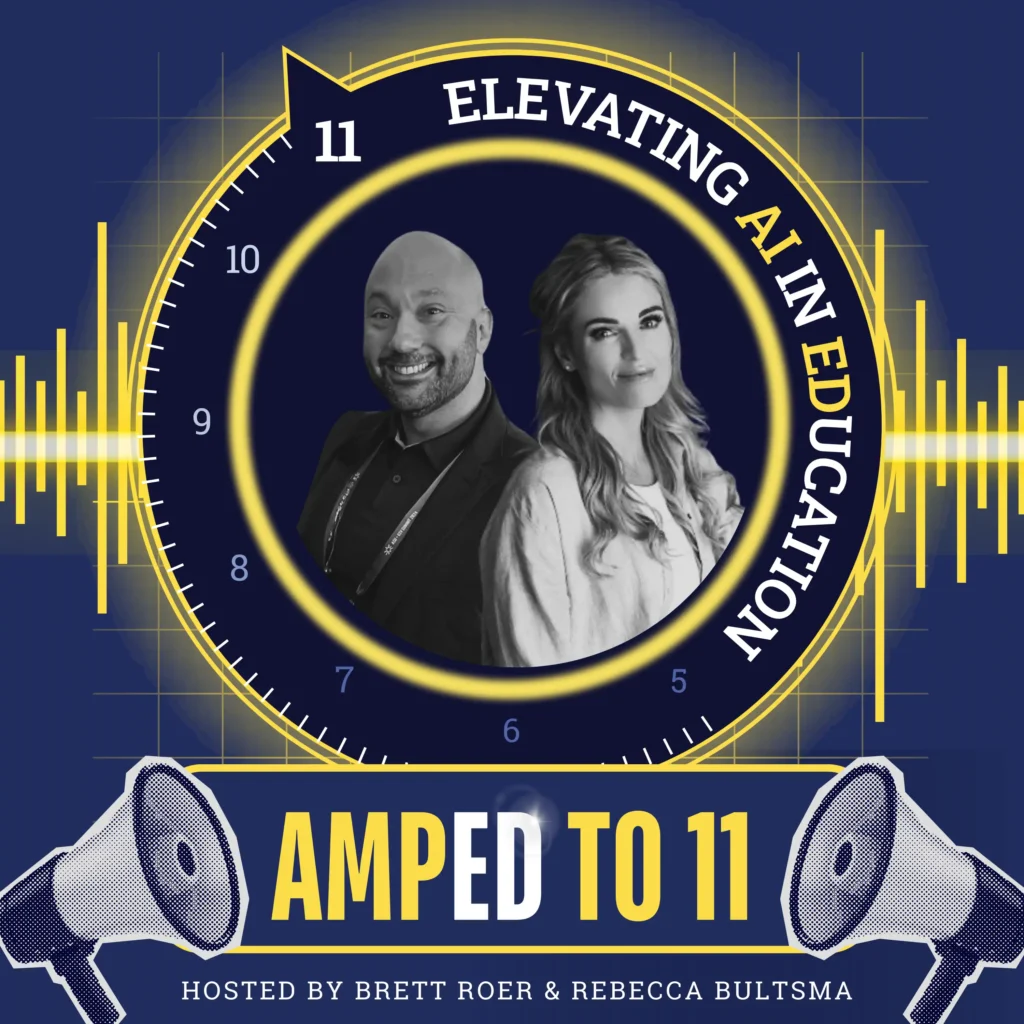
**Speaker 2** *[00:19]*: Hi everyone, My name is Rebecca Boltzma and I am an AI consultant in the K12 education space. And I’m passionate about learning about AI, talking about AI and researching AI ethics. And we are thrilled to kick off our brand new podcast, amp211today. This is our very first episode, so we’re thinking we would just start by telling you a little bit about us and what we’re hoping to do on this podcast together.
**Speaker 1** *[00:49]*: Okay. So Rebecca, everyone wants to know, how did we meet?
**Speaker 2** *[00:53]*: It is of the craziest chance encounter, kind of meant to be kind of stories I think that I’ve ever lived because it was one of the craziest weeks of my life and there were no cars to rent and I was going to speak at an event in Ohio and you were there and we got introduced and then it turned out you couldn’t find a car to rent and were both going to the same airport. So we ended up driving together and being stranded at the airport and spending a lot of time probably we did 20,000 stats walking around the airport and talking and getting to know each other and just realizing we had a lot of the same values and vision and we kept in touch.
**Speaker 1** *[01:33]*: 194 Days ago, I got to see you give a keynote speech at one of the AI summits that aid you put on. And I was very impressed immediately that you were able to give relevant, actual, real life things both for educators and for parents on how to use AI. So I’ll never forget when you showed the audience, like, how you can scan your fridge and it can help you realize what groceries you might currently have, what recipes you can make or what you might need to pick up from the store. And I watched people go, and even though you gave amazing things about AI and education, I watched light bulbs just go off over people’s heads of wow. So I just distinctly remember that moment. And then obviously I was really engaged throughout.
**Speaker 1** *[02:14]*: But yes, the remainder of that at lunch, someone’s saying, you’re going to New York too. And I said, you’re going to New York. And then, yeah, the rest is history. And Here we are 194 days later, filming our recording, our first episode of AMP211.
**Speaker 2** *[02:29]*: I love it. I love that we kept in touch and that we still have so much in common, especially that we love AI and we love education. And now we get to talk about it and share all those things we love and know about AI with other people and hopefully help them out as well.
**Speaker 1** *[02:44]*: It’s one of those things now. It was so easy when I was a teacher or a college advisor or an assistant principal or a principal to say I’m one of those things. And I work in the Bronx or Queens or Brooklyn, everyone just immediately knows what those roles are. I think in 2024, when people ask me, what do you do or what is your role as the CEO and founder of Amplify and Elevate Innovation? I sometimes find myself struggling to answer that question. And now I realize it’s so simple. I literally do that. I try to amplify and elevate the most innovative solutions I see in education. And I try to amplify and elevate the education leaders who are doing the best work the right way, leading by example, leading with their values. And that’s ultimately the most important thing to me.
**Speaker 1** *[03:27]*: So while that can take many shapes, it’s really going to come down to that. I try to invest in people, I try to invest in solutions and find the best way that those great ideas or great solutions can scale and have the greatest impact in K12 education, you know, across the country and, you know, hopefully worldwide.
**Speaker 2** *[03:46]*: So how did you end up doing this? How did you end up from being a principal in New York to doing what you’re doing right now?
**Speaker 1** *[03:54]*: I think the most important thing I learned being a pandemic principal was being present. And that journey was very hard fought. And again, a lot of credit to my amazing wife, Rosa, because it’s something that she led by example and I wasn’t always able to grasp because being a principal means you’re responsible for the safety and well being of hundreds of students and thousands of family members and obviously community of educators. So I really couldn’t shut off that switch. It really mattered to me that people always felt I was present. I inherited an unfortunate situation in the Bronx where students weren’t given the right courses to graduate on time. And I just felt this really strong sense of obligation that I really couldn’t shift to, like being a new parent.
**Speaker 1** *[04:40]*: And that was really unfortunate that those two things happened simultaneously in my life because I really couldn’t switch from one to the other. And so much credit to people who can. I just wasn’t able to find that balance. So in switching into educational partnerships like in ed tech, and then some nonprofit leadership development. I just kept seeing that there are people and there are solutions out there that I didn’t have access to in New York City for 16 years. And so whenever I find things that are really innovative, I put on that switch of, would this have helped me or my teachers or my students or families just have a more impactful experience in education? And if that’s the case, then what am I going to do about that?
**Speaker 1** *[05:19]*: How am I going to make sure I get this to more people, whether it’s through now avenues like a podcast, just making direct connections for others, or just helping them make a better product solution, or think more deeply about how they can scale this work. So really, any avenue I can support people in is what I find the most exciting thing. And I really mean it when I say every day I wake up excited for the work ahead. So that’s been a great transformation in my personal, professional journey that I’m. I’m really fortunate and proud of.
**Speaker 2** *[05:52]*: Well, one thing I can speak to 100% is that you are always very present and good at making people around you feel seen and heard. So thank you for that. But let’s shift gears a little bit and talk a little bit about the idea behind this podcast and why we’re doing this and how this all came about. Do you want to tell that story since I told the How Our Paths Cross story?
**Speaker 1** *[06:15]*: Yeah. It was a Friday night. It was very late on a Friday night, and we both started ideating for a few hours on what is it that people need to learn about AI? So I think we started by you sharing, as always, some of these great AI tips and tricks that you have been doing research on that you love to share with people. It’s one of your passions and skills. And you actually walked me through how to download, for example, some of the beta intelligence options on Apple, how to get kind of cut the line, get to the front. And we realized immediately you can record conversations on your phone call and it tells the people this phone call is about to be recorded and you have an immediate transcript.
**Speaker 1** *[06:57]*: And so we both know the power of a transcript and utilizing that with AI tools to, you know, do all your next steps in your professional life. I even use it sometimes for my personal life in making a game plan or thinking through, you know, logistics or a schedule with family members. So we started that and then we said, well, what are some questions or concerns or what are things people need to know about? And I shared with you. It was right after EdTech Week in New York City, how two times people made this reference to an old film called Spinal Tap where they said, you know, we’re going to max it out to 11 or take it to 11.
**Speaker 1** *[07:34]*: And just twice I saw that and I saw people in the EdTech community laughing about that expression that we’re going to, you know, go all the way to 11. And so we talked about this idea of, well, what if we really amped up how people are using AI and we took it to the max. So in this case, we amped it up to 11 and we really started ideating on, well, what would be the most exciting 11 questions you could ask the most innovative people in the field of education and edtech. And here we are not very much later with our, you know, beginning of the amp to 11 podcast and some really special guests that we have joining us in this initial month and roll out.
**Speaker 2** *[08:12]*: Yeah, I think it’s going to be really great. Obviously this first episode is just you and I, but moving forward, we’re going to go through these 1111 themed questions and get to know some of the people who are really doing great things in the space. But as of today, you’re stuck with us. And we thought we would go through and answer some of these questions for ourselves so you can get a sense of some of the things that we’re going to be asking some of those really innovative people in the space connected to AI. So I’m actually going to start with you, Brett. So question number one. In the Netflix show Stranger Things, have you seen it?
**Speaker 1** *[08:52]*: I have. You? I have, yes.
**Speaker 2** *[08:54]*: Fantastic. Well, there’s a character in that show named 11 who has supernatural powers and every time she uses them, it shocks everybody around her, especially for the very first time. So I want you to tell us about what your jaw dropping, shocking AI moment was. Whether it was the very first time you saw AI or a brand new tool or something that shocked you when you saw what AI was capable of. What was your 11 shocking moment?
**Speaker 1** *[09:23]*: Yeah, I think one. There’s so many obviously, but one recently that really blew me away, that blew my family away. Right. I remember someone texting me with one of the new ChatGPT releases. I forget exactly which one, but the one where you could start to really use voice activation and it would interact back to you with their voice and you could change the name, you could change the modulation, the voice. But what was amazing to me was the fact that my wife and my mother in law were both born in Ecuador. And so the fact that we could immediately have a conversation in English and then immediately translate that into Spanish and had the voice could go in multiple languages. That was just a really big moment for my family.
**Speaker 1** *[10:08]*: We were literally sitting around the couch in the living room and all of us recognizing, wow, the transformational power of this. When I go to visit Ecuador, I’m not a fluent Spanish speaker. For students who English is not their first language here in the United States, just how quickly just having Wi Fi and in this case, ChatGPT or another AI tool, you can eliminate so many barriers to effective communication. And both of them being, you know, obviously fluent English and Spanish, being able to recognize that this is not perfect, but this is, you know, well above and beyond what’s needed to have meaningful, translatable conversations. And those are the kind of tools.
**Speaker 1** *[10:46]*: If I had those as an educator, with so many new families arriving from around the world, when I was both a teacher and an instructional leader, that would have been game changing. That would have just eliminated so many challenges that those students face, that the educators face in trying to meet the needs of diverse learners. So that was the moment where I said, wow, this is shocking. This is incredible. And just, you know, so many light bulbs just went off in my head about the transferability of this exact power and. And other tools like that. Is it. May I, Rebecca, reciprocate and ask you a question?
**Speaker 2** *[11:21]*: Of course.
**Speaker 1** *[11:22]*: Okay. So, as you know, whenever you look at a clock and you see 1111, someone around you will say, oh, make a wish. Because we hope that these things come true. So in that spirit, if you can make one wish for how AI could shape education and society, what would it be?
**Speaker 2** *[11:47]*: That’s a good one. I’ve always worked kind of ed, not ed, adjacent. I’ve worked in K12 education, but as a professional communicator and public relations for K12 education. And I’ve done a lot of policy work in K12 education. And so I’m not an educator in the traditional sense, but I work a lot with educators. And as I’ve traveled around and talked to groups, the one thing I’ve kind of realized, if I could give everybody a gift, my wish would be just to get everybody a little bit of baseline understanding of what AI is and how it works. Because the one thing I’d noticed for sure is after I’m done talking to people and explaining it to them in a way they understand, they feel more comfortable and they’re not as scared and worried about what this might mean.
**Speaker 2** *[12:33]*: So if I could wave my magic wand and make an 1111 W. It would just be that I could remove some of that fear and just automatically give everybody a little bit better understanding so that they were ready to move forward with confidence. I try and do that for as many people as I can, but you can’t get everyone but kind of like the guy throwing the starfish into the ocean. Right. Like, I can help this person or we can reach more people through this podcast when we’re going to explain and really break down some really great ways that educators can use AI to. But my wish would be that we could give that gift of knowledge to absolutely everybody in education so we can all start to move forward together. So I think that’s my wish.
**Speaker 2** *[13:15]*: If I can’t have, you know, be able to eat unlimited chocolate forever and never gain. If I can’t have that, then I’ll make that other 1111 wish.
**Speaker 1** *[13:24]*: It’s very magnanimous of you. Yes, I think that’s. That’s the. That’s what we hope is that we both are cognizant of the fact that little bit of investment of time and AI can really save you so much time long term and just alleviate some of the roadblocks that sometimes stop people from being more innovative or making progress in their work or goals. And just that idea of giving people the moment to realize by just spending a little time, I’ll save so much time. That’s such a hard mindset to embrace because especially in the world of education, that is the most valuable resource is time, and no one has enough of it. And hopefully we can. Like you said, hopefully that wish comes true and we give people some time back for work.
**Speaker 1** *[14:05]*: Life balance as a result of the work we’re about to do on this podcast. And, and in general, I love it.
**Speaker 2** *[14:11]*: Okay, question for you, and this is the perfect question for you. So the movie Ocean’s Eleven, one of my favorites. They’re building a dream team to do a major bank heist in Las Vegas. So because you’re the super connector, you know everybody, you know all the movers and shaker. If you were to assemble your dream team, 11 would be nice. But that’s a lot of people to list. I want you to think about how you build an AI Dream team. Who would be on your AI Dream team? Who are some of the movers and shakers and the big people in the space that you would add to your dream team, your Ocean’s Eleven dream team.
**Speaker 1** *[14:49]*: Okay, so I want to. I want to preface that it’s very early. We’re filming this. So if I forget anyone in advance, I’m going to blame it on lack of coffee and childcare duties right up to the moment we started recording this. The way I really think about AI and how we’re going to tackle some of the challenges, which is really getting everyone to that baseline, foundational understanding, I really think of a pyramid. And so for me, the baseline, the base of that pyramid is foundational AI literacy. So there’s many orgs that do this well, but one that, you know, I work very closely with, that I’m really aligned to their mission and values is aiedu. So they have an amazing team. So not to leave anyone out, but I’m gonna start with their found one of their founders and their leader, Alex Cotran.
**Speaker 1** *[15:32]*: Working alongside him and seeing how he’s able to really build coalitions has been incredible because as we keep saying, this is not a job we can do alone. So someone like him who has built this incredible team who are doing work around the world on foundational AI literacy, that’s crucial. The next step to me is alleviating the additional concerns people have about AI. Is it safe? How do I do this ethically, especially in schools where we know the protecting the privacy of young people and educators is crucial. So then I would find someone like Aaron Moat, who is leading so many different initiatives, but one is innovatedu. She does so much amazing work, again, in building coalitions around ensuring safe and ethical AI policy use and implementation. So she’s someone I would immediately bring along for the ride.
**Speaker 1** *[16:22]*: The next step for me is making sure that the world of AI is inclusive. So I was really fortunate. Just a few weeks ago, were in Chicago working with ties, which is an amazing organization. So again, another super connector, another legend in the game is Jan Morrison, the CEO of ties. And were able to have so many amazing speakers come together and talk about the different ways that AI can really shape, in this case, STEM learning, ecosystems, but the future of workforce, making schools future ready. And so I was fortunate to witness this incredible panel around the ideas of inclusivity, accessibility. And it was led by some incredible people such as Shakri Aldali, Caroline Quintana, Tiffany Taylor and Stacy Chana.
**Speaker 1** *[17:07]*: So these are all people who have led really large initiatives in education who are at the forefront, both in higher ed, K12, education, ed tech, who are just doing amazing things, but they’re rooted in the values of how are we going to make sure that this reaches all students, not just some students, especially in rural and urban areas. And how are we going to make sure that we build the right resources and make them accessible to educators and education leaders?
**Speaker 2** *[17:33]*: We really should make sure that we put in our show notes links to all these people’s professional profiles because they’re all really great people to follow on social media. And I was lucky enough to meet some of them with you a couple weeks ago. Chakri was actually one of my favorite people to talk to. So definitely people worth following there on LinkedIn. We’ll make sure that we get you a link to all of these great follows. Anybody else you’d add to your list? Brett?
**Speaker 1** *[17:58]*: Yeah, yeah. Yesterday I was honored to see Urban Assembly CEO David Adams. He unveiled for a large community of educators, nonprofit foundations, Teach for America, how we can use AI as a coaching tool to scale the impact of coaching instructional instructional leadership. And finally, there’s a few other folks I would say people like Mike Yates, Yousef Ahmad, Wyman Q. They all do incredible work at the reinvention lab for Teach for America as well as through playlab. So getting teachers to really try things and create things. And then finally a tool that I often talk about is just so transformational is schooljoy.
**Speaker 1** *[18:46]*: They have a new platform called Nemo, which allows you to do voice interactive AI simulations around durable skills for adults to get better at working with young people and helping them upskill where they need to go without actually doing it on, you know, real life. Students who have can no longer always be the guinea pigs in education that time is so valuable you have in front of them doing that work in the background. But having me personalized and helping you get better at your practice, whether it’s education or even other transferable skills in, you know, higher education, nursing, medical fields, the possibilities are endless with the power of AI.
**Speaker 1** *[19:23]*: So I think if you brought all those people together and you gave people time to really dig into what they can do and what they’re about, I think that’s how we’re going to change the world of education and maybe society in general.
**Speaker 2** *[19:33]*: I love that list. If I I’m trying to think who I would add to it and a lot of the people that I follow and a lot of the same people you do. But I like people who are really kind of talking about interesting things in the broader AI space. And if you’re listening to this and you’re trying to figure out how to kind of get started with AI, Ethan Mollick is like my be all, end all rock star. If I could buy an Ethan Moloch Rockstar T shirt. I would wear it everywhere. But he’s a professor at Wharton and he talks about AI all the time. He wrote a really great book called CO Intelligence that is a great intro to AI and what it’s all about and how it works. And it’s probably the best AI book I’ve ever read.
**Speaker 2** *[20:13]*: So definitely, if you’re just looking for someone a little more broad who talks about AI and can kind of help you get a little bit of foundational understanding and interesting perspectives on AI, that’s somebody great too. And I know we both love Dan Fitzpatrick as well, right? He is an AI educator who’s always sharing great tips and tricks. I learn lots from him. I know you do too.
**Speaker 1** *[20:32]*: And the last person I wanted to shout out was Claire Zhao over at GSV because same thing, Dan is someone like yourself who can put a 30 second clip up and I it transforms my life. Claire sends out, you know, weekly all the latest and greatest in AI and EdTech and that is just required reading if you want to stay rest and current of what’s going on in the world of edtech and education. So yeah, those are the people that you need to be following as well.
**Speaker 2** *[21:02]*: And Obviously us on LinkedIn, we both post a lot, we talk a lot about AI. So hopefully if you’re not sick of us already, our listeners can go and hit that follow button on some of our LinkedIn platforms and we’d love to connect with people over there too. All right, what’s up next on our docket?
**Speaker 1** *[21:19]*: Reb Rebecca we get a lot done in a little bit of time. We are hyper efficient, effective people and I think we’ve really leveraged the tools that are resources, especially around AI. So right now it’s the 11th hour, right? You have a major deadline. What is the tool that you are going to use to push you to your absolute limits in order to get it done? What are the tools using in the 11th hour to be the most productive version of you using AI?
**Speaker 2** *[21:55]*: So one thing everyone should probably know about me is that I’m like the definition of basic, right? Like I drive a white Jeep, I drink chai tea lattes, I’m like boring blonde, suburban mom, whatever. So with that said, I have to go with like the basic answer, which is ChatGPT because it’s just so amazing. I talk about all different AI tools all the time, but ChatGPT can just like do everything and I find new things it can do all the time. Just had another update last week. There’s lots of other tools that are great for things, but ChatGPT, especially when it comes to analyzing data because I’m a data nerd and I love that it can review huge documents and give me insights and give me lots of point of views.
**Speaker 2** *[22:38]*: You and I are both obsessed with GPTs and that’s a great feature of ChatGPT. And honestly, I use the voice feature on my phone all the time just to. I’m a verbal processor, right? Like I’ll just have a fight or an argument or a debate with my ChatGPT voice to help me see every side of a situation or to crystallize my thinking. Especially if I’m. I’m doing research right now. If I’m trying to work my way through an issue, I like to just talk it out. And so now I don’t have to bother my friends like people like you to have conversations with me. So the 11th hour, I’m always going for Chat GPT. Although Claude, which is one of my other favorite AI tools, just got some really cool updates and I think we’re going to cover those on our next episode.
**Speaker 2** *[23:22]*: I’ll show you some insights about how to use them. But Claude is actually a pretty great tool when it comes to getting things that are writing based. It’s excellent. My go all in, my be all my amp211 tool that has probably made the biggest difference in my life, which is weird, is actually from 11 labs, which was not planned, but 11 labs is what it’s called and I am like a podcast person. I know you are too. And I like to listen to my content and up until like six months a year ago, there was no way to get a good text to voice system that didn’t sound super robotic and was, you know, just really hard to listen to.
**Speaker 2** *[24:02]*: And now eleven Labs offers voices like Maya Angelou, Burt Reynolds, like all these voices that you can listen to any of your email and content in. And I get so much more done now that I can just listen to all of my emails in Burt Reynolds voice. So that’s when I want to dial it up a little bit or if I want to get lots done. Those are kind of my go tools in my toolbox. I have a lot more, but those are probably my favorite.
**Speaker 1** *[24:28]*: Yeah, absolutely.
**Speaker 2** *[24:30]*: So 11 Labs is one of those voice to text features, one of those tools. It does a lot of different things, but that’s one of the features. So if you could choose any voice of any person, alive, dead, you know, imaginary cartoon character, whatever it is. To read you everything every day. All your emails, all of your documents you need to read. Whose voice would you want to read to you all the time?
**Speaker 1** *[24:58]*: You know, we talked about this a little bit when were ideating on this question.
**Speaker 2** *[25:01]*: I know. That’s why I asked you, because you couldn’t come up with anything that I wanted to see. Yeah.
**Speaker 1** *[25:05]*: And, you know, I’ve thought about it since we last spoke about it, and I was like, you know, I think it’s. It’s kind of like different times a day, right? You want to listen to a different type of music to get you in the mood for various parts of your day. So I said I really thought about more and said if I wanted to, like, stay engaged, I think it would be something with like a great accent. So I was sharing yesterday. I love, like, you know, Irish accents, I love Australian accents, different portions of. Of. Of English accents. So, you know, were saying yesterday, like, Adele, like, if I wanted to kind of like have something light, bubbly, but like, have it in the back, have it read me my email so I can just like, oh, what are they?
**Speaker 1** *[25:42]*: How are they gonna say that word? I would love something that just keeps me off guard a little bit. I was sharing yesterday, right? If I wanted to be, like, inspired or someone who I just find so, you know, eloquent and powerful, but also humorous in how they deliver their. Their message. I. I said Barack Obama, he’s someone I could just listen to, speak about high level things forever. So if I had to listen to like a document of something really important, I’d love if Barack could share it with me. And then if I wanted to, like, again, just be a little silly and inspired, I’d say, like, I could listen to, you know, Jason Sudeikis as Ted Lasso. Just have that guy break it down for me all day.
**Speaker 1** *[26:20]*: So I think those are a couple different people that I’d love to see if 11 labs could make happen for. For me and I’m sure other people as well. What about yourself, Rebecca? Who are some people or things you’d love to listen to?
**Speaker 2** *[26:32]*: This is easy for me, but I don’t know if anyone’s heard of my guy. So I. Fun fact. I’m like a true crime fan big time. And there’s a show on NBC called Dateline. And on Dateline there is a narrator, a named Keith Morrison. He’s probably like 80. He’s an old guy. They parody him on Saturday night Live all the time. But I could just listen to him tell me stories Forever. And if he could read me my emails and his creepy voice, like his nice storytelling, that would probably make my day. So that is my wish that I could have Keith Morrison. He’s not listening, but if someone wants to get him that message, I would appreciate if, you know, he would just join 11 labs and help me read all my emails.
**Speaker 2** *[27:16]*: But I think we should wrap it up and I’m going to give you the final question. Okay, so I want you to think about 11 year olds today who are growing up in a world where they will never not have AI as a part of their life. What message would you share with them about their futures and the world that they’re entering and about education now and in the future?
**Speaker 1** *[27:46]*: Well, I have a little ways. In the blink of an eye, I’ll have some 11 year olds here in my house. And sometimes, you know, they watch me engage with AI and I can watch how some of it’s really exciting for them. So I think if I hoped what they would want to do with AI or how they would interact is they keep that sense of wonder that this is like a really powerful tool. You know, I have a four year old and a seven year old, so many things just seem like magic to them and they still have that belief that like some things are just magical. And I know it sounds maybe naive, but that’s how I still feel about AI. I don’t understand all of it, but I see the application of it.
**Speaker 1** *[28:25]*: And I also want to add that there’s many things in my life that I actually don’t. I realize I don’t actually understand how they work and yet I use them every day. And I’m so grateful that I have all these different tools to help me do different things and achieve what I would love to achieve for my family and using AI and other platforms. But I think that’s most important to me is that they realize it’s a tool and that if harnessed correctly and obviously ethically and safely, it really opens doors and allows them to like, create in a way that I couldn’t as an 11 year old or even as a, you know, 21 or 31 year old. Right.
**Speaker 1** *[28:58]*: AI just didn’t exist and it didn’t allow me to take my power of words and language and apply it to data, to art, to so many different areas that I’m passionate about, but didn’t really understand how to build what was going on in my head. So I hope that’s what they think of when they think of AI for their futures is it’s an amazing tool that can unlock the creativity that you have inside of you in a way that hopefully will always feel like magic to them and that they hope they don’t take for granted. I’m sure the same way we take for granted so many technological tools that our parents and grandparents didn’t have access to growing up. I’m sure we did it. I’m sure they will.
**Speaker 1** *[29:35]*: But I also hope they keep that sense of magic and wonder forever around the power of AI.
**Speaker 2** *[29:40]*: And if you were to give a message to people who are just starting to listen to this podcast about what they can expect and what your vision and your goal is, and in just a few short sentences, what can people expect when they tune into our podcast every week?
**Speaker 1** *[29:57]*: I hope you leave inspired. I hope you feel like your cup is full and that there’s something new you can try immediately, whether it’s through, like, tips or tricks that Rebecca provides or some of the insights from our guests that you really leave saying, I want to try this and I want to get better at X because of what I just listened to. And I am just fired up and ready to go. And I’m amped to 11 about the possibilities of AI and the future of technology.
**Speaker 2** *[30:27]*: Me too. And I hopefully we can get everybody to that same place where we can amp people up to 11 so by the time they’re done, you know, their half hour with us or however long we end up talking or however much ends up on the cutting room floor, because we probably ramble a lot, people will feel like amp211 right after they’re done to go try something new or to follow somebody new or to learn from somebody new. I think that’s the goal. So I’m excited for this adventure. We’re going to be. We’ve got some great guests lined up, you know, some pretty cool people. Bret, I’m excited for this adventure, too, and I’m excited to bring everybody along for the ride.
**Speaker 1** *[31:03]*: Looking forward to it. Here we go. Rebecca, I’d love for you to share a little bit about your journey. How did you wind up from where you started to right here on the AMP211 podcast today, recording our premiere episode together. And what do you hope our viewers are going to get out of this journey along with us?
**Speaker 2** *[31:22]*: Do you know what? I ask myself that every day because this is seriously the weirdest thing that has ever happened to me. I. I’ve worked in comms and pr. I think I just. The first time I saw Chatgpt like a week after it came out on TikTok, I was like, blown away. And I think it’s because I’m into words and communication. That’s my background. And I realized this is a technology that you completely control with words and language, and however effectively you talk to it determines what you get back. And I love that. And I just dove all in. I got super into it. I looked for people who could help me figure it out, and there was nobody and who was thinking about it besides scientists and computer scientists who are super smart. But I didn’t understand anything they were saying.
**Speaker 2** *[32:04]*: I just needed someone who could explain it to me in a way that was like, explain it like I’m five. And so I learned. I experimented every day, hours a day, and then I started sharing what I was learning with other people. And then that just kind of grew and snowballed until our paths crossed. And we both had kind of a similar vision for helping people understand it. You let me explain things to you because that’s how I learn and teach you about cool stuff I was learning. And we just decided to combine this fun that were having and all these things that were learning and try and share them with other people that we care about because we had that same vision of making AI accessible and easy for more people, especially in education.
**Speaker 2** *[32:44]*: And yeah, I hope that during this podcast, people get a chance to learn. I’m going to share all the stuff I learn every single day, the new stuff that’s coming out with AI, why it matters, hacks and tricks and tips to improve your efficiency and your workflow and things that we’ve tried that have worked for us. And I hope that it will be helpful to share with other people. And if it helps just one person one time, it’s a win because this is an amazing technology and I’m just excited to be able to talk about it, especially with you, Brett, one of my favorite people. So I think it’s going to be.
**Speaker 1** *[33:17]*: A good time just to give some shine here to Rebecca. We didn’t just like meet at a conference. Rebecca was the keynote speaker at the conference, so international keynote speaker. And not to also just provide more shine here, but when Rebecca talks about the tips and tricks, I can’t believe that I get like one one access to that when I’m like, how do you do this? And she’ll be like, oh, let’s just hop on a zoom or I’ll just walk you through it. But she also puts these clips out where it’s again, Transformational. She breaks down AI, how to make it applicable, how to actually use it in your day to day life. That is just a gift because I think many people get challenged with where do I start?
**Speaker 1** *[33:55]*: And so she’s just like, literally right here, you just open this, you click this button, you do this, and here’s what you can do with it. And I think that like roadmap for most people is what they need right now in AI tools, tricks and tips coming from an expert like you.
**Speaker 2** *[34:11]*: Thanks, Brad.
**Speaker 1** *[34:14]*: So, you know, at amp211, one of the things we’re really passionate about is making people feel really inspired and hopeful about the future of education and ed tech. And something I constantly people ask me two things. What do you do all day? And like, why are you so excited about the future of AI? And so for me, it’s really getting these incredible tools that I think would have helped the communities I served as an education leader into the hands of the most possible people, but then also give them the tricks, the tips and the training so they feel empowered by it. So like, getting to do that every day is my version of amp to 11.
**Speaker 1** *[34:46]*: I wake up every day excited, you know, to spend time with my family, get my kids on the school bus, and then go and do work all day. And I know that’s not everyone’s is as fortunate to get to do that and feel amp211. But I hope from listening to this podcast, meeting inspiring guests and learning amazing things happening in the world of AI and TikTok tips and tricks from Rebecca that you also will feel AMP211 about the power of AI and how it can transform your day to day life and the work you lead.
**Speaker 2** *[35:12]*: And Brett is so well connected to some of the most amazing innovators in the space. And those connections, I think are going to be a huge part of what makes this podcast special, introducing you to people who are making real change in K12 education and innovating in amazing ways in the AI space. And so we’re lucky to have Brett. He really is a super connector. So connect with him on LinkedIn because he will connect you with a lot more people. I’ve met hundreds of amazing people through my connection with Brett and we’re excited to be able to introduce you to some of those people.
**Speaker 2** *[35:44]*: And then we’re going to also on this podcast, as Brett mentioned, take you through kind of a tip trick hack AI tool every week, something you might not know of, something you might know of, but a way to kind of amp up your AI use to 11 and take it a little next level beyond maybe just the basics.
**Speaker 1** *[36:03]*: Something that I hope our audience gets from us also, or I hope something that you feel as you listen to our podcast is this. Rebecca and I are so fortunate that, you know, we, our work allows us to be in community with some of these amazing guests that you’re going to see. And I still sometimes just can’t believe I get to either go to summits or conferences where I get to hear them speak. Literally. That’s how I met Rebecca, was watching her deliver her keynote address in Ohio. But a lot of times you get these down moments where you get to talk to people and ask them questions. And so definitely a superpower, which I don’t know if it was always I don’t know if my parents or my colleagues enjoyed how many questions I like to ask, but I love it.
**Speaker 1** *[36:42]*: I love the fact that I get to ask these people questions and I still can’t believe it. So I hope that’s how this feels to you, that you’re getting a chance to be at some of these conferences. This is those downtime moments and obviously we’re putting an 11 theme spin on these questions, but these are really the questions I love asking people. What are you doing with AI? What are your hopes? What are your wishes? What are your fears? And who do we need to bring to the table in order to make AI more scalable, accessible and powerful in changing student outcomes in education and letting edtech organizations know what direction they should be going with the tools they have at their disposal?
**Speaker 1** *[37:17]*: So again, amp 211 and excited to see you all listen, learn with us, follow this journey with us and can’t wait to get started.